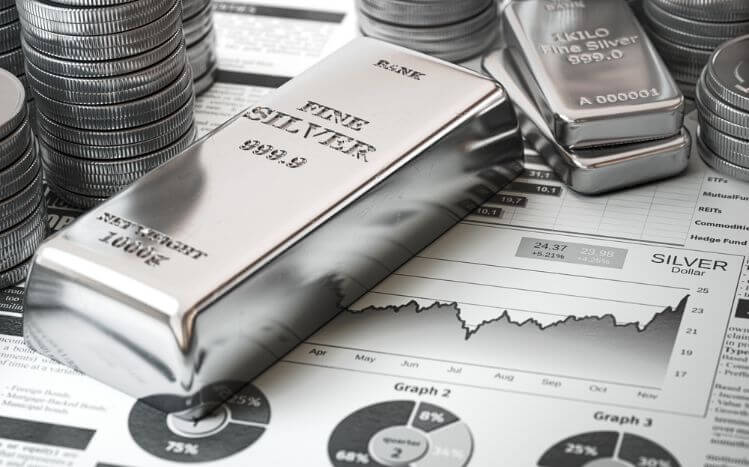
Precious metals have always held up well in times of economic upheaval. Obviously, there’s a finite amount of metal on this planet. Unlike dollar bills, you can’t just create more of them. This scarcity is a major reason precious metals tend to hold their value over time. Investor and financial commentator, Jim Rogers, has previously stated that certain market downturns rank among the worst of his lifetime, and he has often pointed to silver as a potential safe-haven asset during periods of economic uncertainty.
Gold has always been the first metal people turn to; however, silver may be just as important in today’s world. Not only is silver used in jewelry and eating utensils, but it is also widely used in electronics, solar panels, medicine, and vehicles. Traditionally used as a reward for second place, silver often does not receive the attention it deserves and may warrant a closer look from long-term investors. Over the past several years, the price of silver has experienced notable growth, reflecting both investment demand and increased industrial use. This article will discuss the best way to invest in silver.
Key Points
- Although not always regarded as the top precious metal, silver should not be overlooked
- Using a Self-Directed IRA to invest may be a tax-efficient strategy
- When IRS rules are followed, silver can provide a hedge against economic uncertainty
What is a Self-Directed IRA?
Not all IRAs are the same. A Self-Directed IRA is a type of IRA structure that allows an investor to have greater control over retirement funds. It is a retirement vehicle that permits investment in a broader range of assets, including silver and other precious metals.
One of the primary reasons IRA investors turn to silver, gold, and other metals is to hedge against inflation and rising prices. Like gold, silver is often viewed as a safe-harbor investment during periods of financial stress because it is a hard asset and a store of value. It may also be viewed as an alternative to fiat currencies, such as the dollar or euro, which is why silver has historically drawn interest during inflationary periods.
Benefits of Investing in Silver in a Self-Directed IRA
Investing in silver with a Self-Directed IRA offers multiple benefits. Compared to gold, silver is generally more affordable, making it more accessible to a broader range of investors. Silver also has strong industrial demand and is used across various industries, including electronics, jewelry, and solar technology. Like gold and other precious metals, silver has a limited supply and has historically served as an inflation hedge.
These benefits make silver a popular option for Self-Directed IRA investors looking to diversify their holdings and help protect retirement assets. A Self-Directed IRA also allows investors to diversify beyond precious metals, offering access to traditional investments such as stocks and bonds, as well as alternative assets like real estate.
Tax Advantages of Buying Silver in a Self-Directed IRA
Using a Self-Directed IRA to invest in silver can offer meaningful tax advantages. In general, gains from the sale of IRA-owned silver are not subject to immediate taxation. As long as the asset remains within the IRA, income and gains grow on a tax-deferred basis in a Traditional IRA or tax-free in the case of qualified Roth IRA distributions.
For many investors, a Self-Directed IRA is an effective way to take advantage of long-term, tax-advantaged compounding.
What Types of Precious Metals and Coins Are Allowed?
Under Internal Revenue Code Section 408(m), retirement accounts are permitted to invest in certain U.S.-minted gold and silver coins, as well as specific platinum coins. Retirement accounts may also invest in gold, silver, platinum, or palladium bullion that meets required fineness standards and is held by a qualified trustee or approved non-bank custodian.
Generally, silver bullion must meet a minimum fineness of 0.999. Eligible coins and bullion must be held in the physical possession of a qualified depository or financial institution.
Examples of permitted precious metals include:
- Certain gold, silver, and platinum coins described under 31 U.S.C. Section 5112 and IRC Section 408(m)(3)
- Certain bullion coins and bars that meet IRS fineness requirements
- Precious metals that are held by a qualified trustee or approved depository
The Technical and Miscellaneous Revenue Act of 1998 expanded the rules to allow certain platinum coins and specific bullion, provided all IRS custody requirements are satisfied.
In short, IRA-owned precious metals must meet IRS purity standards and must be held by an approved custodian or depository—not in the personal possession of the IRA owner.
How to Buy Silver in a Self-Directed IRA
Full-Service Self-Directed IRA
A full-service Self-Directed IRA offers investors access to a wide range of investment options beyond those typically available through traditional financial institutions. With this structure, a specialized IRA custodian, such as IRA Financial, serves as the custodian of the IRA and executes investments at the direction of the account holder.
Income and gains generated by IRA-owned silver flow back into the IRA without immediate tax consequences. The custodian also handles required IRS reporting, allowing the investor to focus on investment decisions rather than administrative responsibilities.
Self-Directed IRA LLC with Checkbook Control
A “Checkbook Control” IRA uses an LLC that is owned and funded by the IRA and managed by the IRA holder. This structure can offer greater flexibility and faster execution for certain investments.
However, when investing in precious metals, additional IRS rules apply. IRA owners may not take personal possession of IRA-owned metals, and all precious metals must be held by a qualified custodian or approved depository. Investors considering this structure should ensure the IRA and LLC are properly established and operated in compliance with current IRS guidance.
Conclusion
Precious metals, particularly silver, continue to attract investor interest as a hard asset with both industrial demand and potential inflation-hedging qualities. As part of a diversified retirement strategy, silver can offer long-term value when held properly within a retirement account.
The tax advantages of an IRA make it a compelling vehicle for precious metals investing. Just remember that IRA-owned silver must be held by a qualified depository or financial institution and not in the personal possession of the account holder.
This information is for educational purposes only. Investors should conduct their own due diligence and consult with qualified financial or tax professionals before making investment decisions. Ultimately, it is up to you and your advisor to determine whether investing in silver aligns with your retirement goals.

About the Author
Adam Bergman is a tax attorney and the founder of IRA Financial, one of the largest Self-Directed IRA platforms in the United States. He has helped more than 27,000 clients take control of their retirement savings, overseeing over $5 billion in retirement assets. Adam is also the author of nine books focused on helping investors understand and confidently manage their retirement strategies.