


How to Generate a Guaranteed 7.5% Rate of Return from your 401(k)
In 2025, earning a guaranteed 7.5% on your 401(k) plan investment with no risk seems almost too good to be true. Here is the thing – it is not. What if I told you that you can generate a 7.5% annual rate of return for your retirement and you would get tax- and penalty-free use of the funds. All of this is possible thanks to Internal Revenue Code (IRC) Section 4975(d)(1).
By way of background:
IRC Section 72(p) allows a plan participant to take a loan from his or her 401(k), so as long as it is permitted pursuant to the business’s plan documents. Furthermore, IRC Section 4975(d)(1), exempts a 401(k) loan from the IRS prohibited transaction under IRC Section 4975(c).
A 401(k) loan is permitted at any time using the accumulated balance of the 401(k) as collateral for the loan. A plan participant can borrow up to either $50,000 or 50% of their account value - whichever is less. This loan has to be repaid over an amortization schedule of five years or less with payment frequency no greater than quarterly. The interest rate must be set at a reasonable rate of interest. The lowest interest rate permitted to be used for the loan is the Prime Rate, as per the Wall Street Journal, which, as of January 1, 2025, is 7.50%.
Update: On September 17, 2025, the Prime Rate was reduced to 7.25%. This means new 401(k) loans taken after that date may carry a slightly lower required interest rate. Keep in mind, however, that you can elect to use a higher interest rate if permitted under your plan, which would increase the return to your 401(k).
The beauty of a 401(k) loan is that the plan participant can get free reign of the funds for any purpose, and the plan will receive the interest from the loan. With interest rates increasing, the plan can now receive a significant return on the loan investment without risk, since the loan payment is being paid back by you. Of course, one must be careful to pay back the loan on a timely basis. If the loan payments are not made, the outstanding loan amount would be subject to tax and a 10% early distribution penalty if the plan participant is under the age of 59 1/2.
How does the 401(k) Loan Interest Work?
A 401(k) plan loan is a straight-line loan. In other words, interest and principle are combined to make up each loan payment. For example, a five-year, $10,000 loan would have a monthly interest payment of $118.80 for a total of $4,244.41 interest paid over the course of the loan. The individual would get $10,000 to use for any purpose, plus the plan would get a guaranteed rate of return of 7.5% annually.
Most 401(k) loans do not include a prepayment penalty. Moreover, a plan participant can technically elect to use a higher interest rate, even more than the 7.5%, but one must be mindful of your state’s usury rules. Selecting a higher interest rate would allow one to generate even higher returns for the plan. Don't forget to pay back the loan, because if you default, that money can no longer be returned to the plan, and will be considered distributed; applicable tax and penalties will be taken.
Pros and Cons of the 401(k) Plan Loan
The main advantages of taking a loan from a 401(k) plan are as follows:
- Ability to get quick access to cash.
- Lower interest rate – much less than a credit card or pay day loan.
- Interest is being paid back to your 401(k) plan – helping increase the value of your plan. For example, a $50,000 loan at 7.50% interest will give your plan an extra $21,221.06.
- Ability to pay a higher interest rate on the loan, allowing one to increase the value of the plan, while gaining the ability to use loan funds for any personal purpose.
There are a couple of disadvantages to the 401(k) loan:
- Failure to pay back to loan will result in a taxable distribution and a 10% early distribution penalty if you under the age of 59 1/2.
- Money you pull out for the loan will no longer grow tax-deferred.
Studies show that many people have a problem paying back the loan and there is a relatively high delinquent rate. Also – when one changes jobs the loan will become due.
Is There a Difference between a 401(k) Loan and a 401(k) Withdrawal?
A loan and a withdrawal are two very different things. When you borrow money from the plan, you are required to pay it back. Conversely, a withdrawal is when you take money from the plan with no intention of re-contributing those funds. Another major difference is when you can access those funds. Again, assuming the plan docs allow for a loan, you can take one at any time. However, you generally cannot withdraw 401(k) funds without a plan triggering event. There are certain instances where you can qualify for a hardship distribution, although you don't have free reign with those funds.
Lastly, there are taxes and penalties when withdrawing from the plan. When you withdraw any funds from a traditional 401(k), the amount distributed is taxable during the year they are taken. Plus, if you are under age 59 1/2, you will owe the 10% early withdrawal penalty. When taking a loan, there are no taxes or penalties unless you default on paying it back. And again, the interest you pay back actually helps increase your plan balance.
Read this: 401(k) Loan vs. Taxable Distribution
7.5% Annual Rate of Return
One of the advantages of a high interest rate environment, is that the interest payable from the loan will be much more significant for the plan investor. Of course, a lower interest rate means a lower monthly/quarterly loan payment, but it also means a lower annualized rate of return for your 401(k). The ability to pay that interest back to yourself is quite appealing; much better than paying a higher rate to a bank or other lender. Plus, there's no credit check or any other hoops to jump through. Obviously, the only caveat is that the plan allows for the loan.
Nowadays, it's hard to guarantee a solid rate of return on your investment. With high interest rates and a slow economy, one should be looking at ways to build up your nest egg. Taking a loan from your plan may be a good option in the long run during these chaotic times. Just make sure you can repay the loan in the time allotted.


Keep Your Self-Directed IRA LLC in IRS Compliance
A Self-Directed IRA LLC is a type of IRA that allows the IRA holder (you) to gain control over your retirement funds, so you can self-direct the type of investments that you want to make using your retirement funds. Checkbook Control will allow the manager of the IRA LLC the ability to buy real estate or make other investments by simply writing a check. With a Self-Directed IRA LLC, a special purpose limited liability company (LLC) is established and owned by the IRA (care of the IRA custodian) and managed by you or any third party. As manager of the IRA LLC, you will have total control over the assets to make the investments you want and understand by simply writing a check or executing a wire transfer.
Using a Self-Directed IRA LLC with "checkbook control" to make investments involves many important tax rules and guidelines that must be adhered to on an annual basis for the structure and investments to be respected by the IRS and not run afoul of any federal income or state tax rules.
- Your Self-Directed IRA must remain in IRS compliance or else face taxes and penalties
- It's imperative you understand all the rules involved with investing with the plan
- Whether it's filing tax forms, paying UBTI tax or making sure you did not perform a prohibited transaction, IRA Financial has you covered
Below is an annual checklist for your Self-Directed IRA LLC that will help you keep your structure in IRS compliance.
Annual IRA Contributions
For 2026, total IRA contributions to a Traditional or Roth IRA cannot be more than:
- $7,500 ($8,600 if you’re age 50 or older)
- your taxable compensation for the year if your compensation was less than this dollar limit.
Traditional and Roth IRAs must be established by the tax filing deadline for the previous taxable year (without extensions). Applications postmarked by this date will be accepted.
Contributions should be made to the IRA custodian and should not be contributed first to the IRA LLC. Once the IRA contributions have been made to the custodian, you may direct them to invest the funds in the IRA LLC.
Making annual IRA contributions is a great way to build your retirement account and generate tax-deferred or tax-free gains, in the case of a Roth IRA.
IRA LLC Annual Valuation
IRS Form 5498 gives the market value of all assets and cash held within the client account for the previous year and is used for tax reporting. IRA Financial Trust, as custodian of your Self-Directed IRA will file Form 5498 with the IRS. You will receive an email at the beginning of each year that requests you to provide the fair market value of your IRA as of December 31 of the previous year.
Every IRA administrator or custodian is required to complete and file an IRS Form 5498. One of the main purposes of the form is to give the IRS access to the annual valuation of IRA funds on a year-to-year basis. IRA valuations are also needed for in-kind distributions or Roth IRA conversions. In addition, required minimum distribution (RMD) calculations are based on year-end IRA values.
IRS Form 5498 also reports your total annual contributions to an IRA account and identifies the type of retirement account you have, such as a traditional IRA, Roth IRA, SEP IRA or SIMPLE IRA. It also lets the IRS know the amounts that you roll over or transfer from other types of retirement accounts into this IRA. The "custodian" of your IRA, typically the bank or other financial institution that manages your account, will mail a copy of this form to both you and the IRS. Form 5498 requests information pertaining to the IRA account, including the name and address of the IRA custodian, the amount of any IRA contributions or distributions taken during the year and, most specifically, the value of the IRA account as of December 31 of the prior year.
IRA custodians must distribute 5498s to participants and the IRS no later than May 31 of each calendar year -- a full six weeks after the income tax filing deadline. This allows you to continue making contributions to your IRA up until April 15 and have them apply to the previous tax year.
Is Your LLC in Good Standing?
Once an LLC is established for your IRA, many states will require the LLC file an annual report (many just for informational purposes) along with a fee, in many cases.
It is very important that you keep your IRA-owned LLC in good standing with the applicable state of formation. All IRA Financial clients who are enrolled in the annual compliance service will receive the relevant information necessary to keep your LLC in good standing. All LLC annual filing costs should be paid by the LLC.
Annual LLC Tax Return Filing Requirements
An LLC owned by one IRA is treated as a disregarded entity for federal income tax purposes and no federal or state income tax return is generally required to be filed. However, an LLC owned by two or more IRAs is treated as a partnership for federal and state income tax return and an IRS Form 1065 and state partnership return is required to be filed. There would generally be no tax due since an LLC is a flow-through entity for tax purposes; however, the LLC is still required to file the partnership return. The form is due by April 15 and most state partnership returns are due on that date as well. In general, every LLC owned by two or more IRAs must file IRS Form 1065, unless the LLC received no income or took any deductions for the year.
Starting in 2023, IRA Financial is excited to launch its in-house tax filing services for Self-Directed IRA LLC and solo 401(k) plan clients. IRA Financial has designed a specialized Self-Directed IRA & Solo 401(k) tax filing service, which will now offer our clients the necessary tax filing services to keep the self-directed retirement solution in IRS compliance. Now – as part of annual consulting service, IRA Financial will prepare Form 1065 (U.S. Return of Partnership Income), Form 990-T (UBIT income tax return), IRS Form 5500-EZ, and IRS Form 1099-R.
Reviewing the IRS Prohibited Transaction Rules
The Internal Revenue Code (IRC) does not describe what an IRA can invest in, only what it cannot invest in. IRC Sections 408 & 4975 prohibits disqualified persons from engaging in certain types of transactions. The purpose of these rules is to encourage the use of IRAs for accumulation of retirement savings and to prohibit those in control of IRAs from taking advantage of the tax benefits for their personal account.
The foundation of these rules is based on the premise that investments involving IRA and related parties are handled in a way that benefits the retirement account and not the IRA owner.
Who is a “Disqualified Person?"
The definition of a “disqualified person” (Internal Revenue Code Section 4975(e)(2)) extends into a variety of related party scenarios, but generally includes the IRA holder, any ancestors or lineal descendants of the IRA holder, and entities in which the IRA holder holds a controlling equity or management interest. Learn more.
Application of the IRS Prohibited Transaction Rules
In order to determine whether a proposed transaction is a prohibited transaction and violates IRC 4975, it is important to examine all the parties engaged in the proposed transaction rather than on just the IRA owner.
Pursuant to Internal Revenue Code Section 4975, a self-directed IRA is prohibited from engaging in certain types of transactions. The types of prohibited transactions can be best understood by dividing them into three categories: Direct Prohibited Transactions, Self-Dealing Prohibited Transactions, and Conflict of Interest Prohibited Transactions. To learn how those work, check out this article.
Life Insurance and Certain Collectibles
In addition to the above, pursuant to IRC Section 408(m), a Self-Directed IRA cannot Invest in life insurance contracts or collectibles defined below:
- Any work of art
- Any metal or gem
- Any alcoholic beverage
- Any rug or antique
- Any stamp
- Most coins
However, the IRS has carved out a set of exceptions to the disqualified transaction rules under IRC 408(m) for certain precious metals and coins. The following types of precious metals and coins are allowed to be purchased with a Self-Directed IRA:
- one, one-half, one-quarter or one-tenth ounce U.S. gold coins (American Gold Eagle coins are the only gold coins specifically approved for IRAs. Other gold coins, to be eligible as IRA investments, must be at least .995 fine (99.5% pure);
- one ounce silver coins minted by the Treasury Department;
- any coin issued under the laws of any state;
- a platinum coin described in 31 USCS 5112(k) ; and
- gold, silver, platinum or palladium bullion (other than bullion that is made into a coin) of a certain fineness that is in the physical possession of a trustee that meets the requirements for IRA trustees under Code Sec. 408(a).
All IRS-approved precious metals and coins should be held in the physical possession of a United Stated bank or depository and not held personally.
S Corporation Stock
Because of the shareholder restrictions imposed on “S” Corporations, an IRA cannot own stock in an S Corporation.
Overall, when looking at a potential investment with your IRA, it is important to verify that no disqualified person will be involved in the transaction or receive any benefit from such. In addition, if purchasing precious metals or coins, make sure they are IRS-approved and satisfy the requirements under IRC 408(m).
Triggering an IRS prohibited transaction can have steep tax consequences as the individual’s IRA would lose its tax exempt status and the entire fair market value of the IRA would be treated as taxable distribution, subject to ordinary income tax and penalties.
The Application of the UBTI Rules
Most people believe that when they use their retirement funds to make investments such as stocks, mutual funds, and real estate, the income and gains generated will be tax free. In most situations, they are correct. This is because an IRA is exempt from tax pursuant to IRC 408 and 512 which exempt most passive forms of income generated by an IRA from taxation. Some examples of exempt types of passive income include: interest from loans, dividends, annuities, royalties, most rentals from real estate, and gains/losses from the sale of real estate.
However, in a number of instances, the Unrelated Business Taxable Income (UBTI) tax could be triggered when a retirement account engages in certain types of transactions which could turn a potential tax-free investment into a very tax-inefficient one.
The UBTI tax is triggered in three types of investment categories involving retirement accounts:
- Using margin to buy stocks or securities
- Using a nonrecourse loan to buy real estate (there is an exemption for 401(k) plans under certain conditions)
- Investing in an active trade or business operated through an LLC or pass-through entity, such as a partnership.
For 2026, the maximum tax rate of 37% is triggered at just $12,300. However, the UBTI tax rules are not triggered if less than $1,000 of income is generated by the investment at issue. For retirement accounts, the UBTI income is reported on IRS Form 990-T and the tax is due by April 15. The tax would be paid by the Self-Directed IRA.
Thinking of a Roth IRA Conversion?
For many people, the decision on whether to make a Roth IRA conversion is a difficult one. The primary advantages of making a Roth IRA conversion is that Roth IRA distributions are tax-free so long as the IRA holder is over the age of 59 1/2 and the Roth IRA has been open and funded at least five years. The downside for making the conversion is that the tax must be paid on the fair market value of the IRA account at the time of conversion.
The following is a number of items that one should consider before electing to make a Roth IRA conversion:
- Do you have the ability to pay income taxes on the money you convert from your pretax IRA?
- Based on your income tax bracket, does it make sense to pay the entire tax due in 2023? If you expect your income tax rate to go up, converting may be for you. If you think it will go down, then the opposite holds true.
- Do you anticipate withdrawing Roth IRA funds for personal use within five years of conversion? If so, you may face taxes and penalties.
- How confident are that your Roth IRA investments will be successful?
Read more: When to do a Roth Conversion – Advice from a Tax Attorney
Self-Directed IRA Custodian Fees Matter
Fees do matter! Like any services you pay for, whether personal or otherwise, you want to make sure you have a full understanding. Most custodians have a flat annual fee for administering your IRA. However, some also charge an asset valuation fee based on the value of your IRA. The more your account is worth, the more you end up paying each year.
Moreover, some custodian also impose fees per transaction, such as transfers, distributions, investments, conversions, and even for account termination. IRA Financial clients know better. Our Self-Directed IRA fee schedule is quite clear. Pay one annual fee, and that's it.
Staying in IRS Compliance
It is vital that your Self-Directed IRA LLC structure remains up to date and in full IRS compliance in order for the structure to be respected by the IRS. To ensure that your IRA remains IRS compliant, IRA Financial is proud to offer all its clients an optional annual compliance service that gives them access to tax professionals and extensive tax filing services. Of course, this is something you can do on your own, or hire another professional.
Using a Self-Directed IRA LLC is a powerful vehicle to take greater control over your retirement future. Operating the plan is not over complex, however, it is important that every investor has a good understanding of the topics outlined above. However, since most investors are more focused on making investments and less interested in navigating the IRS rules, it's important you work with your plan administrator or financial advisor so you can stay on track.

Can I Contribute to a 401(k) and IRA in the Same Year?
The short answer is yes! However, the type of IRA you can contribute to and the ability to receive a tax deduction is dependent on a number of factors.
In general, anyone who has access to an employer defined contribution plan, such as a 401(k) plan, even if they do not make any contributions to the plan, may be limited in terms of the type of IRA they can contribute to in a given year. To be clear, an individual with access to a 401(k) plan at work is permitted to also make IRA contributions in that year. However, the type of IRA and the deductibility of the IRA contributions are contingent on a number of elements.
- If available, you CAN contribute to a 401(k) and IRA in the same year
- Your annual income will dictate how much you can contribute
- There are restrictions on the destructibility of your contributions
What is an IRA?
Anyone with earned income can make a contribution to an IRA. For 2022, the maximum IRA contribution amount is $6,000 or $7,000 if you are age 50 or older. Earned income is generally defined as compensation for services, commissions, or other self-employment income. Passive income such as capital gains, interest, dividends, and rental real estate income is not considered earned income and, thus, not eligible for IRA contributions.
The advantage of saving through an IRA is the ability to generate tax deductions and benefit from the power of tax deferral (or tax-free growth in the case of a Roth IRA).
There are three types of IRA: (i) pretax Traditional IRA, (ii) after-tax Traditional IRA, and (iii) Roth IRA.
Pretax Traditional IRA
A pretax traditional IRA is the most common type of IRA. In general, you will receive an income tax deduction for the amount of the pretax IRA contribution and all distributions after-the age of 59 1/2 would be subject to income tax. However, any distribution taken prior to that age is subject to tax and a 10% early distribution penalty. Whereas, after the age of 72, the IRA holder is required to take a small percentage of their IRA as a required minimum distribution (RMD).
After-Tax Traditional IRA
An after-tax traditional IRA is a mix of a traditional IRA and a Roth IRA. Or said another way, an after-tax traditional IRA has the weakest characteristics of a pretax traditional IRA and a Roth IRA. In the case of an after-tax IRA, all contributions are made with after-tax funds and are, thus, not tax deductible. In addition, all earnings generated from the after-tax contributions are subject to income tax and early distribution penalties like a pretax traditional IRA and do not receive tax-free treatment like a Roth IRA.
Roth IRA
Unlike a pretax traditional IRA, a Roth IRA is an after-tax account. Roth IRA contributions are made with after-tax funds and are not eligible for any federal income tax deduction. However, so long as you have any Roth IRA that has been opened for at least five years, and the Roth IRA holder is over the age of 59 1/2, all Roth IRA distributions are tax-free. A Roth IRA can be funded in a multiple of ways. The same contribution limits apply as the traditional IRA.
Find out which type of IRA is best for you. Now that we know what an IRA is and have an understanding of the three types of IRAs, let’s dive into the rules involved in making IRA contributions for 401(k) plan eligible participants.
Related: Tax Free vs Tax Deferred: Which is Better?
Contributing to a Pretax IRA & 401(k) Plan in the Same Year
In general, if you have access to a 401(k) plan at work and want to make pretax IRA contributions in that year, the amount of income you earn will essentially govern your ability to make pretax IRA contributions.
| Single | Less than $66,000 | $68,000 to $78,000 | More than $78,000 | $6,000 + $1,000 more if you're 50+ |
| Married, with your own 401(k) | Less than $105,000 | $109,000 to $129,000 | More than $214,000 | $6,000 each + $1,000 more if you're 50+ |
| Married, spouse has a 401(k) | Less than $198,000 | $198,000 to $208,000 | More than $208,000 |
$6,000 each + $1,000 more if you're 50+ |
| Married with own 401(k), filing own return | $0 | $0 to $10,000 | More than $10,000 | $6,000 + $1,000 more if you're 50+ |
In sum, if you earn more than $214,000 and are married and file jointly and have access to a 401(k) plan at work, you will not be able to make pretax IRA contributions. That number drops to $78,000 if you are single.
Even if you don't qualify for a deductible contribution, you can still benefit from the tax-deferred investment growth in an IRA by making a nondeductible contribution. If you do that, you will need to file IRS Form 8606 with your tax return for the year
Contributing to a Roth IRA & 401(k) Plan in the Same Year
With Roth IRAs, which provide no upfront tax benefit, it doesn't matter whether you have an employer plan. How much you can contribute, or whether you can contribute at all, is based on your tax-filing status and your income for the year.
This table shows the current income thresholds:
| Tax-filing status | Income for full contribution | Income for partial contribution | No contribution allowed | Contribution limit |
| Single | Less than $125,000 | $129,000 to $140,000 | More than $14,000 | $6,000 + $1,000 more if you're 50+ |
| Married, filing jointly | Less than $198,000 | $204,000 to $214,000 | More than $21,000 | $6,000 each + $1,000 more if you're 50+ |
In sum, Roth IRA contributions are limited to those who earn less than $21,000 and are single or $208,000 and are married and file jointly in 2022. Although, there is a workaround known as the backdoor Roth IRA.
Backdoor Roth
As of 2010, there is no longer any income level restrictions for making Roth IRA conversions, hence a high income earner can do a conversion of after-tax (non-deductible) IRA funds to a Roth IRA, which is known as a ‘backdoor’ Roth IRA. In other words, the ‘backdoor’ IRA allows a high- income earner who has exceeded the Roth IRA annual income contribution limits ($140,000 if single & $240,000 if married) from circumventing those rules and making the Roth IRA contribution.
Doing a Backdoor Roth IRA is simple. Just make a traditional IRA contribution and then have the custodian or financial institution convert the funds to Roth. The conversion can happen pretty much immediately after the after-tax contribution is made. Since the funds are after-tax and there have been no earnings on the after-tax funds, the conversion would not be taxable. However, there may be a limitation on the amount you can convert to Roth. Under Internal Revenue Code Section 408(d)(2), the aggregation rules hold that when an individual has multiple pretax IRAs, they will all be treated as one account when determining the tax consequences of any distributions (including a distribution out of the account for a Roth conversion). In other words, the aggregation rules can cause issues for individuals looking to take advantage of the ‘backdoor’ Roth IRA strategy that have multiple IRA accounts. Let me explain further. For example, if Jen had a pretax IRA of $5,000 from 2018 and wanted to do a backdoor Roth IRA of $5,000 for 2022, only 50% of the $5,000 would be able to be converted to Roth under the aggregation rules.
Conclusion
Many retirement investors are often surprised when they are told they are not permitted to make pretax IRA contributions along with their 401(k) contributions in the same year because of their income level. Unfortunately, the IRS is focused on limiting taxpayer deduction options. However, there are typically other options, such as the Roth IRA or backdoor Roth IRA. Roth IRA contributions are not tax deductible, but they do provide tax-free growth opportunities for retirement.
The Backdoor Roth IRA
- The Backdoor Roth IRA can help you save for retirement
- IRA and Solo 401k plans are the best for retirement savings
- Be aware of UBTI
How The Backdoor Roth IRA Can Help You
Although the Roth Individual Retirement Account (IRA) is one of the best retirement savings strategies, it's not open to all. But through the Backdoor Roth IRA, you can now get around the income limits on Roth IRA and enjoy its tax advantages.
The backdoor method gives an alternative to the direct Roth IRA strategy. You open a traditional IRA, make your contribution, and then convert the funds to a Roth IRA at a later date.
However, this approach may not assure you of a tax dodge; it can even incur higher taxes. Read on to learn more about the Backdoor Roth IRA.
What Is The Backdoor Roth IRA?
First, you have to understand that the backdoor Roth IRA is not an account, but a strategy. It is a legal method for high-income earners to fund a Roth even when their income exceeds the IRA approved limit for Roth contribution.
A Roth IRA or Roth 401(k) permits taxpayers to contribute a few thousand dollars into a retirement savings account every year. This contribution is post-tax, meaning that the income on those earnings is paid in the year the money is deposited.
This is however not the case with a traditional IRA or 401(k). The traditional IRA delays the income taxes on the deposits until the money is withdrawn, thereby giving the earner an immediate tax advantage. Whenever the account holder (now retired) makes the withdrawals, they will now owe taxes on both their earnings and the dollar invested.
The challenge here is that the Roth IRA is restricted to people with a specified amount of income, under the regular rules. Once your annual income oversteps a certain limit, you cannot participate at all. The limits vary using taxpayers' status (single, married filing jointly, etc.)as a metric. They are also modified every year or so for inflation.
Traditional IRAs don't have income limits. From 2010 till date, the IRS hasn’t placed income limits to restrict who can convert a traditional IRA to a Roth IRA.
Consequently, the backdoor Roth has become an option for higher-income taxpayers who can't contribute to a Roth the normal way.
Related: Can I still do a Mega Backdoor Roth in 2022?
Brief History Of the Backdoor Roth IRA
The Taxpayer Relief Act of 1997 reestablished Individual Retirement Arrangements (IRAs) and created Roth IRAs for the first time. As a result of Congressional rules, both traditional IRAs and Roth IRAs had income limits that restricted high-income professionals from contributing or deducting from traditional IRA contributions, and from converting traditional IRAs to Roth IRAs.
The 2006 Tax Increase Prevention and Reconciliation Act included a change in just one of these rules, the prohibition on Roth IRA conversions. Nonetheless, that change did not actually take effect until 2010.
In 2010, Congress passed rules to allow more flexibility and permit retirement savers to convert savings held in a traditional IRA into a Roth IRA, paying taxes on the distributions when they make the conversion.
How Does the Backdoor Roth IRA Work?
Some higher-income earners use this approach, in a two-step process:
- Open a non-deductible traditional IRA and make after-tax contributions.
For 2021, you’re allowed to contribute up to $6,000 ($7,000 if you’re age 50 or older). Make sure you file IRS Form 8606 every year you do this.
- Transfer the assets from the traditional IRA to a Roth IRA.
You can make this transfer and conversion at any point in the future. Some advisors suggest waiting a few months.
Learn More: Can I still do a Backdoor Roth in 2022?
How to do a Backdoor Roth IRA
You can convert a traditional IRA into a Roth IRA in just a few easy steps:
- Open a traditional IRA
- Make an after tax traditional IRA contribution. Do not treat the IRA contribution as tax deductible on your tax return.
- Make an IRA contribution for 2023 of up to $6,500 or $7500 if over 50.
- Notify your IRA custodian that you want to convert the after-tax traditional IRA to Roth.
- Funds are transferred to Roth IRA.
- IRA custodian issues a 1099-R in the following year indicating that a no tax conversion occurred.
Benefits of a Backdoor Roth IRA
The key advantages to using the backdoor Roth IRA strategy are:
- No income limit to start the traditional IRA: Anyone who earns an income is eligible for a traditional IRA.
- Tax-free gains and withdrawals:
Tax-free growth and withdrawals are one thing you are sure to enjoy(but you have to wait till you reach age 59 1/2 to withdraw).
When you convert your traditional IRA funds to a Roth, you pay the taxes upfront, and this will be less than what you’d pay if they were taxed later on.
How a Solo Entrepreneur Can Use It?
A solo entrepreneur can use the Roth IRA, but not through the "backdoor" Roth IRA conversion. Rather, it's just a conversion of a pre-tax retirement plan to a Roth IRA.
You'd have to take an income tax deduction for SEP-IRA contributions in the year to which the contributions apply.
But there are particular rules for the self-employed. This rule allows for conversion to add back the converted amount as taxable income in the year in which the conversion took place. So as you're working on quickly building your Roth IRA balances.
In 2014, in addition to making deductible SEP-IRA contributions, you can make a nondeductible Roth IRA contribution ($5,500 or $6,500 if age 50+). If you're married, you can also make a spousal Roth IRA contribution.
Eligibility to make a Roth IRA contribution phases out between $114,000 to $129,000 of modified adjusted gross income (MAGI) if you're a single filer, or $181,000 to $191,000 if you're married filing jointly.
Beyond straight Roth IRA contributions, you might want to consider multi-year conversions from your SEP-IRA so you don't take the tax hit all at once.
Related: Importance of Investment Diversity
Conclusion
The Backdoor Roth IRA is a great idea as it helps you tap into the opportunity that Roth IRA provides. However, it’s highly recommended that you work with a professional accountant or tax advisor.

Tax Treatment of Self-Directed IRA LLCs
The use of a limited liability company (LLC), that is wholly owned by an IRA, has become increasingly popular over the last 25 years. The primary reason Self-Directed IRA investors have sought to use an LLC as a special purpose vehicle to make IRA investments is because of its flow-though tax treatment and availability of limited liability protection. The following will detail the tax treatment of Self-Directed IRA LLCs and how to minimize your tax hit.
- An LLC offers you liability protection and more freedom
- When you invest using a Self-Directed IRA LLC, you don't need to ask for custodial consent
- The LLC itself is not required to pay taxes; the owner(s) of the entity is.
What is an LLC?
LLCs are established pursuant to state law. An LLC is somewhat of a hybrid entity in that it can be structured to resemble a corporation for owner liability purposes and a partnership for federal income tax purposes. An LLC offers the limited liability benefit of a corporation and the single level of taxation of a partnership. While other business entities also provide protection from creditors, an LLC possesses the important characteristics of being a “pass-through” entity for federal (and in most cases state) income tax purposes.
A pass-through entity is an entity in which all taxable gains and losses are passed through to the owners of the entity. The owners, not the entity, are then liable for the payment of the tax.
The company's income passes through to its members, who report the income on their personal income tax returns. For tax purposes, a single member LLC is treated as a sole proprietorship, and a multi-member LLC is treated as a partnership.
LLC Tax Treatment
The LLC itself does not ordinarily pay federal income taxes on its own behalf as a separate entity (some states impose taxes on LLCs as a separate entity). For example, if an LLC earns $100 of net profits, the LLC would not be subject to an entity level tax on that income, and only the LLC member would be subject to the tax.
However, in the case of a Self-Directed IRA LLC, the IRA is the member of the LLC and an IRA is exempt from federal income taxation since it is treated as a tax-exempt trust. Whereas, if a C Corporation earned $100 of net income, the $100 would be subject to a corporate level tax and then the net amount (retained earnings) could be sent to the shareholder as a taxable dividend. This is known as the C corporation two-level tax.
Self-Directed IRA LLC Tax Return Filings
A single member LLC is known as a disregarded entity and is not required to file a federal income tax return. Whereas, an LLC that is owned by two or more members, including IRAs, is treated as a partnership for federal income tax purposes and is required to file an annual informational tax return with the Internal Revenue Service (IRS Form 1065) as well as a state partnership return.
It is possible for an LLC, especially a Self-Directed IRA LLC, to elect to be taxed in the same manner as a C corporation (double taxation), but this is generally not advisable, as this election will last for a minimum of five (5) years and there may be tax consequences for switching back to pass-through taxation.
How the Self-Directed IRA LLC Works
The checkbook control Self-Directed IRA has become a popular way for real estate and other IRA investors to gain more control and protection when making an investment with retirement funds. Like the term Self-Directed IRA, the terms Checkbook Control IRA or Checkbook IRA is not a legal term or even a term you will find in the tax code.
A Checkbook IRA is basically a type of Self-Directed IRA that uses an LLC or other entity to invest while having the entity managed or controlled by the IRA owner. Ever since the court in Swanson V. Commissioner 106 T.C. 76 (1996) held that the funding of a new entity by an IRA managed by the IRA owner was not a prohibited transaction pursuant to Code Section 4975, IRA investors have turned to the Checkbook IRA as a way to gain greater control and better protect their IRA assets.
Conclusion
The flow-through tax advantages and limited liability protection offered by an LLC offers Self-Directed IRA investors multiple advantages. In addition, since the IRA investment is made in the name of the LLC and not the IRA, the IRA owner can also benefit from greater privacy and investment control.
To be clear, an LLC is not required for a Self-Directed IRA. However, for many investors, especially those who perform a number of transactions, it's the only way to go! Like most things, it boils down to each individual, and his or her investment goals.
How to Transfer my IRA to IRA Financial?
One of the main advantages of having an IRA over a 401(k) plan is that the transfer rules between IRAs are so flexible. In general, one can transfer IRA funds between IRAs anytime and without limitation. In addition, all direct IRA transfers are tax free. IRA transfers are the most common way to move IRA funds to a Self-Directed IRA with IRA Financial.
This article will explore the IRS rules involving IRA transfers. Additionally, it document the difference between direct and indirect IRA transfers.
- Transferring your IRA funds to IRA Financial is quick and easy
- You can choose a direct or indirect rollover of your funds
- Take control of your future by self-directing your IRA now
IRA Transfer Rules
Direct IRA Transfer
In general, an IRA owner can transfer, tax-free, assets (money or property) from one IRA to another IRA. IRA transfers can be done without limit during a taxable year. Whereas, a transfer of 40(k) funds to an IRA or vice-versa is known as a rollover. IRA transfers are not subject to any vesting or age requirements such as 401(k) plan rollovers.
The IRA funds move directly from one IRA custodian to another. You can simply request a transfer from your current custodian to IRA Financial. Then, you can start self-directing your IRA assets as you wish.
Indirect IRA Transfer
An indirect transfer is when IRA assets are first transferred to the IRA owner before the funds are re-transferred to another IRA. In the case of an indirect IRA transfer, the IRA owner has 60 days to use the funds before they must be contributed to the new IRA.
The funds can be used for any purpose, including personal or business reasons. Failure to comply will cause the IRA to be subject to tax and potentially a 10% early distribution penalty if the IRA owner is under the age of 59 1/2.
It's important to note, an indirect transfer can only be done once every twelve months for all your IRAs in the aggregate. For example, if one has two IRAs, one at Bank X and the other at bank Y. If the IRA owner elects to do a 60-day indirect IRA transfer from Bank X, the IRA owner cannot do an indirect transfer again from Bank X or Bank Y for twelve months. To be clear, an indirect transfer cannot be done once per calendar year. You must wait a full year before you can perform another one.
IRA Transfer vs. Rollover
As mentioned above, an IRA transfer can be done anytime between IRAs. Whereas, in the case of a 401(k) plan rollover, the 401(k) plan participant must generally satisfy a plan triggering event in order to get access to their 401(k) plan funds.
Generally, a triggering event follow into one of the following categories:
- Over the age of 59 1/2
- Separate from your job
- Plan is terminated
Hence, if a 401(k) plan participant is not able to satisfy a plan triggering event or a hardship exception, the plan participant will likely not be eligible to engage in a direct or indirect rollover to a Self-Directed IRA with IRA Financial.
Of course, if you have retirement plan funds from an old employer, you can roll over those funds at any time. Essentially, you have already had a plan triggering even in that instance.
Another drawback of the 401(k) rollover is that the amount indirectly rolled over is subject to a withholding tax. You can't take advantage of the full amount withdrawn.
Obviously, an IRA transfer is usually the preferred option for funding a new Self-Directed IRA. There are no triggering event or vesting requirements, and no tax is withheld.
Two Easy Steps to Transfer IRA Funds to IRA Financial
It is now easier than ever to set-up a Self-Directed IRA and fund it with a tax-free transfer of IRA funds to IRA Financial so you can invest in alternative assets on your own.
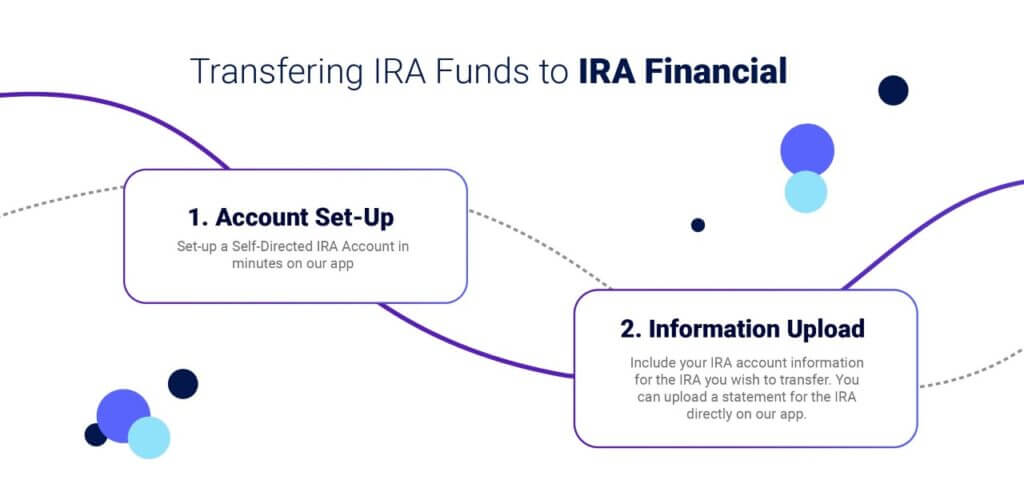
IRA Financial will then complete the tax-free IRA transfer for you. We will work with your IRA custodian to initiate the transfer and notify you when the IRA funds have arrived. You will then be ready to make your Self-Directed IRA investment. It’s super easy and tax free!
Conclusion
If you have an IRA at another custodian and are not happy with your investment options, it's time to look elsewhere. IRA Financial is the leading self-directed retirement platform available. There are lots of options out there, but many of them focus on one specific asset class, such as real estate or cryptocurrency.
What sets IRA Financial apart from the rest is the ability to invest in anything you want. Plus, there are no hidden fees. You pay one annual fee; no wire or check fees, no transaction fees, no asset value fees, and there is no minimum balance required. It's easy to get started and there's no obligation until you fund your account.
IRA funds can be easily transferred from your current custodian to IRA Financial at any time. Plus, if you need the use of those funds for a short time, you have the ability to perform an indirect transfer. Just make sure the funds withdrawn are contributed to your new Self-Directed IRA within 60 days. Of course, if you have old 401(k) funds, you can roll those over too! Just remember, you cannot roll over retirement funds at a job you are currently employed at.

Gold IRA Rollover
With inflation peaking, supply side challenges, and a sputtering stock market, many IRA investors are looking for a safe landing spot for their IRA assets. As you can see form the following figures, 2022 has been a challenging year for many IRA investors:
- S&P 500: down approximately 12%
- Dow Jones: down approximately 8.8%
- Apple stock: down approximately 9.8%
- Tesla stock: down approximately 15%
- Amazon stock: down approximately 13%
- Bitcoin: down approximately 14%
- Ethereum: down approximately 22%
- Silver: down approximately 1.3%
- Amazon stock: down approximately 13%
Gold has so far been the one asset that has held up well in 2022. Year to date, as of April 29, 2022, gold is up approximately 5%. Hence, there has been an increasing number of IRA investors looking to add gold to their portfolio. Gold is viewed as a strong hedge against inflation, as well as a good source of investment diversification.
What is the Difference Between a Rollover and a Transfer?
The Self-Directed IRA structure is a solution that allows one to use his or her retirement funds to make gold and other investments without tax. One of the more popular ways to fund a Self-Directed IRA is via a transfer or rollover.
What is an IRA Transfer?
In general, you can transfer, tax-free, assets (money or property) from one IRA to another IRA. Direct transfers can be done without limit during a taxable year. Assets move from one IRA custodian directly to a new custodian.
An indirect transfer is when IRA assets are first sent to the IRA owner before the funds are then transferred to another IRA. In the case of an indirect IRA transfer, you have 60 days to use the funds before they must be transferred to the new IRA. Failure to comply will cause the IRA to be subject to tax and potentially a 10% early distribution penalty. In addition, an indirect transfer can only be done once every twelve months.
What is an IRA Rollover?
Unlike a transfer, which is between IRAs, a rollover occurs when a non-IRA retirement account transfers cash or assets to an IRA. Like a transfer, a rollover can be direct or indirect. A direct rollover can be done anytime, assuming the 401(k)-plan participant has access to his or her funds.
Just like a transfer, an indirect rollover can only be done once every twelve months. The entire amount distributed from the plan must be contributed to your IRA within that time frame. Keep in mind, an indirect rollover could be subject to withholding tax by the employer.
Generally, one can roll over amounts from the following plans into a Self-Directed IRA:
- Traditional, Roth IRA, SEP IRA, SIMPLE IRA
- Employer’s qualified retirement plan
- A deferred compensation plan of a state or local government (section 457 plan)
- A tax-sheltered annuity plan (section 403 plan)
There are approximately $500 billion dollars worth of rollovers each year. With 10,000 baby boomers retiring a day, rollovers have become the most prevalent manner for funding IRAs.
Can I Buy Gold in an IRA?
A Self-Directed IRA is a type of retirement plan that allows the IRA owner to invest in gold and other alternative asset investments not prohibited by the IRS. In the last several years, the number of Self-Directed IRA accounts has grown significantly.
The types of investments that are not permitted to be made using retirement funds is outlined in Internal Revenue Code (IRC) Section 408 and 4975. These rules are generally known as the “Prohibited Transaction” rules.
Other than life insurance, collectibles, and transactions that involve or benefit the IRA holder or other “disqualified person,” one can use their IRA to make an investment.
IRC Section 408(m) lists the type of precious metals and coins that are permitted investments using IRA funds:
- (A) any coin which is -
- a gold coin described in paragraph (7), (8), (9), or (10) of section 5112(a) of title 31, United States Code,
- a silver coin described in section 5112(e) of title 31, United States Code,
- a platinum coin described in section 5112(k) of title 31, United States Code, or
- a coin issued under the laws of any State,
- (B) any gold, silver, platinum, or palladium bullion of a fineness equal to or exceeding the minimum fineness that a contract market (as described in section 7 of the Commodity Exchange Act, 7 U.S.C. 7) [2] requires for metals which may be delivered in satisfaction of a regulated futures contract, if such bullion is in the physical possession of a trustee described under subsection (a) of this section.
In other words, an IRA can invest in pure bullion bars, coins, as well as American Eagle and state minted coins. All precious metals and IRS-approved coins must not be held personally and must be held in the physical possession of a regulated depository or bank.
Related: Gold Investments in a Self-Directed IRA
Rules for Buying Gold in an IRA
The most important aspect of purchasing gold with an IRA is that the gold satisfy the requirement of 408(m) and be held in the physical possession of a depository.
Over the years, there have been a few companies advertising that an IRA owner can hold precious metals and/or coins in their home. The Tax Court in McNulty v. Commissioner, finally confirmed what the Self-Directed IRA industry has always maintained: that an IRA owner cannot take personal possession of any IRA-owned metal, including gold bars or coins.
Tips for Gold IRA Rollover
Using a Self-Directed IRA to buy gold can help one better diversify their retirement portfolio as well as gain a hedge against inflation. Below are some key tips to consider before investing via a Gold IRA Rollover:
- Spend time researching gold dealers before making a decision.
- Understand how gold is priced before you agree to buy it.
- Ask for references from friends or trusted sources before choosing a gold dealer. IRA Financial has several gold companies it works with.
- Make sure the gold bullion or coin is of the correct finesse as required by IRC 408(m).
- Do not hold the IRA-owned metals at home.
Conclusion
Gold has long since been the go-to during times of economic turmoil. The easiest way to invest with retirement funds is by using a Gold IRA Rollover. Moving money from a current retirement plan to a Self-Directed IRA may be your only option. This is because most plans don't allow investing in alternative assets, including gold.
So long as you abide by the rules set forth by the IRS, anyone can use IRA funds to invest in gold. As always, consult with a financial advisor before deciding how to invest your retirement funds.

Identifying UBTI for a Self-Directed IRA on Form K-1
For most Self-Directed IRA investors, the term, Unrelated Business Taxable Income, also known as UBTI, is not something that they would have to concern themselves with. Most Self-Directed IRA investments involve passive forms of income, such as capital gains, real estate rental income, dividends, interest, or royalties, which would not be subject to the UBTI tax. However, for IRA owners investing in assets involving leverage, margin, or pass-through businesses, the potential financial impact of the UBTI tax must be considered.
This article will describe the UBTI tax, its potential impact on certain Self-Directed IRA investments, as well as how to identify it on IRS Form K-1.
- Certain Self-Directed IRA investments may be subject to the UBTI Tax
- The K-1 form may help identify when you owe UBTI
- It's important to understand when your investment may be subject to the tax
What is the UBTI Tax?
Several specific IRA investments could trigger the UBTI tax. In general, the UBTI tax is triggered in three types of investment categories involving a Self-Directed IRA:
- Using margin to buy stocks or securities
- Using a nonrecourse loan to buy real estate
- Investing in an active trade or business operated through a pass-through entity.
The UBTI tax follows the trust tax rates, which is quite high; in 2022, the highest trust tax rate is 37%.
UBTI Impact on Self-Directed IRA Investments
One of the biggest advantages of using a Self-Directed IRA to make an investment is the tax benefit of not paying tax on any IRA income or gains. This is known as tax-deferral (or tax-free growth in the case of a Roth IRA).
The UBTI tax can turn a very tax-efficient investment into something that is quite the opposite. Turning an investment into a taxable transaction is not ideal, and could prove economically harmful to the IRA.
Identifying the Tax in a Self-Directed IRA Investment
One of the most difficult aspects of using a Self-Directed IRA to engage in a transaction that could potentially trigger the UBTI tax is how to determine if that tax has been triggered and if so, what the amount is.
If one is using a Self-Directed IRA to make a direct investment that triggers UBTI, such as using a nonrecourse loan to buy real estate, calculating the UBTI is possible. This is because the IRA owner would have access to all the required information, including the amount of debt, sum or depreciation, and other related expenses.
For example, if a Self-Directed IRA bought a rental property using $100,000 of IRA funds and borrowing $100,000 from a nonrecourse lender, the IRA owner would have the ability to calculate the pro rata share of all real estate-related expenses in order to arrive at the amount subject to the UBTI tax.
However, in the case where the IRA invests in a fund or private placement, it would receive a K-1 from the investment partnership identifying the IRA partner’s allocable share of partnership income or loss and the character of that income or loss.
Schedule K-1
Schedule K-1 is an IRS tax form issued annually for an investment in partnership interests. The main purpose of the Schedule K-1 is to report each partner's share of the partnership's earnings, losses, deductions, and credits.
In almost all cases, a Self-Directed IRA that is investing in a business or fund would receive a Schedule K-1 as part of the Form 1065 partnership return that the business or fund will file with the IRS. The K-1 will identify any income or loss of the partnership and the type of income generated by the partnership, such as business income, interest, and short- or long-term capital gains.
However, in many instances, the manager or general partner of the partnership will not identify the amount of the UBTI allocated to the Self-Directed IRA on the K-1. There is no particularly good reason why this is, since the identity of the investor as an IRA should be known.
Regardless, in many instances when the investor receives a Schedule K-1, the amount of UBTI is not identified, which makes reporting the UBTI on IRS Form 990-T and paying the UBTI tax quite difficult, if not impossible.
Reporting UBTI on the K-1
In the case of a Self-Directed IRA that invests in a business via a partnership, generally $1,000 or more of business income would mean that the IRA would be subject to the UBTI tax. Note – net business income of less than $1,000 would not requite the filing of IRS Form 990-T or the payment of any UBTI tax.
Whereas, if the Self-Directed IRA invested in a partnership that had debt or leverage, the identity of the UBTI tax would be more difficult. Generally, the manager of general partner would be required to report the amount of any UBTI using Code V in box 20. Otherwise, it would be nearly impossible for the IRA owner to know whether the investment triggered the UBTI tax.
This is the main reason why many investors do not report the UBTI tax to the IRS because they are not being made aware of the presence of the UBTI tax. Because Self-Directed IRA investors are often passive investors in private business- or private investment-type investments, it would be very difficult for the IRA owner to know whether the entity used any leverage that might trigger the UBTI tax. If the K-1 does not identify the UBTI tax in Box 20 using Code V, the investor would have little opportunity to know whether any UBTI tax is due.
This is especially true for Self-Directed IRA investors that have invested in an investment fund or even a private business via a pass-through entity that has used leverage. How would investor know if any leverage was used by the fund and, if so, how much leverage was used? An IRA that invests in a business could potentially uncover the amount of UBTI through the amount of income set forth in Box 1 – ordinary business income.
Conclusion
Having the ability to issue spot when a potential Self-Directed IRA investment could trigger the UBTI tax is important. For investors making direct investments in which they have control over the investment, such as a direct purchase of a house, identifying the potential impact of the UBTI is manageable. In situations where the investor makes a passive investment into a private placement or investment fund-type investment, the Schedule K-1 is essentially the only way to identify if the tax was triggered.
The problem is that some partnership managers or general partners do not identify the amount of the UBTI, either because they are not aware that an IRA is an investor or that the UBTI tax even exists. This is the primary reason why many Self-Directed IRA investors are not properly self-reporting the UBTI tax on Form 990-T.
It's imperative to work with a professional who can help determine any UBTI tax owed from your investment. Failure to do so could lead to an even bigger headache.

Staking Crypto IRAs – What You Need to Know
For many crypto investors, including Crypto IRA investors, staking has become a term that is often discussed. In essence, staking is the manner in which a growing number of cryptocurrencies verify their transactions. Just kike Bitcoin mining, which is based on the proof of work (“POW”) principle, proof of stake (“POS”) is a more environmentally friendly way to mine cryptos and earn rewards to confirm transactions.
- Staking cryptos is a way to passively generate returns on your cryptos
- More and more cryptos are adopting the Proof of Stake concept
- Staking Crypto IRAs may have tax repercussions you should be aware of
This article will explain how POS works, describe how a Self-Directed IRA can take advantage of POS rewards, as well as touch on its tax treatment from a Crypto IRA standpoint.
What is Proof of Stake (POS)?
In general, staking cryptocurrency is a method that involves committing one’s crypto assets to support a blockchain network and confirm transactions on the blockchain. POS is available for cryptos that use the proof of stake model to process payments. POS has been gaining n popularity over POW because it is a more energy-efficient alternative to POW, which relies on mining devices that use a great amount of computing power and electricity to solve mathematical equations.
Without getting too technical, POS is the process of how new transactions are added to the blockchain for that particular cryptocurrency. Solano and Cardano are the cryptos using POS with the largest market cap. Although, Ethereum 2 is expected to go live in the middle of 2022 and will enhance the Ethereum network by moving from POW to the POS model. In addition, cryptos, such as Polygon, use their own POS blockchain and Commit Chain connectivity to help scale the Ethereum network.
Related: Investing in Crypto with a Self-Directed IRA
How Does POS Work?
First, one will pledge his or her coins to the cryptocurrency protocol. The protocol then chooses the participant to serve as the validator in order to confirm blocks of transactions. The more coins a participant pledges, the more likely the participant will be picked as the validator.
Every occurrence that a block is added to the blockchain, new coins are "minted" and distributed as rewards to that block's validator. POS can be viewed as a type of lottery. The larger the stake of tokens committed, the higher odds that the participant has of being chosen as a validator, and thus, receiving a reward.
The advantage of POS is that it replaces bitcoin miners with validators, which requires far less energy consumption than POW’s in energy-intensive computer farms. Essentially, if you want to stake your cryptos in a POS, you would simply move your crypts to a wallet, enter into a smart contract, and use a bit of computer code that runs on the blockchain. One can stake coins individually or use a staking service in order to pool resources with other participants.
Related: Bitcoin Mining: What You Need to Know
IRS & The Crypto IRA
The IRS treats cryptocurrencies, such as Bitcoin, as property, like stock or real estate. In IRS Notice 2014-21, the IRS issued guidance on the tax treatment of cryptos. In the Notice, the IRS confirmed that cryptos would be treated from a tax perspective as a capital asset. Hence, the sale of a cryptocurrency held by an IRA is not subject to tax and all gains are tax-deferred or tax-free in the case of a Roth IRA.
Tax Treatment of POW
IRS Notice 2014-21 provides some guidance as to how the IRS will treat crypto rewards received from POW. The Notice states that “if” a taxpayer’s “mining” of virtual currency constitutes a trade or business, then the cryptos received as part of the mining activity would be deemed business income.
In the case of a Crypto IRA, engaging in an activity that gives rise to business income could be subject to a tax known as UBTI, which can go as high as 37% in 2022. Therefore, if a Self-Directed IRA is deemed to invest in a crypto mining activity that is deemed a trade or business, the income or coins generated from that activity could be subject to the UBTI tax.
The use of the word “if” in Notice 2014-21 reinforces the position that not all mining activity would be deemed a trade or business. Hence, an argument can be made that if an individual or a Crypto IRA invested in some mining activity and was treating the activity as passive and not a trade or business, the cryptos earned as part of the mining activity would not be subject to ordinary business income.
Other than Notice 2014-21, there is very little additional guidance on the IRS’s position on the tax treatment of POW mining activity.
Tax Treatment of POS
A recent court case could potentially offer insight into the IRS’s position on the tax treatment of earning rewards via POS. In 2019, Joshua Jarrett of Nashville engaged in a small-scale virtual currency staking enterprise using a home computer. Jarrett owned a few hundred thousand tokens in Tezos, a POS platform. Over the course of a year, he generated roughly 9,000 new tokens. Jarrett then reported these tokens on his federal income tax return and was assessed $3,793 in taxes.
The question that was then posed to the U.S. District Court for the Middle District of Tennessee was can Jarrett be taxed for new tokens that he generated through staking but has not yet transferred or sold? Jarret believed no. Hoping to avoid an unfavorable decision that might limit its ability to tax staking activities as full ordinary income transactions in the future, the IRS offered to refund Jarrett the full amount of his claim in exchange for dismissing the case.
However, on February 3, 2022, he announced that he was turning down the IRS’s offer and would seek a final court decision instead. The case will now be settled by a U.S. District Court in the Middle District of Tennessee and will have a significant impact on the tax treatment of POS for both individual investors and Crypto IRA investors.
The Jarrett case is so interesting from a Crypto IRA standpoint because he was engaged in POS activity passively and not as a trade or business, which would seemingly be covered by the language in IRS Notice 2014-21. Hence, the court’s ruling in Jarrett can have far-reaching tax consequences for passive Crypto IRA investors involved in POS activity.
Revenue Ruling 2023-14
Revenue Ruling 2023-14 states that staking rewards of taxpayers must be included in taxable income when they acquire possession of the rewards under the “dominion and control” standard. Dominion and control basically means that the taxpayer gains the capability to sell or otherwise transfer the asset.
The Ruling details an example in which a taxpayer-owned 300 units of an unspecified cryptocurrency, staked 200 of such units, validated a new block of transactions on the blockchain associated with such cryptocurrency, and received two units as a staking reward (reward units), which were nontransferable for a short period of time (lock-up period). On the day following the lock-up period, the taxpayer had the ability to sell, exchange or otherwise dispose of the reward units. The IRS ruled that the taxpayer was required to include the fair market value of the reward units in gross income after the lock-up period because the taxpayer had accession to wealth when the taxpayer gained “dominion and control” over the reward units. The taxpayer was held to have gained “dominion and control” over the reward units on the day following the lock-up period when the reward units became freely transferable.
The IRS view set forth in Revenue Ruling 2023-14 is that the receipt of staking rewards is taxable when the taxpayer has control over the crypto, whereas, under Notice 2014-21, crypto rewards received as a result of POW are taxable upon receipt.
One of the most significant aspects of Revenue Ruling 2023-14 is that it clearly discards a common taxpayer tax position that staked tokens received as a reward of POS should not be taxable until the taxpayer disposes of them in a taxable transaction. The Ruling is clear that the taxpayer recognizes income based on the fair market value of the reward token received on the date they have dominion or control, generally after the lock-up period ends.
POS and Your Self-Directed IRA
Similar to Notice 2014-21 treatment of crypto mining, in the case of POS, Revenue Ruling 2023-14 is clear that the reward tokens are subject to gross income or business income when the taxpayer gains control over the cryptos. Thus, the question then becomes whether the Self-Directed IRA’s staking activity rises to a trade or business. If the activity did, the UBTI tax would be triggered. Whereas if the staking activity did not rise to the level of a trade or business, it would appear the IRA would not have any tax on the income.
The fact that the POS or POW activity would generate ordinary income in the hands of a non-retirement taxpayer and not when generated by an IRA seems odd, but other than the UBTI tax regime, a Self-Directed IRA would not be subject to tax on the income generated. The unique aspect of POW and POS is that it could generate ordinary income without being associated with a business. For almost all other activities, the income generated would be passive or ordinary income in the hands of a business.
Conclusion
The IRS has not addressed the specific taxation of POW or POS for retirement accounts. However, we do now know that in the cases of POW and POS, the income generated is deemed ordinary income or business income if done by a business. As outlined above, since the UBTI tax regime is really the only way an IRA can be subject to tax on investment income or gains, the belief is that so long as the POW or POS activity does not rise to a trade or business, a Self-Directed IRA would not seem to be subject to taxation on rewards earned by POW or POS so long as its activity did not rise to a trade or business.
As always, crypto investing is quite volatile, and staking doesn't always reap the rewards you may be seeking. This is especially true if the gains received are taxable. Please consult a financial advisor before engaging in staking Crypto IRAs.'

Invest in a Company the Peter Thiel Way with a Self-Directed Roth IRA
In June 2021, ProPublica released an article focusing on how Peter Thiel was able to amass a $5 billion Roth IRA over the years. The article was based on leaked IRS documentation that were released unlawfully. It was immediately cited by various Democratic members of Congress and the Senate to attack abuses involving the Self-Directed Roth IRA.
I have written extensively in the past on the Peter Thiel Roth IRA story but wanted to write an article that discussed how a new business owner or entrepreneur could potentially use his model to develop a tax advantage exit strategy for their business holding.
- Peter Thiel amassed a $5 billion Roth IRA investing in start-ups/li>
- The Roth IRA is a tax-advantaged retirement account that allows for tax-free withdrawals
- Anyone can use Thiel's blueprint to invest in a business
Before I get into the Peter Thiel story, I just wanted to provide a quick overview of the Roth IRA.
Roth IRA
The Relief Act of 1997 introduced the Roth IRA. The Roth IRA is an is a type of IRA which allows any US person with earned income under a set income threshold (Under $144,000 if single and $214,000 if married and file jointly for 2022) to make after-tax contributions. For 2022, you may contribute $6,000, plus an additional $1,000 "catch-up" if you are at least age 50.
So long as any Roth IRA you own has been opened for at least five years and you are over the age of 59 1/2, all Roth IRA distributions would be tax free! Also, with a Roth IRA there are no required minimum distributions, like a traditional, pretax plan. In other words, if you made an investment into any capital asset, such as stocks, real estate, and even cryptos, all gains would be tax free. All qualified distributions would not be subject to tax ever. This makes it one of the most desirable retirement accounts around.
The Peter Thiel PayPal Story
Peter Thiel, a Stanford law graduate, ran a small hedge fund in the late 1900s. In 1999, single taxpayers were only allowed to contribute to a Roth if they made less than $110,000. Like many startups, PayPal offered its top executives low initial salaries and large stock grants.
Thiel’s income that year was $73,263, the IRS records show. While SEC filings describing that time don’t mention Thiel’s Roth, they show that he bought his first slice of the company in January 1999. Thiel paid $0.001 per share for 1.7 million shares. At that price, he was able to buy a large stake for just $1,700.
PayPal later disclosed details about the early history of the company in an SEC filing before its initial public offering. According to the ProPublica article, the filing reveals that Thiel’s founders’ shares were among those the company sold to employees at “below fair value.”
However, the record revealed that all employees got that same price, which is what the IRS acknowledged when they audited Thiel back in 2012. Soon after the company sold him the shares, investors invested millions of dollars into the company.
About a month after, PayPal opened up the company to more investors. In the summer, "$4.5 million poured in from the venture fund arm of telecom giant Nokia and other investors," those records show.
All in all, in just one year, Thiel's Roth jumped from $1,664 to $3.8 million! In '02, eBay purchased PayPal. Later in the year, Peter Thiel sold his shares. Let us remind you that those shares were still held inside his Roth IRA. Because of that, all the gains from the sale of the company were tax free. By the end of the year, tax records show that his Roth IRA was worth approximately $28.5 million.
Thiel and colleagues in 2003 founded Palantir, a data analytics company, helped by an early investment from a CIA-backed venture fund. Again, Thiel used his Roth IRA to buy shares in the company. It was still private and well before its IPO.
Then, in 2004, Thiel met Mark Zuckerberg, a Harvard undergraduate who was developing the king of social media, Facebook. Thiel invested half a million dollars in the venture with his Roth. By the end of 2008, the Roth was worth $870 million.
Ironically, the IRS and many of Thiel’s opponents spent time focusing on his Papal investment. However, it was his Palantir and Facebook investments that generated the largest returns for his Roth IRA.
Watch this: How to Invest in Startups with a Roth IRA
Following the Thiel PayPal Playbook
Most of us not entrenched in the Silicon Valley social network will ever have the ability to be a seed investor in a multi-billion dollar company, such as Facebook. However, many of us will have the opportunity to invest in a start-up that has the potential to be successful, and quite valuable.
The following are the two keys to safely replicating Peter Thiel and structuring an investment into a start-up using a Roth IRA.
The IRS prohibited Transaction Rules
In general, one may use an IRA or Roth IRA to invest in a private business, including a start-up business. Internal Revenue Code (“IRC”) section 408 and Section 4975 do not state what a retirement plan can invest in – only what it cannot. In general, an IRA cannot invest in life insurance, collectibles, such as antiques, and any transaction involving the retirement plan and a “disqualified person" as outlined under IRC Section 4975.
A business owner should not use a Roth IRA to invest in a start-up if the Roth IRA owner or any disqualified persons own 50% of the business interests. In the case of Peter Thiel & PayPal, Thiel owned less than 50% of the entity and thus, the entity was not deemed a disqualified person.
However, there are instances in where an investment into an entity where the retirement account owner owns less than 50% can still trigger a prohibited transaction. In Rollins v. Commissioner, Mr. Rollins caused his 401(k) to lend funds to three companies, and in each of which he was the largest (9% to 33%), but not controlling, stockholder.
The IRS argued the loans violated the prohibited transaction rules under IRC 4975. The Court agreed with the IRS and concluded that the loan benefited Rollins as an owner of the entities since the entities were able to borrow money without having to go through independent lenders.
The court essentially concluded that because the loan benefited Mr. Rollins and the exclusive benefit from the loan transaction did not benefit the 401(k), the loan transaction were prohibited even though Rollins owned less than 50% of the entity.
Examining the Thiel PayPal transaction considering Rollins, it would have been difficult for the IRS to argue that Thiel personally benefited from the IRA transaction since the amount invested by the Roth IRA was so minimal.
The lower the investment by the Roth IRA the harder it will be for the IRS to argue that an IRA investment would violate IRC 4975 if the ownership level is under 50%
Valuation, Valuation, Valuation
IRA custodians, such as IRA Financial Trust, are responsible for ensuring that all IRA assets are valued annually at their fair market value and are required to report the account’s fair market value at year-end to IRS. In general, an IRA’s fair market value includes any contributions, rollovers into the IRA, investment earnings, and any adjustment to the market value of IRA assets. According to the IRS, non-publicly traded assets do not have easily determined fair market valuations.
The following excerpt from the October 2014 GAO report on IRAs illustrates the difficulty the IRS has in showing a value paid by an IRA for a privately held stock is not its true fair market value:
It is often difficult for IRS to pursue cases of potential abuse based on inappropriately valued assets. First, in response to a congressional inquiry, IRS said it generally requires individuals to assess the FMV of assets in IRAs rather than use a liquidation value or other valuation method.
However, IRS guidance implies that individuals can use the liquidation value of a profits interest for certain tax purposes. One industry stakeholder also noted that individuals can use case law to support very low valuations of nonpublicly traded shares and profits interests.
Second, according to IRS officials, valuation can be subjective and IRS may expend resources and ultimately conclude that the taxpayer’s valuation is reasonable. Third, the statute of limitations for IRS to pursue cases is generally only 3 years, which poses certain obstacles to pursuing noncompliant activity that spans years of IRA investment.
Therefore, before investing Roth IRA funds into a private start-up, make sure the IRA is paying the same price for the respective shares as all other investors. Investing in a start-up with no assets or business history can more easily support a low share price value.
The IRS is focused on the value of IRA assets, specifically privately held investments. Hence, pay special attention to confirming the price the Roth IRA is paying for the shares can be defended as its fair market value. Having a record of other non-IRA investors paying the same price for the same shares is advisable.
Conclusion
Using a Self-Directed Roth IRA to buy start-up stock can prove to be very lucrative. Peter Thiel provided all of us with a blueprint on how to talk advantage of the Roth IRA tax rules in conjunction with a start-up business investment.
However, generating Thiel type returns is highly unlikely considering he was an early investor of three hugely successful publicly traded companies. Regardless, ensuring that the company is not deemed a “disqualified person” as per IRC 4975 and that the IRA is paying fair market value for the shares is crucial in successfully structuring a Self-Directed Roth IRA investment into a start-up business.
