


How to Invest in Real Estate

Key Takeaways
- Real estate can be bought directly, through a REIT, through a crowdfunding platform, or inside a retirement account, and each comes with real tradeoffs.
- A Self-Directed IRA is a regular IRA that lets you hold real estate and other alternative assets instead of just stocks and mutual funds..
- Rent and appreciation earned inside a retirement account grow tax-deferred or tax-free, unlike the same property bought with personal savings.
- Your IRA, not you personally, has to be the buyer, the landlord, and the seller of any property it owns.
- At IRA Financial, a Self-Directed IRA runs $495 a year flat, with no fees tied to how much the property is worth.
The Different Ways People Invest in Real Estate
Before getting into retirement accounts specifically, it's worth seeing the whole landscape, because the right path depends on how hands-on you want to be and how much capital you're starting with.
Buying property directly is the most familiar route. You save up a down payment, get a mortgage or pay cash, and become a landlord or a flipper. It gives you full control and the most direct upside, but it also means real work, tenants, repairs, and a large chunk of capital tied up in one asset.
A REIT, short for real estate investment trust, is a company that owns a portfolio of properties, and you buy shares of it like a stock. It's liquid, requires almost no money to start, and takes zero hands-on effort, but you don't own or control any specific property, and your return is whatever that company's whole portfolio does.
Real estate crowdfunding and syndications sit in between. You pool money with other investors into a specific deal, usually run by a sponsor who does the actual work. It's more hands-off than direct ownership, and often more targeted than a REIT, but you're trusting someone else's management and your money is usually locked up for years.
Then there's the path this guide focuses on: buying real estate directly, the same way you would with your own bank account, except the property is owned by your retirement savings instead of by you personally. It takes the control of direct ownership and pairs it with a tax advantage none of the other three paths offer.
What an IRA Actually Is, and What "Self-Directed" Means
If you're not deep into retirement accounts, here's the short version. An IRA, short for Individual Retirement Account, is a tax-advantaged account you use to save for retirement. Money goes in, either as a new contribution or rolled over from an old 401(k) or another IRA, and depending on whether it's a Traditional or Roth IRA, you get a tax break either now or when you eventually withdraw the money.
Most people open an IRA through a bank or a brokerage firm, and that provider decides what you're allowed to invest in. Almost always, that means stocks, bonds, and mutual funds. That's a business decision those providers make, not an IRS rule. The tax code actually allows an IRA to hold almost anything except life insurance and a narrow list of collectibles. A Self-Directed IRA is the same account, Traditional or Roth, just opened with a custodian built to administer that wider range of assets, real estate included.
Why Doing This Inside a Retirement Account Works So Well
This is the part that makes the fourth path worth the extra learning curve. Buy a rental property with money from your regular bank account, and you pay tax on the rental income every year, plus capital gains tax when you eventually sell. Buy that same property inside a Self-Directed IRA, and the rent and the eventual sale proceeds grow tax-deferred in a Traditional account or completely tax-free in a Roth, exactly the same way stock gains would inside either account.
I've watched this play out with real results. One client of mine, a preacher, used a Self-Directed IRA to invest in real estate over time and grew a Roth IRA to $3.5 million, all of it tax-free once he reaches retirement age. That's the entire case for doing this inside retirement savings instead of outside it.
What Kinds of Property You Can Buy
The range is wider than most first-time investors assume. Inside a real estate IRA you can typically hold single-family homes, townhouses, duplexes and other multi-family properties, condos, commercial buildings, raw land, and even real estate notes or tax lien certificates. You're not limited to rental property either, some investors buy land and hold it, others buy a note secured by someone else's property.
Book a free call with a self-directed retirement specialist
- Review your self-directed retirement options
- Learn about investing in alternative assets
- Get all of your questions answered
The Rules You Need to Know Before You Buy
This is the part that trips up first-time investors, so it's worth slowing down on. The IRS restricts what it calls prohibited transactions between your IRA and anyone considered a disqualified person, which includes you, your spouse, your parents and grandparents, and your children and grandchildren. In practice, this means you can't buy a property from yourself or a family member and put it in your IRA, you can't sell IRA-owned property to a family member, you can't live in it or let a disqualified family member live in it, and you can't personally do repairs or property management on it, even for free.
The reasoning is straightforward once you see it: the tax benefits an IRA gets are meant for your retirement, not for transactions that quietly benefit you or your family right now. Fair market pricing doesn't fix a prohibited transaction either, the mere fact that a disqualified person is on the other side of the deal is what triggers it. Get this wrong and the IRS can disqualify the entire IRA, treating it as fully distributed and taxable.
How the Money Actually Works
Every dollar tied to the property needs to run through the IRA, not through you. If the property needs a new roof, the IRA pays for it from IRA funds, not your checking account. If a tenant pays rent, that rent goes to the IRA, not to you personally. This isn't a technicality, mixing IRA and personal money on the same asset is one of the more common ways investors accidentally trigger a prohibited transaction without realizing it.
Checkbook Control, an Option Worth Knowing About
With a standard Self-Directed IRA, your custodian reviews and processes each purchase, which works fine for most investors but can slow you down if you're competing with cash buyers or need to move fast on a deal. A Checkbook IRA solves that by having your IRA own an LLC that you manage directly, so you can write a check or wire funds yourself the moment you're ready to close. It's not the right fit for someone making a single, occasional real estate purchase, but for investors who plan to be active in real estate over time, it removes a real bottleneck.
Getting Started With IRA Financial
Opening a real estate IRA follows a simple sequence: you open the account, fund it through a rollover or transfer from an existing retirement account, and once the funds are in place, you're ready to make an offer. Most accounts open within a few business days, though funding through a transfer from a prior custodian can take a few weeks depending on how quickly they move.
On cost, I've always believed retirement investors shouldn't be charged based on how much their account is worth or how many properties they own. That's why IRA Financial charges a flat $495 a year for a standard Self-Directed IRA, with no fees tied to your account balance or the number of assets you hold. If you want checkbook control from the start, that runs $999 for the first year, covering LLC formation and setup, then the same $495 flat fee annually after that.
Final Thoughts
There's no single right way to invest in real estate, a REIT and a crowdfunded deal both have a place depending on how hands-on you want to be. But if you're set on owning property directly and you have retirement savings sitting in stocks and mutual funds, doing it through a Self-Directed IRA is worth serious consideration. The rules are learnable, the paperwork is manageable with the right custodian, and the tax treatment is something none of the other paths can match.
This content is for educational purposes only and does not constitute legal, tax, or investment advice. Consult a qualified professional before making any investment decisions.


What Is a Checkbook IRA?
Key Takeaways
- A checkbook IRA is a Self-Directed IRA that owns an LLC, giving you direct signing authority over its bank account./li>
- Its legal basis is Swanson v. Commissioner, 106 T.C. 76 (1996), a Tax Court case confirming an IRA can capitalize a new entity without a prohibited transaction.
- At IRA Financial, setup runs $999 the first year, then $495 annually, with no per-transaction fees.
- No custodian reviews each transaction, so the compliance responsibility shifts to you.
- Leveraged real estate can trigger UDFI, taxed at trust rates up to 37% once UBTI passes $1,000.
How a Checkbook IRA Actually Works
The structure is often described as IRA to LLC to investment, and that's a fair shorthand for the self-directed IRA LLC model. Your Self-Directed IRA funds a newly formed LLC in exchange for 100% of the membership interest, so the LLC itself is owned by the IRA, not by you personally. You're named as the LLC's manager, which gives you authority over its operations and its bank account without making you the owner of the underlying assets in your individual capacity. That distinction matters more than it sounds like it should, because it's what keeps the arrangement inside the rules rather than outside them.
Once the LLC has its own checking account funded by the IRA, you can write a check, wire funds, or use a debit card tied to that account to fund a purchase directly. A rental property, a private loan, a stake in a small business, gold coins that meet IRS purity requirements, a tax lien certificate: all of it gets titled in the name of the LLC, and any income or gain flows back into that same LLC account, then eventually back to the IRA. You're not asking a custodian to cut a check on your behalf every time a deal comes together, which is the entire point.
Why the LLC Layer Exists: Swanson v. Commissioner
The legal reasoning behind checkbook control isn't something IRA Financial invented. It comes from Swanson v. Commissioner, 106 T.C. 76 (1996), where the Tax Court held that a taxpayer's IRA could capitalize a newly formed corporation and hold 100% of its stock without that initial transaction being a prohibited transaction under IRC Section 4975. The reasoning was straightforward: at the moment of formation, a brand-new entity isn't yet a disqualified person, so the IRA funding it doesn't trigger the self-dealing rules that would apply to an existing entity the IRA owner already controls.
Practitioners have relied on that reasoning to extend the same logic to LLCs, and it's held up for nearly three decades of IRA-owned entity structures. What Swanson didn't do is give anyone a blank check. Once the entity exists, it becomes a disqualified person in its own right, and most transactions between the IRA, the LLC, and the IRA owner personally are still subject to the same prohibited transaction rules that apply to a traditional Self-Directed IRA.
What You Can, and Can't, Do With a Checkbook IRA
The appeal of a checkbook IRA is the breadth of what it can hold: residential and commercial real estate, raw land, private company equity, promissory notes, precious metals, tax liens, and cryptocurrency all fall within reach. I've watched clients like James, a preacher who used checkbook control to move on real estate deals fast enough to grow a Roth IRA to $3.5 million, build real wealth specifically because they weren't waiting on custodian approval to close.
The limits sit with IRC Section 4975, and they're worth taking seriously rather than treating as fine print. A disqualified person includes you as the IRA owner, your spouse, your ancestors and lineal descendants, and any entity where disqualified persons hold 50% or more of the interest. You can't buy property from your IRA's LLC, sell it property, lease it space, lend it money, or have it pay you a salary for managing it, even at a fair market rate. Fair market value doesn't cure a prohibited transaction; the mere fact that a disqualified person is on the other side of the deal is what triggers it. A first violation carries a 15% excise tax on the transaction amount, escalating to 100% if it isn't corrected within the tax year, and if the IRA owner personally engages in a prohibited transaction, the consequence is far worse: the entire IRA loses its tax-advantaged status and is treated as fully distributed as of the first day of the year the violation occurred.
Using a Checkbook IRA for Real Estate
Real estate is where checkbook control gets used the most. A standard custodian-directed IRA can still buy property, but every offer and closing routes through the custodian first, and that delay can cost you a deal against a cash buyer. With a checkbook IRA, your LLC holds title and wires funds directly, so you can close the same day you decide to move. You can hold single-family homes, multi-family properties, raw land, commercial buildings, and even notes or tax liens inside the structure, and the same prohibited transaction rules from earlier still apply.
Book a free call with a self-directed retirement specialist
- Review your self-directed retirement options
- Learn about investing in alternative assets
- Get all of your questions answered
Checkbook IRA Setup and Costs
Getting a checkbook IRA open follows the same basic sequence regardless of provider. You open the account, the provider forms the LLC and obtains its EIN, you fund the account and transfer money into the LLC's checking account, and then you're free to invest. At IRA Financial, most accounts open within 1 to 3 business days once documentation is submitted, though funding the account and completing a first investment typically takes 3 to 4 weeks overall, largely dependent on how quickly a prior custodian processes the transfer.
Cost is where checkbook IRAs diverge most from a standard custodian-directed Self-Directed IRA, and it's worth seeing side by side.
| Structure | First-Year Cost | Ongoing Annual Cost | Who Approves Each Investment |
|---|---|---|---|
| Standard Self-Directed IRA | $495 | $495 | Custodian reviews and processes each purchase |
| Checkbook IRA LLC (Individual) | $999 | $495 | You, as LLC manager, with no per-transaction review |
The $999 first-year figure at IRA Financial covers LLC formation, the EIN, and the operating agreement, and after that it drops to the same $495 flat annual fee that applies to a standard Self-Directed IRA, with no asset-value fees or per-transaction charges layered in. That flat structure is deliberate. I've written before about how asset-based custodian fee structures end up squeezing exactly the kind of active, deal-by-deal investing a checkbook IRA is built for, and it's a big part of why we built our pricing the way we did.
UBIT and UDFI Inside a Checkbook IRA
Checkbook control doesn't exempt an IRA from Unrelated Business Income Tax. It's a common misconception that once an IRA-owned LLC holds an asset, all the income coming back into the IRA is automatically tax-sheltered the way a stock dividend would be. Debt-financed real estate is the clearest example where that assumption breaks down. If your checkbook IRA's LLC uses a non-recourse loan to purchase a property, the portion of rental income and eventual capital gain attributable to that borrowed money becomes Unrelated Debt-Financed Income, taxed proportionally to the debt-to-asset ratio on the deal.
UDFI, along with other forms of UBTI, is taxed at trust tax rates rather than individual brackets, which matters because trust brackets compress fast: the top rate of 37% applies at a far lower income level than it would on an individual return. Once your IRA's total UBTI for the year crosses $1,000, the IRA itself, not you personally, is required to file Form 990-T and pay whatever tax is owed. None of this makes leveraged real estate a bad idea inside a checkbook IRA. It just means the numbers on a leveraged deal need to account for UBIT from the start, not get discovered at tax time.
Checkbook IRA vs. a Custodian-Controlled Self-Directed IRA
Not every self-directed investor needs checkbook control, and the honest answer depends on how often you're transacting and how comfortable you are owning the compliance work yourself.
| Feature | Checkbook IRA | Custodian-Controlled Self-Directed IRA |
|---|---|---|
| Transaction speed | Same-day, since you sign directly | Custodian processing time per transaction |
| Best fit | Frequent deals, real estate closings, time-sensitive private placements | One or two alternative investments, less frequent activity |
| Compliance oversight | Falls on you and your advisors | Custodian reviews documentation before funding |
| Setup cost | LLC formation adds an upfront cost | No entity formation required |
If you're making a single real estate investment every few years, the LLC layer probably adds cost and complexity without much practical benefit. If you're the kind of investor closing on deals regularly, competing with cash buyers, or funding private notes on short notice, the LLC is what makes that possible at all.
Final Thoughts
A checkbook IRA is a legitimate, well-established structure with a real Tax Court case behind it. The custodian steps out of the transaction, and the responsibility for staying inside IRC Section 4975 and handling UBIT correctly moves to you. For investors who move on alternative assets often enough that custodian processing time actually costs them deals, that tradeoff is worth it. For everyone else, it's worth having an honest conversation about whether a standard Self-Directed IRA already does the job.

Can I Use a Non-Recourse Loan to Buy Real Estate in My IRA?
Yes, you can use a non-recourse loan to buy real estate inside your IRA, and for most investors who want to leverage a property purchase, it's the only legal way to do it. A regular mortgage won't work because it requires you, the IRA owner, to personally guarantee the debt, and that guarantee is a prohibited transaction under federal tax law. A non-recourse loan solves that problem by holding only the property as collateral, with no personal liability attached to you or your IRA. The trade-off is a tax called UDFI, and understanding it before you close on a property will save you from an unpleasant surprise at tax time.
Key Takeaways
- Your IRA can borrow money to buy real estate, but the loan must be non-recourse, meaning the lender's only recourse if you default is the property itself, not you personally or any other assets in your IRA.
- A portion of the rental income and capital gains from a debt-financed property becomes taxable to your IRA as Unrelated Debt-Financed Income (UDFI), even inside a Roth IRA, and that tax can reach 37% at income levels as low as $16,000 because IRAs are taxed at compressed trust rates.
- Solo 401(k) plans get an exemption from this tax under IRC Section 514(c)(9) that IRAs don't qualify for, which makes a Solo 401(k) the better vehicle for leveraged real estate if you have qualifying self-employment income.
- Most non-recourse lenders require 30% to 40% down, higher interest rates than conventional mortgages, and property types that generate steady cash flow, like rental homes, apartment buildings, and commercial real estate.
What a Non-Recourse Loan Is and Why Your IRA Needs One
A non-recourse loan is a loan secured only by the asset it finances. If the borrower defaults, the lender can seize and sell the property, but it can't come after the borrower's other assets or income to make up the difference. That single feature is what makes non-recourse financing compatible with retirement account rules.
Every other type of real estate loan, including a standard 30-year fixed mortgage, is a recourse loan. The lender can pursue you personally if the property alone doesn't cover the balance. For an IRA, that personal exposure is exactly what the tax code prohibits. So when people ask whether they can get a mortgage inside their IRA, the honest answer is no, not a conventional one. A non-recourse loan is the workaround, and it's a legitimate, well-established one that custodians and lenders handle routinely.
The Prohibited Transaction Rule That Makes This Necessary
Under IRC Section 4975, a "disqualified person" (which includes you as the IRA owner, your spouse, and certain other family members) can't lend money to your IRA or extend credit on its behalf. That same rule works in reverse: you can't personally guarantee a loan your IRA takes out, because a personal guarantee is itself treated as an extension of credit between you and your account.
If you signed a personal guarantee on an IRA-held property and the IRS caught it, the consequence isn't a fine. The entire IRA loses its tax-deferred status and is treated as distributed to you as of January 1 of the year the transaction occurred, triggering income tax on the full account balance plus a possible 10% early withdrawal penalty if you're under 59½. That's a heavy price for signing on a loan the way you would for your own house. This is the entire reason non-recourse lending exists as a category, and it's why every reputable Self-Directed IRA custodian will insist on it before your IRA closes on a leveraged property.
How Non-Recourse Loans Work in Practice
Because the lender is taking on more risk with no personal guarantee to fall back on, the terms look different from a conventional mortgage.
| Factor | Typical Non-Recourse Terms |
|---|---|
| Down payment / equity required | 30% to 40%, sometimes more |
| Interest rate | Higher than conventional mortgages, reflecting lender risk |
| Loan documentation | Underwritten around the property's income potential, not your personal credit |
| Eligible properties | Income-producing real estate: rentals, multifamily, commercial |
| Title | Held in the name of the IRA (or the IRA-owned LLC), never in your personal name |
Lenders underwrite these loans primarily on the property's ability to generate income, since that income, not your paycheck, is what services the debt. That's part of why fix-and-flip deals and raw land tend to be poor fits for non-recourse financing. Lenders want to see cash flow.
I've worked with clients who used this exact structure to build significant wealth inside a retirement account. One client, James, a preacher by profession, used real estate inside his Self-Directed Roth IRA to grow the account to $3.5 million. Leverage, used carefully and within these rules, is part of how that kind of growth happens, especially in a Roth IRA where the eventual gains come out completely tax-free.
Book a free call with a self-directed retirement specialist
- Review your self-directed retirement options
- Learn about investing in alternative assets
- Get all of your questions answered
UDFI and UBIT: The Tax Trade-Off You Need to Understand
Here's where non-recourse financing gets more complicated than people expect. When your IRA borrows money to buy a property, the portion of the income attributable to the borrowed funds becomes Unrelated Debt-Financed Income, or UDFI. UDFI isn't a penalty and it isn't unique to real estate loans gone wrong. It's simply how the tax code treats leveraged income inside an otherwise tax-exempt account, under IRC Sections 511 through 514. If your UDFI for the year is $1,000 or more, your IRA has to file Form 990-T and pay Unrelated Business Income Tax (UBIT) on that portion.
This applies whether your IRA is a Traditional or a Roth. A lot of investors assume a Roth IRA's tax-free treatment protects them from UBIT. It doesn't. The IRS taxes the debt-financed portion of the income regardless of which type of IRA holds the property.
How to Calculate UDFI on a Leveraged Property
The formula is straightforward once you see it worked through. You calculate the "debt-financed percentage," which is the average acquisition debt on the property divided by the property's average adjusted basis, then apply that percentage to the net income (or gain) the property produces.
Here's a real example. Say your IRA buys a $400,000 rental property, putting $160,000 down in cash (40%) and financing the remaining $240,000 with a non-recourse loan. That makes the property 60% debt-financed. If the property nets $20,000 in rental income for the year after expenses, 60% of that, or $12,000, is UDFI and gets taxed.
What Tax Rate Applies to UDFI
UBIT is calculated using trust tax brackets, not individual income tax brackets, and trust brackets are extremely compressed. For 2026, the brackets look like this:
| Taxable UDFI | Tax Rate |
|---|---|
| $0 to $3,300 | 10% |
| $3,300 to $11,700 | 24% |
| $11,700 to $16,000 | 35% |
| Over $16,000 | 37% |
Running the $12,000 example above through these brackets produces roughly $2,451 in tax, an effective rate north of 20% on that portion of income, in a single year. Sell the property later and the same debt-financed percentage applies to the capital gain, based on the average outstanding loan balance over the 12 months before the sale. On a large gain, that can be a meaningful check.
One detail that trips people up: this tax has to be paid out of the IRA itself. You can't write a personal check to cover your IRA's 990-T bill. Using outside money to pay an IRA's tax liability is treated as an excess contribution, which creates its own compliance problem. Your custodian typically handles the filing and payment from IRA funds directly.
Non-Recourse Loans in a Solo 401(k) vs. a Self-Directed IRA
If you have self-employment income, there's a way around the UDFI tax entirely, and it's worth knowing about before you leverage a property in an IRA. Congress added an exemption under IRC Section 514(c)(9) back in 1980 for qualified pension and 401(k) plans, but never extended it to IRAs. A Solo 401(k) plan qualifies for that exemption. A Self-Directed IRA does not.
| Self-Directed IRA | Solo 401(k) | |
|---|---|---|
| UDFI on debt-financed real estate income | Taxable | Exempt under IRC 514(c)(9) |
| Personal guarantee on the loan allowed | No | No |
| Eligibility | Anyone with an IRA | Requires genuine self-employment income and no full-time employees other than a spouse |
| Loan must still be non-recourse | Yes | Yes |
That last row matters. The 401(k) exemption removes the UDFI tax, not the non-recourse requirement. You're still a disqualified person under IRC 4975 as the plan participant, so you still can't personally guarantee the debt. What changes is that the income the leveraged property generates flows back into the plan without triggering UBIT.
If you're self-employed with no full-time employees, and you know real estate leverage is part of your strategy, setting up a Solo 401(k) instead of, or alongside, an IRA can be worth serious consideration for that reason alone. The eligibility bar is real, though. The business needs a legitimate profit motive, and if you own multiple businesses that could be considered a controlled group, that can jeopardize the plan's "solo" status and the exemption with it.
Book a free call with a Self-Directed IRA real estate specialist
- Find out whether your specific deal and income situation would benefit from a Solo 401(k) instead of an IRA
- Get a realistic estimate of your UDFI exposure before you make an offer, not after you've closed
- Connect with one of the non-recourse lenders in our network who understand retirement account financing
Steps to Buy Real Estate in Your IRA With a Non-Recourse Loan
- Open and fund a Self-Directed IRA (or IRA LLC, if you want checkbook control) with a custodian experienced in real estate.
- Identify an income-producing property and get it under contract in the name of the IRA, never your personal name.
- Apply for non-recourse financing, expecting to put down 30% to 40% or more.
- Have the custodian, not you personally, sign all loan and closing documents on the IRA's behalf.
- Track the debt-financed percentage each year and set aside a reserve inside the IRA for the eventual UBIT bill.
- File Form 990-T through your custodian once UDFI hits $1,000 for the year.
Common Mistakes to Avoid
The single most damaging mistake is signing a personal guarantee, even informally, to get better loan terms. It feels harmless in the moment and it isn't. I'd also flag paying any expense related to the property, repairs, property taxes, insurance, directly from your own bank account instead of from IRA funds. That's a separate prohibited transaction, distinct from the financing issue, and one I see trip up otherwise careful investors. Every dollar in and every dollar out has to move through the IRA.
Frequently Asked Questions
Can I get a regular mortgage for a property owned by my IRA?
No. A conventional mortgage requires a personal guarantee, and that guarantee is a prohibited transaction under IRC 4975 because you're a disqualified person to your own IRA.
Does UDFI apply to a Roth IRA the same way it applies to a Traditional IRA?
Yes. The tax-free growth a Roth IRA offers doesn't exempt it from UBIT on debt-financed income. Both account types are treated the same way for UDFI purposes.
What happens if I personally guarantee a loan for my IRA-owned property?
The IRS treats the entire IRA as distributed as of the start of that tax year, meaning you'd owe income tax on the full balance and possibly a 10% early withdrawal penalty, not just tax on the property in question.
How much down payment does a non-recourse lender typically require?
Most non-recourse lenders want at least 30% down, and some require 40% or more, well above what a conventional mortgage lender would ask for.
Can a Solo 401(k) really avoid UDFI on the same property an IRA would owe tax on?
Yes, as long as you have genuine self-employment income and qualify for a Solo 401(k) under the plan rules, IRC Section 514(c)(9) exempts leveraged real estate income in a 401(k) from UBIT in a way that IRAs never receive.
Final Thoughts
Leverage inside a retirement account isn't complicated once you understand the two rules that govern it: the loan has to be non-recourse, and the IRS wants its share of the income that leverage generates. Neither of those rules should scare you off a good real estate deal. They just need to be built into your numbers from the start, the same way you'd account for property taxes or insurance. Plenty of investors have used leveraged real estate to grow retirement accounts far beyond what a portfolio of stocks and bonds alone could produce. Whether an IRA or a Solo 401(k) makes more sense for your situation comes down to how you earn your income, and that's worth figuring out before you sign a contract, not after.
This content is for educational purposes only and does not constitute legal, tax, or investment advice. Consult a qualified professional before making any investment decisions.

Use Your IRA to Buy a Rental Property
You found the rental property. The numbers work, the neighborhood is right, and you're ready to make an offer. The only question left is where the down payment comes from, and writing a $150,000 or $200,000 check from personal savings isn't something you want to do for one property. Before you walk away or drain your liquidity, it's worth looking at a capital source most investors never consider: your IRA or an old 401(k). You can use retirement funds to buy real estate directly, and it's been legal the entire time, most people just assume IRA money has to stay in stocks and bonds until retirement.
Key Takeaways
- You may already have the capital.
- A Self-Directed IRA can purchase real estate directly. The IRS doesn't require retirement funds to stay in publicly traded securities, that's a limitation set by individual brokerage firms, not the tax code.
- Moving money into a Self-Directed IRA generally doesn't trigger current taxes. An existing IRA moves through a trustee-to-trustee transfer, and an old 401(k) moves through a direct rollover, and you don't have to move your entire balance to fund one property.
- Two structures are available: a full-service Self-Directed IRA, where the custodian processes each transaction, or a Self-Directed IRA LLC with checkbook control, where you manage the account directly for faster-moving deals.
Your Retirement Account Might Already Have the Capital
Picture an investor with $125,000 in personal savings eyeing a $400,000 rental property. Committing nearly all of that cash to one deal feels risky, and understandably so. But she also has $600,000 sitting in retirement accounts, money she's mentally filed away as "Wall Street money" that isn't available for this kind of investment. It is. A Self-Directed IRA doesn't let you spend retirement funds personally, but it does let the IRA itself make the investment, with rental income and future appreciation flowing back into the account. The capital problem often isn't a lack of capital. It's capital sitting in the wrong mental category.
What a Self-Directed IRA Actually Changes
A Self-Directed IRA isn't a separate account type under the tax code. A Traditional Self-Directed IRA follows the same rules as any other Traditional IRA, and the Roth version follows the same Roth rules. What changes is the custodian's willingness to administer something other than stocks, bonds, and mutual funds, things like real estate, private funds, and promissory notes. The prohibited transaction rules under IRC Section 4975 still apply. Owning real estate isn't the issue. How the property is acquired, used, and operated is.
Book a free call with a self-directed retirement specialist
- Review your self-directed retirement options
- Learn about investing in alternative assets
- Get all of your questions answered
Two Ways to Structure the Purchase
| Full-Service Self-Directed IRA | Self-Directed IRA LLC (Checkbook Control) | |
|---|---|---|
| Best for | An occasional investor buying one property | An active investor with frequent transactions |
| How it works | The custodian processes each transaction | You, as LLC manager, control the bank account directly |
| Speed | Slower, since the custodian is involved each time | Faster, since you can wire funds or cut a check yourself |
| Good fit when | You don't expect recurring expenses or repairs | You'll be paying contractors, taxes, or insurance often, or buying more than one property |
Checkbook control changes how quickly transactions move, not what's actually permitted. You're still bound by the same prohibited transaction rules either way. For a deeper breakdown of the two structures, see our Checkbook Control vs. SDIRA comparison.
Where the Money Actually Comes From
| Source | How to Access It |
|---|---|
| An existing IRA at another custodian | Trustee-to-trustee transfer. You can move just what you need, not the whole balance. |
| A former employer's 401(k) | Direct rollover to a Self-Directed IRA, generally with no current tax if done correctly. |
| A current employer's 401(k), age 59½ or older | An in-service distribution, only if the specific plan document allows it. |
None of this requires liquidating your entire retirement account. If you have $700,000 in a Traditional IRA and need $200,000 for a property, you transfer $200,000 and leave the rest invested however you like.
The Prohibited Transaction Rules, in Plain English
An IRA exists to benefit your retirement, not to give you or certain family members a current personal benefit. That means your IRA can't buy a property you then use yourself, even part-time, and you can't sell a property you already own personally to your own IRA. Disqualified persons under Section 4975 include you, your spouse, your parents and grandparents, your children and grandchildren, and entities they control. These rules are manageable once you understand the boundary: the property belongs to the retirement structure and has to be run accordingly, not treated like a personal asset you happen to control.
Book a free call with a real estate IRA specialist
IRA Financial charges a flat $495 annual fee regardless of what your property is worth, so a successful investment doesn't hand your provider a bigger cut. That structure, combined with in-house tax and compliance expertise, is why real estate investors tend to stick around once they see how a deal actually gets processed.
Frequently Asked Questions
Do I have to withdraw money from my IRA to buy real estate with it?
No. The IRA, or an LLC owned by the IRA, purchases and holds the property directly. You never take personal possession of the funds.
Can I use an old 401(k) from a previous employer?
Generally yes, through a direct rollover to a Self-Directed IRA, which typically doesn't trigger current income tax when done properly.
Can I use my current employer's 401(k)?
Only if your specific plan allows an in-service distribution, which most plans permit starting at age 59½, but the plan document controls, not the tax code alone.
What's the real difference between a Self-Directed IRA and a Self-Directed IRA LLC?
A standard Self-Directed IRA has the custodian process each transaction. An LLC structure gives you, as manager, direct checkbook control over the account, which is faster for frequent expenses but doesn't change the underlying rules.
Can I use the rental property myself or let a family member live there?
No. Personal use by you or a disqualified person is a prohibited transaction and can jeopardize the entire IRA's tax-advantaged status.
Final Thoughts
If you've already found the property, you've done the hard part. What's left is figuring out where the capital comes from, and for a lot of investors, the answer has been sitting in a retirement account they never thought to check. Before you write a large personal check or walk away from a deal that made sense, it's worth a few minutes to see whether the money was there all along.
This content is for educational purposes only and does not constitute legal, tax, or investment advice. Consult a qualified professional before making any investment decisions.

What Every Retirement Investor Can Learn From SpaceX
Yes, you can invest in a private company before it goes public through your IRA, and it's been legal the entire time. When SpaceX went public in June 2026 at a valuation near $1.8 trillion, the largest IPO in U.S. history, most investors were only seeing the opportunity for the first time. Some retirement investors had already been in the company for years, using a Self-Directed IRA to buy shares long before Wall Street ever got a chance.
Key Takeaways
- Retirement accounts have never been restricted to publicly traded stock. Under IRC Section 4975, an IRA can invest in a private company as long as the transaction doesn't involve a disqualified person, the same rule that governs every other Self-Directed IRA investment.
- By the time a company like SpaceX reaches the public markets, most of its value has usually already been created. SpaceX was founded in 2002 and spent more than two decades raising capital privately before its 2026 debut.
- A Self-Directed Roth IRA is generally the strongest vehicle for this strategy, since a successful pre-IPO investment can appreciate many times over, and every dollar of that growth can come out completely tax-free once you meet the Roth rules.
What the SpaceX IPO Actually Proved
SpaceX didn't become a nearly $2 trillion company on the day it rang the opening bell. It became one over the two decades before that, through private financing rounds that took it from a startup with an improbable idea to one of the most valuable businesses on earth. The IPO didn't create that value. It just gave public investors their first chance to buy in, after the majority of the appreciation had already happened.
That pattern isn't unique to SpaceX. When Google went public in 2004, it was valued at roughly $23 billion. Alphabet is worth over $4 trillion today, which sounds like public shareholders did extremely well, and they did. But Google's founders, employees, and early venture investors captured a far larger multiple, because they got in before the public markets ever had the chance.

Why Today's Biggest Companies Stay Private Longer
Twenty years ago, companies like Microsoft and Amazon went public while they still had most of their growth ahead of them, largely because they needed Wall Street's capital to keep expanding. That's no longer true. Venture capital funds, private equity, sovereign wealth funds, and family offices now have enough capital to fund a company for years without ever touching the public markets. Stripe, Databricks, and Canva have all reached massive valuations while staying private far longer than a prior generation of companies would have.
The practical effect for retirement investors is that a growing share of the best wealth creation now happens before a single share trades on an exchange.
The Tax Code Never Stopped You From Investing Pre-IPO
Most investors assume a brokerage IRA can't hold private stock because the IRS won't allow it. That's not accurate. Outside of a narrow list, life insurance contracts, collectibles under IRC Section 408(m), and S-corporation stock, an IRA can invest in almost anything, including shares in a private company, provided the deal doesn't run afoul of the prohibited transaction rules under IRC Section 4975. Those rules exist to stop an IRA owner from personally benefiting from the account or dealing with a disqualified person. They were never written to keep IRAs out of private markets.
The real reason most brokerage firms never offered this isn't the tax code. It's economics. Private investments require subscription agreements, custom valuations, and ongoing administration that doesn't fit a business built around trading public securities with the click of a button. A Self-Directed IRA custodian is built specifically to handle that administration, which is the actual gap between what the law allows and what most retirement accounts can access.
Why a Self-Directed Roth IRA Is Built for This
Most investments grow steadily. A pre-IPO stake in the right company doesn't. It has the potential to grow in multiples rather than percentages, and that changes which account you want holding it.
| Traditional IRA | Roth IRA | |
|---|---|---|
| Contribution | Pre-tax, deduction now | After-tax, no deduction |
| Growth | Tax-deferred | Tax-free once qualified |
| Withdrawal of investment gains | Taxed as ordinary income, up to 37% | 0% tax on qualified distributions |
| Fit for pre-IPO investing | Workable, but the IRS collects later | Built for this kind of upside |
Say your Roth IRA puts $50,000 into a private company that eventually becomes the next SpaceX and that stake grows to $2 million. Once you've met the five-year holding period and reached 59½, every dollar of that $1.95 million gain comes out with no federal income tax owed. In a Traditional IRA, that same gain gets taxed as ordinary income the day you withdraw it.
Book a free call with a private markets specialist
- Find out which current private offerings and secondary market deals are open to Self-Directed IRA investors
- Get a straight answer on whether a Roth conversion makes sense before you make a pre-IPO investment
- Confirm a specific company is actually eligible for IRA ownership before you wire any money
What to Know Before You Invest
A Self-Directed IRA doesn't make a bad investment good. Most startups fail, private shares are illiquid, and some offerings require you to meet accredited investor standards before you can participate. Due diligence on management, financials, and the competitive landscape matters just as much here as it would with your own money. One structural detail worth knowing: if a private company is organized as an S-corporation, your IRA can't hold that stock at all, since IRAs aren't eligible S-corp shareholders. Most VC-backed companies are C-corporations, so this rarely comes up with startup investing specifically, but it's worth confirming on any deal.
We've spent more than 15 years helping investors put retirement funds into exactly this kind of opportunity, and a meaningful number of IRA Financial clients held SpaceX inside their Self-Directed IRAs, many of them Roth accounts, years before the IPO. Those accounts are now sitting on substantial tax-advantaged gains that a traditional brokerage IRA simply never would have made available to them.
Frequently Asked Questions
Can my IRA legally buy stock in a private company before it goes public?
Yes. The IRS doesn't prohibit it. The main restrictions are life insurance, collectibles, and S-corporation stock, along with the standard prohibited transaction rules under IRC 4975.
Why doesn't my brokerage offer pre-IPO investing through my IRA?
Most brokerage IRAs are built around publicly traded securities because that's where their business model works. A Self-Directed IRA custodian is set up specifically to administer private investments.
Is a Roth IRA or Traditional IRA better for pre-IPO investing?
A Roth IRA is generally the stronger fit, since a large gain from a successful private investment can come out completely tax-free once you meet the Roth qualification rules, instead of being taxed as ordinary income later.space
What happens if the private company fails?
You lose the investment, the same as you would outside a retirement account. A Self-Directed IRA doesn't reduce investment risk, it only changes how a successful investment gets taxed.
Final Thoughts
Nobody knows what the next SpaceX will be, or what industry it comes from. What's clear is that the biggest gains increasingly happen while a company is still private, before the public markets ever get a look. The question worth asking isn't whether another company like SpaceX is out there. It's whether your retirement account is set up to get in before it goes public, not after.
This content is for educational purposes only and does not constitute legal, tax, or investment advice. Consult a qualified professional before making any investment decisions.

Every Retirement Portfolio Needs Some Crypto: Why 1%–5% Exposure Is No Longer Optional
For years, the debate surrounding cryptocurrency has centered on one question: should investors own Bitcoin at all? I think that is the wrong question. A better question is how much crypto belongs in a diversified portfolio.
A recent CNBC article highlighted what has become a growing consensus among financial professionals: cryptocurrency has earned a place as an alternative asset within a well-diversified investment portfolio, but only in moderation. Rather than recommending investors bet their retirement on Bitcoin, many advisors now suggest limiting crypto exposure to approximately 1% to 5% of a portfolio. At that level, investors can participate in the long-term growth potential of digital assets without allowing volatility to derail their overall retirement strategy.
As a tax attorney who has spent more than 25 years helping Americans build retirement wealth, I could not agree more with that approach. I have personally been investing in Bitcoin since 2015, and it has been one of the best-performing investments in my retirement portfolio. I still remember when my traditional financial advisor told me not to buy it because it was too risky and had no future. Had I listened, I would have millions of dollars less in my IRA today. That experience reinforced an important lesson: sometimes the biggest investment risk is not owning a new asset class. Sometimes it is refusing to consider it at all.
I am not suggesting anyone put 25%, 50%, or even 10% of their retirement savings into Bitcoin. What I am saying is that having zero exposure to one of the fastest-growing asset classes of the past decade may no longer make sense for most long-term investors. The key is owning crypto intelligently, tax-efficiently, and as part of a diversified retirement strategy.
Key Takeaways
- Bitcoin has become a legitimate institutional asset class. The question is no longer whether crypto is real. It is whether you have appropriate exposure.
- A 1% to 5% allocation can provide meaningful diversification benefits without allowing volatility to materially impact your overall retirement strategy.
- A Self-Directed IRA allows you to hold crypto with tax-deferred or potentially tax-free growth, eliminating the capital gains exposure that comes with a taxable account.
- Direct ownership inside a Self-Directed IRA is generally preferable to crypto ETFs. No management fees, actual ownership of the asset, and access to a broader range of cryptocurrencies.
Why Cryptocurrency Has Earned a Place in Retirement Portfolios
For years, cryptocurrency was viewed as a speculative investment that belonged on the sidelines of a serious portfolio. I understand why. Bitcoin has experienced tremendous volatility, regulatory uncertainty, and more than its share of skeptics.
That conversation has changed.
Today, Bitcoin has become a legitimate institutional asset class. Public companies hold it on their balance sheets. Pension funds, endowments, hedge funds, and some of the world's largest asset managers now have exposure. Financial advisors who once dismissed crypto are increasingly recommending a modest allocation because of its potential diversification benefits and asymmetric upside.
The key is not putting everything into Bitcoin. It is making sure you have enough exposure that you do not completely miss what could become one of the defining investments of your generation. A modest 1% to 5% allocation provides meaningful participation in the asset class while keeping overall portfolio risk in check.
The Diversification Problem Most Investors Do Not See
One of the biggest investing mistakes I see has nothing to do with crypto. It is lack of true diversification.
Many Americans believe they are diversified because they own an S&P 500 index fund. They are not. The S&P 500 owns 500 companies, but it is still entirely composed of large-cap U.S. stocks. Even more concerning, today's index has become increasingly concentrated in a relatively small group of mega-cap technology companies. Many retirement investors unknowingly have an enormous percentage of their wealth tied to the same handful of businesses.
History teaches us that market leadership changes. There have been long periods when international stocks outperformed U.S. equities, decades when real estate generated superior returns, and times when gold or private equity led the market. True diversification is not about predicting which asset class will perform best next. It is about building a portfolio that can succeed under a variety of market conditions.
I view cryptocurrency as another tool for diversification alongside real estate, private equity, precious metals, and private credit. For most long-term retirement investors, allocating somewhere between 1% and 5% of a portfolio to Bitcoin and other leading cryptocurrencies may be enough to gain meaningful exposure while keeping overall portfolio risk in check.
Why a Self-Directed IRA Is the Best Way to Own Crypto
https://youtu.be/y-RCaTkfLIM
One of the biggest misconceptions I hear is that investors cannot own cryptocurrency inside an IRA. They absolutely can. Most traditional banks and large brokerage firms simply do not offer it. That is a business decision, not a legal one. The IRS has never prohibited retirement accounts from holding digital assets.
This is where a Self-Directed IRA changes everything. A Self-Directed IRA follows the exact same IRS contribution and distribution rules as any other IRA. The difference is investment flexibility. Instead of being limited to Wall Street products, a Self-Directed IRA allows investors to purchase Bitcoin, Ethereum, hundreds of other cryptocurrencies, and a broad range of alternative assets including real estate, gold, private equity, venture capital, private credit, and startup investments.
From a tax perspective, cryptocurrency receives significant advantages inside an IRA. In 2014, the IRS confirmed that virtual currency is treated as property for federal income tax purposes. Outside a retirement account, every taxable sale or exchange can create capital gains that must be reported. Inside an IRA, those ongoing trading gains are generally not currently taxable. In a Traditional IRA, taxation is deferred until distributions are taken. In a Roth IRA, qualified distributions can be completely tax-free.
For investors who believe Bitcoin and blockchain technology still have substantial long-term growth potential, that tax advantage can be transformative. Instead of worrying about annual capital gains taxes, investments can continue compounding inside a tax-advantaged account for decades.
Why I Prefer Direct Crypto Over Crypto ETFs
Crypto ETFs have helped bring digital assets into the mainstream, and they have made Bitcoin exposure available through traditional brokerage accounts. That is certainly positive for the industry.
But given the choice, I would much rather own cryptocurrency directly inside a Self-Directed IRA.
When you own a crypto ETF, you own shares of an investment vehicle designed to track a digital asset, not the asset itself. Direct ownership means your IRA actually holds the cryptocurrency. Beyond that distinction, direct ownership generally avoids the ongoing management fees charged by ETFs. Those fees may appear small, perhaps 0.25% to 0.50% annually, but over decades they compound in the wrong direction. As I often tell clients, fees compound just like investment returns. Reducing unnecessary costs can have a meaningful impact over a 20- or 30-year retirement horizon.
Direct ownership also offers greater flexibility. Investors are not limited to Bitcoin ETFs. They can diversify across Ethereum and many other cryptocurrencies as the digital asset ecosystem continues to evolve. The goal is not simply buying one ETF. It is having access to an entire emerging asset class.
Why IRA Financial Offers the Best Crypto Retirement Platform
At IRA Financial, we built our Crypto IRA platform specifically for retirement investors who want direct access to cryptocurrency in a tax-advantaged account. Trades are executed on Bitstamp, a U.S.-regulated cryptocurrency exchange established in 2011, with nearly 100 supported cryptocurrencies available. The account is $100 annually with a flat 1% trading fee, no minimum account balance, and no asset-based custody fees. IRA Financial handles all required IRS reporting.
What makes our platform genuinely unique is that cryptocurrency is only one piece of what we offer. Clients can hold crypto alongside stocks, ETFs, real estate, gold, private equity, and other alternative assets, all within a single retirement account under one flat fee.
Book a free call with a self-directed retirement specialist
- Review your self-directed retirement options
- Learn about investing in alternative assets
- Get all of your questions answered
Final Thoughts
Retirement investing should never be about chasing the latest trend. It should be about building a diversified portfolio capable of creating long-term wealth.
I still believe U.S. equities deserve an important place in nearly every retirement account. I also believe real estate, precious metals, and private investments continue to play valuable roles. But I now believe cryptocurrency belongs in that conversation as well.
Could Bitcoin experience another major correction? Absolutely. Could it become significantly more valuable over the next decade? Absolutely. Nobody knows. That uncertainty is precisely why I do not recommend concentrating a retirement account in crypto. But I also believe ignoring the asset class entirely creates its own risk. If Bitcoin continues gaining institutional acceptance and broader adoption, investors with no exposure may regret missing one of the defining investment trends of their generation.
Whether your allocation is 1%, 2%, or 5%, most long-term retirement investors should have at least some exposure to this rapidly evolving asset class. A Self-Directed IRA allows you to do that while preserving the powerful tax benefits Congress created to help Americans build retirement wealth.

IRA Financial vs Inspira Financial
When it comes to self-directed retirement investing, IRA Financial and Inspira Financial (formerly Millennium Trust Company) take very different approaches. Inspira operates as a large-scale custodian focused on traditional oversight and compliance, while IRA Financial is designed for investors who want more hands-on control through a flexible, technology-driven platform.
In this comparison, we'll break down how the two companies stack up across pricing, investment flexibility, technology, and reputation.
Pricing & Fees: Transparent, Flat, and Investor-Friendly
Fees can make or break your long-term returns. IRA Financial and Inspira Financial both charge administrative costs, but their structures are fundamentally different. IRA Financial offers flat, predictable pricing, while Inspira Financial's fee scales with the number of alternative assets held.
IRA Financial | Inspira Financial | |
Setup Fee | $0 | $0 |
Annual Fee | $495 | $750 |
Asset Value Fee | $0 | $0 |
Investment Fee | $0 | $0 |
Roth Conversion Fee | $0 | $50 |
1 Year Total Cost | $495 | $750 |
5 Year Total Cost | $2,475 | $3,750 |
Pricing pulled from company website, as of the article publish date, based on 4 investments with a $200K total balance.
IRA Financial:
- IRA Financial offers flat, transparent annual fees starting at $495/year for a Self-Directed IRA, with other plans available starting as low as $100 annually.
- No asset-based fees, no transaction fees, and no hidden charges; what you see is what you pay.
- Their IRAfi Crypto platform offers low trading fees for buying, selling, and trading crypto through the integrated app.
Inspira Financial:
- No account setup fee
- $100 annual maintenance fee, plus an alternative asset holding fee that scales with the number of holdings: $350 for one, up to $650 for four or more
- No per-transaction purchase or sale fee for alternative assets
- $50 fee for Roth conversions or recharacterizations, plus a $150 per-asset re-registration fee if transferring assets out
Summary
Inspira's fee structure is a flat annual maintenance fee plus a holding fee that increases with the number of alternative assets, but doesn't scale further with account value or transaction activity. At 4 holdings, Inspira actually comes in slightly higher than IRA Financial in year one and stays higher every year after, since the holding fee doesn't decrease even if account value is modest.

Winner: IRA Financial.
A single flat annual fee that's lower than Inspira's cost once 4 or more alternative assets are held.
Investment Flexibility & Product Options
Both IRA Financial and Inspira Financial let clients move beyond traditional investments, but they differ greatly in how investors access and control those assets. Inspira offers a strong custodial model, while IRA Financial provides true Checkbook Control and direct investing power.
IRA Financial | Inspira Financial | |
Account Type | ||
Self-Directed IRA | ||
Solo 401(k) | ||
HSA | ||
Checkbook Control | ||
ROBS Structure | ||
Platform & Investments | ||
Crypto Platform | ||
Stock Trading | ||
Compliance & Protection | ||
In-House Compliance & Tax Services | ||
IRS Audit Protection |
IRA Financial:
- Offers all the traditional SDIRA investments, including real estate, private lending, startups, precious metals, as well as direct crypto investing.
- Integrated platform for crypto, checkbook control, real estate, and more under one roof.
- Stock, ETF, bond, and options trading powered by Interactive Brokers - available as a $100/year add-on, fully integrated inside your IRA Financial account.
- Advanced structures like Solo 401(k) plans, SEP & SIMPLE IRAs, HSA & Coverdell accounts, and ROBS structures for business funding.
- IRA Compliance Shield ($299/year): in-house audit protection, tax consultation, deal reviews, prohibited transaction pre-clearance, and UBIT/UDFI modeling.
Inspira Financial:
- Account types limited to Traditional, Roth, SEP, and SIMPLE IRAs, no Solo 401(k) or Checkbook Control
- HSAs are offered as a separate consumer benefits product, not part of the Self-Directed IRA
- Supports alternative investments like hedge funds, private equity, real estate, and marketplace loans, plus direct stock, ETF, and mutual fund trading in the same account
- Custodian-based structure; every alternative investment requires Inspira's approval before it's processed
Summary
Inspira offers an impressive list of alternative investment options and even supports direct stock trading, a genuine strength. But every alternative asset transaction requires custodial approval, and Inspira doesn't offer Checkbook Control, Solo 401(k), or ROBS. IRA Financial gives investors true independence through Checkbook Control, allowing quicker action and greater flexibility, along with broader account types.
Winner: IRA Financial
With Checkbook Control, Solo 401(k), and ROBS for business funding, IRA Financial offers more ways to structure and control your retirement investing.
Technology: Built for the Modern Investor
Today's investors expect fast, seamless account management. IRA Financial's technology-first approach delivers that with an integrated mobile app, while Inspira's tools are built around traditional custodial workflows.
IRA Financial:
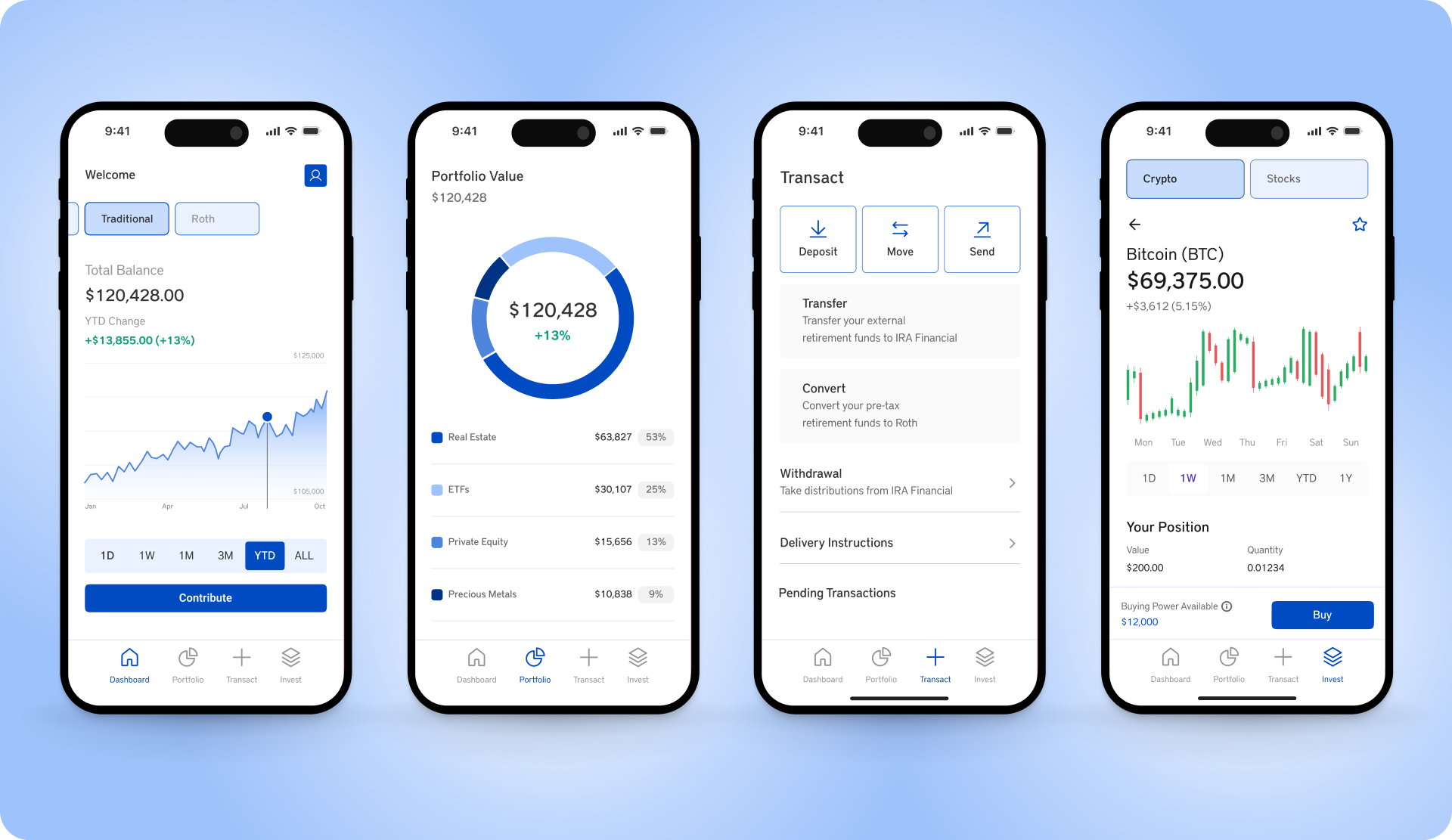
- Newly-updated mobile app and account dashboard with clean UI/UX and modern functionality.
- Offers a fully digital on-boarding experience, automated compliance, and secure document storage.
- In-house crypto trading, real-time dashboards, and checkbook control in a single portal.
Inspira Financial:
- Online account portal for clients and advisors
- Primarily focused on administrative tasks and reporting
- Limited functionality for direct alternative-asset investing or digital transactions
- More dependent on manual document processing and support requests
Summary
Inspira's platform supports reliable account management but lacks the modern, investor-facing tools that make the process efficient. IRA Financial's app-based system offers convenience, control, and speed, ideal for hands-on investors.
Winner: IRA Financial.
IRA Financial stands out for its integrated mobile platform, providing real-time access and digital management that Inspira's traditional interface can't match.
Reputation & Customer Reviews: Trusted by Thousands
Both IRA Financial and Inspira Financial have built strong reputations for serving investors nationwide. Inspira's long-standing experience as a large custodian adds credibility, while IRA Financial stands out for its innovation, customer education, and accessibility.
IRA Financial | Inspira Financial | |
Trustpilot | 4.8 / 5 | 3.7 / 5 |
4.3 / 5 | 4.1 / 5 |
IRA Financial:
- Strong reputation for fast account setup, responsive customer service, and straightforward pricing.
- Over 3,000 5-star reviews across Google, Trustpilot, and other platforms.
- Founded by tax attorney Adam Bergman, who educates investors via weekly videos, podcasts, and blog articles.
Inspira Financial:
- Formerly Millennium Trust, with decades of custodial experience and a very large client base across retirement, health, and benefits accounts
- Solid Google rating at real scale: 4.1/5 from 1,180 reviews
- Some client feedback mentions slow turnaround times for investment approvals, transfers, and communication
Summary
Inspira's Trustpilot sample size is enormous, but the 3.7/5 score reflects feedback across Inspira's entire business, including consumer benefits accounts like HSAs and FSAs, not just its self-directed IRA product specifically. IRA Financial's rating, while smaller in volume, is more concentrated and consistently high across platforms.
Winner: IRA Financial.
A higher, more consistent rating focused specifically on self-directed retirement services.
The Bottom Line: Why IRA Financial Is the Smarter Choice
Inspira Financial is a trusted name in custodial retirement services, offering extensive experience and a broad investment menu, including direct stock trading alongside alternative assets. However, IRA Financial delivers something different: greater freedom through Checkbook Control, broader account types like Solo 401(k) and ROBS, and a modern platform designed for investors who want full control over their retirement future.
Book a free call with a self-directed retirement specialist
- Review your self-directed retirement options
- Learn about investing in alternative assets
- Get all of your questions answered
IRA Financial vs Advanta IRA
If you're looking to take control of your retirement investments, both IRA Financial and Advanta IRA offer self-directed options that open the door to alternative assets like real estate, private lending, and precious metals.
While both firms share a mission to empower investors, they differ in pricing, flexibility, and technology, all of which can shape your investing experience. Here's how they compare across the key categories that matter most.
Pricing & Fees: Transparent, Flat, and Investor-Friendly
Understanding fees is essential when choosing a Self-Directed IRA provider. Some companies charge based on your account size or the number of transactions, costs that can eat into returns over time..
IRA Financial | Advanta IRA | |
Setup Fee | $0 | $50 |
Annual Fee | $495 | $700 |
Asset Value Fee | $0 | $0 |
Investment Fee | $0 | $380 |
Roth Conversion Fee | $0 | Not published |
1 Year Total Cost | $495 | $1,130 |
5 Year Total Cost | $2,475 | $3,930 |
Pricing pulled from company website, as of the article publish date, based on 4 investments with a $200K total balance.
IRA Financial:
- Flat annual fee starting at $495/year for Self-Directed IRAs, with additional plan options available beginning at $100 annually
- Optional Checkbook Control with one-time setup cost
- No asset-based fees or per-transaction charges
- IRAfi Crypto platform offers low-cost trading for buying, selling, and managing crypto directly within the IRA Financial app
Advanta IRA:
- $50 account opening fee
- Choice of two annual fee structures: a per-asset fee (starting at $295/asset), or an account-value based fee ($700/year for a $200,000 balance)
- $95 fee per purchase, sale, or exchange of most assets ($145 for real estate)
- Additional fees for wires, expedited processing, and account closure
Summary
Advanta IRA's account-value based fee structure means costs are predictable at a given balance, but per-transaction charges on top of that add up for active investors. For an investor with 4 assets on a $200,000 balance, Advanta IRA costs more than double what IRA Financial charges in year one, and the gap widens over 5 years.
Winner: IRA Financial.
A single flat fee with no per-transaction charges, versus a fee structure that combines an account-value based annual charge with a separate cost for every purchase or sale.
Investment Flexibility & Product Options
Both providers enable investors to diversify into a wide range of assets, but how you access and manage those investments differs.
IRA Financial | Advanta IRA | |
Account Type | ||
Self-Directed IRA | ||
Solo 401(k) | ||
HSA | ||
Checkbook Control | ||
ROBS Structure | ||
Platform & Investments | ||
Crypto Platform | ||
Stock Trading | ||
Compliance & Protection | ||
In-House Compliance & Tax Services | ||
IRS Audit Protection |
IRA Financial:
- True control: invest in real estate, private businesses, precious metals, and more
- Direct crypto investing through IRA Financial's integrated platform, with the LLC formed for you as part of the service
- Supports Solo 401(k), SEP and SIMPLE IRAs, HSA and Coverdell ESAs, plus ROBS for business funding
- IRA Compliance Shield provides in-house audit protection and tax consultation
Advanta IRA:
- Offers a broad set of account types: Traditional, Roth, SEP, and SIMPLE IRAs, Solo 401(k), HSA, Coverdell ESA, and ROBS for business funding
- Checkbook control available through an IRA LLC structure, but Advanta does not set up or sell the LLC itself, investors must arrange that independently
- Crypto investing supported through approved third-party exchange partners, not an in-house platform
- No integrated stock trading or in-house compliance and audit protection services
Summary
Advanta IRA actually matches IRA Financial on account type breadth, including ROBS, HSA, and Coverdell, a genuinely comprehensive lineup. Where IRA Financial pulls ahead is in how directly those features are delivered: crypto trades inside the same account rather than through a separate exchange partner, and the LLC for checkbook control is formed as part of the service rather than left to the investor.
Winner: IRA Financial
Crypto and checkbook control delivered directly within the platform, plus in-house compliance support that Advanta IRA does not offer.
Technology: Built for the Modern Investor
Technology sets the pace for convenience in today's investing world. While both companies are service-oriented, their tech capabilities differ.
IRA Financial:
- Newly-updated mobile app and account dashboard with clean UI/UX and modern functionality.
- Offers a fully digital on-boarding experience, automated compliance, and secure document storage.
- In-house crypto trading, real-time dashboards, and checkbook control in a single portal.
Advanta IRA:
- Client portal for checking account information and statements
- No comprehensive mobile app
- Relies on a dedicated account manager and document-based processing for most transactions
Summary
Advanta IRA offers reliable, personalized service, but IRA Financial's modern digital tools give investors a smoother, more self-service experience.
Winner: IRA Financial.
IRA Financial's tech-first platform makes it easier to manage your account anywhere, anytime.
Reputation & Customer Reviews: Trusted by Thousands
Reputation and service quality often separate the good from the great in the self-directed industry.
IRA Financial | Advanta IRA | |
Trustpilot | 4.8 / 5 | N/A |
4.3 / 5 | 4.8 / 5 |
IRA Financial:
- Strong reputation for fast account setup, responsive customer service, and straightforward pricing.
- Over 3,000 5-star reviews across Google, Trustpilot, and other platforms.
- Founded by tax attorney Adam Bergman, who educates investors via weekly videos, podcasts, and blog articles.
Advanta IRA:
- Strong Google rating at real scale: 4.8/5 from 285 reviews
- Established since 2003, structured as a group of self-directed IRA administrators under one brand
- Clients frequently cite a dedicated account manager and personalized service
Summary
Advanta IRA's Google reviews are genuinely excellent and backed by real scale, a legitimate strength. IRA Financial's advantage comes from a consistent presence across multiple major platforms rather than concentrated on one.
Winner: IRA Financial.
Strong reviews at scale across multiple platforms versus a strong showing concentrated mainly on Google.
The Bottom Line: Why IRA Financial Is the Smarter Choice
IRA Financial and Advanta IRA share a commitment to helping investors take charge of their retirement savings. But for those who want greater autonomy, faster transactions, transparent pricing, and features delivered directly within the platform rather than through third parties, IRA Financial stands out as the more versatile solution.
Book a free call with a self-directed retirement specialist
- Review your self-directed retirement options
- Learn about investing in alternative assets
- Get all of your questions answered

Investing Your Retirement Savings in Accordance with Shariah Law: How a Self-Directed IRA Can Help
For more than twenty years, I have helped Americans use Self-Directed IRAs and Solo 401(k)s to invest beyond Wall Street. While many people associate Self-Directed IRAs with real estate, private equity, or cryptocurrency, one area that continues to grow is helping Muslim investors structure retirement investments in a manner intended to align with Islamic financial principles.
As a tax attorney, I have always believed that one of the greatest strengths of the Self-Directed IRA is freedom. Congress created IRAs to encourage Americans to save for retirement, not to dictate where they invest. While the Internal Revenue Code establishes certain rules, such as prohibited transaction restrictions and limitations on investing in collectibles or life insurance, it generally gives retirement investors tremendous flexibility. For Muslim investors, that flexibility can be especially valuable.
Many traditional retirement accounts are invested almost entirely in publicly traded stocks, mutual funds, corporate bonds, Treasury securities, and other conventional financial products. While these investments may be appropriate for many investors, they do not always align with the principles of Islamic finance, particularly where returns are generated primarily through interest, or riba. A Self-Directed IRA provides another option. Rather than being limited to traditional Wall Street investments, it allows investors to own real estate, private businesses, private equity, real estate partnerships, and many other alternative assets that may be structured in a manner intended to be consistent with Shariah principles.
One important clarification: the Self-Directed IRA itself is not a "Shariah IRA." It is simply a retirement account governed by Section 408 of the Internal Revenue Code. What makes an investment suitable from an Islamic perspective depends on the underlying investment structure, not the retirement account itself. That distinction is important because it allows Muslim investors to pursue retirement savings while working with qualified Islamic scholars or Shariah advisers to determine whether a particular investment meets their religious objectives.
Key Takeaways
- A Self-Directed IRA follows the same IRS tax rules as any Traditional or Roth IRA. The difference is investment flexibility, allowing investors to hold real estate, private businesses, private equity, and other alternative assets rather than being limited to a brokerage platform's investment menu.
- The IRS does not dictate how investors should invest based on personal values or religious beliefs. Beyond prohibited transaction rules and a short list of restricted asset types, Congress intentionally gave retirement investors broad flexibility.
- Many alternative investments available through a Self-Directed IRA, including real estate, private equity, and LLC ownership interests, are structured around ownership and profit participation rather than interest-bearing debt, which may align more naturally with Islamic finance principles.
- Every investment must comply with IRS prohibited transaction rules regardless of its religious suitability. The investment must be made solely for the benefit of the retirement account, not for the personal benefit of the IRA owner or any disqualified person.
- Working with experienced Self-Directed IRA professionals is essential. Proper titling, documentation, funding, and IRS reporting requirements must all be handled correctly to preserve the account's tax-advantaged status.
Why Traditional Retirement Investing Can Present Challenges
Most Americans save for retirement through a Traditional IRA, Roth IRA, or employer-sponsored 401(k) plan invested in mutual funds selected from a limited menu. The problem for many Muslim investors is that those investment options frequently include securities that derive returns from lending money or businesses that may not satisfy Islamic investment principles.
A traditional retirement portfolio may include corporate bonds, U.S. Treasury securities, certificates of deposit, money market funds, mortgage-backed securities, conventional fixed-income funds, and financial institutions whose revenues are largely generated through interest. Although these investments are commonplace in conventional finance, many Muslim investors seek to avoid earning returns based primarily on interest.
Islamic finance generally emphasizes investment through ownership of assets, participation in business risk, profit-sharing arrangements, leasing structures, and productive economic activity. This is where the flexibility of a Self-Directed IRA becomes so valuable.
The Self-Directed IRA Is About Investment Freedom
A Self-Directed IRA follows exactly the same tax rules as any other Traditional or Roth IRA. A Traditional Self-Directed IRA generally offers tax-deferred growth, while a Roth Self-Directed IRA can provide tax-free qualified distributions if the applicable IRS requirements are satisfied. The difference is not the tax treatment. The difference is the investment options.
Instead of being limited to the investments offered by a brokerage firm, a Self-Directed IRA allows you to invest in a much broader range of assets, including residential and commercial real estate, apartment buildings, private lending where appropriate, private equity, venture capital, start-up companies, real estate syndications, oil and gas interests, precious metals, farmland, tax liens, LLC interests, limited partnerships, and other alternative investments permitted under IRS rules.
For Muslim investors, this expanded investment universe creates opportunities to focus on investments that may better align with Islamic financial principles.
The Foundation of Islamic Investing: Ownership Instead of Interest
One of the central themes of Islamic finance is that wealth should generally be generated through ownership, entrepreneurship, productive assets, and shared economic risk rather than simply lending money in exchange for guaranteed interest. This concept naturally aligns with many alternative investments available through a Self-Directed IRA.
The difference comes down to ownership versus lending. A bond pays you interest regardless of what the underlying business does. An ownership interest in a real estate project or private company ties your returns to how the investment actually performs. That is the distinction many Muslim investors are looking for, and it is exactly how many Self-Directed IRA investments are structured.
Although every investment should be independently reviewed by qualified Shariah advisers, many real estate and private investment structures are designed around ownership and profit participation rather than interest-bearing debt.
Building a Shariah-Oriented Retirement Portfolio
Real Estate: One of the Most Natural Fits
Real estate has always been one of the most popular investments inside a Self-Directed IRA, and for many Muslim investors it can also be one of the most attractive from an Islamic finance perspective. Real estate investing is fundamentally based on ownership of a tangible asset. When your IRA purchases an apartment building, office building, warehouse, retail center, or vacant land, it owns a real asset that can appreciate in value over time. Rental income is generally generated from leasing property to tenants, and gains are typically realized through appreciation and eventual sale, not from earning interest on a loan.
A Self-Directed IRA can invest in virtually every type of real estate permitted under IRS rules, including single-family rental homes, multi-family apartment buildings, commercial office buildings, industrial and warehouse properties, retail shopping centers, self-storage facilities, agricultural land and farmland, raw land for future development, and real estate development projects. The key IRS rule is simple: the investment must be held strictly for investment purposes, and neither you nor other disqualified persons may personally use or benefit from the property.
Becoming an Owner Instead of a Lender
Instead of making a loan to a developer, your IRA may purchase a membership interest in the LLC that owns the project. Instead of acting as a creditor, your retirement account becomes an equity investor. As an owner, your IRA shares in the success of the investment and also shares in the business risk. This distinction between ownership and lending is one of the reasons many Muslim investors are drawn to private real estate investments.
Real Estate Syndications
In a syndication, multiple investors combine their capital to acquire a larger property that would be difficult to purchase individually, such as apartment complexes, hotels, medical office buildings, distribution centers, student housing, or mixed-use developments. Your Self-Directed IRA typically purchases an ownership interest in the entity acquiring the property. Returns generally come from rental income, property appreciation, refinancing events, and sale proceeds, all tied to ownership of the underlying asset rather than collecting interest from a borrower.
Preferred Equity: Understanding the Difference
Preferred equity is an area where investors need to be particularly careful. Properly structured preferred equity represents an ownership interest in a business or real estate project rather than a loan. Preferred equity investors often receive priority distributions before common equity investors and may also participate in appreciation or profits once certain investment hurdles are achieved. Unlike a lender, the preferred equity investor generally remains an owner of the business.
Every preferred equity investment is different, and investors should carefully review the governing documents with qualified legal counsel and, where appropriate, a qualified Shariah adviser to determine whether the structure aligns with Islamic finance principles. The legal documentation, not simply the title of the investment, determines its true economic substance.
Private Equity Opportunities
A Self-Directed IRA also allows investments into private companies across many industries including technology, manufacturing, healthcare, logistics, software, food production, and commercial services. Many private equity investments generate returns through business growth and increased enterprise value rather than fixed-interest payments. As with all investments, careful due diligence remains essential.
Book a free call with a self-directed retirement specialist
- Review your self-directed retirement options
- Learn about investing in alternative assets
- Get all of your questions answered
Common Islamic Finance Structures
Many Muslim investors are already familiar with several concepts commonly used in Islamic finance. Understanding these structures helps explain why alternative investments may fit well within a Self-Directed IRA.
Musharakah is a joint ownership arrangement in which each investor contributes capital and shares proportionately in both profits and losses. This concept closely resembles many LLCs, partnerships, and joint venture investments commonly used in private real estate.
Mudarabah involves one party providing investment capital while another contributes expertise and management. Profits are shared according to an agreed formula, while losses generally follow the capital invested. Many private investment funds share similar economic characteristics.
Murabaha is a cost-plus financing arrangement in which an asset is purchased and resold at an agreed markup instead of charging traditional interest. This structure illustrates another way Islamic finance seeks to facilitate commerce without relying on conventional interest-bearing loans.
Ijara is a leasing arrangement in which the owner receives lease payments generated from the use of an asset rather than earning interest on borrowed money. Because many real estate investments involve rental income derived from leasing property, Muslim investors often find this concept particularly familiar.
IRS Rules Every Self-Directed IRA Investor Must Follow
As a tax attorney, I always remind clients that there is no universal checklist that automatically makes an investment Shariah compliant. The facts matter, the governing documents matter, and the economics of the transaction matter. Most importantly, religious determinations should be made by the investor working with qualified Islamic scholars or Shariah advisers who understand the specific investment being considered.
Our role is different. At IRA Financial, our responsibility is helping clients properly structure Self-Directed IRA investments so they comply with IRS rules while providing the flexibility to invest in alternative assets.
The Prohibited Transaction Rules
The single most important set of rules governing Self-Directed IRAs is found in Internal Revenue Code Section 4975. Congress created these rules to ensure that retirement accounts are used exclusively for retirement investing, not for providing current personal benefits to the IRA owner or certain related individuals. The IRS generally does not prohibit your IRA from investing in real estate, private equity, or private businesses. Instead, it focuses on whether the transaction improperly benefits you or another disqualified person.
Disqualified persons generally include you as the IRA owner, your spouse, your parents and grandparents, your children and grandchildren, their spouses, businesses you control, and certain fiduciaries and service providers to the IRA. Your IRA generally cannot buy from, sell to, lease to, lend money to, or otherwise transact with a disqualified person, regardless of whether the investment is otherwise consistent with Islamic finance principles.
The Investment Must Be for the IRA's Benefit
Every investment must be made solely for the benefit of the retirement account. If your Self-Directed IRA purchases an apartment building, the rental income belongs to the IRA, not to you personally. You cannot personally guarantee an IRA loan, perform uncompensated services that rise to the level of self-dealing, or use IRA assets for your own immediate benefit. The retirement account is the investor.
Why Many Investors Choose an IRA LLC
Many experienced Self-Directed IRA investors establish an IRA LLC, a limited liability company wholly owned by the IRA. This structure provides checkbook control, meaning the manager of the LLC has direct authority to write checks and complete investments without waiting for custodian approval on every transaction. For active investors, particularly those involved in privately negotiated transactions such as real estate acquisitions, joint ventures, and private equity investments, this flexibility is especially valuable in competitive markets where sellers expect rapid closings.
UBTI and UDFI
Although IRAs generally enjoy tax-deferred or tax-free growth, Congress created exceptions for certain types of business income. If an IRA actively operates a trade or business through a pass-through entity, Unrelated Business Taxable Income may apply. If an IRA purchases investment property using borrowed money, a portion of the income and gain attributable to the financing may be subject to Unrelated Debt-Financed Income rules under Internal Revenue Code Section 514.
Rental income from debt-free investment real estate is generally excluded from UBTI, and capital gains from the sale of debt-free investment real estate are generally also excluded. Once leverage is introduced, the analysis changes. These are highly technical tax rules, which is why proper planning before making an investment is so important.
Why Experience Makes a Difference
Self-Directed IRAs are governed by a unique combination of tax law, retirement law, entity structuring, and operational requirements. Properly structuring alternative investments requires a much deeper understanding of the Internal Revenue Code than many financial institutions, attorneys, or accountants encounter in their everyday practice.
At IRA Financial, our team has helped clients complete more than 150,000 alternative asset investments across virtually every major asset class, including direct real estate acquisitions, real estate syndications, LLC and partnership investments, joint venture arrangements, private equity transactions, preferred equity investments, and Checkbook Control IRA LLC structures. We administer more than $8 billion in retirement assets for over 27,000 clients.
While we do not issue religious opinions or determine whether an investment is Shariah compliant, that responsibility belongs to qualified Islamic scholars and advisers, we understand many of the structures commonly used in Islamic finance and have significant experience helping clients properly implement those investments within the framework of a Self-Directed IRA. Our role is to ensure the retirement account is structured correctly, the investment is properly documented, and the transaction complies with applicable IRS rules so clients can focus on selecting investments that align with both their financial goals and their personal beliefs.
Final Thoughts
Retirement planning is about more than maximizing returns. It is about creating a strategy that allows you to invest with confidence while staying true to your long-term goals and personal convictions.
For Muslim investors, that may mean avoiding interest-based investments and focusing instead on ownership interests, real estate, private businesses, and other investment structures intended to align with Shariah principles. A Self-Directed IRA provides the flexibility to pursue those opportunities without sacrificing the powerful tax advantages Congress created for retirement savings.
Before making any investment, investors should consult qualified legal, tax, and Islamic finance advisers to ensure the proposed transaction satisfies both the applicable IRS rules and their own religious objectives. At IRA Financial, we are proud to help clients navigate the tax and operational side of that process.
Retirement investing should never force you to choose between your financial future and your personal values. With the right planning, the right structure, and the right team, a Self-Directed IRA can help you pursue both.
IRA Financial vs STRATA Trust Company
When choosing a self-directed retirement provider, investors often compare IRA Financial and STRATA Trust Company, two established names offering access to alternative investments beyond traditional assets. Both give investors more control over their retirement savings, but they differ significantly in how they deliver that control, and in how their fees are structured.
Let's explore how they compare across pricing, investment flexibility, technology, and reputation.
Pricing & Fees: Transparent, Flat, and Investor-Friendly
Fees are one of the first things investors look at when comparing providers. IRA Financial uses a single flat annual fee, while STRATA's Flex Tier combines a base annual fee with a per-asset charge that scales with how many alternative assets you hold.
IRA Financial | STRATA Trust Company | |
Setup Fee | $0 | $50 |
Annual Fee | $495 | $395 |
Asset Value Fee | $0 | $200 |
Investment Fee | $0 | $200 |
Roth Conversion Fee | $0 | $50 per asset |
1 Year Total Cost | $495 | $845 |
5 Year Total Cost | $2,475 | $3,225 |
Pricing pulled from company website, as of the article publish date, based on 4 investments with a $200K total balance.
IRA Financial:
- Flat annual fee structure starting at $495/year for Self-Directed IRAs, with additional plan options available beginning at $100 annually
- No setup fee for custodian-controlled plans; a one-time fee for Checkbook IRAs or similar structures
- No asset-based or transaction fees, keeping costs predictable as your account grows
- Direct crypto investing through IRA Financial's integrated platform
STRATA Trust Company:
- $50 account setup fee (waived for electronic applications)
- Flex Tier annual fee of $395, plus a $50 per-asset annual holding fee (capped at $500 for private assets, $1,500 for real estate)
- $50 fee to purchase, sell, or exchange each private asset
- $50 per-asset fee for Roth conversions or recharacterizations
Summary
STRATA's Flex Tier base fee is actually lower than IRA Financial's flat rate, but its per-asset annual holding fee and per-transaction charges add up quickly for investors holding several alternative assets. For an investor with 4 assets on a $200,000 balance, STRATA costs more than IRA Financial both in year one and over 5 years.
Winner: IRA Financial.
A single flat annual fee that doesn't grow with the number of assets held, versus a base fee plus per-asset charges that scale with your portfolio.
Investment Flexibility & Product Options
Both IRA Financial and STRATA empower clients to go beyond stocks and mutual funds, but they differ in how much control the investor really has. IRA Financial's open architecture gives account holders the freedom to choose nearly any investment allowed by the IRS, while STRATA operates purely as a directed custodian.
IRA Financial | STRATA Trust Company | |
Account Type | ||
Self-Directed IRA | ||
Solo 401(k) | ||
HSA | ||
Checkbook Control | ||
ROBS Structure | ||
Platform & Investments | ||
Crypto Platform | ||
Stock Trading | ||
Compliance & Protection | ||
In-House Compliance & Tax Services | ||
IRS Audit Protection |
IRA Financial:
- Full access to real estate, private placements, precious metals, and crypto
- Checkbook Control option available for faster, self-managed investments
- Ability to invest through LLCs or trusts for added flexibility
- Solo 401(k) and ROBS business funding options available
- Ideal for investors who want total control and fast execution
STRATA Trust Company:
- Offers custody for private assets, directly owned real estate, private equity, private debt, precious metals, and public investments
- Account types limited to Traditional, Roth, SEP, and SIMPLE IRAs, no Solo 401(k) or HSA
- No true Checkbook Control feature; all transactions must be submitted to and processed by the custodian
- No dedicated crypto investment category
- Processing times can vary depending on asset type and documentation
Summary
STRATA offers solid custody across a range of alternative and traditional assets, but every transaction requires custodian review and approval, and its account types stay narrower than IRA Financial's. IRA Financial gives investors more autonomy through Checkbook Control, a broader set of account types, and direct crypto access.
Winner: IRA Financial
With more account types, direct crypto access, and the freedom of Checkbook Control, IRA Financial offers unmatched flexibility for hands-on investors.
Technology: Built for the Modern Investor
Technology is what turns a complicated investment process into a seamless experience. IRA Financial leads with an advanced app that allows clients to open accounts, manage investments, and trade crypto directly. STRATA's platform is functional but lacks some of the digital convenience today's investors expect.
IRA Financial:
- Industry-leading mobile app for account setup, funding, and management
- Integrated crypto trading through IRA Financial's own platform
- Secure document upload and e-signature capabilities
- Real-time visibility into account activity and balances.
STRATA Trust Company:
- Offers online account access with basic functionality
- Traditional interface for document management and reporting
- Lacks integrated trading or advanced automation features
Summary
STRATA provides a reliable online portal, but IRA Financial's tech-forward approach delivers a more streamlined, modern user experience, ideal for investors who value convenience and transparency.
Winner: IRA Financial.
IRA Financial stands out for its intuitive mobile platform, giving investors full control and real-time access from anywhere.
Reputation & Customer Reviews: Trusted by Thousands
Both companies have strong track records in the Self-Directed IRA industry, serving thousands of clients nationwide. IRA Financial's hands-on support model and active educational presence stand out, while STRATA's long-standing custodial experience gives it solid credibility.
IRA Financial | STRATA Trust Company | |
Trustpilot | 4.8 / 5 | 4.8 / 5 |
4.3 / 5 | 4.8 / 5 |
IRA Financial:
- Strong reputation for fast account setup, responsive customer service, and straightforward pricing.
- Over 3,000 5-star reviews across Google, Trustpilot, and other platforms.
- Founded by tax attorney Adam Bergman, who educates investors via weekly videos, podcasts, and blog articles.
STRATA Trust Company:
- Founded in 2008, with over 350 years of combined team experience and $10B+ in assets under custody
Matches or exceeds IRA Financial's ratings on both Trustpilot and Google, at real scale
Clients frequently cite responsive, knowledgeable customer service representatives by name
Summary
STRATA's reputation is genuinely excellent, matching IRA Financial's Trustpilot rating exactly and edging ahead on Google, both backed by real review volume. This is one of the closest comparisons in the industry on pure reputation.
Winner: Tie.
Both companies maintain excellent, comparable ratings across major review platforms, backed by real scale on both sides.
The Bottom Line: Why IRA Financial Is the Smarter Choice
Both IRA Financial and STRATA Trust Company serve different types of investors well. STRATA is an experienced and capable custodian with a genuinely strong reputation, appealing to those who prefer traditional administrative support. However, IRA Financial's model is built for investors who want more control, a simpler fee structure, and a smoother, more modern experience.
Book a free call with a self-directed retirement specialist
- Review your self-directed retirement options
- Learn about investing in alternative assets
- Get all of your questions answered