


What is a Self-Directed Account?
A Self-Directed account in the retirement account world can mean a Self-Directed IRA or a Self-Directed Solo 401(k) plan. This article will examine the key details surrounding both the Self-Directed IRA and the Self-Directed Solo 401(k).
What is a Self-Directed Account?
A Self-Directed IRA is not a legal term that you will find in the Internal Revenue Code. A Self-Directed IRA is essentially an IRA that allows for alternative asset investments, such as real estate or even cryptocurrency. Traditional financial institutions do not allow IRAs to invest in IRS-approved alternative assets, such as real estate, because their focus is on earning fees through traditional investments. Hence, the birth of the Self-Directed IRA industry. Today, the Retirement Industry Trust Association (RITA) estimates anywhere between 4-7% of all IRAs are invested in alternative assets. Accordingly, the Self-Directed IRA is the only way one can purchase alternative assets in an IRA.
How Does the Self-Directed IRA Work?
With a Self-Directed IRA, a special IRA custodian, IRA Financial, will serve as the custodian of the IRA. All types of IRAs can be used in a Self-Directed IRA structure, such as a Traditional IRA, Roth IRA, SEP IRA, SIMPLE IRA, 401(k) rollover, and even a Coverdell and HSA.
Unlike a typical financial institution which generates fees by selling products and providing investment services, a Self-Directed IRA custodian earns fees by simply opening and maintaining IRA accounts and does not offer any financial investment products or platforms. With a Self-Directed IRA, the IRA funds are generally held with the IRA custodian. The IRA owner will then direct the IRA custodian to invest the IRA funds in IRS-approved alternative asset investments, such as real estate. Title to the Self-Directed IRA asset will be in the name of the Self-Directed IRA custodian care of the IRA owner.
A Self-Directed IRA is popular with retirement investors looking to invest in alternative assets that do not involve a high frequency of transactions, such as the purchase of raw land or private fund investments.
Types of Self-Directed Accounts
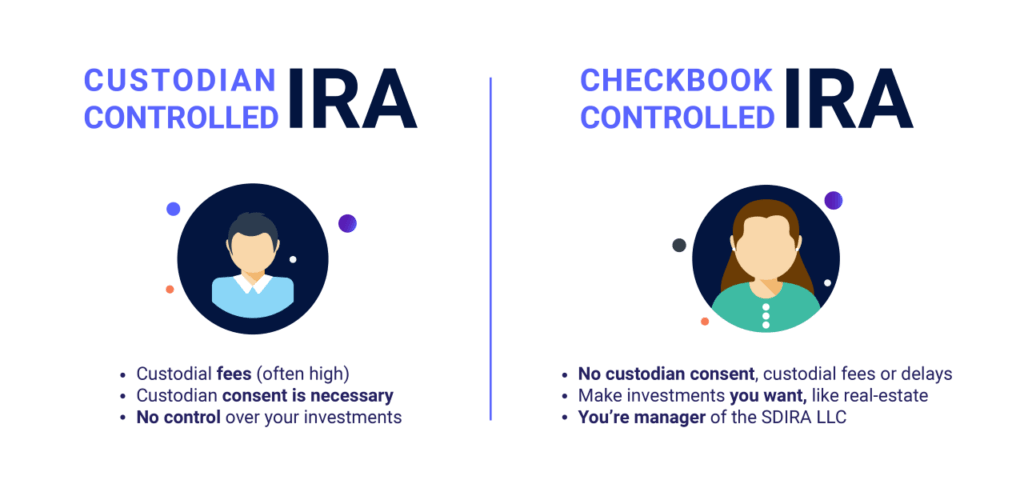
The two primary options for using a Self-Directed IRA to make alternative asset investments are the (i) full-service Self-Directed IRA and (ii) the Self-Directed IRA with “checkbook control.”
Self-Directed IRA Account Full Service
With a full-service Self-Directed IRA, a special IRA custodian, IRA Financial, will serve as the custodian of the IRA. Unlike a typical financial institution which generates fees by selling products and providing investment services, a Self-Directed IRA custodian earns fees by simply opening and maintaining IRA accounts and does not offer any financial investment products or platforms.
With a full-service Self-Directed IRA, the IRA funds are generally held with the IRA custodian. The IRA owner will then direct the IRA custodian to invest the IRA funds in IRS-approved alternative asset investments, such as real estate. Title to the Self-Directed IRA asset will be in the name of the Self-Directed IRA custodian care of the IRA owner. For example: IRA Financial Trust Company CFBO John Doe IRA.
A Self-Directed IRA that is full-service is popular with retirement investors looking to invest in alternative assets that do not involve a high frequency of transactions, such as the purchase of raw land or private fund investments.
Self-Directed IRA Account "Checkbook Control"
With a Self-Directed IRA with checkbook control, an IRA is set-up with a Self-Directed IRA custodian, such as IRA Financial. The IRA is then invested into a special purpose limited liability company (“LLC”), which IRA Financial can help you establish. The Self-Directed IRA LLC is then managed by the IRA owner providing the IRA owner with “checkbook control” over the IRA funds. With a “checkbook control” Self-Directed IRA LLC, the manager of the Self-Directed IRA LLC will have the authority to make investment decisions without the involvement of the custodian. Plus, a Self-Directed IRA LLC will offer the IRA owner limited liability protection over IRA investments. Moreover, all Self-Directed IRA investments will be titled in the name of the LLC offering the IRA owner more privacy. With a Self-Directed IRA LLC with “Checkbook Control’ you will be able to buy real estate by simply writing a check.
All types of IRAs can be transferred tax-free to a Self-Directed IRA LLC. A Self-Directed Roth IRA with “checkbook control” is popular with IRA investors seeking to invest in alternative assets, such as rental properties, fixes, and flips, tax liens, or cryptocurrencies that require a high frequency of transactions.
Why Set Up a Self-Directed IRA
The Self-Directed IRA is the most popular Self-Directed retirement solution. A Self-Directed IRA is the perfect retirement or investment vehicle for anyone looking to use their IRA funds to invest in non-publicly traded securities. The primary advantages of using a Self-Directed IRA are you gain the ability to invest in almost anything you want, diversify your retirement assets, hedge against inflation, plus generate income and gains tax-free.
The Self-Directed Solo 401(k)
A Solo 401(k) plan is not a new type of retirement plan. It is a traditional 401(k) plan covering only one employee. In general, to be eligible to establish a Solo 401(k) plan, one must be self-employed or have a small business with no full-time employees (over 1000 hours during the year) other than a spouse or other owner(s).
As the name implies, the Solo 401(k) plan is an IRS-approved qualified 401(k) plan designed for a self-employed individual or the sole owner-employee of a corporation. It works best when there are no other employees or a very small number of employees.
Unlike a Solo 401(k) plan that can be opened at a traditional financial institution, a Self-Directed Solo 401(K) plan allows one to invest in alternative assets and not just stocks, just like a Self-Directed IRA.
How Does the Solo 401(k) Plan Work
The Solo 401(k) plan documents essentially control what a Solo 401(k) plan can invest in. Not all Solo 401(k) plans are the same. For example, only a Self-Directed Solo 401(k) plan will allow you to buy alternative assets, such as real estate with your plan funds. Whereas, a Solo 401(k) plan provided by a traditional financial institution, such as Vanguard, would not permit the plan to invest in alternative assets, such as real estate.
When it comes to making investments with a Self-Directed Solo 401(k) account, the IRS generally does not tell you what you can invest in, only what you cannot invest in. The types of investments that are not permitted to be made using retirement funds is outlined in Internal Revenue Code Sections 408 and 4975. These rules are generally known as the “Prohibited Transaction” rules. Other than collectibles, and transactions that involve or directly or indirectly benefit the plan participant or a “disqualified person,” one can use their 401(k) to make the investments. A “disqualified person” is generally defined as the plan participant and any of his or her lineal descendants and/or any entities controlled by such persons.
Hence, so long as the Self-Directed Solo 401(k) account plan documents allow for real estate investments and the real estate investment does not directly or indirectly benefit a “disqualified person,” real estate is a permissible Solo 401(k) investment.
Why Should I Set Up a Solo 401(k) Account?
To be eligible to benefit from the Solo 401(k) plan, investors must meet just two eligibility requirements:
- The presence of self-employment activity.
- The absence of full-time employees.
Hence, anyone with a part-time or full-time business, whether operated as a sole proprietorship, LLC, or corporation, would generally be eligible to establish a Self-Directed Solo 401(k) account, provided the business has no non-spouse common-law employees who meet the plan’s eligibility requirements.
For more information, see the IRS guidance on One-Participant 401(k) Plans.
The following are the key reasons why the Self-Directed Solo 401(k) account is the most popular retirement plan for the self-employed or small business owner.
High Contribution Limits
With a Self-Directed Solo 401(k) Plan account, in 2026, a plan participant can make contributions up to $72,000 (70,000 in 2025) annually with an additional $7,500 catch-up contribution for those age 50 and older. Plus, if you are between the ages of 60 and 63, the catch-up contribution increases to $11,250.
Under the 2026 Solo 401(k) contribution rules, a plan participant under the age of 50 can make a maximum annual employee deferral contribution of $24,500 ($23,500 for 2025). That amount can be made in pretax, after-tax, or Roth. On the profit-sharing side, the business can make a 25% (20% in the case of a sole proprietorship or single member LLC) annual profit-sharing contribution based on the amount of the net Schedule C amount or W-2, as applicable, up to a combined maximum, including the employee deferral, of $72,000 in 2026.
For plan participants aged 50 and older, an individual can contribute an additional $7,500 in 2025, and $8,000 in 2026. That amount can be made in pretax, after-tax, or Roth. On the profit-sharing side, the business can make a 25% (20% in the case of a sole proprietorship or single member LLC) annual profit-sharing contribution based on the amount of the net Schedule C amount or W-2, as applicable, up to the maximum.
The Self-Directed Solo 401(k) account can help business owners generate tax deductions as well as sock away a significant amount of money each year.
Loan Feature
If your plan permits loans, you may borrow from the vested balance of your 401(k) account. Internal Revenue Code Section 72(p) and the 2001 EGGTRA rules allow a plan participant to borrow money from the plan tax free and without penalty. As long as the plan documents allow for it and the proper loan documents are prepared and executed, a participant loan can be made for any reason.
A Self-Directed Solo 401(k) participant can borrow up to $50,000 or 50% of their vested account balance, whichever is less. The loan must be repaid over a period of five years or less with a payment frequency no greater than quarterly. The interest rate must be set at a reasonable rate of interest, generally based on the prime rate as per the Wall Street Journal. The Interest rate is fixed based on the prime rate at the time of the loan application.
Read More: Solo 401(k) Loan

“Checkbook Control”
One of the most popular features of the Self-Directed Solo 401k Plan is that it does not require the participant to hire a bank or trust company to serve as trustee. Instead, all assets of the Self-Directed 401(k) account are under the sole authority of the Solo 401k participant.
With a “checkbook control” Self-Directed Solo 401(k) account, you have the ability to invest in traditional as well as alternative assets, such as real estate. This structure eliminates the expense and delays associated with an IRA custodian, enabling you to act quickly when the right investment opportunity presents itself. In many cases, making a Self-Directed Solo 401(k) account investment is as simple as writing a check.
Related: What is a Checkbook Control IRA?
Flexible Contribution Options
With a Self-Directed Solo 401(k) account, contributions are completely discretionary. You always have the option to try to contribute as much as legally possible, but you always have the option of reducing or even suspending plan contributions if necessary.
Roth-Type Contributions
The IRA Financial Self-Directed Solo 401(k) account contains a built-in Roth sub-account which can be contributed to without any income restrictions. In addition, our Self-Directed Solo 401(k) account allows you to take advantage of the “mega backdoor Roth” option allowing you to reach your maximum contribution limit quicker all in Roth. The Solo 401(k) “mega backdoor Roth” option is the ultimate Roth solution.
The “Backdoor Roth Solo 401(k)” strategy allows participants to use after-tax contributions to move additional retirement savings into Roth accounts. For 2026, total contributions to a Solo 401(k) plan—including employee deferrals, employer profit-sharing, and after-tax contributions—are capped at $72,000, not including applicable catch-up contributions.
After-tax 401(k) contributions are not treated as employee deferrals or employer profit-sharing contributions and may be made only to the extent permitted by the annual contribution limit and the participant’s compensation. If the plan allows, these after-tax contributions may then be converted to a Roth 401(k) or rolled over to a Roth IRA, generally without additional tax on the converted amount.
For example, a self-employed individual over age 50 earning $70,000 could contribute $31,500 as an employee deferral (including catch-up) and approximately $14,000 as an employer profit-sharing contribution, for a total of $45,500. Depending on plan design and available contribution room, the remaining amount up to the annual limit may be contributed on an after-tax basis and subsequently converted to Roth.
Cost Effective Administration
The Self-Directed Solo 401(k) account is easy to operate and administer. There is generally no annual filing requirement unless your Solo 401(k) Plan exceeds $250,000 in assets, in which case you will need to file a short information return with the IRS (Form 5500-EZ). A Form 5500-EZ is also required in the final year of the plan, regardless of the account balance.
Secret Weapon for Real Estate Investors
Pursuant to Internal Revenue Code Section 514, a 401(k) account is not subject to the unrelated business taxable income tax (UBTI) on the use of a non-recourse loan (leverage) in connection with the purchase of real estate. An IRA that uses leverage to purchase real estate would be subject to the UBTI on the debt-financed portion of the property. The current maximum UBTI tax rate is 37%.
Tax-Deferred or Tax-Free Gains
In general, all income and gains generated from a 401(k) account will flow back to the plan without tax. That means you will pay no tax on any income or gains earned by your plan investments while they are held inside the account. Traditional plan withdrawals are subject to tax, while qualified Roth withdrawals are not.
Conclusion
Over the last several years, the self-directed account has become an increasingly popular vehicle for retirement account investors looking to gain more investment freedom and greater retirement tax savings. In addition, a self-directed account is the perfect retirement or investment vehicle for anyone looking to use their retirement funds to invest in non-publicly traded securities. The primary advantage of using a Self-Directed Solo 401(k) is that the account owner gains the ability to invest in almost anything they want, better diversify their retirement assets, hedge against inflation, plus generate income and gains without tax.


What is a SIMPLE IRA? A Guide to Your Retirement Plan Options
A SIMPLE IRA, or Savings Incentive Match Plan for Employees IRA, is a retirement plan designed for small businesses. It allows both employers and employees to contribute to retirement savings, offering tax advantages and easy setup. In this article, we’ll explore how SIMPLE IRAs work, their benefits, and how to set one up.
Key Takeaways
- SIMPLE IRAs are employer-sponsored retirement plans designed for small businesses, allowing both employers and employees to contribute.
- Key features of SIMPLE IRAs include mandatory employer contributions, higher contribution limits, and substantial tax benefits for both employers and employees.
- Participation in a SIMPLE IRA requires meeting specific eligibility criteria, and the setup process is relatively simple.
Understanding SIMPLE IRAs
SIMPLE IRAs are tailored as employer-sponsored retirement plans targeting small business entities. These accounts allow both employees and employers to make contributions towards building a substantial nest egg for future financial security. The main intent behind establishing a SIMPLE IRA plans is to deliver an easy-to-manage and financially feasible method through which small business owners can offer their workforce access to a retirement savings plan.
Designed with small employers in mind who may not yet provide a retirement plan, SIMPLE IRAs stand out due to their tax benefits and the potential growth from compound interest that can considerably enhance one’s savings over time. What makes them even more appealing is the relatively low operational costs they incur when compared with other traditional forms of employee-funded retirement plans, positioning them as particularly beneficial options within smaller corporate settings.
How SIMPLE IRAs Work
SIMPLE IRAs stand out because they allow contributions to the retirement account from both employers and employees. This feature distinguishes SIMPLE IRAs from other types of retirement plans by promoting a joint effort in amassing funds for retirement. Employees have the option to allocate a portion of their earnings into their SIMPLE IRAs, while employers are mandated to contribute either by matching or through non-elective payments into the plan.
The investment choices within a SIMPLE IRA mirror those accessible in a traditional IRA, encompassing an array of options such as stocks, bonds, and mutual funds. Similarly, if you self-direct your SIMPLE, you can access an almost-unlimited array of alternative investments, including real estate, cryptos, and private placements. This is akin to the Self-Directed IRA. The versatility provided enables individuals participating in SIMPLE IRAs to shape their investment strategies around personal financial goals and risk tolerance since all investing carries inherent risks.
To maximize their potential for accumulating wealth for later years, it is crucial for both employers and staff members alike to gain insight into how SIMPLE IRAs operate effectively toward securing robust retirement savings.
Key Features of SIMPLE IRAs
SIMPLE IRAs present several compelling characteristics that render them an excellent choice for small business retirement plans. They boast contribution limits that surpass those of traditional IRAs, require contributions from employers, and provide substantial tax advantages. The combination of these attributes yields considerable advantages for both employees and their employers.

Contribution Limits
SIMPLE IRAs stand out for offering more generous annual contribution limits than traditional IRAs. Employees are permitted to allocate a portion of their earnings directly into their SIMPLE IRA each year, with a set limit determined by the IRS. In 2026, for instance, individuals below 50 years old can defer up to $17,000 of their salary into these accounts while those aged 50 and over have the advantage of making catch-up contributions that amount to an extra $4,000.
Thanks to SECURE Act 2.0, savers can contribute more to a SIMPLE IRA if he or she is between the ages of 60 and 63. This “enhanced” catch-up contribution is $5,250 making the total maximum contribution of $22,250 for this year.
Contributions made via employee salary deferrals become fully vested immediately upon depositing them into a SIMPLE IRA account. This feature is key in bolstering long-term retirement savings for employees because it includes not only personal deferred wages but also integrates additional employer matching funds as well as both employee salary deferral contributions and straightforward employee pay deductions.
Employer Contributions
Contributions from employers are an essential element of SIMPLE IRAs, and they must select one of two contribution options. They can either provide a matching contribution that equals up to 3% of the employee’s pay or opt for a non-elective deposit equaling 2% for each qualifying staff member’s compensation—regardless if the individual makes personal contributions. This design is aimed at bolstering retirement savings and promoting more widespread involvement in these plans.
Tax Benefits
SIMPLE IRAs provide significant tax advantages for employees and employers alike. For employees, contributions to a SIMPLE IRA are made with pretax dollars, which decreases their taxable income and enables their retirement savings to grow tax-deferred. This defers taxes on both the contributions and the earnings until withdrawals begin, typically at retirement.
Similarly, employers benefit from these plans because their contributions are usually deductible. The tax-advantaged nature of SIMPLE IRAs makes them an attractive option for small businesses wanting to establish a retirement plan while minimizing tax burdens.
Eligibility Requirements
Eligibility for participation in a SIMPLE IRA retirement plan is determined by specific criteria. It’s tailored to eligible employers operating small businesses with no more than 100 employees and prohibits the simultaneous operation of another retirement plan within the same tax year. This exclusivity helps maintain simpler and less restrictive eligibility standards, streamlining their approach to employee retirement benefits.
To participate, employees must have received compensation of at least $5,000 during any two previous years and anticipate an equivalent amount in the upcoming year. Eligible employers are not permitted to impose additional eligibility stipulations that are less stringent than those outlined here, thus ensuring all qualifying employees can straightforwardly join the SIMPLE IRA plan without encountering overly restrictive barriers based on their compensation or employment history.
Book a free call with a self-directed retirement specialist
- Review your self-directed retirement options
- Learn about investing in alternative assets
- Get all of your questions answered
Setting Up a SIMPLE IRA
Establishing a SIMPLE IRA for small businesses is straightforward, entailing the selection of a financial institution, such as IRA Financial, filling out necessary paperwork for the plan, and communicating to employees their entitlements. The uncomplicated nature of this procedure renders SIMPLE IRAs appealing as a fuss-free retirement planning option.
Choose a Financial Institution
To initiate a SIMPLE IRA, the initial course of action is to select a financial institution that will act as the trustee for your plan. This could be any IRS-sanctioned establishment such as banks, mutual funds companies, or insurance providers—all varying in investment choices and pricing models.
Choosing an appropriate financial institution is vital because it oversees investment management and maintains adherence to IRS regulations. Both setup costs and yearly fees associated with a SIMPLE IRA account tend to be more economical compared to those tied to 401(k) plans, presenting them as cost-effective solutions particularly suited for small businesses.
Notify Eligible Employees
Employers are required to notify eligible employees about the SIMPLE IRA plan and their rights no less than 60 days before the start of the annual election period. The notification must encompass information regarding contribution limits, how employer contributions work, and instructions for electing salary deferral contributions.
By providing this knowledge, employers guarantee that their employees have a clear understanding enabling them to make informed choices concerning their plans for retirement savings.
Establish Accounts
After selecting a financial institution and informing the employees, the next step involves creating individual SIMPLE IRA accounts for every qualified employee. The establishment of these accounts enables employees to begin their contributions towards retirement savings without delay.
Managing a SIMPLE IRA

Overseeing a SIMPLE IRA account entails handling contributions, selecting investment choices, and managing withdrawals. The straightforward nature of the plan eases the administrative burden, thus simplifying upkeep for small businesses. Specific procedures and factors must be taken into account when administering both employee contributions and employer contributions within this framework.
Employee Contributions
Workers make contributions to their SIMPLE IRA by setting aside a portion of their salary, which may be allocated among various investment vehicles like stocks and mutual funds (or alternative investments if you utilize the Self-Directed HSA structure). It is mandatory for employers to deposit these funds within a span of seven business days after deducting them from the workers’ wages, ensuring that the investments begin accruing potential earnings without delay.
Employees are granted the liberty to halt their SIMPLE IRA contributions whenever they choose. Should they opt to do so, they are only permitted to restart contributing at the onset of the subsequent calendar year. Employers bear the responsibility of providing transparent information regarding any charges or commissions associated with SIMPLE IRA investments and must communicate this during the period when employees select their contribution options.
Employer Responsibilities
When administering a SIMPLE IRA plan, employers are tasked with several obligations. It is essential for them to furnish participating employees each year with an itemized statement that outlines the aggregate contributions deposited into their SIMPLE IRA accounts. This clarity supports employees in monitoring their retirement savings and appreciating the advantages of being enrolled in such a plan.
Should there be instances where eligible employees have been erroneously omitted from participation, it becomes necessary for employers to make additional financial inputs as rectification for any overlooked deferrals. Conversely, if ineligible individuals were inadvertently included in the plan, it falls upon employers to rectify by ensuring over-contributions are duly retracted and accurately documented.
Fulfilling these duties upholds both the credibility of the SIMPLE IRA plan and adherence to regulations set forth by IRS rules.
Comparison with Other Retirement Plans
SIMPLE IRAs are just one of many retirement plan options available. A comparison with other plans like SEP IRAs and traditional IRAs can help identify the best option for your business and employees.
Here’s how SIMPLE IRAs compare to these plans:
SIMPLE IRA vs. SEP IRA
- SIMPLE IRAs and SEP IRAs are both designed for small businesses, yet they have several key distinctions.
- SIMPLE IRAs permit contributions from both the employer and the employee; only employers contribute to SEP IRAs.
- In a SIMPLE IRA arrangement, it is mandatory for employers to match their employees’ contributions, often up to 3% of the employee’s pay; SEP IRAs may provide more versatility in contribution choices.
- Both plans can be self-directed to include “alts”
The criteria for eligibility also vary between the two. SIMPLE IRAs enable employees to make contributions, whereas SEP IRAs depend entirely on employer funding. Understanding these variations is crucial when determining which plan best aligns with your company’s unique requirements.
SIMPLE IRA vs. Traditional IRA
SIMPLE IRAs are tailored for small businesses and mandate contributions from employers, contrasting traditional IRAs that any individual with earned income can establish independently of employer involvement. The contribution ceiling for SIMPLE IRAs is higher than that of traditional IRAs, especially for those of catch-up age. The compulsory nature of employer contributions within SIMPLE IRAs serves as an advantage to enhance retirement savings.
In terms of investment opportunities, both SIMPLE and Traditional IRAs provide access to a variety of options such as stocks, bonds, and mutual funds. As stated before, both individual plans, and small business IRAs can choose to self-direct opening the door to endless investment opportunities. Yet it’s the obligatory aspect of employer contributions in SIMPLE IRAs that often renders them a more beneficial choice for employees working at small companies seeking to augment their retirement reserves.
Common Mistakes and How to Avoid Them
Administering a SIMPLE IRA plan may pose certain difficulties. Mistakes often arise when employees in associated companies are not accounted for or when eligibility criteria are misapplied, potentially causing substantial problems. Implementing proper checks within payroll structures is vital to avoid such errors.

Participants must recognize that they have the ability to take out funds from their SIMPLE IRA whenever necessary. Penalties can apply for early withdrawals made before reaching 59½ years of age. To address any discrepancies that occur, employers have the option of utilizing the IRS’s Voluntary Correction Program, which offers a framework for correcting these mishaps.
Terminating a SIMPLE IRA Plan
Ending a SIMPLE IRA plan necessitates communicating with the financial institution to cease contributions in the upcoming year and conveying the decision to end the agreement. Employers are also obligated to inform their employees about the discontinuation of the plan.
While there is no mandate to report the cessation of a SIMPLE IRA plan to the IRS, withdrawals from such an account are taxable as income. Early withdrawals may result in extra penalties, especially if they occur within two years after starting participation in the plan.
Summary
SIMPLE IRAs present an uncomplicated (they are “simple” after all) and affordable avenue for retirement savings specifically tailored to the needs of small businesses. They stand out due to their generous contribution limits, obligatory contributions from employers, and substantial tax advantages, making them appealing to both business owners and their staff. Grasping who qualifies for a SIMPLE IRA, the processes involved in establishing and maintaining one, as well as its position relative to other types of retirement plans, is crucial for judicious retirement strategy decisions.
Small businesses can capitalize on the perks that SIMPLE IRAs bring forth by providing employees with robust options for accumulating funds toward their later years, thereby promoting greater financial stability upon reaching retirement age. Lastly, self-directing your SIMPLE IRA is a popular option for those who wish to offer their employees alternative investments, including real estate, precious metals, and private equity.
Ready to Set Up a SIMPLE IRA for Your Business?
If you’re a small-business owner or solopreneur with no more than 100 employees, a SIMPLE IRA offers a straightforward, tax-advantaged retirement plan with minimal administration. But the right setup matters to ensure you maximize the benefits and stay compliant. Let our experts walk you through your options and get started the right way.
Schedule a Free Consultation
Open an Account
Frequently Asked Questions
What are the contribution limits for SIMPLE IRAs?
The contribution limits for SIMPLE IRAs in 2026 are $17,000 for employees under 50 and $21,000 for those aged 50 and above. If you are between the ages of 60 and 63, you may contribute an additional $5,250.
Can employers choose not to make contributions to SIMPLE IRAs?
Employers must make contributions to SIMPLE IRAs, either through matching or non-elective contributions; they cannot opt out of this requirement.
How do SIMPLE IRAs differ from SEP IRAs?
SIMPLE IRAs permit both employer and employee contributions with mandatory employer contributions, whereas SEP IRAs are exclusively funded by the employer and allow more flexible contribution options.
Are there tax benefits associated with SIMPLE IRAs?
Yes, contributions to SIMPLE IRAs are tax-deductible, allowing for tax-deferred growth until withdrawal. This makes them a beneficial option for retirement savings.
What happens if I make an early withdrawal from my SIMPLE IRA?
An early withdrawal from your SIMPLE IRA before age 59½ may result in a 10% penalty, which increases to 25% if the withdrawal is made within the first two years of the account. It is advisable to carefully consider the implications before proceeding with an early withdrawal.

What Are the Requirements to Open a Self-Directed IRA?
A Self-Directed IRA (SDIRA) offers investors the ability to diversify retirement savings beyond traditional stocks, bonds, and mutual funds by allowing alternative investments such as real estate, private equity, private lending, cryptocurrencies, and precious metals. While the investment flexibility is broader, the requirements to open a Self-Directed IRA are straightforward and governed by the same rules that apply to standard IRAs.
This article outlines the key requirements you must meet to open and fund a Self-Directed IRA, along with important compliance considerations.
What Is a Self-Directed IRA?
A Self-Directed IRA is an individual retirement account that follows the same tax rules as a Traditional or Roth IRA but allows for a much wider range of investment options. The account must be administered by a specialized custodian who supports alternative assets and ensures the account remains compliant with IRS regulations.
Basic Eligibility Requirements
To open a Self-Directed IRA, you must meet the same eligibility standards that apply to any IRA under rules established by the Internal Revenue Service.
1. Earned Income (for Contributions)
To make new annual contributions, you must have earned income (such as wages or self-employment income). Investment income alone does not qualify.
- Annual contribution limits are set by the IRS and may be adjusted each year
- Individuals age 50 or older may qualify for catch-up contributions
- You may still open and fund a Self-Directed IRA through a transfer or rollover even if you do not currently have earned income.
Choosing the Right Type of Self-Directed IRA
When opening a Self-Directed IRA, you must choose the account type that best aligns with your tax strategy.
Traditional Self-Directed IRA
Contributions may be tax-deductible, and taxes are paid when distributions are taken in retirement.
Roth Self-Directed IRA
Contributions are made with after-tax dollars, but qualified distributions are tax-free.
Income limits apply to Roth IRA contributions, though rollovers and Roth conversions may still be permitted.
Selecting a Self-Directed IRA Custodian
A key requirement for opening a Self-Directed IRA is choosing a custodian that allows alternative investments. Not all IRA custodians offer self-direction.
The custodian is responsible for:
- Establishing and maintaining the IRA
- Executing investments at your direction
- Holding IRA assets
- Completing required IRS reporting, including Forms 5498 and 1099-R
Custodians do not provide investment advice but play a critical role in account administration and compliance.
Funding Your Self-Directed IRA
You can fund a Self-Directed IRA using several IRS-approved methods:
Annual Contributions
Contributions are subject to IRS limits and eligibility rules.
IRA Transfers
A tax-free transfer of funds from an existing IRA into a Self-Directed IRA.
Retirement Account Rollovers
You may roll over funds from:
- Traditional IRAs
- SEP IRAs
- SIMPLE IRAs (after the required holding period)
- Employer-sponsored plans such as 401(k)s, 403(b)s, and Thrift Savings Plans
Rollovers must be handled properly to avoid unnecessary taxes or penalties.
Using Your Self-Directed IRA to Invest in Alternative Assets
Once your Self-Directed IRA is properly funded through contributions, transfers, or rollovers, the account can be used to invest in a broad range of alternative assets not typically available in standard IRAs. These may include real estate, private equity, private lending, cryptocurrencies, precious metals, and other non-traditional investments, provided they are permitted under IRS rules.
Working with an experienced Self-Directed IRA provider like IRA Financial can help ensure these investments are structured correctly, processed efficiently, and remain compliant with prohibited transaction regulations.
Investment Requirements and Restrictions
While Self-Directed IRAs allow a broader range of assets, certain investments and transactions are prohibited.
Prohibited Investments
The IRS does not allow IRAs to invest in:
- Life insurance contracts
- Collectibles, including artwork, antiques, rugs, alcoholic beverages, and most coins
Prohibited Transactions
You may not:
- Personally use or benefit from IRA-owned assets
- Transact with disqualified persons, such as yourself, your spouse, parents, children, or entities you control
- Provide services to the IRA or its investments
Engaging in a prohibited transaction can result in the loss of the IRAâs tax-advantaged status.
Recordkeeping and Compliance Responsibilities
Although custodians handle administrative reporting, the account holder is responsible for:
- Performing due diligence on investments
- Ensuring all income and expenses flow through the IRA
- Maintaining proper documentation
- Understanding valuation and reporting requirements
Self-direction provides control, but it also requires careful attention to IRS rules.
Minimum and Ongoing Requirements
There is no minimum income requirement to open a Self-Directed IRA, and many custodians do not require a minimum account balance. However, investors should be prepared for:
- Account setup and annual maintenance fees
- Transaction-related fees for alternative assets
- Ongoing administrative and compliance obligations
Final Thoughts
Opening a Self-Directed IRA does not require special credentials or advanced investing experience, but it does require a solid understanding of IRS rules and a commitment to compliance. For investors seeking diversification and greater control over retirement assets, a Self-Directed IRA can be a powerful planning tool when structured correctly.
Choosing the right Self-Directed IRA custodian is critical to long-term success and compliance. IRA Financial is a leading provider of Self-Directed IRAs and Solo 401(k)s, offering deep expertise in alternative investments, strong compliance support, flexible account structures such as checkbook control, and transparent pricing with no asset-based fees. For investors seeking greater control while staying aligned with IRS rules, IRA Financial may be the right long-term partner for a diversified retirement strategy.

The Roth IRA Five-Year Rule Explained
The Roth IRA is one of the most accessible tax‑advantaged retirement accounts available to Americans. However, to fully benefit from the tax-free advantages of the plan, it is critical to understand the Roth IRA rules. For Roth IRA distributions to be tax-free, the account owner must generally be over the age of 59½ and at least one Roth IRA must have been opened and funded for a minimum of five years.
This article explores the nuts and bolts of the Roth IRA five-year rule and how it applies to contributions, earnings, and conversions.
Key Points
- Roth IRA contributions can be withdrawn at any time without tax or penalty
- Roth IRA earnings and converted amounts may be subject to the Roth IRA five-year rule to avoid taxes or penalties
- Once a distribution is qualified, Roth IRA withdrawals are tax-free
Roth IRA Basics
The Roth IRA was created in 1997 and is an after-tax retirement account. Unlike a Traditional IRA, Roth IRA contributions are not tax deductible when made. Instead, contributions are funded with after-tax dollars, and all qualified distributions are tax-free, including investment earnings.
Roth IRA contributions can be withdrawn at any time without tax or penalty. Contribution limits for Roth IRAs are the same as Traditional IRAs. For 2026, the contribution limit is $7,500, with an additional $1,100 catch-up contribution for individuals age 50 or older, subject to IRS cost-of-living adjustments.
Lastly, Roth IRAs are not subject to required minimum distributions (RMDs) during the lifetime of the account owner, allowing funds to grow tax-free for as long as desired.
Who Is Eligible for a Roth IRA?
Roth IRA rules impose income limitations on who can make direct Roth contributions. For 2026, Roth IRA eligibility is subject to modified adjusted gross income (MAGI) phase-out ranges:
- Single filers: $153,000 – $168,000
- Married filing jointly: $242,000 – $252,000
These income thresholds are adjusted periodically by the Internal Revenue Service.
Individuals who exceed these limits may still be able to fund a Roth IRA using a strategy commonly referred to as a “Backdoor Roth IRA.” This strategy generally involves making a nondeductible traditional IRA contribution and subsequently converting it to a Roth IRA, subject to the IRS pro-rata rule and other applicable tax considerations.
To fully understand how the Roth IRA five-year rule works, it is helpful to distinguish between Roth IRA contributions and Roth IRA conversions.
Roth IRA Contributions
For Roth IRA contributions, a distribution is considered “qualified” if the account owner is age 59½ or older and at least five years have passed since the first Roth IRA was opened and funded. Qualified distributions are entirely tax-free.
The method for counting the five-year period is unique. For example, a Roth IRA contribution made in April for the previous tax year is treated as though it were made on January 1 of that tax year. As a result, the earliest year a qualified distribution could occur is five tax years after that year.
Once the five-year rule has been satisfied for any Roth IRA, it is considered satisfied for all Roth IRAs owned by the individual. However, this aggregation rule does not apply to employer-sponsored Roth accounts such as Roth 401(k)s, which maintain their own separate five-year clocks.
Non-Qualified Roth IRA Distributions
If a Roth IRA distribution does not meet the requirements for a qualified distribution, either because the five-year rule has not been satisfied or the account owner is under age 59½, then the Roth IRA ordering rules must be applied to determine the tax treatment.
These ordering rules dictate which portion of the distribution is treated as contributions, conversions, or earnings, and whether taxes or penalties may apply.
Contributions
Roth IRA contributions may always be withdrawn tax-free and penalty-free at any time. For example, if a Roth IRA contribution is made on June 1, 2026, the full amount may be withdrawn as early as June 2, 2026, without tax or penalty.
Because Roth IRA contributions are made with after-tax funds, allowing these amounts to be withdrawn does not result in a tax loss to the IRS. The five-year rule does not apply to Roth IRA contributions. However, different rules apply to Roth IRA conversions.
Earnings
Roth IRA earnings represent the investment growth generated inside the account. Contributions reflect the amount deposited, while earnings consist of interest, dividends, and capital appreciation.
For example, if Mike contributes $7,000 to a Roth IRA at age 28, he may withdraw the full $7,000 at any time without tax or penalty. If the account later grows to $8,000, the $1,000 of earnings would generally be subject to income tax and a 10% early distribution penalty if withdrawn before age 59½ and before satisfying the five-year rule.
Once Mike reaches age 59½ and the five-year rule has been met, the entire Roth IRA balance, including earnings, may be withdrawn tax-free.
Roth IRA Conversions
A Roth IRA conversion occurs when pretax IRA assets are converted to a Roth IRA. The primary benefit of a conversion is the ability to move funds from a tax-deferred account, potentially subject to future taxation and RMDs, into a Roth IRA, where future qualified distributions are tax-free and no RMDs apply.
Converted amounts are included in taxable income in the year of conversion. While converted principal is not taxed again upon distribution, early withdrawals may be subject to penalties if certain requirements are not met.
Converted Amounts and the Five-Year Rule
Each Roth IRA conversion has its own separate five-year holding period. The five-year clock begins on January 1 of the year in which the conversion occurs, regardless of the actual conversion date.
If an individual is under the age of 59½, converted amounts withdrawn within five years of the conversion may be subject to the 10% early distribution penalty, even though income taxes were already paid at conversion. This penalty generally does not apply once the individual reaches age 59½.
If the account owner is age 59½ or older, converted principal may be withdrawn at any time without penalty. However, earnings associated with converted funds must still meet the requirements for a qualified distribution to be tax-free.
Ordering Rules Summary
Roth IRA distributions are deemed to occur in the following order:
- Contributions
- Conversions (on a first-in, first-out basis)
- Earnings
Careful recordkeeping is essential to determine the tax treatment of Roth IRA distributions.
Example
Jen is 45 years old and completes a Roth IRA conversion of $60,000 in 2026. Because she is under the age of 59½, she must wait five years before withdrawing the converted amount without penalty. Upon reaching age 59½ and satisfying the applicable five-year requirements, Jen may withdraw the entire Roth IRA balance tax-free.
Conclusion
Key considerations regarding the Roth IRA five-year rule include:
- Roth IRA contributions can be withdrawn at any time without tax or penalty
- Earnings require both age 59½ and satisfaction of the five-year rule to be tax-free
- Once the Roth IRA five-year rule has been satisfied, it applies to all Roth IRAs owned by the individual
- Starting a Roth IRA early helps begin the five-year clock
- Each Roth IRA conversion has its own five-year holding period
- Converted amounts withdrawn before age 59½ may be subject to penalties
- Earnings on converted amounts must meet both age and five-year requirements
The Roth IRA five-year rule can be complex, but understanding these distinctions is essential to maximizing the tax-free benefits of the Roth IRA while remaining compliant with IRS rules.
Is a Solo 401(k) Roth Employer Contribution Tax Deductible?
Thanks to the SECURE Act 2.0, which became law in December 2022, Solo 401(k) employer profit-sharing contributions can now be made in pretax or Roth. This article will explore the tax ramifications for the employee and employee in the case of employer profit-sharing contributions made in Roth. However, before we get into the Solo 401(k) employer profit-sharing contribution Roth rules, it is important to understand what a Solo 401(k) plan is and how the 2026 Solo 401(k) contribution rules work.
What is a Solo 401(k)?
A Solo 401(k) plan” is an IRS-approved retirement plan, which is designed for business owners who do not have any employees, other than themselves and perhaps their spouse. The Solo 401(k) plan is not a new type of plan. It is essentially a regular 401(k) plan covering only one employee. The Economic Growth Tax Relief and Reconciliation Act of 2001 (EGTRRA) created a strong interest in the Solo 401(k) Plan. EGTRRA added employee deferrals, the loan feature, and Roth contributions to the Solo 401(k) plan making it a far better option for the self-employed or small business owner than a SEP IRA.
Who Can Establish a Solo 401(k) Plan?
The Solo 401(k) plan may be adopted by an individual sole proprietor, or any other business entity, such as an LLC, corporation, or partnership. In general, to be eligible to benefit from the Solo 401(k) Plan, one must meet just two eligibility requirements:
(i) The presence of self-employment activity.
(ii) The absence of full-time employees.
The following types of employees may be generally excluded from coverage:
- Employees under 21 years of age
- Employees who work less than 1000 hours annually or two years of 500 hours or more
- Union employees
- Nonresident alien employees
2026 Solo 401(k) Plan Contribution Rules
Under the 2026 Solo 401(k) contribution rules, a plan participant under the age of 50 can make a maximum annual employee deferral contribution in the amount of $24,500. That amount can be made in pretax, after-tax, or Roth. On the profit-sharing side, the business can make a 25% (20% in the case of a sole proprietorship or single member LLC) annual profit-sharing contribution. in pretax or Roth, based on the amount of the net Schedule C amount or W-2, as applicable, up to a combined maximum, including the employee deferral, of $72,000.
For plan participants over the age of 50, an individual can make a maximum annual employee deferral contribution of $32,500. That amount can be made in pretax, after-tax, or Roth. On the profit-sharing side, the business can make a 25% (20% in the case of a sole proprietorship or single member LLC) annual profit-sharing contribution, in pretax or Roth, based on the amount of the net Schedule C amount or W-2, as applicable, up to a combined maximum, including the employee deferral, of $80,000 ($77,500 in 2023).
Roth Employer Profit Sharing Contribution & SECURE Act 2.0
In the case of a Solo 401(k), employer profit-sharing contributions are generally based on a percentage of compensation. For a sole proprietor or single-member LLC taxed as a disregarded entity, the contribution is calculated using a special formula that effectively allows up to 20 percent of net Schedule C income. For an S corporation or C corporation owner paid via W-2 wages, the employer contribution can be up to 25 percent of W-2 compensation.
Prior to 2023, all Solo 401(k) employer profit-sharing contributions were required to be made on a pre-tax basis. The business received a tax deduction for the contribution, and the participant did not recognize any current income. Instead, the contribution (and its earnings) would be taxed when distributed in retirement, potentially along with a 10 percent early distribution penalty if taken too soon. Because the IRS would eventually tax these funds at distribution, there was no need to impose taxation when the contribution was made.
That framework changed with the passage of SECURE 2.0 in late 2022. Among its many retirement-related provisions, SECURE 2.0 introduced the ability for 401(k), 403(b), and governmental 457(b) plans to permit vested employer matching and non-elective contributions to be treated as Roth contributions. This provision became effective after enactment, allowing plan sponsors, including Solo 401(k) plans, to offer Roth employer contributions if properly drafted.
As a result, beginning in 2023, a Solo 401(k) participant may elect to have employer profit-sharing contributions made on a Roth basis instead of pre-tax. The business remains eligible to deduct the employer contribution, but the participant must include the Roth employer contribution in taxable income in the year it is made. This immediate taxation is required because qualified Roth 401(k) distributions are generally tax-free, and the IRS must collect the tax upfront rather than at retirement.
New for 2026: Mandatory Roth Catch-Up Contributions for Higher-Income Solo 401(k) Owners
Beginning January 1, 2026, SECURE 2.0 imposes an additional Roth requirement that specifically affects catch-up contributions. If a Solo 401(k) participant is age 50 or older and had prior-year wages exceeding $150,000 from the employer sponsoring the plan, any catch-up contributions must be made on a Roth (after-tax) basis. The $150,000 threshold is indexed for inflation and is measured using prior-year Social Security wages (typically Box 3 of the W-2).
Under this rule, only the catch-up portion of employee deferrals is affected. Standard employee deferrals up to the regular annual limit may still be made on either a pre-tax or Roth basis. However, once the income threshold is exceeded, every dollar of the catch-up contribution must be Roth.
This rule applies to Solo 401(k) plans because they are still 401(k) plans under the tax code. For owners of S corporations or C corporations who pay themselves W-2 wages, the Roth catch-up requirement will clearly apply if the wage threshold is met. While the rule is more nuanced for sole proprietors without W-2 wages, most high-income Solo 401(k) owners should assume Roth catch-up contributions will be required and ensure their plan document supports Roth deferrals.
Importantly, if a Solo 401(k) plan does not offer Roth contributions at all, high-income participants will not be permitted to make catch-up contributions beginning in 2026. This makes Roth-ready plan design a critical consideration for older, higher-income business owners.
Learn More: The New 2026 Solo 401(k) Roth Catch-Up Rule: What High-Income Owners Need to Know
Items to Consider When Making Solo 401(k) Roth Employer Contributions
- Participants must election to designate as Roth.
- Roth employer contributions likely starts five-year clock, if not already started for the year income included.
- Tax reporting. Probably appear on Form W-2, box 1 in year contribution made; maybe Form 1099-R. Not clear whether these amounts count for FICA/Medicare taxes.
- The employee is responsible for taxes; the employer gets a deduction.
- Roth employer contribution shouldn’t be counted as compensation for plan purposes.
- Alternatively, Roth employer plan contribution could be done as in-plan Roth conversation and Form 1099R.
Conclusion
The SECURE Act 2.0 introduced a groundbreaking change by allowing Solo 401(k) employer profit-sharing contributions to be made as Roth contributions. While this new option gives self-employed individuals more flexibility in managing their tax strategy, it also introduces important considerations around timing, taxation, and reporting.
A Roth employer contribution is not tax-deductible, since it is made with after-tax dollars. However, it allows for tax-free growth and tax-free qualified withdrawals in retirement—an advantage for those who expect to be in a higher tax bracket later on. Business owners should weigh the immediate tax cost against the long-term benefit of tax-free income.
As the IRS continues to clarify certain reporting and administrative details, Solo 401(k) owners should work closely with a tax professional to ensure proper compliance and optimize their contributions. The ability to choose between pretax and Roth employer contributions gives self-employed investors greater control and flexibility over their retirement planning—empowering them to invest freely and retire confidently.
Ready to Take Advantage of the New Roth Employer Contribution Rules?
Thanks to the SECURE Act 2.0, Solo 401(k) owners now have more flexibility than ever—allowing employer profit-sharing contributions in Roth. Whether you’re self-employed or running your own small business, understanding how these rules impact your taxes and retirement strategy is crucial.
Schedule a Free Consultation to learn how IRA Financial can help you structure your Solo 401(k) for maximum tax efficiency and long-term growth.
Open a Solo 401(k) Account today and take control of your retirement with flexible contribution options, Roth advantages, and full IRS compliance.

The Benefits of Diversification with Real Estate IRA Investments
For decades, most retirement portfolios have been built around traditional investments like stocks, bonds, and mutual funds. While these products provide exposure to public markets, they can leave investors vulnerable to market volatility, inflation risk, and sector-wide downturns. As a result, many retirement investors are now looking beyond Wall Street to real estate and alternative assets for greater stability and diversification.
A Self-Directed IRA (SDIRA) provides one of the most effective ways to diversify a retirement portfolio with real estate while still preserving the powerful tax advantages of retirement investing. Below is a breakdown of how SDIRAs work, why diversification matters, and why real estate has become one of the most popular asset classes for retirement investors seeking long-term growth and risk management.
What Is a Self-Directed IRA (SDIRA)?
A Self-Directed IRA is a retirement account that allows investors to use their funds for IRS-approved alternative investments, including:
- Residential and commercial real estate
- Private equity
- Cryptocurrencies
- Private lending
- Tax liens
- Precious metals
- Startups and venture funds
- LLCs and partnerships
Traditional IRAs at banks and brokerages like Fidelity, Schwab, and Vanguard are limited to stocks, mutual funds, and bond products. These firms do not permit alternative assets, not because the IRS prohibits them, but because their platforms and business models are not built to support private investments.
A SDIRA gives investors the freedom to invest in what they know and trust without sacrificing IRA tax benefits.
Book a free call with a self-directed retirement specialist
- Review your self-directed retirement options
- Learn about investing in alternative assets
- Get all of your questions answered
Tax Advantages of Using a SDIRA to Buy Real Estate
One of the biggest advantages of buying real estate with a SDIRA is the powerful tax treatment:
Traditional Self-Directed IRA
Rental income and capital gains are tax-deferred. Taxes are paid later when distributions are taken.
Roth Self-Directed IRA
All gains and rental income may be completely tax-free if Roth requirements are met.
Additional benefits include:
- Profits remain inside the IRA to compound faster
- No annual income tax on rental income unless UBIT applies
- No capital gains tax at sale; Traditional or Roth tax treatment applies
Compared to taxable real estate ownership, where income and gains are taxed each year, real estate inside a SDIRA compounds more efficiently.
Why Diversification Is Essential to Retirement Planning
Diversification spreads investments across different asset classes to reduce overall risk. A portfolio invested entirely in stocks and bonds may perform well in strong markets but can suffer dramatically during downturns.
Real estate provides diversification benefits because:
- It does not move in lockstep with equity markets
- It generates income independent of stock performance
- It protects against inflation through rent increases and appreciation
- It provides tangible, income-producing value
A well-diversified IRA is more resilient during:
- Stock market corrections
- Inflationary periods
- Rising interest rate environments
- Economic slowdowns
Examples of Why Diversification Matters
Market Crash Risk
During major downturns like 2008 or 2020, stock-heavy portfolios experienced massive losses in short time frames. Meanwhile, real estate in many markets held value and in some cases continued producing rental income.
Inflation Hedge
When inflation rises, the purchasing power of cash and bond income declines. Real estate historically offsets inflation because rents and property values tend to rise alongside it.
Income Stability
Stocks may cut dividends, but real estate can continue generating monthly rental income even when public companies struggle.
Private Market Advantage
While public markets react to headlines and panic, real estate values are based on economic fundamentals like location, demand, and supply.
Two Ways to Buy Real Estate with a SDIRA
There are two primary methods for purchasing real estate inside a SDIRA:
1. Custodian-Controlled SDIRA
With direct custody:
- The IRA owns the real estate
- The custodian processes all paperwork
- The investor submits instructions for every transaction
- Rent and expenses flow through the custodian
Advantages
- Simple structure
- Custodian handles administration
- Good for passive holdings
Disadvantages
- Slower transactions
- More paperwork
- Often higher transaction fees
- Less investor control
2. Checkbook Control IRA (IRA LLC)
With checkbook control:
- The IRA owns an LLC
- The LLC owns the property
- The account holder acts as manager
- The LLC has its own bank account
- Transactions occur without custodian approval
Advantages
- Immediate access to funds
- Faster closings
- Greater privacy
- Fewer custodian fees
- Simplified bookkeeping
This structure is ideal for investors buying multiple properties, engaging in private lending, participating in syndications or joint ventures, and active investors seeking efficiency and flexibility.
Why IRA Financial for Real Estate IRA Investing
IRA Financial is the national leader in Self-Directed IRAs and Solo 401(k) plans for real estate investors, serving over 27,000 clients and custodies over $5 billion in retirement assets.
What Sets IRA Financial Apart
1. Industry-Leading Legal Expertise
Founded by Adam Bergman, Esq., a tax attorney and nationally recognized SDIRA expert, IRA Financial brings unmatched legal and tax insight to retirement investing. Adam Bergman has authored nine books on self-directed investing and is widely regarded as the leading authority on Checkbook Control IRA structures.
2. Specialized Real Estate Support
IRA Financial supports:
- Real estate acquisitions
- IRA-owned LLC formation
- Nonrecourse loan analysis
- UBIT/UDFI guidance
- Closing coordination
- Syndications and partnerships
3. Flat-Fee Pricing Model
No asset-based fees. Your success does not increase your cost.
4. Compliance and Tax Filing Services
IRA Financial offers:
- Annual compliance reviews
- 5498 and 1099-R reporting
- UBIT (990-T) filing
- LLC tax returns
- Fair market valuations
- Unlimited consulting
Very few SDIRA custodians offer this level of tax integration.
Conclusion
Diversification is the foundation of sound retirement planning, and real estate plays a critical role in building a resilient, income-producing portfolio. Through the Self-Directed IRA, investors can access real estate opportunities while retaining powerful tax advantages unavailable in taxable accounts.
With unmatched expertise, flat fees, and comprehensive tax and compliance support, IRA Financial is the premier partner for investors seeking to diversify their retirement portfolios with real estate.

Solo 401(k) and SEP IRA: Can You Have Both at the Same Time?
The simple answer is yes and no.
You may contribute to a Solo 401(k) and SEP IRA in the same year. It all depends on the forms you use, which we’ll explain later. Your small business can maintain both plans, but there’s really no advantage to utilizing both for a business owner. Generally, unless you have full-time employees, the Solo 401(k) plan is the superior option. Once you hire employees for your business (other than a spouse or partner), you can no longer have a Solo 401(k). These plans are for owner-only businesses and the self-employed. The SEP IRA (Simplified Employee Pension) remains a solid option for expanding small businesses.
Key Takeaways
- Solo 401(k)s offer higher contribution limits and more flexibility than SEP IRAs, making them the stronger choice for most self-employed individuals.
- SEP IRAs are best suited for businesses with employees, since contributions must be made for eligible workers if the owner contributes for themselves.
- It is possible to maintain both plans, but in practice, most business owners only benefit from one (depending on whether they have employees or multiple streams of income).
What is a Solo 401(k) for Small Business Owners?
A Solo 401(k) is a retirement plan specifically designed for the self-employed. You don’t need your own business to open one. In fact, many people who have regular jobs can have one. The key is that you need some sort of self-employed income. This will generally come from a side job, oftentimes “gig” work. This may include driving for a ride-share company, hiring speaking engagements, or an Etsy store.
Of course, if you have your own business, you can get the most advantage of the Solo 401(k). The caveat is that you cannot have any full-time employees, aside from your spouse or a business partner. A full-time employee is someone who works more than 1,000 hours for you during the year. Of course, temp workers and seasonal employees can be hired, so long as they don’t exceed the hour threshold. When calculating your net earnings for contribution limits, remember to account for self employment tax, which can affect your overall contribution amount.
One of the biggest advantages of the Solo 401(k) is the high annual contribution limits.
Contribution Limits and Tax Benefits (2026)
- For 2026, the maximum Solo 401(k) contribution is $72,000 if you are under age 50.
- If you are 50 or older, you can make an additional catch-up contribution of $8,000, raising the limit to $80,000.
- Under SECURE 2.0 rules, individuals aged 60–63 are eligible for an enhanced catch-up contribution of $11,250, allowing a maximum contribution of $83,250.
The Solo 401(k) combines both employee and employer contributions. As the employee, you can defer up to $24,500 in 2026 (or $32,500 if age 50+). As the employer, you can contribute up to 25% of eligible compensation—but total contributions must remain within the overall limits above.
Contributions must generally be made by the tax-filing deadline for your business, including extensions, giving self-employed individuals additional flexibility.
What is a SEP IRA?
A SEP IRA, known as a Simplified Employee Pension, is another option for the self-employed. It’s especially beneficial for small business owners who have full-time employees. There are two major differences between a Solo 401(k) and SEP IRA. First, there is “no catch-up” contribution. There is no increase in the amount you may contribute at age 50. Secondly, there isn’t an employee deferral. All contributions are based on a percentage of your annual income. Generally, it’s 20% for business owners and 25% for self-employment work.
If you have other employees, you must contribute on their behalf the same percentage you take yourself. However, you do not have to make contributions every year. During a down year, you may skip saving altogether. A SEP is a very cost-effective way to offer a retirement plan for small business owners. On the other hand, it doesn’t really make much sense for an owner-only business.
By comparison, SEP IRAs allow contributions of up to 25% of compensation, capped at $72,000. However, SEP IRAs do not allow catch-up contributions. This makes it harder for those age 50 and older to save as aggressively as they could with a Solo 401(k).
Book a free call with a self-directed retirement specialist
- Review your self-directed retirement options
- Learn about investing in alternative assets
- Get all of your questions answered
When Can You NOT Do Both?
If you use a financial institution or custodian to set up your SEP IRA, you need to be aware of what form they use. If they use the standard IRS Form 5305, then you cannot also set up a Solo 401(k). This form is provided by the IRS, so it is unusual that you are limited in your options when you use it.
However, there is a workaround. You simply need to set up the SEP IRA not using Form 5305. You can essentially take the basics of the form and tweak it for your use. Of course, your financial institution must accept the form in order to be eligible. You can work with an attorney or financial planner to help design the form. But again, if you have zero full-time employees, it’s probably not worth the hassle anyway.
Solo 401(k) vs. SEP IRA
As detailed above, the Solo 401(k) is the far superior option for the self-employed. It is only when you hire non-spouse or non-owner full-time employees that a SEP IRA makes sense. Contributing to both plans makes little sense.
The only time it may be useful is if you have both a small business and other self-employed income. A SEP IRA can be set up for your business where only that income will be contributed to the plan. If you have a side job, apart from the business, you can set up a Solo 401(k) for your own use.
Example
Let’s say Phil is a part owner in a small cafe. He has two partners, and each owns 33% of the business. As a small business owner, Phil can take advantage of the SEP IRA to contribute a percentage of his business income to his retirement plan. He starts a SEP IRA for his business and decides to contribute 10% to the plan. Generally, all partners would contribute the same amount, assuming they earn compensation from the business. The business earns $200,000 during the year. Therefore, he will contribute $20,000 to his SEP IRA (10% of $200,000).
Phil also works for DoorDash on the side and earns an extra $15,000 per year. He sets up a Solo 401(k), which allows him to contribute the entire amount into the plan. In total, Phil will save $35,000 towards retirement for the year.
During a tough financial year for the cafe, Phil may elect to not contribute anything to the SEP IRA. On the plus side, he may still elect to contribute funds to his Solo 401(k), provided he has other self-employed income.
Other Circumstances
Let’s say Phil was the sole owner of the cafe and had a few full-time employees. In this case, Phil would not be able to contribute to a Solo 401(k) unless he offered the same benefit to the employees of the cafe. This is known as a controlled group. Because he owns more than 80% of each business (the cafe and his DoorDash business), he cannot “stiff” the employees.
Essentially, if you are the sole owner of a business that has full-time employees, you cannot exclude them by opening up a separate retirement plan for yourself.
Self-Directing Your Solo 401(k) and SEP IRA
Lastly, we wanted to mention the benefits of self-directing your Solo 401(k) and SEP IRA plans. The benefits of opening your plan with IRA Financial is that you can have checkbook control of your funds. This allows you to make both traditional investments, in addition to alternative investments, such as real estate, precious metals and cryptocurrencies, like Bitcoin.
As a business owner, having checkbook control of your retirement funds allows you to make timely and strategic investment decisions. Further, with checkbook control, you never need to ask for permission to invest. A bank account is associated with your plan and can be used to make investments without a middleman. This allows you to make any investment you want in a timely manner. The checkbook control structure can be used with both a Solo 401(k) and SEP IRA.
Choose the Right Plan for Your Business
Whether you’re self-employed with no employees or running a growing small business, selecting the right retirement plan can make a major difference in your future savings. A Solo 401(k) may maximize your contributions, while a SEP IRA can provide flexibility for businesses with employees.
Schedule a free consultation with an IRA Financial specialist to find out which plan best fits your goals.
Open a Self-Directed Solo 401(k) or SEP IRA today and start investing with more control.
Invest Freely. Retire Confidently.

Best Small Business Retirement Plans for 2026
If you are self-employed or own a small business, you still have a number of retirement plan options available to you. Below, you’ll find out all about our list of the top four small business retirement plans and self-employed individuals. Each plan comes with its own unique set of pros and cons, and each will be discussed below.
Key Takeaways
- There are four retirement plan options for small businesses – SEP IRAs, SIMPLE IRAs, Solo 401(k), and Defined Benefit Plans
- If you have no full-time employees (other than a co-owner or spouse), the Solo 401(k) is the obvious choice
- If you have employees, the other plans offer their own unique benefits
Simple IRA
In passing the 1996 Small Business Job Protection Act, Congress implemented the Savings Incentive Match Plan for Employees, more commonly known as a SIMPLE IRA. This type of retirement plan can be set up by any U.S. business with fewer than 100 employees. The SIMPLE IRA has a lower deferral limit than a 401(k) plan, but unlike a 401(k) plan, the SIMPLE IRA uses an IRA-style trust to hold contributions for each employee. In 2026, the annual employee deferral for a SIMPLE IRA is limited to $17,000 per year, with a $4,000 catch-up contribution allowed for those at least age 50. This is up $500 from the 2025 limit.
Pros of a SIMPLE IRA
- Easy setup: It is incredibly easy to set up a SIMPLE IRA plan using forms provided by the IRS. In essence, Form 5304-SIMPLE can be used if you’ll allow your employees to choose where to invest their contributions themselves. Form 5305-SIMPLE is the correct option if you plan to choose the financial institution for everyone on the plan. Once you set up the plan and notify your employees, you’re ready to get started.
- Affordable setup: It is also cheap (maybe even free) to set up a SIMPLE IRA. What small amounts it may cost may also be written off as a business expense on your taxes.
- Affordable maintenance: While your employees may incur some small costs for an investment adviser, you aren’t likely to need to pay anything for plan maintenance. Under a SIMPLE IRA, no plan administrator is required, and the IRA custodian is responsible for all IRS reporting.
- Easy maintenance: The name SIMPLE is more than just a moniker. Year-end paperwork is surprisingly easy to understand and complete. Maintaining this type of plan is more than simple.
- Higher limits: More is always better, right? A SIMPLE IRA offers higher contribution limits than a traditional or Roth IRA. Here, employees can contribute up to $17,000 for 2026, up from $16,500 in 2025. A $4,000 catch-up contribution is also allowed for employees age 50 and older. Importantly, employers are required to contribute three percent of each employee’s total compensation.
- Matches are deductible: Money that you put into an account for your employees is tax deductible as a business expense.
Cons of a SIMPLE IRA
- Limited to small companies: This plan is designed for small businesses. If you expect your business to grow to one with more than 100 employees, you’ll have to change plans down the road.
- Contributions count against your 401(k) contributions: If you’re running a small business on the side, but still contribute elsewhere to an employer’s 401(k) program, this isn’t the best option for you. In other words, contributions to a SIMPLE IRA count against the annual contribution limit for your 401(k), seriously limiting your overall retirement savings options.
- Big penalties may apply: With most (but not all) retirement accounts, you’ll pay a 10 percent penalty if you withdraw early. But with the SIMPLE IRA, the penalty can be as high as 25 percent! Timing remains an issue here, as for two full years, you can’t roll your money into a new account without incurring this steep penalty.
- Accounts must be open by October 1: If you’re looking for a way to cut your tax bill late in the year, the SIMPLE IRA won’t do the trick. You must open an account by October 1 to make contributions for that tax year.
- Mandatory contributions: As an employer, you are required to make certain contributions to your employees’ accounts every year, even if your business isn’t going especially well.
- Low contribution limits: In contrast to other options for small businesses and the self-employed, the SIMPLE IRA has very low contribution limits. This can hurt you if you’re trying to save big for retirement.
Book a free call with a self-directed retirement specialist
- Review your self-directed retirement options
- Learn about investing in alternative assets
- Get all of your questions answered
SEP IRA
1978’s Revenue Act implemented the Simplified Employee Pension IRA (SEP IRA), which provided for a contributory retirement account, primarily for small businesses. A SEP IRA is essentially a profit-sharing plan. In 2026, the maximum SEP IRA contribution is $72,000 (up $2,000 from 2025) and must be made in a pretax form. Contributions are based on a percentage of income/salary (20%, or 25% if W-2) and must be made to all eligible employees.
For example: If an individual at least age 50 made $40,000 as a sole proprietor, they would only be able to contribute 25% of their $40,000 in income ($10,000) in their SEP IRA. Whereas in a Solo 401(k), the individual would be able to make an employee deferral contribution of $32,500 plus a 25% employer contribution of $10,000 for a total deferral of $42,500. Hence, the Solo 401(k) plan would allow the individual to contribute more than four times what he or she would be able to do in a SEP IRA alone.
Pros of a SEP IRA
- Easy setup: Setting up a SEP IRA is as easy as setting up a SIMPLE IRA. Fill out form 5305-SEP, let your employees know, and get started.
- Affordable setup: Again, because setting up a SEP IRA is easy, there aren’t many administrative costs, and you can write off the setup costs as a business expense.
- Easy maintenance: As with the SIMPLE IRA, administration of a SEP IRA account is simple and inexpensive, if not free.
- Non-mandatory contributions: Employers make all the contributions to a SEP account. Employees are not required to make contributions, and contributions can be flexible as you like.
- Tax-deductible contributions: Any contributions you make to your IRA or your employees’ SEP IRAs are tax deductible as business expenses.
- Contributions don’t affect other accounts: Contributions that you make to an employee’s SEP IRA don’t affect your ability to contribute to other types of IRAs. Even more, employees who also work for another business with separate retirement accounts can still have a SEP IRA with your company.
- Good motivation: Many businesses run a SEP IRA so that the more a business profits, the more the employer contributes. This type of retirement plan can provide good motivation for employees to help boost the company’s bottom line.
- Can be terminated at any time: If your business grows beyond the point where a SEP IRA plan is effective or desirable, or if an employee leaves the business, the plan — and contributions to it — can be easily terminated.
- Larger contributions are possible: Unlike a traditional or Roth IRA, a SEP IRA lets you make larger contributions: $72,000 for 2026, and $70,000 for 2025.
Cons of a SEP IRA
- Employers contribute everything: With a SIMPLE IRA, part of the contributions can be taken out of the employee’s salary. With a SEP, the employer makes 100 percent of the contributions.
- Contribution percentages must be the same: You can’t pay yourself a higher contribution percentage than your employees, which means this is an expensive option if you add employees and want to keep your own contributions high.
- All employees must be included: Every employee who is eligible for this plan must be included, which, again, can make it expensive if you start growing your business.
Related: Tax Deferral vs Tax Free
Solo 401(k)
The Solo 401(k) retirement plan, also known as the Individual 401(k) or Self-Directed 401(k), is a type of 401(k) account for self-employed individuals or the owner of a very small business. It can be a great way to boost your retirement savings.
You have the option of borrowing up to $50,000 or 50% of your account value (whichever is less). You can then use this loan for any purpose, tax and penalty-free
A Solo 401(k) plan is an IRS approved retirement plan suited for business owners who do not have any employees, other than themselves and perhaps their spouse. Also called the self-employed 401(k) and individual 401(k), the Solo 401(k) is not a new type of plan. Essentially, it’s a traditional 401(k) plan that covers one employee.
To be eligible to benefit from the Solo 401(k) plan, a business must meet just two eligibility requirements: the presence of self-employment activity and the absence of full-time employees.
One important concept to understand is that under IRS rules, the business owner and their spouse are technically considered “owner-employees” rather than “employees”. Further, the following types of employees are also excluded from being “employees” under the rules.
- Employees under 21
- Employees that work less than 1,000 hours annually, or can show three consecutive years of 500 hours of annual service
- Union employees
- Nonresident alien employees
Unique Benefits of the Solo 401(k)
In addition to having more investment opportunities, the Solo 401(k) plan is easy and cost effective to administer. It also comes with a multitude of benefits that a sole proprietor or small business owner can easily take advantage of.
High Contribution Limits
If you are eligible for the plan, one of the primary benefits is that you can reach your maximum contributions faster than a SEP IRA. The maximum contribution truly sets the Solo 401(k) apart from the SEP especially when it comes to contribution limits. A SEP IRA is exclusively a profit-sharing plan. The Solo 401(k) is also a profit-sharing plan, but it also comes with the employee-deferral feature.
A Solo 401(k) Plan includes both an employee and profit-sharing contribution option. Whereas, a SEP IRA only allows for a profit-sharing contribution. Hence, a participant in a SEP IRA will be limited to 25% (20% in the case of a sole proprietorship or single member LLC) profit sharing contribution up to a combined maximum of $69,000 for 2024. No employee deferral exists for a SEP IRA.
This employee deferral allows Solo 401(k) investors to contribute to the plan on a dollar for dollar basis. Combined with the employee deferral feature, the profit sharing feature of the Solo 401(k) allows nearly all small business owners to make higher maximum contributions. In 2026, the maximum contribution is $72,000 if you are under 50, and $80,000 if you’re 50 or older. These values mark increases from 2025, where the maximum limits were $70,000, and $77,500 respectively. Just note, if you're over the age of 50 and made more than $150,000 in the previous year, your catch up contributions will need to be made in Roth due to the new Secure Act 2.0 rule.
Greater Asset and Creditor Protection
If your state opted into the 2005 Bankruptcy Act, your 401(k) comes with unlimited protection from creditors if you go bankrupt. Most states will even protect your 401(k) account outside of bankruptcy if it were to be attacked by creditors. With a Solo 401(k) retirement plan, you may receive even more protection than with a Self-Directed IRA.
Special Exception for Real Estate Investors
For a small business owner who is also interested in investing in real estate or other non-traditional investments, you will really benefit from the Solo 401(k). One of the biggest advantages comes from an exception for using ‘leverage’. By taking a non-recourse loan, you can combine it with a Solo 401(k), use a loan to purchase property, and you will not trigger the UBIT (or UBTI) tax, which has a maximum tax rate of 37%. If you were to use a Self-Directed IRA in this example, you would be taxed.
Non-recourse leverage exceptions in IRC 514 apply to 401(k) retirement plans, not individual retirement accounts (IRAs). In other words, a Self-Directed SEP IRA involving non-recourse financing will, unfortunately, trigger the UBTI tax.
Solo 401(k) Loan
IRAs don’t have a loan feature, but the Solo 401(k) allows you to take a $50,000 (or 50% of your account value (whichever is less)) loan, for any purpose. You can use a Solo 401(k) loan fund your business, make investments, or use it for personal reasons, whatever you need.
Pros of a Solo 401(k)
- More contribution possibilities: By using a Solo 401(k) for yourself and your spouse, if the spouse works as your employee, you can contribute as both an employee and as an employer. Therefore, you can make employee deferral contributions of up to $24,500 (or $32,500 if 50+) for 2026, and still have your business contribute up to 25 percent of your total earnings.
- Flexible contributions: You don’t have to contribute a set amount to a Solo 401(k) each year, so you can contribute less if you have a tough year or more if you have a good year.
- Tax-deductible employer contribution: If you make an employee deferred contribution to this account as an employee, the contribution can be made in pretax or Roth styles.
- Contribute in the next calendar year: If you are a sole proprietor or single member LLC, you can set up a Solo 401(k) by December 31 to make contributions for that tax year all the way up to the April 15 filing deadline (plus extensions). This makes it a good way to shelter some of your income if you need to reduce your tax bill.
Cons of a Solo 401(k)
- More complicated: A Solo 401(k) isn’t as complex as some plans, but it is more complicated than most plans for small business owners. You’ll have to find a plan administrator to set up your plan.
- More expensive: The Solo 401(k) isn’t incredibly expensive, but it will cost you some money to set up and maintain, especially because you need to pay administrator fees.
- Required reporting: Once there is at least $250,000 in your account, you must annually report your benefits through form 5500-EZ.
Defined Benefit Plan
Defined benefit plans, like pensions, are becoming much less common with big businesses. But they remain a great way for small-business owners and the self-employed to save more for retirement than they would otherwise be able to.
Pros of Defined Benefit Plans
- You can contribute a lot of money: This expensive plan is best for business owners who are looking to save a lot of money for retirement and who consistently have money available to save. You can use it to save more than $290,000 a year for retirement ($1,000 more than 2025).
- Can be combined with other options: Because a defined benefit plan is so different from other retirement savings accounts, you can combine it with a Solo 401(k) and/or a SEP IRA to save even more.
- Reduce tax liability: Defined benefit plan contributions can be written off as business expenses, reducing your business income and personal income, which can decrease your tax rate and your tax bill.
Cons of Defined Benefit Plans
- Costs are high: With this plan, an actuary needs to run calculations to determine minimum funding levels for each employee every year, which can be very costly.
- You have to make the minimum funding: When you set up Defined Benefit Plans, you’re committed to funding it at a certain level to meet the eventual payout, even if your business has a bad year. It’s important to ensure your business can handle the minimums, regardless of cash flow.
- Payouts are limited when you set up the plan: When you set up Defined Benefit Plans, you define your payouts at the start. You can withdraw only a set amount per year during retirement, unless you roll the money into another retirement account.
- They’re not great for more employees: Defined benefit plans are created for your entire company, so payouts depend on how long someone works for you and other factors. If you use this plan for your retirement, you’ll have to offer it for your employees as well, which can get expensive. This is why defined benefit plans have become less popular for larger businesses but may still be a good option for a solo operation or if you plan to only ever have one or two employees.
Conclusion
Being self-employed or a small business owner provides one with the ability to control their own financial future, plus the ability to maximize their retirement savings. For example, a Solo 401(k) plan will allow the self-employed or small business owner to generate over $72,000 in tax deductions every year, plus gain the ability to invest in almost any investment they wish, including real estate and cryptos. Of course, if you have other full-time employees, contact us to learn more about options for your business retirement needs.

Solo 401(k) Rollover vs Contribution
Solo 401(k) rollovers and contributions are not the same, but it is a common question retirement investors ask. In this article, we look at Solo 401(k) rollover vs contribution, and the types of rollovers you can make with your retirement account(s).
- Solo 401(k) Rollovers and Contributions are two ways to fund the plan
- Rollover funds come from another retirement plan
- Contributions generally come from cash considerations, either made on a pretax or Roth basis
What is a Solo 401(k) Plan?
A Solo 401(k) plan is not a new type of retirement plan. It is a traditional 401(k) plan covering only one employee. In general, to be eligible to establish a Solo 401(k) plan, one must be self-employed or have a small business with no full-time employees, other than a spouse or other owner(s).
As the name implies, the Solo 401(k) plan is an IRS-approved qualified 401(k) plan designed for a self-employed individual or the sole owner-employee of a corporation. It works best when there are no other employees or a very small number of employees.
Read More: Solo 401(k) Investments
The Solo 401(k) Rollover
Can I rollover my 401(k) to a Solo 401(k)? Yes, a 401(k) can be rolled over to a Solo 401(k), under the assumption that you are eligible for a Solo 401(k) and if the funds are not Roth IRA funds. In general, you can better understand a 401(k) rollover as existing retirement funds. This can be either IRA, SEP IRA, SIMPLE IRA, 401(k), profit sharing, or other pretax retirement funds you intend on rolling over to a 401(k) or Solo 401(k) Plan.
Learn More: What is a Solo 401(k) Plan
401(k) Transfer vs 401(k) Rollover
The difference between a 401(k) or Solo 401(k) Plan transfer vs a rollover is that transfers are generally between IRA and IRA, or for inter-plan transfers. Anytime that IRA or outside qualified plan funds are transferred to a new or existing 401(k) Plan, the movement of funds is treated as a rollover. When it comes to rolling over funds to a 401(k) or Solo 401(k) Plan, you should complete a direct rollover.
Two Types of Rollovers
Direct Rollover
A direct rollover is the direct movement of retirement funds from an existing retirement custodian directly to the 401(k) Plan custodian. In other words, the rollover check must be made out to the name of the receiving 401(k) or Solo 401(k) Plan and not the plan participant. Whereas, in the case of an indirect rollover, the funds are transferred directly to the plan participant and the plan participant has 60 days to move the funds to another retirement plan.
The downside of an indirect rollover is that, in general, the payer custodian would be requited to withhold 20% of the gross amount of the funds as a withholding tax. The recipient must then make up the shortfall to avoid being subject to tax on the withholding. Therefore, when moving retirement funds to a 401(k), the individual should strive to engineer a direct rollover of funds and not an indirect rollover which would trigger a 20% withholding tax.
Remember, the check should be made out to the receiving plan. Also, make sure to use the correct terminology – a transfer essentially involves IRAs, whereas a rollover involves a 401(k) plan.
Indirect Rollover
In the case of an indirect rollover, the funds are transferred directly to the plan participant and the plan participant has 60 days to move the funds to another retirement plan. The downside of an indirect rollover is that, in general, the payer custodian would be required to withhold 20% of the gross amount of the funds as a withholding tax. The recipient would then have to make up the shortfall. Thus, when moving retirement funds to a Solo 401(k), the individual should strive to engineer a direct rollover of funds and not an indirect rollover which would trigger a 20% withholding tax. Remember, the check should be made out to the receiving 401(k) plan.
Related: Importance of Investment Diversity with Your Retirement Funds
Solo 401(k) Contribution
On the other hand, a contribution, such as a Solo 401(k) contribution, involves depositing or contributing funds to an IRA or 401(k) retirement plan from compensation earned by the payer not from existing retirement funds. For example, if an individual earns compensation from his or her self-employed business, the individual can contribute up to $72,000 if he or she is under 50 and $80,000 if he or she is age 50 or older (in 2026). Any such amounts contributed will be considered a contribution.
Whereas, if the individual has an existing IRA or 401(k) plan, the amount of retirement funds that are moved into the 401(k) would be treated as a rollover. Unlike a 401(k) contribution, there are no limitations or minimums on the amount of funds that can be rolled into a 401(k). The only time limit imposed is on the amount of annual contributions that can be made – not rolled over.
For example, if Joe is 55 years old and has a traditional IRA of $75,000, Joe can roll those IRA funds into a new Solo 401(k) plan he adopts for his new self-employed business. Whereas if Joe earns $22,000 in compensation from his new business, Joe can only contribute $22,000 to the plan.
In other words, there is no limitation on the amount of pretax IRA or qualified plan retirement funds that can be rolled into a 401(k), while, in the case of a Solo 401(k) contribution, an annual contribution limitation exists.
Get in Touch
Schedule a Free Consultation
Open Your Solo 401(k) Account Today.

Top Tips to Convert a SEP IRA to a Solo 401(k) for Self-Employed Success
Looking to convert a SEP IRA to Solo 401(k)? This article will show you the main benefits of converting and provide a step-by-step guide to make the process seamless.
Key Takeaways
- Converting a SEP IRA to a Solo 401(k) provides higher contribution limits, allowing for greater retirement savings potential through dual contributions of salary deferral and employer contributions.
- Solo 401(k) plans offer enhanced flexibility in investment options and the ability to borrow against the account balance, which are not available with SEP IRAs.
- The conversion process includes establishing the Solo 401(k), transferring funds through a direct rollover, and adhering to IRS tax reporting requirements to avoid penalties.
Understanding the Basics of SEP IRA and Solo 401(k)
Grasping the essentials of these retirement accounts is crucial prior to getting into the conversion process from a SEP IRA to a Solo 401(k) plan. Both options cater specifically to self-employed professionals and owners of small businesses, providing advantages that are customized for their circumstances.
The Simplified Employee Pension IRA (SEP IRA) grants business proprietors the ability to make contributions that can be deducted from taxes, with earnings on those contributions accumulating free of tax until funds are taken out during retirement. Conversely, a Solo 401(k) plan is intended predominantly for sole proprietors as well as independent consultants and companies with only employee - the owner (or perhaps a spouse). It offers an opportunity for higher contribution limits compared to SEP IRAs, along with more diverse investment choices and straightforward management processes.
What is a SEP IRA?
A SEP IRA serves as a retirement savings plan tailored for self-employed individuals and proprietors of small businesses. This type of account allows business owners to make contributions that are tax-deductible on behalf of their staff, themselves included. Among the standout features of SEP IRAs is their lofty contribution ceiling, which has been set at $72,000 or 25% of an employee’s earnings—whichever figure is lower for 2026.
Any entrepreneur who employs others—even if it’s only one other person—or those running solo operations can create a SEP IRA. These accounts share some similarities with traditional IRAs in that contributions deducted from taxes and investment growth remain untaxed until funds are withdrawn during retirement, presenting an attractive option for accumulating retirement reserves.
Despite these advantages, there exists a limitation wherein contributions are tied to a proportionate amount relative to employee paychecks. This may pose restrictions when compared to other smaller-scale retirement vehicles such as Solo 401(k)s due to its intricacy and potential administrative costs incurred by participants managing these plans alone.
What is a Solo 401(k)?
A Self-Employed 401(k), also known as a Solo 401(k)k, serves as a retirement savings plan tailored for small business owners who do not have employees other than perhaps their spouse or other owners. This type of plan is available to various self-employed individuals including sole proprietors, independent contractors, partnerships, and owner-only corporations. The contribution structure of the plan allows participants to put aside funds through both salary deferrals and employer contributions—this leads to potential higher limits on overall retirement savings and the ability to reach the maximum faster when compared with those possible under a SEP IRA.
The ability to choose from an array of investment options stands out as one of the primary benefits of participating in a Solo 401(k) plan. Business owners can select investments such as stocks, bonds, mutual funds or even alternatives, like real estate and cryptos, according to what best aligns with their individual retirement objectives.
Savers can choose a traditional Solo 401(k), which offers an immediate tax break, or a Roth Solo 401(k), which features qualified tax-free withdrawals from the plan.

Reasons to Convert from a SEP IRA to a Solo 401(k)
Transitioning from a SEP IRA to a Solo 401(k) could substantially improve the prospects of your retirement savings. For self-employed individuals and owners of small businesses, the Solo 401(k) stands out due to its elevated contribution limits, provisions for loans, and wider range of investment choices.
Adopting a Solo 401(k) allows you to harness these features to bolster your nest egg for retirement, aiming for greater financial security as you look ahead. We shall dive into the merits that make this option so advantageous.
Higher Contribution Limits
One of the key incentives to transition from a SEP IRA to a Solo 401(k) is the opportunity for increased retirement savings due to higher contribution limits. The Solo K permits you to increase your total contributions by making both employee salary deferrals on a pro rate basis and employer contributions, which collectively can exceed what’s possible with a SEP IRA.
SEP IRAs only allow for employer contributions. Smaller businesses cannot take full advantage as the SEP since contributions are directly related to your compensation. For example, if you're over 50 and make $100,000 in self-employed income, you may contribute up to $25,000 (or $20,000 depending on the entity type). If you had a Solo 401(k), you could contribute the full annual 401(k) limit, which is $32,500 for 2025, as the employee of the business, plus 20 or 25% of the total income as the employer.
Plus, SEP IRAs do not have catch-up contributions. Therefore, individuals age 50 and older cannot make additional contributions as they near retirement. This is a major drawback for those who want to increase their retirement wealth.
To fully capitalize on building wealth for retirement through a Solo 401(k) plan, it’s beneficial to employ strategies that involve both types of contributions. By leveraging this combination effectively, you’re poised to considerably amplify your retirement funds and secure ample financial resources down the line.
Loan Provision
Switching to a Solo 401(k) offers the distinct advantage of being able to take loans from your account balance, an option not available with SEP IRAs. With a 401(k) plan, you can tap into up to half of your vested balance, subject to a cap of $50,000, providing crucial financial support when necessary. For example, if you have $40,000 in your plan, you may borrow up to $20,000 and use it for any reason. Just make sure to pay it back while adhering to IRS rules.
The loan feature enhances the versatility of the Solo 401(k) as a retirement plan by offering access to funds without incurring tax penalties and avoiding the constraints typically imposed on early distributions from other types of retirement accounts like IRAs.
Book a free call with a self-directed retirement specialist
- Review your self-directed retirement options
- Learn about investing in alternative assets
- Get all of your questions answered
Flexible Investment Options
A Solo 401(k) generally offers greater investment flexibility compared to a SEP IRA, presenting an extensive array of investment choices. You can choose traditional options like stocks, mutual funds, and ETFs, or nontraditional (or alternative) assets such as real estate, precious metals, cryptos, and private equity. This wide selection enables you to craft your retirement strategy in alignment with your unique goals and comfort level with risk.
Through diversifying your holdings, it’s possible to enhance the growth prospects of your portfolio while simultaneously mitigating risk. The inclusion of alternative investments like real estate bolsters both the adaptability and potential for expansion of your retirement savings.
It's important to note that you must carefully consider your plan provider, as not all providers are the same. Make sure they offer full anonymity with respect with the investments you can make. Also, make sure to scrutinize the fee schedule before deciding on a custodian. Lastly, while not many custodians allow you to self-direct a SEP IRA, IRA Financial is one of the few providers that do! Whether you choose to utilize a Solo 401(k) or SEP IRA, you can make the same types of investments.
Steps to Convert a SEP IRA to a Solo 401(k)
One of the main reasons for converting a SEP IRA to a Solo 401(k) (or vice versa) is because of the makeup of your business. As mentioned, Solo 401(k) plans are limited to owner-only business. You cannot employ full-time non-owner employees. While SEP IRAs can be used by self-employed individuals, they are generally used by businesses with employees. The TL;DR is that Solo 401(k) plans are better for owner-only businesses, while SEP IRAs are perfect for small business owners.

The transition from a SEP IRA to a Solo 401(k) can be seamless with meticulous planning and implementation. The process primarily involves setting up the Solo 401(k), moving funds appropriately, and adhering to all necessary tax reporting obligations.
It’s essential to grasp each stage thoroughly to circumvent any possible complications and maximize the benefits of switching to a Solo 401(k). We will delve into every step more comprehensively.
Establishing a Solo 401(k) Plan
Initiating the transition from a SEP IRA to a Solo 401(k) requires you first to set up the Solo 401(k) plan. This process is facilitated by financial institutions proficient in administering retirement plans, such as IRA Financial, which offer assistance and required paperwork for effective establishment of your plan.
Handling a Solo 401(k) requires greater attention to paperwork and meticulous record maintenance than does managing a SEP IRA. It’s crucial to maintain accurate records pertaining to contributions and withdrawals as part of adherence with IRS rules, thus circumventing possible penalties.
Transferring Funds
After setting up your plan, proceed by moving the money from your SEP IRA to your Solo K. To avoid any tax consequences and fines, carry out a direct rollover. Begin the rollover procedure by reaching out to your SEP IRA's administrator so they can transfer the funds straight into your Solo 401(k).
If you take possession of the funds, ensure you finalize this rollover within a span of 60 days to avoid penalties. It’s also critical that you grasp both the tax repercussions and reporting obligations associated with this process to prevent possible complications with the IRS.
Tax Reporting Requirements
It’s critical to adhere to correct tax reporting procedures when transitioning in order to avoid any fines. Be well-informed about the filing mandates stipulated by the IRS and dutifully submit all required documentation within the set deadlines. For instance, should your Solo 401(k) funds exceed $250,000, you are obligated to file Form 5500-EZ.
Keeping precise logs of every payroll activity and contribution is imperative for staying in line with IRS rules. By doing so, you’ll be able to avoid possible penalties while ensuring an effortless shift into your new retirement plan that must be diligently upheld.
Potential Challenges and How to Overcome Them
Transitioning to a Solo 401(k) can bring about several advantages, but one must also be prepared to navigate potential difficulties. It’s essential for individuals and small businesses that are self-employed to grasp these complications and the strategies for managing them effectively. Among these challenges are the intricate administrative responsibilities and adhering strictly to IRS regulations, which encompass grasping taxes related to self-employment.
Administrative Complexity
Managing a Solo 401(k) can be daunting due to the substantial administrative responsibilities involved. The necessity of meticulously tracking contributions and keeping comprehensive records adds complexity and time consumption, which could potentially result in errors if not handled with care.

To mitigate this obstacle, it might be beneficial to engage a specialized Solo 401(k) plan administrator who is adept at simplifying these tasks while simultaneously ensuring adherence to all IRS stipulations. Establishing thorough record-keeping practices from the beginning will aid in handling the administrative duties effectively.
Compliance with IRS Rules
Adhering to the rules set by the IRS becomes a considerable obstacle when transitioning to a Solo 401(k). You’re mandated to engage in tax reporting if your account exceeds $250,000, upon termination of the plan, or if there’s an eligible employee present. Ignoring these directives could lead to substantial fines.
To guarantee compliance, remain informed about current IRS submission requisites and deadlines for tax filing. It might be beneficial to seek assistance from a seasoned tax professional who can guide you through the intricacies of tax reporting and ensure that all required paperwork is filed punctually.
Maximizing Benefits Post-Conversion
Upon transitioning to a Solo 401(K), optimizing your retirement plan is crucial for growing your nest egg. Smartly managing investments and carefully scheduling contributions can substantially boost the growth of your retirement savings.
It’s essential to hone in on strategic contribution allocation, broaden your investment portfolio, and prepare for required minimum distributions as you aim to secure a solid financial foundation with your Solo K for when you retire.
Optimizing Contributions
Maximizing your contributions is key to enhancing your retirement savings. Take advantage of the higher contribution limits by making both salary deferral and employer contributions. This dual contribution approach can significantly boost your retirement savings. Once you reach the age of 50, increase your contributions thanks to catch-up contributions.
Strategically planning your annual contributions throughout the same calendar year will help you decide how to contribute to the maximum limits and ensure you are making the most of your retirement plan type.
Diversifying Investments
It is essential to spread your assets across different asset classes, as this can heighten the likelihood of growth and diminish exposure to risk. Constructing a diversified portfolio that includes an array of investments like equities, fixed-income securities, and alternative options ensures balance with an emphasis on advancement.
To ensure that the strategy you have in place for your Solo 401(k) remains effective in leveraging its advantages for future financial stability involving cash and money reserves, it’s important to consistently evaluate and modify your investment approach in response to evolving economic landscapes. This will assist you in assessing whether your current methods are well-suited for achieving optimal results.
Planning for Required Minimum Distributions (RMDs)
Ensuring that you manage your required minimum distributions (RMDs) is critical to avoid hefty tax penalties. When you reach 73 years of age, it becomes mandatory to withdraw RMDs from your 401(k) by April 1st of the subsequent year, and by December 31 every year after. Neglecting this obligation can lead to severe fines that may heavily deplete your retirement savings.
For concise handling of RMD obligations, consistently monitor both the balance in your account and anticipated distribution amounts. It’s advisable to seek guidance from a financial advisor who can assist in crafting an approach designed not only to comply with RMD regulations but also to reduce the potential tax burden on your funds earmarked for retirement.
Summary
When you convert a SEP IRA to a Solo 401(k), it may considerably boost your potential for retirement savings by providing you with increased contribution methods, varied investment choices, and the possibility of taking out loans. Understanding the necessary procedures will help facilitate an efficient changeover and allow you to fully capitalize on the advantages offered by your upgraded retirement plan.
It’s essential to grasp fundamental concepts, devise an informed strategy, and follow all IRS regulations when converting. Seize the opportunities presented by a Solo 401(k) and actively work towards ensuring financial security for a thriving retirement future.
Ready to Upgrade Your Retirement Strategy?
Converting a SEP IRA to a Solo 401(k) can give you higher contribution limits, more flexibility, and better control over your investments. Let our retirement specialists guide you through the process, ensure IRS compliance, and help unlock your full retirement potential.
Schedule a Free Consultation
Open an Account