


Can a Self-Directed IRA Invest into a Company I Serve as a Director?
One of the more popular questions from first-time Self-Directed IRA investors is can I invest in a business or company that I am personally involved in. The good news is that the IRS-prohibited transaction rules are quite simple, especially when it comes to investing in a business where the IRA owner personally serves as a director.
- One can use IRA funds to invest in a business
- You must be aware of the prohibited transaction rules
- Facts and circumstances will determine if you can invest in a particular business
Self-Directed IRA in a Nutshell
There are several types of Individual retirement accounts, or IRAs. In general, if one has income from working for yourself or someone else, you may set up and contribute to an IRA. Most of the more than $12 trillion held in IRA accounts are controlled by the major brokerage firms and invested in stocks, bonds and mutual funds. Alternative investments, such as real estate, have always been permitted in IRAs, but few people seemed to know about this option - until the last several years.
The large financial institutions have little incentive to recommend investments other than their traditional offerings which bring in extremely profitable commissions and fees. A Self-Directed IRA is essentially a type of IRA that allows you to invest in alternative assets (non-publicly traded investments).
IRC 4975 - The IRS Prohibited Transaction Rules
The Internal Revenue Code (“IRC”) does not describe what an IRA can invest in, only what it cannot invest in, which is outlined in IRC Section 4975(c). Other than life insurance and collectibles, one can generally invest in anything that doesn't involve a disqualified person.
In general, the IRS prohibits certain transactions involving “disqualified persons.” The definition of a disqualified person (Internal Revenue Code Section 4975(e)(2)) extends into a variety of related party scenarios, but generally includes the IRA holder, any ancestors or lineal descendants of the IRA holder, and entities in which the IRA holder holds a controlling equity or management interest
Therefore, an IRA investment cannot include you, your spouse, parents, grandparents, children and their spouses. Other relatives, friends, coworkers and neighbors are allowed.
Investing in a Business with a Self-Directed IRA
When using an IRA to invest in a business the IRA owner will be personally involved in, it is important that the IRA owns less than 50% of the entity. For example, if an IRA owner or any disqualified person will own more than 50% of an entity, that individual should not use IRA funds to invest into that entity, as it would trigger a prohibited transaction under IRC 4975.
On the flip side, an IRA can own more than 50% of an entity so long as the IRA owner nor any disqualified person owns any interest in the entity, or is personally involved in the entity.
Serving as Manager/Director of a Self-Directed IRA-Owned Business
The Court case, Swanson V. Commissioner 106 T.C. 76 (1996), confirmed that an IRA could capitalize a new entity and the entity can be managed by the IRA owner, (who is a disqualified person) without triggering the IRS prohibited transaction rules. The Swanson Case was later affirmed by the IRS in Field Service Advice Memorandum (FSA) 200128011.
However, what about the case where the IRA wishes to make an investment into an existing company where the IRA owner or a disqualified person will serve as manager or director? The answer generally depends on the facts and circumstances of the investment.
In the simplest case, if the IRA will owns less than 50% of the entity and the IRA owner will not earn any compensation from the entity, then the transaction would likely not trigger the prohibited transaction rules. However, where the IRA will own more than 50% of the entity and the IRA owner will be a paid employee or director, the transaction could be deemed an indirect, self-dealing, conflict of interest prohibited transaction.
The key point to remember is that the Self-Directed IRA investment must be one to exclusively benefit the IRA and not to directly or indirectly benefit the IRA owner personally.
Conclusion
Interpreting the IRS prohibited transaction rules under IRC 4975 tends to boil down to the specific situation. In the case of a Self-Directed IRA investment into an entity managed by the IRA owner or another disqualified person, below are a few key points to consider:
- An IRA investment of 50% or greater into an entity adds greater prohibited transaction risk, especially if the IRA owner or a disqualified person will be personally involved in the entity
- If the IRA will own more than 50% of the entity, the IRA owner, nor any disqualified person, should receive compensation from the entity as manager/director
- If an entity is owned 50% or more by the IRA owner or a disqualified person, the Self-Directed IRA should be cautious of investing into that entity
- If the Self-Directed IRA will be owning less than 50% of the entity, there is more flexibility for the IRA owner or any disqualified person to have a personal interest/compensation relationship with the entity
Get in Touch
The experts at IRA Financial can help you navigate the prohibited transactions rules. If you have any questions, please reach out to us @ 800.472.0646 today.


Do I need an LLC for my Self-Directed IRA Investment?
Over the last several years, there has been a growing trend to use LLCs to start businesses and for investment ventures. There are over 22 million LLCs in the United States. In comparison, there are approximately 2 million traditional C Corporations, and approximately 24 million sole proprietorships. IRS statistics show a year-over-year increase in domestic LLCs since 2004. This article will explain what an LLC is and why it is so popular for businesses and retirement accounts. It will then explore the emergence of the Self-Directed IRA LLC for investors and the types of IRA investments that can benefit from the use of an LLC.
- The use of an LLC for Self-Directed IRA has become increasingly popular
- Although an LLC is not needed, it offers one with protection, privacy and control
- Investments that require frequent transactions benefit from the Checkbook IRA LLC structure
What is an LLC?
A Limited Liability Company (LLC) is a business structure allowed by state statute. The LLC is so popular because it combines the corporate advantages of a corporation with the pass-through tax advantages of a partnership. Owners of an LLC are called members. Most states do not restrict ownership, so members may include individuals, corporations, other LLCs, and even retirement accounts; there is no maximum number of members. Most states also permit “single-member” LLCs, those having only one owner. Obviously, an LLC provides its owners with limited liability protection.
A domestic LLC with at least two members is classified as a partnership for federal income tax purposes. Whereas, an LLC with only one member is treated as an entity disregarded as separate from its owner. An LLC has one layer of tax at the member lever. On the other hand, a C corporation has two layers of taxation, an entity level tax and a shareholder level tax. For example, if a C corporation generated $1,000 of net income, it would be subject to a 21% corporate level tax, and if the retained earnings are sent to the shareholder as a dividend, the shareholder would be subject to tax on the dividend. The shareholder tax would be based on whether the dividend is from a private or public company (qualified).
Why Use an LLC?
As discussed above, the primary reasons to use an LLC over a corporation when making an investment are limited liability protection, and pass-through taxation. Whereas, the main advantage of using an LLC versus a sole proprietorship is the limited liability protection.
Protecting one's assets outside of the LLC is extremely important to many business owners and investors. This is why using an LLC as a shield against a creditor attack of the LLCs owner's assets outside of the LLC is so important.
What is a Self-Directed IRA?
As mentioned, over the last 25 years or so, a significant number of Self-Directed IRA investors have elected to use an LLC wholly owned by the IRA and managed by the IRA owner. So what exactly is a Self-Directed IRA?
Since IRAs were created by ERISA in 1974, the IRS rules have permitted a retirement investor to use retirement funds to make almost any type of investment, aside generally from any investment involving a disqualified person. The tax code never distinguished between an IRA that could invest in equities and an IRA that could invest in alternative assets. In fact, the IRA that was created by ERISA permits the IRA to invest in almost any type of investment from stocks to real estate.
The term Self-Directed IRA is not a legal term. You will not find it in the tax code. In general, so long as the IRA is not invested in life insurance, collectibles, or any investment personally benefiting the IRA owner or another disqualified person, the investment can be made.
Two Self-Directed IRA Options
In general, pursuant to Internal Revenue Code Section 408, an IRA can be established and administered by a bank, financial institution, or authorized state-regulated trust company. An IRA trustee, also called a custodian, is the institution that administers the IRA plan. By law, every IRA must have a custodian or trustee.
The IRA custodian has the right to decide what types of IRS approved investments it will allow its IRA clients to invest in, such as real estate. Most banks and traditional financial institutions that offer IRAs only permit their IRA clients to invest in traditional assets, such as equities, mutual funds, and ETFs. On the other hand, a Self-Directed IRA custodian, such as IRA Financial, allows IRA owners to invest in alternative asset investments, such as real estate. In addition, a Self-Directed IRA custodian does not offer investment advice or sell investments and is, thus, not treated as a fiduciary.
There are several reasons why an IRA owner would consider establishing an LLC as an investment vehicle. However, an LLC is not required to make an IRA investment. The following are the two common ways to use an IRA to make alternative asset investments.
Self-Directed IRA
In order to establish a Self-Directed IRA, the plan should be opened with a "special" Self-Directed IRA custodian, such as IRA Financial. Even though ERISA never differentiated between an IRA that invests exclusively in traditional investments, and one that invests in alternative assets, traditional banks and financial institutions generally do not allow their IRA holders to invest in alternative assets for the simple reason that they don’t make any money from those investments.
The IRA custodian is essentially responsible for maintaining and administering the IRA. To this end, the IRA custodian is tasked with the responsibility of complying with all IRS reporting requirements with respect to the IRA, such as the filing of IRS Forms 5498 and 1099-R.
With a Self-Directed IRA, the custodian will serve as the custodian of the IRA and offers alternative asset investment options. Unlike a typical financial institution, most IRA custodians generate fees simply by opening and maintaining IRA accounts and do not offer any financial investment products. The IRA funds are generally held with the custodian and at the IRA owner’s sole direction, the custodian will then invest those funds. The investment is titled in the name of the IRA custodian for the benefit of the IRA owner.
For example, John Smith establishes an IRA with IRA Financial to buy a home. John rolls over $100,000 from his former employer 401(k) plan tax free. John uploads the necessary real estate closing document on the IRA Financial app. IRA Financial processes the closing documents and signs the documents as follows: IRA FINANCIAL CFBO JOHN SMITH IRA. IRA Financial then wires the funds to the seller and the IRA takes title to the property.
Self-Directed IRA LLC
The 1996 Tax Court case, Swanson v. Commissioner, 106 T.C. 76 (1996), facilitated the growth of the Self-Directed IRA industry by allowing IRAs to invest in entities owned by a retirement account and controlled by the IRA owner to make investments. With the growing popularity of LLCs, the Swanson case provided a track for how one could use a special purpose entity, wholly owned by an IRA, and managed by the IRA owner to make investments. The Self-Directed IRA LLC, also known as a Checkbook IRA, has become an enormously popular solution for real estate investors looking to use IRA funds to invest in alternative assets while also benefiting from the power of limited liability protection.
The LLC will have its own bank account that will be controlled by the IRA owner. Once the LLC is funded, the IRA owner, as manager of the LLC, will have the authority to make IRS-approved investments. In other words, you will have "checkbook control" over the IRA assets and will be able to make investments directly from your LLC bank account, which can be opened at any local bank. If there is an alternative investment you want to make - simply write a check or wire the funds straight from your IRA LLC bank account.
For example, Jane Smith establishes an IRA with IRA Financial to buy a home in Texas. Jane rolls over $100,000 from his former employer 401(k) plan tax-free to IRA Financial. Jane works with IRA Financial to establish an LLC in the state of Texas. She names the LLC JS Investments LLC. IRA Financial acquires a Tax EIN for the LLC and even provides an LLC operating agreement showing the IRA as owner and manager of the LLC.
IRA Financial then opens an LLC bank account for JS Investments LLC with Capital One bank, its banking partner. Funds are sent from the IRA to the LLC via the bank account at Capital One. Jane, as manager of the LLC, then wires the funds to the seller of the real estate. Title to the real estate will be titled in the name of the LLC.
Do I really Need an LLC for My Self-Directed IRA?
A Self-Directed IRA investor is not required to use an LLC to make an alternative asset investment. In fact, the majority of investors typically are made directly by the IRA into the underlying investment. There is no right or wrong answer as to whether one should use an LLC, however, the following is a helpful guide that describes the investments categories when an LLC is typically used.
Self-Directed IRA with No LLC
If you are looking to invest your IRA into an investment that is not expected to involve a high number of transactions, the LLC is typically not employed, such as:
- Private placement
- Investment fund
- Real estate fund
- Private business investments
- Debt fund
- Raw land
- Cryptocurrency
Self-Directed IRA LLC
The most popular reason why a Self-Directed IRA owner would use an LLC to invest is the limited liability protection. In addition, the use of an IRA LLC provides the IRA owner with a certain level of privacy since the investment is made in the name of the LLC and not their individual name. The most important reason an LLC is used is the greater control one has over the investment process. Investments can be made quickly and expenses are handled more efficiently.
The following are the most popular investments where a Self-Directed IRA investor will use an LLC to make an investment:
- Rental real estate
- Real estate flips
- Investment fund investments involving fund personnel
- Private business investments involving business management
- International real estate
- Investments requiring an entity, such as a real estate investment using a loan
- Cold wallet cryptocurrency investments
- Defi digital asset investments
Conclusion
The Swanson case set forth the path for Self-Directed IRA owners to use a special purpose entity, such as an LLC, to make investments. The fact that the LLC offers limited liability protection and pass-through tax treatment makes it a perfect vehicle for investors. In general, investments that involve a high frequency of transactions, have liability risk, or involve an IRA owner seeking more control or privacy, are well suited for the Checkbook IRA LLC solution.

Hard Money Loans with a Self-Directed IRA in 5 Steps
Hard Money Loans with a Self-Directed IRA
Hard money loans with the use of a Self-Directed IRA have become a popular investment option for many Americans.
You may know that Self-Directed IRA simply refers to an IRA (Individual Retirement Account) which allows traditional assets, such as stocks, but also alternative assets, such as gold and real estate. In the last several years, the number of Self-Directed IRA accounts has grown significantly.
A hard money loan is a specific type of loan financing where a borrower receives funds secured by real property. Companies or private investors usually issue hard money loans. Many Self-Directed IRA investors in 2024 see hard money as an attractive investment option. It generates strong returns in a tax-deferred or tax-free manner, in the case of a Self-Directed Roth IRA.
- The ability to loan IRA funds is an attractive way to generate income
- Make sure you are not lending to a disqualified person
- Using an LLC to loan the money is generally the best option
The Advantages of a Self-Directed IRA
The best part of using a Self-Directed IRA to make a hard money loan is that you can invest in what you understand. Additionally, Self-Directed IRAs are valuable for retirement portfolio diversification options. It also acts as a hedge against inflation. Moreover, the interest a hard money loan generates flows back to the Self-Directed IRA without tax.
Generally, hard money loans can be secure or unsecure. If you use a Self-Directed IRA to make a hard money loan, it's important that the borrower not be a "disqualified person." As the IRA holder, you are a "disqualified person." Your lineal descendants are seen as disqualified persons, as well as entities you or such persons own.
Read More: What is Checkbook Control?
Below is a step-by-step breakdown of how to use a Self-Directed IRA or checkbook control IRA to make a loan to a non-disqualified person.
5 Steps to Make a Hard Money Loan (to a Non-Disqualified Person)
Establish a Self-Directed IRA
1. Establish a Self-Directed IRA with an IRA custodian or trust company. The company must allow for alternative asset investments, such as IRA Financial Trust. Transfer or Rollover your retirement assets that you will use for investment tax-free to the new IRA custodian.
Establish a Special Purpose LLC
2. In the case of a checkbook control Self-Directed IRA solution, establish a special purpose LLC that the IRA entirely owns. There's no requirement to establish an LLC to make hard money loan investments. The IRA custodian can transfer the funds to the borrower on behalf of the IRA. However, using the LLC will likely cut down on annual IRA custodian transaction fees.
Start a Bank Account
3. Establish a bank account for your LLC. You will need to have the LLC article of formation, a Tax ID#, as well as a Self-Directed IRA LLC operating agreement.
IRA Custodian
4. Notify the IRA custodian that you want the funds sent to the newly established LLC bank account. The IRA assets/cash will then transfer to the LLC tax-free. This is in exchange for 100% interest in the LLC. Alternatively, if an LLC is not used, the IRA custodian must transfer the funds to the borrower on behalf of the LLC.
Full Checkbook Control
5. As manager of the LLC, you will have checkbook control over all the assets/funds in the IRA LLC. You will have the authority to send the funds to the borrower as part of a loan agreement or promissory note. Make the option of having a secure or non-secure loan. Based on the terms of the loan, the borrower must send the interest and principal payments back to the LLC or the IRA custodian directly if an LLC is not used.
Learn More:
Self-Directed IRA Prohibited Transactions
How to Choose the Best Self-Directed IRA Custodian
Options to Buy Real Estate in a Self-Directed IRA
Contact Us
You can learn more about how to use a Self-Directed IRA to make hard money loans. Simply contact IRA Financial and speak directly with an in-house tax & ERISA specialist at 800-472-0646. Or fill out our contact form.

Buying T-Bills with a Retirement Plan
With higher interest rates, many retirement investors have turned to investing in Treasury Bills to hedge against inflation. T-Bills provide a safe investment option with little downside. This article will explain what a Treasury Bill is and how it compares with I-Bonds. It will then explore how to use a Self-Directed IRA or Solo 401(k) plan to buy T-Bills.
- A Treasury Bill is a short-term debt obligation backed by the Treasury Department
- "T-Bills" have a maturity date of less than one year
- A self-directed retirement plan can buy T-Bills via the TreasuryDirect website
What is a Treasury Bill?
Treasury Bills are different from U.S. savings bonds; EE Bonds, I Bonds, and HH Bonds are U.S. savings bonds. Treasury Bills (or T-Bills for short) are short-term securities that mature within a year and pay less interest than T-bonds Whereas, Treasury bonds are considered long-term debt securities, maturing 30 years after they are sold.
In general, T-Bills is a short-term financial instrument that is issued by the US Treasury with maturity periods ranging from a few days up to 52 weeks. T-Bills are considered among the safest investments since they are backed by the full faith and credit of the United States government. T-Bills are sold in denominations ranging from $1,000 (standard) up to a maximum of $10 million.
As demonstrated in the chart, T-Bill rates have been rising throughout 2023, making them a popular investment. While T-Bills mature at different intervals, the high rate of return has led many individuals to consider adding T-Bills to their retirement funds to diversify their portfolios.
What is an I-Bond?
Treasury bills are short-term debt securities issued by the federal government that matures within a year of purchase. Bonds, on the other hand, come in several variations and typically come with much longer maturity periods. I-bonds have a maturity date of 30 years unless you cash it before then. You can cash in (redeem) your I-bond after 12 months. However, if you cash in the bond in less than five years, you lose the last three months of interest. For example, if you cash in the bond after 20 months, you get the first 17 months of interest.
I savings bonds earn interest monthly. Interest is compounded semiannually, meaning that every six months, we apply the bond’s interest rate to a new principal value. Thus, your bond's value grows both because it earns interest and because the principal value gets bigger. With a Series I savings bond, you wait to get all the money until you cash in the bond.
Hence, the major difference between a T-Bill and an I-bond is a T-Bill has a much shorter maturity period, generally up to one year, whereas the I-Bond has a thirty-year maturity.
[elementor-template id="70660"]
How to Buy T-Bills with a Self-Directed IRA
T-Bills are sold at auction electronically. Auctions occur every four weeks for 52-week bills and weekly for 4-, 8-, 13-, 17-, and 26-week bills.
Below are the steps you will need to take to purchase T-Bills in a Self-Directed IRA.
- Set-up a Self-Directed IRA LLC. "Checkbook Control is needed, via the LLC, so you have control over the operations, such as establishing an account at Treasury Direct to purchase T-Bills at auction.
- To buy Treasury marketable securities, you must bid when the type of security you want is up for auction. You can buy (bid for) Treasury marketable securities through a TreasuryDirect account — non-competitive bids only. Each auction is for a specific type of security which is identified with a unique CUSIP number.
- Select the Limited Liability Company option
- Open the account in the name of the LLC – not the IRA
- Include the name of the LLC
- Include the LLC Tax ID Number
- For account manager information, the LLC manager would include their own personal info.
- Include the LLC bank account information.
- From there, you will be purchasing the T-Bills with your IRA.
How to Buy T-Bills with a Solo 401(k) Plan
If you are eligible, meaning you have self-employment income and no full-time employees, you can utilize the Solo 401(k) plan.
Below are the steps you will need to take to purchase T-Bills in a Solo 401(k) Plan.
- Establish a Self-Directed Solo 401(k) plan. As the trustee of the plan, you will have “checkbook control," giving you the ability to establish an account at TreasuryDirect and buy T-Bills.
- To buy Treasury marketable securities, you must bid when we auction the type of security you want. You can buy (bid for) Treasury marketable securities through a TreasuryDirect account — non-competitive bids only. Each auction is for a specific type of security which is identified with a unique CUSIP number.
- Select the Trust option (a 401(k) plan is taxed as a trust as per IRC Section 401)
- Enter the name of the 401(k) plan
- Enter the Tax ID# associated with the plan
- Enter the address associated with the plan
- For account manager information, the trustee of the 401(k) plan would include his or her own personal info
- Include the 401(k) bank account information
- You can then purchase T-Bills with your Solo 401(k) plan.
Conclusion
Using a retirement account to invest in T-Bills is a tax-advantageous way to gain access to a safe investment with solid returns. However, in order to invest in T-Bills direct via TreasuryDirect, one will need to establish a “checkbook control” Self-Directed IRA LLC or Solo 401(k) plan.

How to Transfer Your TD Ameritrade Solo 401(k) Plan Tax Free
Over the last several years, many traditional financial institutions and brokerage firms, such as Charles Schwab and TD Ameritrade, have moved away from allowing clients to use a Self-Directed Solo 401(k) plan to make alternative asset investments. The intent behind their decision likely is fueled by their inexperience working with retirement plans that have interests in such classes. IRA Financial has helped hundreds of these clients who have been told by their brokerage firm that they could no longer maintain a Solo 401(k) account and must move the plan to another institution.
This article will describe the procedures involved in moving a Solo 401(k) from TD Ameritrade or any other brokerage firm to another institution. Moreover, it will explain the different types of Solo 401(k) plans, as well as detail the primary advantages of establishing one.
- Learn why TD Ameritrade is not the best place to start a Solo 401(k)
- If you want full control of your retirement plan, you must self-direct it
- IRA Financial is the best place to open a Solo 401(k); Learn how to move your plan over
What is a Solo 401(k)?
The Solo 401(k) plan, also known as an Individual 401(k) or Self-Directed 401(k) is an IRS-approved plan that was designed specifically for the self-employed or small business owner with no employees other than the owners(s).
Not All Solo 401(k) Plans are the Same
When it comes to deciding what type of Solo 401(k) plan is best for you and your business, it is important to look at all the options the plan provides to make sure it will satisfy your retirement planning, tax, and investment goals.
Most banks and financial institutions, such as TD Ameritrade, offer Solo 401(k) plans. These plans are typically quite restrictive and only permit the plan participant to make limited investments without benefiting from most of the available IRS-approved options such as the loan and Roth features. In addition, brokerage firms have, in the past, allowed clients with a Solo 401(k) to open an account and use their brokerage services. Unfortunately, TD Ameritrade, as well as many other popular brokerage firms, have begun forcing Solo 401(k) plan clients to find another custodian for their plan.
The reason is not well understood, but its likely centers around the fact that most traditional brokerage firms do not feel comfortable serving as the plan custodian that contains alternative assets. Thankfully, there are companies, such as IRA Financial and others, which will serve as the custodian for your Self-Directed Solo 401(k) plan.
Transferring a Solo 401(k) Plan Tax-Free
A Solo 401(k) plan is adopted by the employer. Unlike a Self-Directed IRA, the plan documents control the operations the plan can do, such as the type of investments, loan option, Roth contribution option, and much more. A Solo 401(k) plan can be transferred from one brokerage firm or custodian to another, tax-free. Such a transfer is not treated as a taxable transfer or rollover, much like an LLC moving funds from one bank to another under the LLC name.
For example, if a Solo 401(k) client of IRA Financial opened an account with TD Ameritrade and now wanted to move the plan funds to Fidelity, the client would just need to open a new plan there and move the funds. The problem arises when one acquires a plan from a brokerage firm, which is often free, and now wants to move that plan to another brokerage firm. In such a case, the employer would need to open a new Solo 401(k) plan account and will likely need to treat it as a new plan since there is a new plan document.
This issue does not arise when one acquires a Solo 401(k) plan from a plan document provider, such as IRA Financial, since one is bringing his or her own Solo 401(k) plan to the brokerage firm. Whereas, if the employer acquires the plan document directly from the brokerage firm, the plan documents belong to the brokerage firm and not the employer.
Transferring a TD Ameritrade Plan to IRA Financial
If one has a TD Ameritrade Solo 401(k) plan and is being required to close the account and move the plan funds, the individual can open a Solo 401(k) with IRA Financial. The plan assets can be moved tax-free. IRA Financial would be responsible for the plan documents and would assist with all annual IRS administration, something TD Ameritrade does not do. Once your IRA Financial Solo 401(k) plan is established, you can invest in alternative assets directly with IRA Financial or you may open a brokerage account.
How to Open a Solo 401(k) Plan with IRA Financial
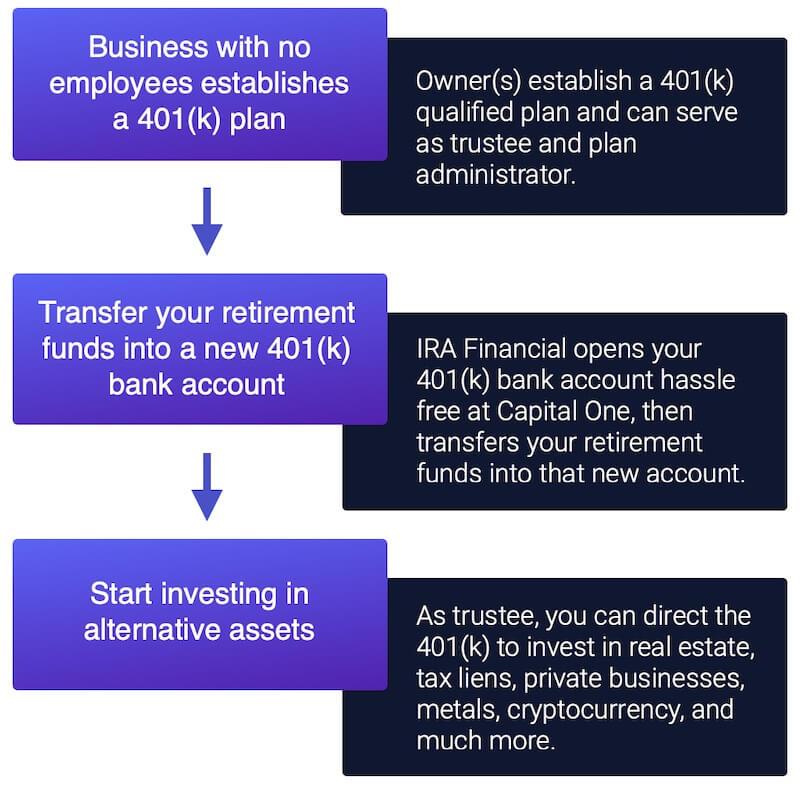
How Involved is IRA Financial?
Once IRA Financial has funded the Solo 401(k), you, as trustee of the plan, will have 100% control over the plan assets. At that time, IRA Financial is no longer involved in the investment, but we continue to be responsible for all IRS reporting regarding your plan.
The IRA Financial Solo 401(k) Plan
The IRA Financial Solo 401(k) plan is unique and popular because it is designed explicitly for small, owner-only businesses.
Unlike a TD Ameritrade Solo 401(k) plan, IRA Financial’s offering will allow one to invest in traditional, as well as alternative assets, such as real estate or cryptos.
Tax-Free Loan: The IRA Financial Solo 401(k) plan allows plan participants to borrow up to $50,000 or 50% of their account value (whichever is less) for any purpose. The loan must be paid back over a five-year period at least quarterly at a minimum interest rate of Prime (you have the option of selecting a higher interest rate).
Checkbook Control: The most significant advantage of the IRA Financial Solo 401(k) plan versus the TD Ameritrade plan is that it offers you checkbook control over your retirement funds. At TD, one is relegated to making traditional investments, such as stocks and or mutual funds. In addition, the plan account is required to be opened at TD Ameritrade.
With the IRA Financial Solo 401(k) plan, the plan account can be opened with IRA Financial as well as many local banks. Plus, the plan participant can make almost any traditional as well as non-traditional investments, such as real estate, precious metals, cryptos, third-party lending, notes, stocks, private business, and much more. You have the freedom to make the investments you want as trustee of the plan.
Easy Administration: There is generally no annual filing requirement unless your plan value exceeds $250,000 in assets. You would then need to file a short information return with the IRS (Form 5500-EZ). Unlike TD Ameritrade, however, the tax professionals at IRA Financial will assist you in completing this form is required
No Tax on Real Estate Financing: Since TD does not allow real estate investments, one would not be able to benefit from the ability to use nonrecourse financing, tax-free, when making real estate investments with Solo 401(k) retirement funds. With IRA Financial, you can utilize arguably the best retirement plan for real estate investors.
Conclusion
For those TD Ameritrade Solo 401(k) plan clients who are being compelled to close their plans, you have options! Simply open a Solo 401(k) plan with IRA Financial and move the plan funds tax-free to us. With our plan, you will gain the ability to invest in alternative assets directly with us, while also gaining the ability to invest in stocks via a brokerage account. Plus, the IRA Financial tax professionals will assist you with the administration of your Solo 401(k) plan. Get started by scheduling a free consultation today!

How to Exit a ROBS Structure

The Rollovers as Business Start-ups structure, or ROBS, is a popular method that uses retirement funds to start your own business. What happens when you no longer have that business? You may have sold it for a nice profit, or it just never caught steam and had to close the doors (we hope it's the former). When it comes time to exit the ROBS structure, you must follow all procedures or be subject to real fines from the IRS and the Department of Labor. Winding down the 401(k) plan used for the business is crucial, and the paperwork is less forgiving than most business owners expect. Here's everything you need to know about exiting the ROBS structure the right way.
Key Takeaways
- Exiting a ROBS structure means formally terminating the C Corporation's 401(k) plan, not just walking away once the business sells or closes.
- TA final Form 5500 is due by the last day of the seventh month after the plan terminates or the trust holds no assets, whichever is later.
- Participants receive a Form 1099-R for their final distribution, not a generic Form 1099.
- Missing the Form 5500 deadline exposes the plan to IRS penalties up to $250 a day, capped at $150,000, plus uncapped DOL penalties of $2,739 a day in 2026.
- Your ROBS provider should stop billing plan administration fees the moment the plan is officially terminated.
ROBS 401(k) Refresher
If you are reading about how to exit the ROBS structure, you probably already know how it works. However, for those that don't, here's a quick synopsis of what the ROBS structure is. Essentially, you roll over funds from your current retirement plan, such as an IRA or 401(k), into a new plan intended to finance a business. A C Corporation is formed, and a new 401(k) plan is created for the business. The money from your previous retirement plan is then used to fund the new 401(k). Finally, the funds in the 401(k) are used to purchase stock in the C Corporation. Selling the stocks gives you capital to either start a new business or invest in a current one.
It's a strategy many people use when they're short on capital to get their business off and running. Obviously, it does come with risks. If your business fails, not only does it cost you in the present, but your retirement is put in serious jeopardy. You should only implement the ROBS structure if you are 110% sure your business will succeed, or you have enough saved to cover the losses. Therefore, it's imperative that you do your due diligence when researching your business and what the ROBS structure entails.
Related: Buying a Business with Your IRA
How to Exit the ROBS Structure
Congrats! Your business is a huge hit and now it's time to sell for a big profit. (Here at IRA Financial, we always think positive, so we won't discuss the other reason you may need to exit the ROBS structure!) Not only do you have to deal with all the trivialities that comes with selling a business, but you need to dissolve your ROBS arrangement. To reiterate: failure to do so will lead to stiff penalties. Winding down the 401(k) should be near the top of your list of things to do.
The first thing you need to do is get in touch with your ROBS provider and notify them that you want to exit the ROBS structure. You should also contact your attorney and accountant to make sure everything is in order. There are several things your attorney will need to deal with:
- Adopt a Board resolution that will terminate the 401(k) plan
- Make sure all participants of the plan know that it will be terminating
- Make sure the plan is compliant with all amendments before terminating
- Determine if a Form 5310 needs to be filed
- Any additional requirements needed to correctly terminate the plan
Filing the Final Form 5500
IRS Form 5500 must be filed every year the 401(k) plan is in use. This form is used for information about your plan. It's to ensure the plan adheres to all rules and regulations, what investments are being made and how much is in the plan.
It's imperative you file Form 5500 even when you need to terminate your 401(k) plan. Failure to do so will lead to the plan not being considered terminated by the IRS and DOL. Generally, your ROBS provider will file this form on your behalf. Again, make sure you are on constant contact with them throughout this process.
Once the participants make their final distributions from the plan, IRS Form 1099 must be filed as well. This is another task that will be performed by your administrator.
Final Steps to Exiting the ROBS Structure
The day the funds are withdrawn from the plan is the final distribution date. Usually you have 30 days from this date to make sure everything is in order and all forms filed. Here's a quick list of everything that needs to be given to your ROBS provider:
- You should have an adopted board resolution for when the plan was decided to be terminated
- You may need an IRS Determination Letter to ensure your plan is IRS-compliant before it is terminated
- A Copy of the 401(k) accounts (or bank accounts) that show all assets have been distributed and there is a zero balance in the plan
- If you need 1099 forms, you must provide the information of the participants and amounts withdrawn
- You also need a copy of the Corporate Stock Ledger that should the corporation has bought back all the stock the 401(k) purchased
- A Census Form that shows all employee information for the year
- A Year End Summary for the plan
One last thing to consider is any monthly fees your provider charges for plan administration. Once you exit the ROBS structure, you no longer need these services and shouldn't be charged for them.
Related: Potential Drawbacks to using Rollover Business as Startups
Summary
Starting a business with your retirement funds is an exciting opportunity. Hopefully, exiting the ROBS structure is just as exciting. It's time to reap the rewards for building a rewarding business. Unfortunately, if you business did happen to fail, you still need to follow the proper procedure to terminate the plan.
If you have any questions about how the ROBS structure works, or your need to exit your plan, please give us a call at @ 800.472.0646. You can also fill out a contact form and we'll be in touch with you!

Using a Loan with a Self-Directed IRA to Make an Investment
A Self-Directed IRA is a unique retirement solution that can be used to unlock a vast universe of investment opportunities unavailable to most retirement investors. By using one, you can use retirement funds to make traditional investments, but you are also allowed to invest in more non-traditional investments, including real estate - tax-free and without custodian consent. Cash is the traditional asset used to purchase investments for retirement, whether the investment ultimately comes in the form of stocks, precious metals, or real estate. Most investors using retirement funds to make an investment will not borrow any funds to make the investment.
- The internal Revenue Code prohibited the use of a loan that is personally guaranteed
- Retirement plans can only use non-recourse financing for an investment
- If you are self-employed, you can utilize the Solo 401(k) loan feature to borrow money from the plan
IRS Tax Code and Using an IRA as Collateral
The primary reason retirement account investors don’t typically borrow cash (also called debt or leverage) to invest in real estate is Internal Revenue Code Section 4975, which prohibits the IRA holder from personally guaranteeing a Self-Directed IRA Loan. Pursuant to the Internal Revenue Code, a disqualified person (i.e., the IRA holder) cannot lend money or use any other extension of credit with respect to an IRA. In other words, only non-recourse financing is allowed.
As a result, the owner of a Self-Directed IRA cannot use a standard loan or mortgage loan as part of an IRA transaction because that would trigger a prohibited transaction pursuant to Code Section 4975. A loan becomes a ‘recourse loan’ when the bank can seek recourse or payback from the individual guaranteeing the loan. Recourse loans are generally the most common loan offered by banks and financial institutions across the country. As such, with a Self-Directed IRA, a recourse loan cannot be used as a part of your investment strategy. This leaves the Self-Directed IRA investor with only one financing option – a non-recourse loan.
Related: Self-Directed IRA Rules Investors Commonly Break
What is a Non-Recourse Loan?
Put simply, a non-recourse loan is a loan that is not guaranteed by anyone. In essence, the lender is securing the loan only with the underlying asset that the loan will be used to pay for. Therefore, if the borrower is unable to repay the loan, the lender’s only recourse is against the underlying asset (i.e., the real estate) and not the individual. This is where the term non-recourse comes from. Of course, the issue arises that non-recourse loans are far more difficult to secure than a traditional recourse loan or mortgage. While reputable non-recourse lenders exist, the rate on a non-recourse loan is typically less attractive than a traditional recourse loan.
The IRS allows IRA and 401(k) plans to use non-recourse financing, and only non-recourse financing. Additional rules discussing the use of non-recourse financing by an IRA can be found in Internal Revenue Code Section 514, which confirms the real issue with this kind of situation. The Code requires debt-financed income to be included in unrelated business taxable income (UBTI or UBIT), which generally triggers a maximum tax of 37% tax.
Even if non-recourse debt financing is used, the portion of the income generated by the debt-financed asset will be subject to the UBTI tax. Thus, for example, if a Self-Directed IRA investor invests $70,000 cash and borrows $30,000 on a non-recourse basis, and the IRA investment generates $1,000 of income annually. Here, 30% of the income (or $300) would be subject to UBTI tax, even if that $300 tax base could be reduced by any deduction/depreciation associated the debt-financed property. The rationale behind the IRS code is often muddled, but here, the IRS is treating the IRA, typically treated as tax-exempt pursuant to IRC 408, as a taxpayer by imposing a tax on the debt-financed portion. In other words, the IRS allows the investor to proportionally allocate any asset expenses or depreciation in order to reduce the tax base. This is accomplished through IRS Form 990-T.
Interestingly, the UBTI/UBIT taxes in this scenario can be avoided by investing in real estate through a Solo 401(k) Plan while using non-recourse financing. This reality comes from an exception to the Unrelated Debt Financed Income (UDFI) rules found in IRC 514(c)(9). This is only one reason why the Solo 401(k) Plan is such an attractive investment vehicle.
Avoiding the UBTI Tax for a Self-Directed IRA Investor
Most Self-Directed IRA investors will never have to deal with the UBTI tax because it is only triggered under specific situations. In general, the UBTI tax is triggered in three ways:
- By using margin to buy stocks or securities;
- By using a non-recourse loan to acquire real estate, even if there is an exemption for some 401(k) plans. The golden rule here is that the loan cannot be guaranteed by the IRA owner pursuant to the IRS prohibited transaction rules; or
- By investing in an active trade or business operated through an LLC or pass-through entity, such as a partnership.
The most common way to avoid the application of the UBTI tax is via the use of a subchapter C-Corporation blocker.
The Subchapter C-Corporation Blocker
Using a C Corporation is the most common way to block the imposition of the UBTI tax. Here’s how it works. A C Corporation is taxed as a separate entity, distinct from its shareholders, making it subject to a corporate entity tax. A pass-through entity, like an LLC, is a flow-through entity, and as such, there is no entity lever tax and all LLC income and gains flow through to the members. Put simply, with an LLC, the members pay tax on the LLC’s income. On the other hand, if a Self-Directed IRA (through a C Corporation) makes an investment, income would be subject to corporate income tax, currently at 21% in 2022 and 2023 on the net corporate income. However, that income would not be subject to the UBTI tax.
Structuring the Investment as Debt
If a Self-Directed IRA can structure an investment though a flow-through entity as a loan instead of an equity, the IRA would not be subject to UBTI tax because interest on a loan is exempt from UBTI tax.
The Solo 401(k) Option
IRC 514(c)(9) contains an important exemption to the UBTI tax for 401(k) plans who use a non-recourse loan to acquire real estate. Unfortunately, the exemption does not apply to other IRAs and only applies to the acquisition of real estate. To benefit from the Solo 401(k) plan, an investor must meet just two eligibility requirements:
- The presence of self-employment activity.
- The absence of full-time employees.
If you pass these two eligibility requirements, you and your spouse are technically considered “owner-employees” rather than “employees” under the IRS code. In addition, the following types of employees may be excluded from coverage under these rules:
- Employees under 21 years of age.
- Employees that work fewer than 1,000 hours annually or can show a history of at least three consecutive years of 500 hours of annual service.
- Union employees
- Nonresident alien employees
What type of Business can set up a Solo 401(k)?
Any U.S. based legal business. At a basic level, a business is defined under the IRS code as an activity in which a profit motive is present and economic activity is involved. The business can be a side gig, such as driving for Uber as a 1099 or even selling shoes on eBay. If you are self-employed, then using a Schedule C to report income or expenses will work. However, if you report rental income on a Schedule E as your sole source of income, you will not be deemed to be in business since a Schedule E is for passive real estate or interest income.
Conclusion
Using a loan with a Self-Directed IRA often comes with some substantial disadvantageous tax consequences. The most important thing for any self-directed IRA seeking to use a loan for investment purposes is that the loan must be non-recourse. In addition, a Self-Directed IRA investor using a non-recourse loan to acquire real estate should be mindful of the potential application of the UBTI tax rules and consider the potential work around provided above.

How to Choose the Best Self-Directed IRA Custodian
Choosing the Best Self-Directed IRA Custodian
When considering Self-Directing your retirement account, many people wonder, how to choose the best Self-Directed IRA Custodian." In this article, we will describe the role of a Self-Directed IRA custodian and identify factors you should consider before selecting a Self-Directed IRA custodian.
What is a Self-Directed IRA Custodian?
Pursuant to IRC Section 408, an IRA (individual retirement account) can only be established and administered by the following institutions, under state law:
- A bank
- Financial institution
- Authorized trust company
An IRA Trustee (custodian) is the institution that administers your retirement account. By law, every IRA must have a custodian or trustee.
Currently, most of the 50 or so million IRAs invest in traditional asset investments. This includes stocks, bonds and mutual funds. However, since the 2008 financial crisis, retirement account investors began to see the advantages of alternative assets, such as real estate. It better diversifies their retirement account investment portfolio, and acts as a hedge against inflation.
- Choosing a custodian is the most important decision when using a Self-Directed IRA
- The custodian should allow for the types of investments you wish to make
- Ensure you know all the services they provide before committing
There are certain non-traditional investments that you cannot make, including:
- Life insurance
- Collectibles
- Certain self-dealing and conflict-of-interest transactions under IRC section 4975
Other than that, you can make any type of investment with your IRA.
The majority of banks and financial institutions that offer IRAs only permit their IRA clients to invest in traditional assets because that's how they earn their fees. The IRA custodian has the right to decide what types of IRS-approved investments it will allow its IRA clients to invest in.
Self-Directed IRA Custodian
On the other hand, a Self-Directed IRA custodian, or passive custodian, allows you to engage in non-traditional investments, like real estate and cryptocurrencies. It also differs from financial institutions in not offering investment advice. Additionally, a Self-Directed IRA custodian does not sell investment products.
So how does a Self-Directed IRA custodian earn its fees? Self-directed IRA custodians earn fees from the custody and administration of IRS-approved alternative asset investments in the IRA, or other retirement plan.
As you can see, to establish an IRA, you will have to open an account at a bank, financial institution, or authorized trust company, like IRA Financial.
Essentially, the IRA custodian is responsible for maintaining and administering the IRA. As a result, it must comply with all IRS reporting requirements surrounding the IRA. This includes filing IRS forms 5498 and 1099-R.
Most IRA holders have an individual retirement account with a bank or financial institution. Therefore, the investments they make are typically traditional investments, such as mutual funds.
When choosing the best Self-Directed IRA custodian, focus on your needs. For example, do you think you will need investment advice? If you work with a bank or financial institution, the IRA custodian could have a fiduciary or "best interest' responsibility if a registered investment advisor is involved. This means you will receive advice on the investments you make.
Whereas, if you're an IRA investor who wants to make alternative asset investments with your IRA, the IRA custodian is not considered a fiduciary, as it does not provide any investment advice. Its primary responsibilities include facilitating the transactions based on your direction. Additionally, it provides and takes custody of the IRA's alternative asset investments.
Therefore, a Self-Directed IRA custodian is not responsible for reviewing the transaction. As a result, you have more responsibility and will need to do your due diligence.
Factors to Consider When Choosing a Self-Directed IRA Custodian
Below is a list of four important factors you should consider regarding the role of a Self-Directed IRA custodian:
1. Open Your IRA with a Passive Custodian
You must open a Self-Directed IRA with a passive custodian, or self-directed IRA custodian that will allow you to make alternative asset investments. The self-directed retirement industry was born to serve the need for retirement investors to make IRS-approved alternative asset investments with their IRA.
The reason for this is not all IRA custodians allow their clients to make alternative investments. Almost all banks and financial institutions that are IRA custodians do not allow their clients to use IRA funds to make alternative asset investments because they do not make money from such investments.
2. Know the Role of a Passive Custodian
As we mentioned earlier, the Self-Directed IRA custodian is not treated as a fiduciary by the U.S. Securities and Exchange Commission (“SEC”). It does not sell investment products or provide any investment advisory services.
Its sole role is to facilitate investments you exclusively direct. In other words, the custodian serves the growing demand from retirement account holders who wish to make IRS-approved alternative asset investments that traditional financial institutions do not offer.
Keep in mind, the Self-Directed IRA custodian is not permitted to offer legal or tax advice.
3. Transaction Fees
It's important to know the process and fees for your transactions. Is there a fee charged for each transaction? Do I need custodial consent for an investment I choose? If you plan on making several transactions per week, fees might cut into your earnings. However, if you’re only making one or two per year, this might not be a big deal.
The major issue may be the timeliness of the transactions. If you need to wait for consent from your custodian, you may miss out on an investment opportunity. However, if the custodian offers “checkbook control”, no consent is necessary. Therefore, you can make investments whenever you choose.
4. Miscellaneous Fees
There are general fees that your IRA custodian will charge. Some IRA custodians may charge a fee based on your account balance. Others may simply charge a flat fee regardless of the amount of transactions you make, or your account balance.
You should find a custodian that suits your exact needs. More than likely, you may be hit with various miscellaneous fees, as well as account and transaction fees. Again, these fees are based on the custodian that you choose.
Checkbook Control Self-Directed IRA
If you prefer a Self-Directed IRA with checkbook control, make sure the custodian you select has the requisite experience to custody and facilitate such investments.
A checkbook control Self-Directed IRA is an investment solution that involves the IRA being the owner of a special purpose limited liability company (LLC). You, as the IRA holder, will manage the LLC. The limited liability company offers protection regarding your IRA investments.
To Summarize
When choosing the best Self-Directed IRA custodian for you, make sure the custodian can meet your investment goals. You also want a custodian that specializes in alternative asset investments. They have the knowledge and experience to administer a self-directed retirement account.
As previously stated, a Self-Directed IRA is not a fiduciary and is not required to put your best interests first. You must understand the risks of any investment you choose.
Get in Touch
Do you still have questions about choosing the best Self-Directed IRA custodian? Contact IRA Financial Group at 800-472-0646. We're available to answer all of your questions, and if you choose our services, we can establish your Self-Directed IRA in a matter of days. You can also fill out the form to speak with one of our on-site IRA specialists today.
Did You Know?
The top Self-Directed IRA custodians are a member of Retirement Industry Trust Association, or RITA. This shows a commitment to the industry and continuing education to help our clients.

Crypto Private Key Options for Your Self-Directed IRA or Solo 401(k)
If 2022 taught crypto investors anything, it's that having control of crypto private keys is a fundamental way to protect your cryptos from exchange-related risks and cyber hacks. A private key is essentially a gateway to your crypto, and a malicious individual who has gained access to your private key can take control of your cryptos. With the collapse of the crypto exchange FTX, many crypto investors, including retirement account investors, have looked for the best way to protect their assets from risks associated with a crypto exchange collapse or bankruptcy. Holding your private keys is a way to take control of your crypto and help safeguard your retirement. So, you may be wondering, can you hold your private keys with a Self-Directed IRA for Cryptocurrency or a Solo 401(k)? At IRA Financial, we allow you to hold your private keys. Keep reading to learn how you can benefit from our Self-Directed IRA solution.
What is a Cryptocurrency?
Cryptocurrency is a form of digital currency that is designed to be secure and, in many cases, anonymous. The first cryptocurrency was Bitcoin, which was created in 2009 and is still the best-known and most traded. There has been a proliferation of cryptocurrencies in the past decade and there are now more than 1,000 available on the internet. It is a digital currency that is secured by cryptography, which makes it nearly impossible to counterfeit or double-spend. Many cryptocurrencies are decentralized networks based on blockchain technology—a distributed ledger enforced by a disparate network of computers.
Crypto Public & Private Keys
Every cryptocurrency wallet has a public and private key. Here are the definitions of each.
What is a Public Key?
A cryptocurrency public key is used to receive funds; the public key identifies your crypto. A public key allows you to receive a cryptocurrency transaction. It is made up of a cryptographic code that's linked to a private key. While anyone can send transactions to the public key, you need the private key to “unlock” them. The public key can be searched on the blockchain. In other words, the public key is used to verify the digital signature, which proves ownership of the private key. The public key is generated from the private key.
What is a Private Key?
A crypto private key is only used to sign transactions and prove you own the related public key. A private key is a large, arbitrarily generated string of alphanumeric characters with hundreds of digits. This secret number acts as a password to protect a cryptocurrency owner and is the key to unlocking access to the virtual vault that holds your cryptocurrency.
Crypto Exchanges & Private Keys
Most crypto investors are not aware that when purchasing cryptos on a centralized exchange, such as Coinbase, the cryptos acquired are automatically stored in your exchange-hosted wallet, which is generally custodial controlled. In other words, the exchange has control of your crypto private keys, which means that you do not control the underlying crypto. Therefore, the phrase “no keys, no cheese” has become such a popular slogan for traditionalist crypto investors.
Since the fallout of FTX and several other crypto exchanges which caused millions of crypto investors to lose control of their cryptos, more and more crypto investors are seeking to control their crypto private keys in order to secure ownership of the crypto.
How to Control Your Crypto Private Key?
In general, there are numerous ways to control one’s crypto private keys. It can be stored on a hot or cold wallet. Hot wallets are connected to the internet, while cold wallets are not. Most people who hold digital assets have both cold and hot wallets because they are designed for different purposes. A cold wallet is a tool that stores Bitcoin and other cryptocurrencies offline (looks like a USB thumb drive). To keep cryptos offline in a cold wallet means to reduce the threat of their abduction by hackers. If one is using a cold wallet, it is important to remember to keep the wallet somewhere safe and remember your password!
Can I Own Cryptos in a Retirement Account?
On March 25, 2014, the IRS issued Notice 2014-21, which, for the first time, set forth the IRS position on the taxation of virtual currencies, such as Bitcoin. According to the IRS Notice, "Virtual currency is treated as property for U.S. federal tax purposes. General tax principles that apply to property transactions apply to transactions using virtual currency."
The IRS is treating the income or gains from the sale of a virtual currency as a capital asset, subject to either short-term (ordinary income tax rates) or long-term capital gains tax rates if the asset is held greater than twelve months (15% or 20% tax rates based on income). Hence, since an IRA and 401(k) plan can invest in property, such as stocks, a retirement account is permitted to invest in cryptocurrency.
On March 10, 2022, the Department of Labor (DOL) released Compliance Assistance Release 2022-01 (CAR 2022-01), which specifically addressed 401(k) plan investments in cryptocurrencies.
The primary purpose of CAR 2022-01 is to put plan fiduciaries of 401(k) plans on notice to exercise “extreme care” in considering cryptocurrencies as part of 401(k) investment options for plan participants. This release comes one day after the White House released an executive order on digital assets. The DOL Notice did not mention IRAs or Solo 401(k) plans and did not prohibit 401(k) plans from investing in cryptos, it simply cautioned plan fiduciaries about the risks of cryptos as a plan investment option.
Best Ways to Own Cryptos in a Retirement Account
You have multiple options when it comes to holding cryptocurrency in a retirement plan. If you are self-employed and have no employees, you can hold your private keys directly in your Solo 401(k). If you do not have self-employment activity, you can use a Self-Directed IRA LLC to hold your private keys. Alternatively, if you are not interested in holding your private keys, you can open a traditional Crypto IRA for just $100 per year. These options will be broken down below to help you understand your options when investing in cryptocurrency with retirement funds and how you can legally hold your private keys.
The IRA Financial Cold Wallet Crypto Solo 401(k) Plan Solution
The IRA Financial cold wallet crypto Solo 401(k) plan solution will allow a Solo 401(k) plan trustee to hold 401(k) plan-owned cryptos off the exchange and in a cold wallet.

Who Can Setup a Solo 401(k) Plan?
A Solo 401(k) plan is not a new type of retirement plan. It is a traditional 401(k) plan covering only one employee. In general, to be eligible to establish a Solo 401(K) plan, one must be self-employed or have a small business with no full-time employees (over 1000 hours during the year) other than a spouse or other owner(s).
How Does the Solo 401(k) Crypto Wallet Solution Work?
The IRA Financial Solo 401(k) cold wallet crypto solution will allow a plan participant to purchase cryptos using 401(k) funds and then hold the cryptos in a cold wallet off the exchange. The reason that a Solo 401(k) plan trustee can hold cryptos off in an exchange in a cold wallet and not an IRA relates to the nature of the role of a 401(k)-plan trustee.
In the case of an IRA, the IRA custodian is the trustee of the IRA and is required to custody IRA assets. Whereas, regarding a Solo 401(k) plan, the trustee of the plan is required to hold plan assets in trust on behalf of the plan participant. The trustee of a 401(K) plan may be an individual. Below is an excerpt from the IRA Financial 401(k) plan document which has been approved by the IRS:
Powers of the Trustee
The Trustee will have the power, but, in the absence of proper direction from the Plan Administrator, not the duty, to take any action set forth below:
- purchase or subscribe for securities or other property and to retain them in trust; to sell any such property at any time held by it for cash or other consideration at such time or times and on such terms and conditions as may be deemed appropriate.
Therefore, based on the IRS-approved 401(k) plan documents, a Solo 401(k) plan trustee can hold 401(k) owned property, such as cryptos, and “retain them in trust.” Whereas, using a self-directed IRA would not offer the IRA owner the same right since the IRA rules require the custodian or trustee to retain full control over the assets. Hence, the IRA Financial Solo 401(k) plan cold wallet crypto solution would allow one to have 401(k) plan-owned cryptos moved off-exchange and held “in trust” by the trustee of the plan. The Solo 401(k) plan solution would seemingly not violate the McNulty ruling, since McNulty only addressed the personal possession of an IRA-owned asset, which involves different rules than what would apply to the possession plan assets by a 401(k) plan trustee.
Crypto IRA LLC
Most crypto exchanges do not offer one the ability to open an IRA at a crypto exchange. The only legal way to purchase cryptocurrencies is through a regulated crypto exchange. Using an LLC wholly owned by an IRA has become a popular way to purchase cryptos. Opening a Crypto IRA using an LLC will allow the IRA owner to essentially use any exchange they wish to buy and sell cryptos, in the U.S. as well as internationally.
In addition, using a Crypto IRA LLC solution will offer the IRA owner with the ability to hold the crypto private key on a cold wallet. Considering the FTX bankruptcy, holding one’s crypto private key has become almost a requirement from a security standpoint. This is especially important when one owns cryptos in a retirement account. Moreover, using a Crypto IRA LLC would allow one to open a crypto exchange account at a foreign exchange and purchase XRP and other cryptos that may not be available in the United States. Although, one should be cautious about holding cryptos on a foreign exchange, especially in light of FTX.
Below is a breakdown of how it works
- Individual opens an IRA at IRA Financial, a regulated Self-Directed IRA trust company
- IRA would own 100% of the LLC and you, the IRA owner, would serve as manager of the LLC
- As manager of the LLC, you would open an account with any crypto exchange (i.e. Coinbase or Binance)
- IRA owner would open the LLC account at the crypto exchange
- The LLC’s bank account would be linked to the crypto exchange account
- The IRA owner would have total control over the account and can hold cryptos on the exchange or pull cryptos off the exchange and hold in a cold wallet
The Crypto IRA LLC is the only Self-Directed IRA crypto solution that will offer a retirement account owner the ability to hold their crypto private key as well as use a US or foreign crypto exchange of their choice. For more information on the rules surrounding the ability to hold your retirement account-owned cryptos on a cold wallet, please see below.
Crypto IRA Direct
We are very proud to have the industry’s best solution for buying Bitcoin and other major cryptocurrencies on an exchange in the name of an IRA or 401(k). IRA Financial was the first self-directed retirement company to allow its clients to invest in cryptocurrencies directly via a cryptocurrency exchange without the need for a third-party broker or the use of an LLC.
Now, investors can use their retirement funds to buy all the major cryptocurrencies directly through Bitstamp, one of the leading US cryptocurrency exchanges. Bitstamp was founded in 2011 and is present in over 100 countries, with offices in the UK, Luxembourg, the USA, Singapore, and Slovenia, and caters to over 4 million customers across the globe.
The IRA Financial crypto solution is the first to allow retirement holders to hold cryptocurrencies in an IRA directly on an exchange. The account is opened in the name of the IRA, but controlled by you as the authorized representative on the account. The IRA holder has 100% control over the account and can trade anytime.
How Does the IRAfi-Bitstamp Crypto Solution work?
Step 1: Open an IRA or Solo 401(k) account at IRA Financial Trust.
Step 2: Move IRA or 401(k) funds to a new account tax-free.
Step 3: Funds are moved From IRA Financial to Bitstamp.
Step 4: Begin buying and selling cryptos 24/7 on the IRA Financial app on your own without the need for a broker or the use of an LLC.
With the Crypto IRA direct solution, you can invest in cryptos directly. In other words, you do not need a costly broker or LLC. In addition, the cryptos will be held in the name of the IRA custodian. This will be in the benefit of the IRA holder. As a result, it’s much cleaner from a tax reporting perspective.
Advantages
- No requirement to use broker
- No requirement to use LLC
- Ability to buy, sell, or exchange cryptocurrencies at anytime through a PC or mobile application
- Flat, low annual IRA custodian fee – no asset valuation fees
Disadvantages
- You can only purchase the most popular cryptocurrencies
- The cryptos must be held on the Bitstamp exchange
Taking Possession of IRA Assets
The only provision in the Internal Revenue Code (“IRC”) that directly prohibits the IRA owner from personally possessing an IRA asset is IRC 408(m). IRC 408(m) prohibits an IRA owner from taking personal possession of an IRS-approved precious metal or coin. IRC 408 specifically requires that any IRS-approved precious metal owned by an IRA or 401(k) must be held at a U.S. trust company, such as a depository.
Yet, other than precious metals or coins, which are tangible assets, there are very few tangible assets that can be purchased by a retirement account. For example, case law is clear that an IRA owner can take possession of a stock certificate or real estate deed, which is titled in the name of the retirement account. However, the emergence of digital assets, such as cryptos, presents a new and unique case where an asset is intangible but can be held tangibly.
For example, a crypto, which is an intangible asset, can also be held in a physical cold wallet. There is currently no direct IRS guidance on whether a retirement account owner can take possession of a digital asset, however, a recent tax court case offered some insight as to the extent in which a retirement account owner can take greater control over an IRA asset.
The McNulty Case
In McNulty v. Commissioner, 157 T.C. No. 10 (November 18, 2021), the tax court ruled that an IRA owner cannot take personal possession of an IRA asset and cannot have unfettered control over any IRA asset.
The McNulty case involved a taxpayer who used a Self-Directed IRA LLC to invest in precious metals and real estate. The McNultys decided to take personal possession of the IRA-owned coins, which clearly violated a provision in the tax code. The tax court opinion did not reference cryptos in the written opinion, however, it went on in length about the concept of “unfettered command” over IRA assets. The court noted, “When coins or bullion are in the physical possession of the IRA owner (in whatever capacity the owner may be acting), there is no independent oversight that could prevent the owner from invading her retirement funds. This lack of oversight is clearly inconsistent with the statutory scheme. Personal control over the IRA assets by the IRA owner is against the very nature of an IRA.”
In addition, the court went on to state that, “An owner of a Self-Directed IRA may not take actual and unfettered possession of the IRA assets. It is a basic axiom of tax law that taxpayers have income when they exercise complete dominion over.” However, the court differentiated the case when the IRA owner merely acted as a conduit for the IRA asset but not maintain actual control over the asset. Below is the language from the tax court opinion:
“While an IRA owner may act as a conduit or agent of the IRA custodian, she may do so only as long as she is not in constructive or actual receipt of the IRA assets. See Ancira v. Commissioner, 119 T.C. 135, 137-140 (2002) (holding no taxable distribution occurred when the IRA owner personally received a check that he could not negotiate, the funds were then used to acquire stock, and the stock certificate was issued in the IRA's name); McGaugh v. Commissioner, at *13-*14 (holding no taxable distribution occurred even if a stock certificate was in the IRA owner's possession but it issued in the IRA's name and thus the owner could not realize any benefits from it and did not have constructive receipt of IRA assets); Dabney v. Commissioner, T.C. Memo. 2014-108 (holding a taxable distribution occurred when real estate was titled in the IRA owner's name)."
Hence, in McNulty, the tax court was clear that an IRA owner should not have unfettered command over any IRA asset. So how does the ruling in the McNulty case apply to taking control over retirement account-owed cryptos in a cold wallet?
Navigating the McNulty Case for Crypto IRA Investors
After a careful read of the McNulty case, it would seem clear to many that taking personal possession of one’s retirement account-owed cryptos in a cold wallet is a no-no. However, below are several points that could be considered that could offer some strength to the argument that the personal possession of cryptos in a cold wallet is unlike any other IRA asset.
- Cryptocurrency is a new type of digital asset that is based off blockchain technology. It is a unique asset because even though it is an intangible asset, it can still be held physically in a cold wallet. Thus, applying the traditional rules of McNulty to a digital asset would be inappropriate.
- The bankruptcy of FTX crypto exchange in November 2022, along with a number of other large crypto firms that went under, such as Voyager, Celsius, and Blockfi, has created a sense of urgency among crypto investors seeking to protect their cryptos from crypto exchange risk. Cryptos held on an exchange are controlled by the exchange, and since the exchange controls the crypto private key, a crypto exchange bankruptcy will put cryptos on the exchange at risk. For retirement account investors shielding their crypto from exchange risks is even more vital since, for many Americans, their retirement account is their primary source of savings. Hence, because of the nature of cryptos and its privacy features, keeping the cryptos safe and secure is even more paramount than precious metals or any other asset.
- Blockchains are entirely open and accessible to everyone. Thanks to the transparency of the blockchain, it is easy to track the movement of cryptos. If the identity behind a crypto wallet address is known, then the transactions made can be traced back and traced in the future. All these transactions can be viewed in detail. Therefore, a retirement account owner would be able to provide to the IRS or any third-party that the crypto held in the cold wallet was not used for any personal purpose by simply providing the IRS with the crypto wallet number. This fact alone demonstrates that important differences between taking possession of a tangible asset, such as gold, versus, a digital asset. The blockchain would provide the IRS or any third-party with audit and verification tools over a digital asset, which is not available for any other asset.
- The internal technology team at IRA Financial is working on a multi-signature wallet option that will allow the retirement account owner to take personal possession of a crypto wallet but would need the signature of IRA Financial to move the cryptos off the wallet. This would provide the retirement account owner with ability to protect themselves from crypto exchange exposure and hacking, while at the same time, satisfying the McNulty case since IRA Financial, as IRA custodian, will still maintain custody of the crypto. Of course, providing the crypto owner with total control over the retirement account-owned cryptos would be ideal. However, based on the “unfettered command” requirement in McNulty, a multi-signature approach may ultimately be the most attractive option.
- For retirement account investors seeking to use an LLC to invest in cryptos, moving the cryptos off the exchange to a cold wallet that is held at a depository, like metals, could be a solution. The advantage of this option is that you would be able to get the cryptos off the exchange and held secure in a depository that specializes in safe keeping of valuable assets, such as gold. The downside is that you do not retain total control over the wallet, although, considering the McNulty case, retaining total control is likely not a viable option.
Putting it all Together
Considering the McNulty case, finding a way to hold cryptos owned by a retirement account on a cold wallet is quite difficult. The facts in the McNulty case surrounded IRS-approved coins which IRC 408(m) requires to be held in the physical possession of a U.S. trust company. Nevertheless, the tax court opinion is very broad and its focus on the prohibition of “unfettered command” over IRA assets is a difficult threshold to navigate.
Clearly, a dual signature wallet where the IRA custodian retains custody of the asset, and the individual does not retain “unfettered command” is ideal. Alternatively, cryptos are a unique asset that cannot be compared to traditional, tangible assets, such as gold, especially from a security standpoint. In addition, the fact that blockchain technology can track a crypto wallet could offer the IRS comfort relating to an IRA owner taking control of a crypto wallet.
Unfortunately, it is unlikely that the IRS will specifically address the matter of personal possession of retirement account-owned cryptos, so until a multi-signature wallet option is available, it may be best to proceed with caution.

Can I Use My IRA to Buy an Investment Property?
Many ponder whether they can or should cash out their IRA or 401(k) to buy an investment property. After all, real estate is one of the top assets held by millionaires. Still, few people know that you can use your IRA or 401(k) to purchase an investment property without tax consequences. This article will discuss how you can use your retirement funds to legally buy an investment property without suffering any tax consequences.
Should I Cash Out My IRA to Buy an Investment Property?
Before deciding whether you should cash out your IRA to buy an investment property, it is important to consider the tax consequences. In the case of a pretax IRA, cashing out your IRA has significant tax implications. Cashing out your IRA prior to the age of 59½ will trigger a 10% early distribution penalty, plus an income tax on the amount of the distribution. Whereas, cashing out an IRA after the age of 59½ will just be subject to income tax and no 10% early distribution penalty. On the other hand, in the case of a Roth IRA, cashing out a Roth IRA before the Roth IRA owner reaches the age of 59½ and/or the Roth IRA was opened 5 years can trigger a taxable distribution, plus a 10% early distribution penalty on the earnings generated from the Roth IRA contributions. Therefore, cashing out your IRA or 401(k) to buy an investment property may not be the best idea. However, you do have other options.
What is a Self-Directed IRA?
Since the creation of IRAs in 1974, alternative investments such as real estate have always been permitted to be invested by IRAs. A Self-Directed IRA is essentially an IRA account that is permitted to be invested in alternative assets, such as real estate or even cryptocurrencies. In other words, a Self-Directed IRA follows the same rules as a Traditional or Roth IRA respectively from a contribution and distribution standpoint.
Read More: Self-Directed IRA for Real Estate
Why Use a Self-Directed IRA to Invest in Real Estate
Instead of paying taxes on a distribution, a Self-Directed IRA to invest in real estate is a tax-savvy strategy used by countless investors. However, in order to take advantage of the tax advantages of using a Self-Directed IRA to make real estate and other investments, it is crucial that the investment be made directly by the retirement account and not the individual IRA owner. For example, in the case of a real estate investment, the investment must be made in the name of the IRA for the income and gains from the IRA investment to be excluded from immediate tax.
Starting in 1974 with the creation of IRAs, Congress wanted to incentivize Americans to save. Hence, they created rules whereby income and gains from an IRA investment would not be subject to tax and would benefit from a tax-deferral regime. Tax deferral is when all gains generated by a pretax retirement account investment flow back into the retirement account tax-free. This allows your retirement funds to grow at a much faster pace than if the funds were held personally, allowing you to build for your retirement more quickly. This is also known as compounding interest, which Albert Einstein coined the 8th wonder of the world.
[elementor-template id="70660"]
Based on the concept of tax deferral, using an IRA to make investments versus using personal funds has enormous tax benefits. For example, if an IRA owner makes an annual contribution of $1825 a year from age 21 to 70, assuming an 8% annual rate of return and a 25% tax rate, the IRA owner would have $1,045,306 versus just $462,488 with personal funds.
Related: Tax Deferral vs. Tax Free Investing
How Do I Start a Self-Directed IRA?
There are two ways to start a Self-Directed IRA.The first is making an IRA contribution. So long as you or a spouse have earned income, in 2025 you can contribute up to $7,000 or $8,000, if at least age 50, to an IRA. The IRS imposes certain income limitations to determine if your IRA contribution will be tax deductible.
For example, if you are married and filing jointly and earn more than $246,000, you will not be able to make a direct Roth IRA contribution. However, the “Backdoor” Roth IRA allows any taxpayer to make a Roth IRA contribution irrespective of income. Unlike a pretax IRA, a Roth IRA is an after-tax IRA, but so long as the Roth IRA owner is over the age of 59½ and the Roth IRA has been opened for at least five years, all Roth IRA distributions are tax free.
The second way to fund a Self-Directed IRA is via an IRA transfer or rollover. Transfers and rollovers are types of transactions that allow movements of assets between like IRAs – Traditional IRA to Traditional IRA. An IRA transfer is the most common method of funding a Self-Directed IRA. An IRA rollover generally involves the rollover of funds form a 401(k), 403(b), 457(b), or other employer retirement plan to a Self-Directed IRA. IRA transfers are-tax free and can be done an unlimited amount of times. Whereas, an indirect IRA transfer, where the IRA funds are first transferred to the IRA owner instead of the IRA custodian can only be done once every 12 months and the funds must be transferred to an IRA custodian within 60 days. In contrast, a rollover of 401(k) funds can only be accomplished when the 401(k)-plan participant satisfies a plan triggering event, for example, employment separation or reaches the age of 59½. Like IRA transfers, 401(k) rollovers are also tax-free.
*If you are Self-Employed, you also have the option of using your IRA or 401(k) to invest in real estate using a Solo 401(k).
Learn More:
Investment Properties for Beginners
Beginners Guide to Investing in Real Estate with Retirement Funds