

Invest in an S Corp with a Self-Directed IRA
The most popular reason millions of American IRA holders have turned to the Self-Directed IRA is to gain more control and investment options. The ability to gain investment diversification and invest in a wide variety of assets in a tax-deferred or tax-free manner, is very attractive. However, are you allowed to invest in an S corp with your IRA funds? Read more to find out.
- A Self-Directed IRA allows one to diversify their retirement portfolio
- S Corps are a type of business entity that is taxed at the shareholder level
- An IRA cannot directly invest in an S Corp, but there are some workarounds. The prohibition of an IRA from investing in an S Corporation is an S Corporation based on IRC Section 1361 rule and not an IRA prohibited transaction rule
Investments Allowed with a Self-Directed IRA
The Internal Revenue Code do not describe what an IRA can invest in, only what it cannot invest in. It boils down to three types of investments you can't do with IRA funds. Number one, you cannot invest in life insurance. Secondly, you cannot invest in collectibles, including art, stamps, and antiques. Lastly, you cannot invest in a transaction that includes a disqualified person.
To the last point, essentially, any investment made with IRA funds must "exclusively benefit" the IRA itself. A disqualified person, which includes you and your spouse, any lineal descendants and ascendants, their spouses, and any entities controlled by such, cannot benefit from the IRA-held investment.
Therefore, so long as no disqualified person is involved, and the investment is not prohibited by the IRS, you can do it. Investments include real estate, precious metals, and even S corps.
What is an S Corp?
S corps are corporations that elect to pass corporate income, losses, deductions, and credits through to their shareholders for federal tax purposes. Shareholders of S corps report the flow-through of income and losses on their personal tax returns, and are assessed tax at their individual income tax rates. This allows S corporations to avoid double taxation on the corporate income. S corporations are responsible for tax on certain built-in gains and passive income at the entity level.
C Corp vs. S Corp
A corporation (sometimes referred to as a C corporation) is an independent legal entity owned by shareholders. This means that the corporation itself, not the shareholders that own it, is held legally liable for the actions and debts the business incurs.
One of the major disadvantages of a C Corp is taxation. C Corps are required to pay federal, state, and in some cases, local taxes. When you form a corporation, you create a separate tax-paying entity. C Corps are known has having two layers of tax: (i) a corporate level, which is currently 21%, and (ii) a shareholder tax, which is subject to tax on corporate dividends received.
Whereas, an S corporation is treated as a pass-through entity, such as an LLC, for federal income tax purposes. All S corp items of income, loss, deductions "pass through" to the shareholders and reported on their federal income tax returns.
S Corp Requirements
To qualify for S corporation status, the corporation must meet the following requirements:
- Be a domestic corporation
- Have only allowable shareholders
- Have no more than 100 shareholders
- Have only one class of stock
- Not be an ineligible corporation (i.e. certain financial institutions, insurance companies, and domestic international sales corporations).
In sum, the S Corp have very specific shareholder restrictions. For example, corporations, foreigners, and only certain trusts can be shareholders of an S corp. Unfortunately, an IRA is not a permitted shareholder of an S corp. In addition, a single member LLC, owned by an IRA, is also not a permitted S corp shareholder since the LLC is a pass-through entity.
However, a 401(k) plan is technically a permitted trust that can be a shareholder of an S corp. Although, the issue with a 401(k) plan owning S corp stock is that any pass-through income exceeding $1,000 could trigger the UBTI tax, which has a maximum tax rate of 37%.
Unlike an S Corp, C Corps, LLCs, and partnerships do not generally have any shareholder restrictions.
How can a Self-Directed IRA Invest in an S Corp?
Now that we know that an IRA cannot be a shareholder of an S corp, what can an investor do who wants to use an IRA to buy S corp stock? Here are a few options:
Revoke the S Corporation Election
A C corp may revoke the S election. To revoke a sub-chapter S election/small business election that was made on Form 2553, submit a statement of revocation to the service center where you file your annual return. The statement would need to include certain information about the corporation.
If revoking effective the first day of the tax year, the revocation is due by the 16th day of the third month of the tax year. Whereas, if revoking effective any day other than the first day of the tax year, the revocation must be received by IRS by the requested effective date.
By revoking the S election, the corporation reverts back to a C Corp and the two layers of taxation.
Debt vs. Equity Investment
An IRA investor can elect to lend funds to the S corp versus making an equity investment. The downside of a loan investment is that the IRA will simply be a lender to the S corp and not a shareholder. Hence, the IRA will not share in any of the upside equity value of the corporation.
However, a loan with favorable rates could yield a decent return for your IRA. Of course, the profits will be limited.
Conclusion
The S corp shareholder limitation rules are often viewed as irrational as well as frustrating. The fact that an IRA can invest in a C Corp or an LLC, but not an S corp, often infuriates investors. Nevertheless, it is important to remember that these S corp shareholder restrictions are based on rules in the tax code and not IRA tax rules.
You do have options when it comes to investing in an S corp with a Self-Directed IRA, however, they are limited. Before investing, speak with a financial advisor to see if it's the right deal for you. Never settle when it comes to investing in your future!


Correcting a Prohibited Transaction
When using a Self-Directed IRA or Solo 401(k) plan to make alternative investments, you must pay attention to all the rules set forth by the IRS. Arguably, the most important of these rules are the prohibited transaction rules. While the IRS does not say what you are allowed to invest in with retirement funds, it does outline what you absolutely cannot invest in. These include life insurance, antiques, many collectibles, and certain coins. In addition to these items, you also may not take part in a transaction involving a disqualified person. Disqualified persons include you, your spouse, and all lineal ascendants and descendants and their spouses. Correcting a prohibited transaction is technical, but fairly easy to correct. You must do so in a timely matter, however.
What is a Prohibited Transaction?
The Prohibited Transaction Rules can be found in Internal Revenue Code 4975. There are three types of prohibited transactions: Direct/Indirect, Self-Dealing, and Conflict of Interest. These apply to both IRAs and 401(k) plans. They're in place so you don't get a personal advantage in addition to the tax benefits of the plan. Here's quick summary of each one:
- Direct/Indirect - This is a transaction between a disqualified person and his or her retirement account. For example, using your Self-Directed IRA to purchase a house that you then lease to your daughter Since your daughter is a lineal descendant, this is a prohibited transaction.
- Self-Dealing - You cannot personally gain by the investments made by your plan. Your retirement plan is already tax-advantaged, therefore you cannot also personally gain from it. An example is when you want to personally own a real estate property, but you use funds from your 401(k), in addition to personal funds, to make the purchase. Since this benefits you personally, it is prohibited. Here's another example: You invest in your son's business with your Self-Directed IRA. Since, your son is a disqualified person, this is not allowed.
- Conflict of Interest - This involves a disqualified person who is also a fiduciary and is connected to a transaction that involves the income or assets of the individual’s IRA. Here's an example: You take a loan from your Solo 401(k) plan and invest it in a business you manage and also have an ownership stake in. Since you are the fiduciary, there is a conflict of interest in the investment.
These are just a few examples of the prohibited transaction rules.
Penalties for Engaging in a Prohibited Transaction
Failure to abide by these laws come with serious consequences for your retirement plan. Typically, the penalty starts out at 15% for most retirement plans. However, Self-Directed IRAs are treated more harshly.
If you or your beneficiary of the IRA engages in a prohibited transaction, the IRA will lose its tax-exempt status. The entire fair market value (FMV) of the IRA will then be treated as taxable distribution and be subject to ordinary income tax. Furthermore, the IRA holder (or beneficiary) is subject to a 15% penalty, plus the 10% early distribution penalty if the IRA holder (or beneficiary) is under the age of 59 1/2.
If you have a Solo 401(k) and engage in a prohibited transaction, the penalty is 15% of the amount involved. The IRS allows for some time to pay this tax and fix the transaction. Failure to do so will lead to an additional 100% penalty of the amount involved.
Correcting a Prohibited Transaction
Basically, to correct a prohibited transaction within a retirement account, you must undo it as soon as reasonably possible. A frequent one that occurs is when you sell an investment held by your Self-Directed IRA and the funds go directly to you (or to a different IRA and custodian). Since they didn't first go to the original custodian, this constitutes a prohibited transaction. To correct this, you (or the new custodian) would need to send the funds back to the investment. In turn, the investment would then send them to the correct IRA and custodian. You may then choose what to do with the funds.
Correcting a prohibited transaction is not always that simple. The rules set forth by the IRS are quite complicated. For example, if real property was involved (say you sold a 401(k)-owned property to your father), you would first need to rescind the sale. If any income was earned using the property, it must also be returned to the plan.
Final Take
Navigating the complicated IRS Prohibited Transaction rules is quite difficult, even for experts. Self-directed retirement plans allow for numerous types of investment that can be made with just about anyone. However, when family is involved, you must tread lightly.
The content laid out here is just a "Cliff notes" version of all the nuances associated with these rules. It's best to deal with professionals, who know the law backwards and forwards, before engaging in a transaction that might not be allowed by the IRS. The last thing you want is to be hit with a huge penalty, on top of a huge tax bill if your Self-Directed IRA is deemed "distributed" because of a mistake. Correcting a prohibited transaction can be done, but help will generally be needed.
Contact Us
If you have any questions about the prohibited transaction rules, please contact us @ 800.472.0646!

How to Use a Self-Directed IRA to Invest in Forex
One of the primary reasons millions of Americans have turned to a Self-Directed IRA as the investment vehicle of choice for their retirement funds is the ability to have greater investment control. Gaining the ability to invest IRA funds into assets outside of equities is viewed as a great way to diversify one’s retirement savings as well as a hedge against rising prices and inflation. Forex, or foreign currency trading, is an alternative investment option that several Self-Directed IRA investors have explored.
- Investing in foreign currency has become popular among retirement savers
- Using a Self-Directed IRA LLC is the best way to invest in Forex
- Know the risks before you start investing
What is Forex?
Forex, also known as foreign exchange or FX trading, is the conversion of one currency into another. It is one of the most actively traded markets in the world, with an average daily trading volume of $5 trillion.
Forex is traded 24 hours a day, 5 days a week by banks, financial institutions, and individual traders worldwide. Unlike other financial markets, there is no centralized marketplace for Forex; currencies trade over the counter in whatever market is open at that time.
Trading Forex involves the buying of one currency and the simultaneous selling of another. In Forex, traders attempt to profit by buying and selling currencies by actively speculating on the direction currencies are likely to take in the future. For example, a Self-Directed IRA trader may buy Euros and sell U.S. dollars or may buy Canadian dollars and sell British pounds. Forex investing is somewhat risky because of the 24-hour-a-day, 5-day-a-week marketplace.
What is a Self-Directed IRA?
A Self-Directed IRA is not a term you will discover in the Internal Revenue Code. In essence, it is an IRA account in which the IRA custodian allows the IRA to be invested in alternative assets, such as real estate or Forex. A Self-Directed IRA follows the same tax rules as a traditional IRA. The sole distinction is that a Self-Directed IRA can invest in alternative assets.
Benefits of Forex Trading in a Self-Directed IRA
Diversification: Investing in foreign currencies can provide a unique opportunity. Unlike other investments, such as stocks and bonds, forex trading in an IRA can help diversify your retirement and better prepare you for a market downturn.
Ease of Trading: Since Forex trading is international, you can trade Forex in your IRA 24 hours a day, five days per week.
Transaction Costs: Forex trading tends to have lower transaction costs. However, these costs may vary based on the chosen provider.
Profits: An individual who understands Forex trading will know that there are potential profits that flow back to your IRA when the international markets fluctuate.
Taxes: With a Self-Directed IRA you can avoid paying taxes on your gains. Since all trading is done within your IRA, your profits flow back to the IRA tax-free!
Self-Directed IRA Forex Options
There are two ways to use a Self-Directed IRA to invest in Forex.
The Self-Directed IRA
A Self-Directed IRA offers an IRA investor more investment options than stocks sold at a traditional financial institution. With a Self-Directed IRA, a special IRA custodian, such as IRA Financial, will serve as the custodian of the IRA.
Unlike a typical financial institution, most IRA custodians generate fees simply by opening and maintaining IRA accounts and do not offer any investment products or platforms. In the case of a Self-Directed IRA, the funds are generally held with the IRA custodian, and at the IRA holder’s sole direction, the IRA custodian will then invest those funds into alternative asset investments, such as foreign currency.
Self-Directed IRA LLC
The Self-Directed IRA LLC with “checkbook control” has quickly become the most popular vehicle for investors looking to make alternative assets investments where the IRA owner is seeking a high degree of control.
Under the Checkbook IRA LLC set-up, a limited liability company (“LLC”) is established, which is funded and owned by the IRA, and managed by the IRA owner. The Checkbook IRA LLC structure allows the investor to act quickly when the right investment opportunity presents itself cost-effectively and without delay.
The Checkbook IRA LLC also offers a greater degree of privacy than the standard Self-Directed IRA since the IRA investment is made in the name of the LLC versus in the name of the IRA. In addition, using an LLC owned by the IRA provides limited liability protection to the IRA owner on all IRA assets owned outside of the LLC.
Most foreign currency exchange institutions will not allow an IRA to be the owner of the account directly. Hence, the use of a Self-Directed IRA LLC is typically the most common vehicle used to invest in foreign currency.
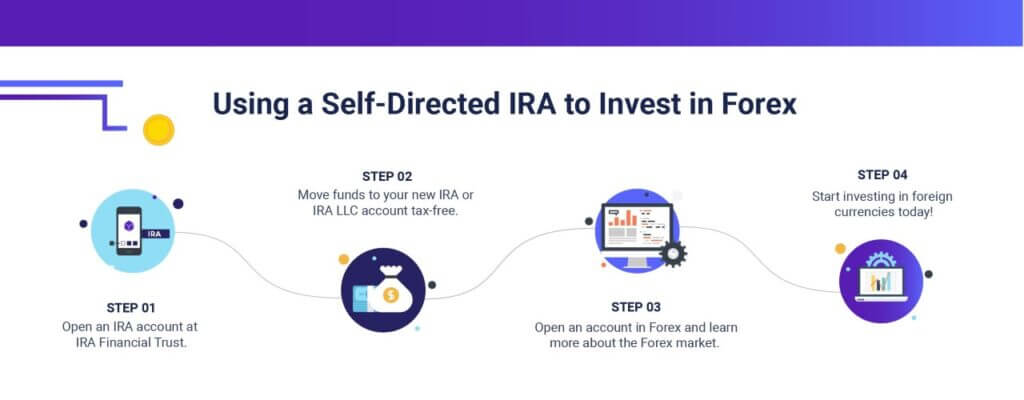
Tips to Use a Self-Directed IRA to Invest in Forex
- Do your research on the Forex company you will be using
- Understand that the Forex market is 24 hours and 5 days a week
- Forex investing can be highly profitable but also extremely volatile and risky
- You will likely need to establish a Self-Directed IRA LLC to invest in foreign currency
- All gains from the Forex investments will go back to the IRA without tax
- If you use margin to buy foreign currency, the loan cannot be personally guaranteed by the IRA owner. In addition, the use of margin could trigger the UBTI tax.
Conclusion
Using a Self-Directed IRA to invest in foreign currency investments could help better diversify your IRA savings, as well as allow you to generate tax-deferred (or tax-free with a Roth IRA) gains. Forex investments are risky and volatile, and one should do his or her research before investing retirement funds in foreign currency.

Cryptocurrency IRA (Crypto IRA)
The IRA Financial Crypto IRA allows you to use your retirement funds to invest in all types of cryptocurrencies, such as Bitcoin directly from your mobile device or PC securely, and cost-effectively.
What’s special about this IRAfi Crypto Platform?
- It is designed for Novice and Intermediate traders who want to get started without having to master a complex trading platform.
- No annual account valuation fees.
- $100 flat annual fee
- Most cost-effective way to HODL cryptos in an IRA
- It has a unique profit and history tracking tool that allows users to have a clear picture of their activities and the outcomes.
- It has direct education links to popular education sites to help users learn more about which coins to invest in. An example would be CoinMarketCap
- It provides real-time pricing and profit/loss trends on-screen that other popular trading platforms do not offer.
What is the IRA Financial Crypto Platform?
The IRAfi Crypto™ platform brings together the leading self-directed retirement provider with a leading regulated crypto exchange to remake and enhance the self-directed retirement account crypto industry. Powered by Bitstamp, a global cryptocurrency leader, retirement account investors can now buy, sell, or hold cryptocurrency via the IRA Financial app or website quickly, easily, and cost-effectively.
The IRA Financial Crypto™ platform is a dedicated platform for crypto traders. The platform will offer all retirement account owners the ability to invest in many of the most popular cryptocurrencies offered by the Bitstamp exchange, including Bitcoin, Ethereum, XRP, and much more with no annual custody asset holding fees. IRA Financial clients will be able to buy and sell cryptos 24/7 instantly or via a limit trading feature. The platform is available on Apple, Android & desktop. Cryptocurrency prices are updated in real-time with historical data on each coin, including total value & profit/loss at a glance.
Benefits of Investing in Cryptocurrency in an IRA
Cryptocurrency is a form of digital money that is designed to be secure and, in many cases, anonymous. A primary reason that cryptocurrencies have become a popular investment class for investors around the world is the idea of gaining exposure to an emerging asset class. In addition, blockchain technology, which is the main technology that powers cryptocurrency, is expected by many to revolutionize the way financial transactions occur globally.
For many investors, there is a significant upside to investing in cryptocurrency. That is, the cryptocurrency market is still young, and many investors are projecting future prices that would make buying any of the major cryptocurrencies a good long-term investment. There is a strong expectation that cryptocurrency will be an important medium of exchange and store of value in the future. Hence, the thinking goes that if cryptos, such as Bitcoin, have enormous upside, it makes tax sense to buy the cryptos in a self-directed IRA, especially a Self-Directed Roth IRA where all the gains can be tax-free. If you believe that the price of the most popular cryptos, such as Bitcoin or Ethereum will be considerably higher in the future, then it makes tax sense to buy the cryptos in a Self-Directed Roth IRA so you can lock in tax-free gains so long as you are over the age of 591.2 and the Roth has been opened at least 5 years.
Types of Cryptocurrencies
Bitcoin has become the leader in a wave of cryptocurrencies built on decentralized peer-to-peer networks and has become the primary standard for cryptocurrencies. The currencies inspired by Bitcoin are collectively called altcoins and have tried to present themselves as modified or improved versions of Bitcoin. While some of these currencies are easier to mine than Bitcoin, there are tradeoffs, including greater risk brought on by a degree of lesser liquidity, acceptance, and value retention.
A Bitcoin holds a very simple data ledger file called a blockchain. Each blockchain is unique to each user and his/her Bitcoin wallet.
All Bitcoin transactions are logged and made available in a public ledger, helping ensure their authenticity and preventing fraud. This process helps to prevent transactions from being duplicated and people from copying bitcoins.
While every Bitcoin records the digital address of every wallet it touches, the Bitcoin system does NOT record the names of the individuals who own wallets. In practical terms, this means that every Bitcoin transaction is digitally confirmed but is completely anonymous at the same time. People cannot easily see your identity; however, they will be able to see the history of your Bitcoin wallet.
While Bitcoin is the most popular cryptocurrency, there are countless others. Some individuals invest in Ethereum, while others like XRP, Cardano, Polkadot, VeChain, or other cryptocurrencies. Other individuals like to invest in stablecoins. Regardless of your crypto preferences, countless cryptocurrencies can be held in a Self-Directed IRA.
Related: The Positive Impact of Cryptocurrencies
Most Popular Cryptocurrency Investments
The following cryptocurrency investments have been popular with our Self-Directed IRA clients:
- Bitcoin
- Ethereum
- Litecoin
- Ripple
- Bitcoin Cash
- Binance Coin
- Tether
How are Cryptocurrencies Treated by the IRS?
Even though Bitcoin is labeled as a “cryptocurrency”, from a federal income tax standpoint, Bitcoins and other cryptocurrencies are not considered a “currency.” On March 25, 2014, the IRS issued Notice 2014-21, which for the first time set forth the IRS's position on the taxation of virtual currencies, such as Bitcoins. According to the IRS Notice, "Virtual currency is treated as property for U.S. federal tax purposes." The Notice further stated, "General tax principles that apply to property transactions apply to transactions using virtual currency."
In other words, the IRS is treating the income or gains from the sale of a virtual currency, such as Bitcoins, as a capital asset, subject to either short-term (ordinary income tax rates) or long-term capital gains tax rates, if the asset is held greater than twelve months (15% or 20% tax rates based on income). By treating Bitcoins and other virtual currencies as property and not currency, the IRS is imposing extensive record-keeping rules - and significant taxes - on their use.
Related: Can I hold my Private Keys in a Crypto IRA?
Can I Legally Purchase Cryptocurrency in my IRA?
The Internal Revenue Code does not describe what a Self-Directed IRA can invest in, only what it cannot invest in. Internal Revenue Code Sections 408 & 4975 prohibit Disqualified Persons from engaging in certain types of transactions. The foundation of the prohibited transaction rules is based on the premise that investments involving IRA and related parties are handled in a way that benefits the retirement account and not the IRA owner. The rules prohibit transactions between the IRA and certain individuals known as “disqualified persons”.
The definition of a “disqualified person” (Internal Revenue Code Section 4975(e)(2)) extends into a variety of related party scenarios but generally includes the IRA holder, any ancestors or lineal descendants of the IRA holder, and entities in which the IRA holder holds a controlling equity or management interest.
Because the IRS treats cryptocurrencies, such as Bitcoins, as a capital asset, such as stocks or real estate, a retirement account is permitted to buy, sell, or hold cryptocurrencies in their retirement subject to the prohibited transaction rules found under Internal Revenue Code Section 4975(c).
Tax Advantages of a Crypto IRA
The advantage of using retirement funds to invest in cryptocurrencies is that, in general, all the income and gains generated by the investment would not be subject to any tax or penalty. Instead of paying tax on the returns associated with the cryptocurrency investment, tax is paid at a later date, leaving the investment to grow unhindered. Using a self-directed IRA to make cryptocurrency investments is tax advantageous because the tax on the interest payments can be deferred in the case of a pre-tax IRA or exempted permanently in the case of a Roth IRA.
In addition, self-directed IRA investments are made when a person is earning a higher income and is taxed at a higher tax rate. Withdrawals are made from an investment account when a person is earning little or no income and is taxed at a lower rate.
How Do Your Fees Compare with Other Crypto IRA Companies?
IRA Financial does not charge an annual asset custody or valuation fees which makes our fees significantly lower than the majority of the Self-Directed IRA crypto providers. For example, several Self-Directed IRA crypto providers will charge trading fees plus a 1% annual asset custody fee. Thus, if your IRA crypto has a value of $100,000, you would pay a $1,000 annual fee, plus trading fees. In contrast, IRA Financial has a flat annual $100 fee, plus comparable trading fees.
How Does the IRA Financial Crypto Platform Work?
Step 1: Open an IRA or Solo 401(k) account via the IRA Financial app or website.
Step 2: Move IRA or 401(k) funds to a new IRA Financial account tax-free via transfer, rollover, or contribution.
Step 3: Once your self-directed IRA or 401(k) fund has been funded, you will be notified. Begin buying and selling cryptos 24/7 on your own without the need for any broker or the use of an LLC.
Why I Need a Self-Directed IRA to Invest in Cryptocurrencies
Unfortunately, none of the major financial institutions will allow you to use IRA or 401(k) plan funds to invest in cryptocurrencies or essentially anything outside of Wall Street. The reason for this is simple: banks do not make money when you invest in non-traditional equities, such as private equity or venture capital investments. They make money when you buy stock, mutual funds, and other financial products they market. As a result, a large number of individuals are turning to a Self-Directed IRA to invest in bitcoin and other cryptocurrencies.
Can you Explain Crypto Currency Investing?
We are very proud to have the industry’s best solution for buying Bitcoin and other major cryptocurrencies on an exchange in the name of an IRA or 401(k). IRA Financial was the first self-directed IRA company to allow their clients to invest in cryptocurrencies, such as Bitcoin, directly via a cryptocurrency exchange without the need for a third-party broker or the use of an LLC. Now, investors can use their retirement funds to buy all the major cryptocurrencies directly through Bitstamp, one of the leading US cryptocurrency exchanges. The IRA Financial Crypto™ Platform is unique because it allows retirement holders to hold cryptocurrencies in an IRA directly on an exchange. The account is opened in the name of the IRA but controlled by you as the authorized representative on the account. The IRA holder has 100% control over the account and can trade anytime.
Why did You Select Bitstamp as your Crypto Partner?
Bitstamp is the oldest and most reputable cryptocurrency exchange in the industry and has been operating since 2011. Bitstamp is regulated by the New York State Department of Financial Services (NYDFS). Bitstamp uses 2FA, SSL encryption, and cold storage for most of their crypto holdings, and have a dedicated security team working around the clock to prevent and respond to security attacks.
What Makes Bitstamp Security So Special?
Bitstamp’s main priority is to keep clients’ personal data safe and secure. Bitstamp employs best practices in terms of security, by utilizing advanced security technologies. Bitstamp has implemented the Multi-Sig technology to our hot wallet, where we keep only a very small portion of crypto assets, while the majority are safely stored offline, in cold storage systems.
Bitstamp has excellent security and is one of the safest cryptocurrency platforms. The exchange keeps 98% of assets offline in cold crypto storage. This is the most secure type of crypto storage because offline storage protects funds from hackers.
Do You Offer Crypto Limit Trading?
Yes. A limit order is a direction to purchase or sell crypto at a specified price or better. This feature allows retirement account investors to better control the prices at which they trade. A limit can be placed on either a buy or a sell order:
- A buy limit order will be executed only at the limit price or a lower price.
- A sell limit order will be executed only at the limit price or a higher one.
Can I Open an IRA or 401(k) Directly with Bitstamp?
No – the IRA Financial Crypto™ platform is the only way you can buy cryptos on Bitstamp using a retirement account directly.
What is the Difference Between a Self-Directed IRA and an IRA Financial Crypto™ Account?
A Self-Directed IRA account with IRA Financial allows you to invest in any IRS-approved alternative investment like real estate, private placements, gold, investment funds, including cryptos for one low flat fee. Whereas an IRA Financial Crypto™ account will you to exclusively buy cryptos for the annual low fee of just $100, plus trading fees. IRA Financial does not charge an annual custody fee based on the value of your cryptos.
Getting Started
We’re here to assist you. Contact IRA Financial to establish the Pocket Bitcoin IRA directly at 800-472-0646. You can also fill out one of our contact forms to speak with a tax specialist.

Do I need an EIN for my Solo 401(k)?
The Solo 401(k) plan, also known as an Individual 401(k) plan, has quickly become the most popular retirement plan for the self-employed or small business owner with no full-time employees. One may wonder if you need an EIN for your Solo 401(k) plan.
- When deciding on a Solo 401(k) plan provider, make sure they offer what you want
- An EIN is used as an identifier for a business or trust
- If you wish to open a bank acount for the plan, you will generally need an EIN
An Overview of the Solo 401(k)
Not all Solo 401(k) plans are the same! A business can acquire a Solo 401(k) plan from a bank or traditional financial institution. However, the plan will likely not include many of the most popular plan options, such as Roth contributions, a loan feature, and the ability to make alternative asset investments, such as real estate.
However, companies, such as IRA Financial, will help you establish a Self-Directed Solo 401(k) plan that include all IRS-permitted options, including a Roth sub-account, if interested, the ability to borrow up to $50,000 tax-free, and the option of investing in traditional, as well as alternative, asset investments on your own as trustee of the plan.
Solo 401(k) Plan EIN
An Employer Identification Number (EIN) is also referred to as a Federal Tax Identification Number, or FIN. The EIN is generally used to identify a business entity or trust, such as a retirement plan. In general, an EIN will be acquired on behalf of the plan. The EIN is used to allow the plan to open a bank account.
There is no formal requirement that an EIN be acquired for a Solo 401(k) plan since it is an owner-only plan. Many plan sponsors will use the plan participant’s social security number or business EIN as the plan tax identification number.
However, any Solo 401(k) plan that wants to establish a bank account will likely need an EIN for the plan. With IRA Financial, we can establish the plan's bank account via Capital One without an EIN, however, if you wish to use your own bank, you will need to have IRA Financial acquire an EIN for you.
[elementor-template id="70660"]
Does the Solo 401(k) Plan Trust Need an EIN?
A 401(k) plan is a trust, and under Internal Revenue Code Section 401, plan assets must be held in trust. There is no IRS or Department of Labor requirement that a separate trust be created in connection with the establishment of the plan. As a result, a separate trust is often not established as per the plan documents.
This is the reason why, in such a case, no separate trust agreement is required to be included in the plan documents, and it is also why a separate EIN is not required to be acquired for the plan trust. Typically, an EIN would only be acquired for the plan itself. Most Solo 401(k) plans will acquire an EIN for the plan for purposes of opening a bank or brokerage account.
Related: Popular Investments in a Solo 401(k)
Process for Acquiring a Solo 401(k) Plan EIN
For purposes of this article, let’s assume that Mike and his business ABC LLC establish a Solo 401(k) plan with IRA Financial. He requests IRA Financial to acquire an EIN for the plan so he can open a plan bank account. An EIN can be acquired by completing an online questionnaire at the IRS website or by completing and sending in IRS Form SS-4 to an IRS representative. When securing an EIN for a Solo 401(k) plan, the IRS will require the following information:
- Name of adopting employer
- Address and phone number of adopting employer
- Name of the trustee of the Solo 401(k) plan
- Name of plan
The IRS website will then provide the EIN# that can be used to open a bank account. Typically, the bank will require a copy of the plan adoption agreement, basic plan document, and EIN to open a plan bank account.
Why Work with IRA Financial?
It is important to work with a company that has the tax expertise to help establish an IRS-approved Solo 401(k) plan. Here are a few items that we feel sets IRA Financial apart from other providers:
- We literally wrote the book on the Self-Directed Solo 401(k) plan
- Get started in minutes with our industry leading app!
- Customized plan design based on your retirement & investment goals
- Never step foot in a bank—we open your self-directed bank account for you at Capital One
- We handle all IRS reporting and offer annual IRS compliance services
- Checkbook Control
- No Transaction fees
- No minimum balance fees
- No account valuation fees
- No wire fees
- Invest in alternative assets
- Dedicated one-on-one support from a 401(k) plan specialist
You will be assigned a dedicated self-directed retirement tax specialist that will assist you in setting up your IRS-compliant Solo 401(k) plan. Your specialist will finalize your plan documents as well as acquire the plan EIN.
Conclusion
In general, one is not required to acquire an EIN for his or her Solo 401(k) plan. However, most plans will acquire an EIN from the IRS for purposes of opening a bank account or establishing a plan brokerage firm.
Feel free to reach out to us if you have any questions about the Solo 401(k) plan and when you need to acquire an EIN for your plan.
Is ERISA Testing Required for a Solo 401(k) Plan?
A business owner with no common-law employees, who adopts a Solo 401(k) plan, is generally not required to perform ERISA nondiscrimination testing for the plan. This is because there are no non-owner employees. In fact, one of the requirements for opening a Solo 401(k) is the absence of full-time employees, other than a spouse or other owner.
- ERISA testing was put in place to protect all employees of a business
- Owners and highly compensated employees should not have an unfair advantage over those earning less
- A Solo 401(k) plan is designed for owner-only businesses and, therefore, ERISA testing is not reequired
What is ERISA?
The Employee Retirement Income Security Act (ERISA) is a 1974 federal law that oversees how employers provide benefit plans to employees. ERISA is administered by the Department of Labor (DOL). ERISA set forth rules and procedures for employers and benefit plan managers, trustees, and certain other service providers involving employer-sponsored retirement plans.
ERISA generally confirms minimum standards are set for most of the private industry retirement and pension plans. Rules under ERISA provide that eligible plan participants must be notified of benefit plan terms, including funding, coverage, and costs. Employees are also offered protections against fiduciary misconduct.
Related: Solo 401(k) Benefits
ERISA Testing – Quick Summary
Employer-sponsored 401(k) plans that cover non-owner employees are subject to ERISA law. ERISA was created to ensure that highly compensated employees (HCEs) or key employees do not receive or are provided with greater benefits than are available to lower paid workers. Therefore, ERISA has included certain compliance tests in order to compare benefits paid to lower paid employees to the HCEs.
The ERISA 401(k) plan annual compliance tests are the following:
- General Nondiscrimination Test (IRC 401(a)(4) (ADP & ACP)
- The Minimum Coverage Tests (IRC 401(b))
- Top Heavy Test (IRC 416)
- 402(g) limit test (i.e. employee deferral limit - $20,500 for 2022 - $27,000 if age 50+)
- 415 limits (i.e. $61,000 for 2022 - $67,500 for those age 50+)
Related: Solo 401(k) Investment Options
ERISA & the Solo 401(k)
A Solo 401(k) plan is essentially a 401(k) plan adopted by a business that has no full-time employees (over 1000 hours during the year) other than the owner(s) or spouse(s) of the owner(s). Under ERISA law, a spouse is not deemed an employee for testing purposes.
In other words, because a Solo 401(k) plan is not subject to the ERISA rules, as the adopting employer has no full-time employees other than the owner(s) or spouse(s), it is not required to perform any nondiscrimination testing. This makes a ton of sense since a business with no full-time employees is not in need of supervision by the DOL since they are in control of the plan.
The Solo 401(k) no-testing advantage vanishes if the employer hires employees. No matter what the 401(k) plan is called by a plan provider, it must meet the rules of the Internal Revenue Code. If employees are hired and they meet the eligibility requirements of the plan and the Code, they must be included in the plan and their elective deferrals will be subject to nondiscrimination testing (unless the 401(k) plan is a safe harbor plan or other plan exempt from testing).
Conclusion
If you are self-employed or own a business with no full-time employees, the Solo 401(k) plan is the best retirement plan you can open. ERISA was put into place to protect the "little man." One would hope every business owner would do right by all their employees (not just the owners or HCEs). Obviously, some business owners put their bottom line over that of the best interests of their employees. Hence, why the ERISA laws were created.
Obviously, when a business owner does not have other employees to worry about, they will choose the plan that is best suited for them. Because of this, the complicated ERISA non-discrimination testing is not needed. It's also one of the deciding factors when choosing a retirement plan when you are self-employed.
As mentioned above, as soon as you do hire any non-owner full-time employees, your plan will be subject to ERISA. You must ensure the plan benefits not only you, as the owner, but everyone who works for you. After all, the better benefits you offer your employee, the better employees you will attract, and retain.

Buy Tax Liens with Your Self-Directed IRA or Solo 401(k)
Few IRA holders realize they can use their retirement account funds to invest in tax liens. When you self-direct your IRA or Solo 401(k) Plan, your tax lien investments are tax-deferred. Tax liens are a lesser known and under-appreciated money-maker. However, learning how they can magnify your earnings in a tax-deferred IRA or 401(k) will make them among the soundest investments in your IRA.
Purchasing Tax Liens with Retirement Funds
Tax liens may be purchased using retirement funds. The purchase of tax lien certificates is a surprisingly safe investment, and the use of a Self-Directed IRA is one of the most tax efficient ways to finance your tax lien purchase. The primary advantages of using a self-directed IRA to make tax lien investments are as follows:
- Investment flexibility
- Steady Income Generator with no tax bite
– Tax Deferral
– Gains from the tax liens investment will flow back to the Self-Directed IRA - Control
- Diversification
- Tax Advantaged Investing
What is a Tax Lien?
Purchasing tax lien certificates is one way to get real estate exposure in your portfolio without investing in any property. While sophisticated investors can make decent returns by investing in tax liens, novices can easily get burned. Here’s how it works: When a property owner fails to pay his or her taxes, the municipality in which the property is located can sell its tax lien — the right to foreclose on a property when the owner has failed to pay taxes.
The winner of a tax lien certificate is typically the investor willing to accept the lowest interest rate. Most tax liens purchased at auction are sold at rates between 3 percent and 8 percent nationally. The property owner has a redemption period — generally one to three years — to pay the taxes plus interest. If the property owner fails to pay the property taxes by the end of the redemption period, the lienholder can initiate foreclosure proceedings to take ownership of the property. However, this rarely happens because the taxes are generally paid before the redemption date. The interest rates make tax liens an attractive investment.
Types of Tax Liens
There are two types of tax lien sales through auction: the tax lien certificate and the tax lien deed. Both can be a safe yet profitable opportunity for investors with checkbook control.
Tax Lien Certificates
Tax Lien Certificate sales offer the delinquent homeowner one last chance to retain ownership of their property. This occurs by using third-party investment money to pay off the taxes and give them a bit more time to collect the money necessary to pay their debt without the risk of losing their home.
When an investor bids on a tax lien certificate, he is in essence agreeing to loan the homeowner the money necessary to pay all taxes due. The homeowner, in turn, agrees to pay back the tax lien certificate holder - with interest - by a specified date.
If the homeowner fails to pay the debt on time, the deed to the property is transferred to the investor for the amount paid on the taxes. Either way, the investor makes a profit. Either on the interest he earns on the loan, or by obtaining the property for a fraction of its value through the tax lien sale, and then reselling it.
Tax Lien Deed
Tax Lien Deed sales are handled a bit differently since the investor is actually bidding (or buying), the complete property at the time of auction. The investor has no responsibility to give the homeowner more time to pay his/her tax debt.
Once the selling price is approved, the deed is automatically transferred to its new owner. This gives the investor full reign as to what to do with the property next: renovate it, sell it as-is, or raze the existing house and build anew.
Investors usually pay more for properties in this type of tax lien sale, which may lower their profit margins in comparison to the acquisition of tax lien certificate properties.
But many investors prefer outright purchases to eliminate problems with current homeowners. Either way, this is a profitable and easy way to enter the real estate market in virtually any area.
Facts & Opportunities Surrounding Tax Liens
Real estate has long been considered one of the best (and safest) investment opportunities for both the large and small capitalist. Savvy investors know that the trick to making money in a downward spiraling market is to purchase properties for a fraction of their value.
The question is…How? Many are finding the perfect answer in the high-profit possibilities of investing in Tax Lien Sales.
When a property owner falls behind on their taxes, failing to pay for one or more years, the local taxing authority has the legal right to place a lien or repossess the property. They often sell it at auction to recoup the lost tax revenue.
The lien laws in your area detail how long local authorities wait to seize your properties. It also determines how much they allow to be owed in the property.
In many cases, properties can be acquired for a few thousand dollars, regardless of how much it's actually worth. Similarly, paying off the lien on others may more than the house or land is worth. A savvy investor takes the time to research each property carefully prior to sale day.
Tax Lien Sales
Tax lien sales usually happen at public auctions once or twice a year. This depends on the area in which it is located, and how many properties the government may seize annually for back taxes.
Larger urban areas may hold monthly auctions, while smaller rural ones might only have one a year.
Investing in Tax Liens with Retirement Funds
The use of a Self-Directed IRA is one of the most tax-efficient ways to finance your tax lien purchase. IRA Financial Group’s IRA LLC allows investors to participate in a wide range of investment vehicles including, but not limited to:
- tax liens
- real estate
- mortgages
- franchise
- notes
- stocks and mutual funds
- partnerships,
- Cryptocurrencies and more!
Learn More: Open a Self-Directed IRA Online
The Solo 401(k) Plan
The Solo 401(k) Plan offers a highly attractive loan feature. This can allow for the purchase of tax liens. Under the Solo 401(k) Plan, you can borrow either $50,000 or 50% of their account value - whichever is less.
The IRA Financial Group Solo 401(k) Plan documents will allow you to use a loan from your Solo 401(k) to finance your tax lien purchase.
These unique IRS approved structures are created by IRA Financial Group’s in-house tax and ERISA professionals who personally customize your account structure to suit your needs.
Only a handful of institutions are skilled in these specialized account structures and IRA Financial Group is the “gold standard” for Compliance, Leadership, Customer Service, and Technological Innovation.
Read More: How to Open a Solo 401(k) Online
Are Tax Liens a Good Investment?
While we can't give you investment advice, investing in tax lien certificates in an IRA or Solo 401(k) has the following benefits:
Double Your Money Quickly
You can supercharge a Self-Directed IRA LLC or Solo 401(k) plan when you buy tax lien certificates.
Example: A tax lien certificate can earn up to 16% annually in your Self-Directed IRA or Solo 401(k). When you buy tax lien investments you generally receive the amount invested plus interest within 12 months.
If you continue to reinvest in tax liens year after year at 16%, you can double your money in about 4.4 years. Only a Self-Directed IRA LLC can preserve this 16% return.
Your Money Grows Tax-Free
When you buy tax liens in an IRA Financial Self-Directed IRA LLC or Solo 401(k), you can avoid all taxes until the money invested is withdrawn from the IRA or 401(k). The distribution usually occurs around age 59 1/2.
You can invest the money once, twice or a thousand times. Continue to grow your investments tax-free, so long as it is not withdrawn for personal use. If you use a Self-Directed Roth IRA LLC, your investment will grow tax-free and you can withdraw the funds tax-free once you reach the age of 59 1/2.
The Flexibility to Buy Time Sensitive Investments
IRA Financial Group’s Self-Directed IRA LLC allows you to carry a checkbook that is tied to the account. The Solo 401(k) Plan allows you to serve in the trustee role. This means that all assets of the 401(k) trust are under your sole authority (“checkbook control”).
This gives you incredible freedom to fund the investment at a moment's notice. In this arrangement, you can buy tax liens with the stroke of the pen. You don't need a custodian or other bureaucrat saying no or try to slow down the process.
Tax liens are backed and leveraged by real estate and guaranteed by the governmental taxing authority. In most states, they are a first lien on real estate. When foreclosed, they wipe out all junior liens, including mortgages.
This allows you to potentially receive a valuable piece of real estate for pennies on the dollar!
Time to Act
Real property has been the cornerstone of wealth for thousands of years. While ill-informed speculators have fled real estate because of the housing bust, intelligent real estate investors are enjoying immense profits by expanding their geographic scope and investing for predictable income.
Get in Touch
Do you still have questions that were not discussed in this article? You can contact IRA Financial Group directly at 800-472-0646 with your questions. Or fill out the form and speak with an IRA or 401(k) specialist today.

How to Transfer a Roth IRA to a Self-Directed Roth IRA
Individuals may generally transfer Roth IRA or rollover eligible qualified retirement plan assets into a Self-Directed Roth IRA structure. Individuals may not rollover Roth IRA funds into a qualified retirement plan, such as a Solo 401(k) Plan, or a pretax IRA account, such as a Traditional IRA or SEP IRA.
- Roth IRAs are funded with after-tax money, however, all qualified distributions are tax free
- A Self-Directed IRAs allows for alternative asset investments, including real estate, cryptos and private businesses
- A transfer occurs when funds are moved from one IRA (or Roth IRA) to another
What is the most Common Way to Fund a Self-Directed Roth IRA?
Transfers and rollovers are types of transactions that allow movements of assets between like IRAs – Roth IRA to Roth IRA. Note – only after-tax funds can be rolled into a Roth IRA. No pretax retirement funds are eligible to be rolled into a Roth IRA.
Roth IRA Transfers to a Self-Directed Roth IRA
A Roth IRA-to Roth IRA transfer is one of the most common methods of moving assets from one Roth IRA to another. A transfer usually occurs between two separate financial organizations, but a transfer may also occur between Roth IRAs held at the same organization. If a Roth IRA transfer is handled correctly the transfer is neither taxable nor reportable to the IRS. With a Roth IRA transfer, the Roth IRA holder directs the transfer but does not receive the Roth IRA assets. Instead, the transaction is completed by the distributing and receiving financial institutions. In sum, for the Roth IRA transfer to be tax-free and penalty-free, the Roth IRA holder must not receive the Roth IRA funds in a transfer. Rather, the check must be made payable to the new Roth IRA custodian. Also, there is no reporting or withholding to the IRS on a Roth IRA transfer.
The retirement tax professionals at the IRA Financial will assist you fund your Self-Directed Roth IRA LLC by transferring your current Roth IRA funds to your new Self-Directed Roth IRA structure tax-free and penalty-free.
Considering a Roth Conversion?
Our Experts are Here to Help
How The Transfer Works
Your assigned retirement tax professional will work with you to establish a new Self-Directed Roth IRA account at a new FDIC and IRS-approved Roth IRA custodian. The new custodian will then, with your consent, request the transfer of your Roth IRA assets from your existing Roth IRA custodian in a tax-free and penalty-free Roth IRA transfer. Once the Roth IRA funds are either transferred by wire or check tax-free to the new Roth IRA custodian, the new custodian will be able to invest the Roth IRA assets into the new Roth IRA LLC “checkbook control” structure. Once the funds have been transferred to the new Roth IRA LLC, you, as manager of the Roth IRA LLC, would have “checkbook control” over your retirement funds so you can make traditional as well as non-traditional investments tax-free and penalty-free.
Read More: What is Checkbook Control Self-Directed IRA?
60-Day Rollover Rule
An individual generally has sixty (60) days from receipt of the eligible rollover distribution from a Roth IRA account to roll the funds into a Self-Directed Roth IRA LLC structure. The 60-day period starts the day after the individual receives the distribution. Usually, no exceptions apply to the 60-day time period. However, in cases where the 60-day period expires on a Saturday, Sunday, or legal holiday, the individual may execute the rollover on the following business day.
An individual receiving an eligible rollover distribution may rollover the entire amount received or any portion of the amount received. The amount of the eligible rollover distribution that is not rolled over to a Roth IRA is generally included in the individual’s gross income and could be subject to a 10% early distribution penalty if the individual is under the age of 59 1/2.
Read More: Roth IRA Distribution Rules
How the 60-Day Rollover Works
The retirement tax professionals at the IRA Financial Group will assist you in rolling over your 60-day eligible rollover distribution to a new FDIC and IRS-approved IRA custodian. Once the 60-day eligible rollover distribution has been deposited with the new Roth IRA custodian within the 60-day period, the new custodian will be able to invest the Roth IRA assets into the new Roth IRA LLC “checkbook control” structure. Once the Roth IRA funds have been transferred to the new Roth IRA LLC, you, as manager of the Roth IRA LLC, would have “checkbook control” over your retirement funds so you can make traditional as well as non-traditional investments tax-free and penalty-free.
Learn More:
Alternative Investments in an IRA
Real Estate Investing with a Self-Directed IRA

Investing in Precious Metals with Your Retirement Account

It has been almost 50 years since the establishment of IRAs. Yet most retirement account holders are still not aware that they can buy real estate, precious metals, and other alternative assets with an IRA (individual retirement account).
By using a self-directed IRA, an IRA holder can make traditional as well as alternative asset investments. Such investments include:
- Real estate
- Notes
- Tax liens
- Precious metals
- Cryptocurrencies
- Private businesses
In fact, the Internal Revenue Code only describes two assets you cannot invest in: collectibles and the prohibited transactions under IRS 4975. Code Sections 408 and 4975 prohibit Disqualified Persons from engaging in certain types of transactions, but in general, the self-directed IRA can make just about any investment.
Because of advertising by precious metals dealers, more people are becoming aware that they can invest in precious metals with retirement funds. In fact, as an IRA investor, you can purchase some of the most popular metals, such as gold, silver, and palladium.
Individual retirement accounts can even hold certain coins. The IRC has a list of coins and precious metals that you can purchase, because the IRC doesn't consider them to be "collectibles." You can find this list in IRC Section 408(m). Section (m) applies to both IRAs and 401(k) plans.
Investing in Precious Metals
Gold, palladium, and silver are always a good investment, especially when being held for retirement. With a Self-Directed IRA, investors can devote their funds to many different alternative assets that are not as affected by stock market fluctuations and other volatility.
Alternative assets are investments outside of traditional investments. Common examples of alternative investments include real estate, private equity, precious metals, such as gold, and venture capital investments. Whereas traditional investments include stocks, bonds and bank CDs. Alternative investments are more complex than traditional investments, which is why they appear to be better suited for "accredited" or "qualified" investors.
Interest in precious metals has grown further since the COVID-19 pandemic. A surge in inflation, combined with record government spending, rapidly rising interest rates, and ongoing geopolitical tension, pushed the price of everyday goods higher across the board, from groceries and housing to automobiles and travel. That environment renewed investor focus on protecting purchasing power, and it is one of the main reasons more retirement investors now consider gold, silver, platinum, and palladium as part of a diversified portfolio.
Is Gold a Good Investment?
Recently, there has been much discussion over the impact of alternative investments with the recent Stock Market downturn. The price of Gold and other precious metals have remained high over the past two years. As the future of gold appears more and more favorable, is now the time to buy?
IG Index contributor and author of the Brookville Capital Newsletter, Simon Popple reiterates what every investor should know: investing is all about timing.
“For the past few years there have been many other, more traditional investments that have been doing very well,” Popple explains. “But all these markets are either at or close to all-time highs, so people are being forced to look elsewhere.”
Gold is an inflation hedge and is a more attractive investment during times of inflation. As the cost of the U.S. dollar declines, the value of gold rises. With the current global financial market, the latent inflationary fears have rebounded and as a result, more individuals are turning to gold investments.
Certainty in an Uncertain World
“In the current market, you have a lot to worry about,” says Popple. “For many, physical gold provides a degree of certainty in an uncertain world.”
The importance of retirement portfolio diversification has increased with the devalue of currencies and the concerns of debt and inflation.
Self-Directed retirement plans, such as the Self-Directed IRA, are perfect retirement vehicles for retirement diversification. For example, retirement investors have the ability to purchase traditional assets, such as stocks and bonds, but they can also purchase alternative assets, like gold, to mitigate risk of investments moving in the same direction.
“Bonds and the U.S. dollar used to be viewed as the go-to assets in weak markets,” says Popple. “But with many bonds offering little or negative yield, investing where you're going to lose money does not make a huge amount of sense.”
Palladium Emerging as a Hot Investment
Unlike gold and silver, palladium has been relatively ignored by self-directed IRA investors over the years. However, over the last year or so investors are starting to look more positively at palladium as an appropriate investment for their retirement account.
On March 19, 2019, palladium rose to an all-time high as the supply outlook tightened further, while gold dipped ahead of an interest rate decision in the United States.
Spot palladium hit a record $1,608 an ounce earlier before easing back to trade 0.29 percent lower at $1,591.85. Because of the tight supply in the palladium market, along with Russia's threat of potentially cutting supply, the Palladium market has heated up over the last several months. However, the main reason the price of palladium has increased over the years is because its primary use is as an emissions reducing catalyst in automobiles and gasoline engines.
Common Uses of Palladium
In general, about 80 percent of palladium ends up in the exhaust systems in cars, where it helps turn toxic pollutants into less-harmful carbon dioxide and water vapor. It is also used in electronics, dentistry and jewelry. The metal is mined primarily in Russia and South Africa.
Depending on where the supply goes, the price of palladium may increase in the future. Some self-directed IRA and solo 401(k) plan investors are counting on this.
Buying Silver with Retirement Funds
Silver prices have climbed higher in the last few weeks than they have been in years, lifted by factors such as soaring investor demand for precious metals. Silver has climbed a whopping 68% since the middle of March. Almost all asset classes tanked at the start of this crisis. However, silver has made a remarkable improvement. Investors are encouraged by the steps governments and central banks have taken to strengthen an economy decimated by COVID-19.
In addition, silver prices have also benefited from the reopening of factories in the U.S., China and elsewhere. Silver has industrial applications, medical purposes, and use in consumer electronics, among other uses. From jewelry and table settings, to dentistry and more, there are common uses for silver throughout the world. Although many people flock to gold, silver should not be overlooked!
Why Does the IRS Allow Precious Metals in an IRA?
Most investors know that the Internal Revenue Code generally prohibits IRAs from holding collectibles, such as artwork, antiques, rugs, gems, stamps, alcoholic beverages, and most rare or graded coins. Under IRC Section 408(m), if an IRA acquires a collectible, the purchase is treated as a taxable distribution to the account holder as of the date of purchase.
Congress created a specific exception for certain precious metals because investment grade bullion behaves differently than a collectible. It has a widely recognized market value, trades on established global markets, and has long served as a legitimate store of wealth rather than a personal keepsake. That exception is why an IRA can own certain gold, silver, platinum, and palladium bullion and coins, provided the metals meet strict purity standards and are held the right way.
The exception is narrow, however. Owning something made of gold or silver does not automatically make it IRA eligible. The rules focus on bullion and a limited list of approved coins, not on items whose value comes primarily from rarity, age, or collectability.
What Type of Precious Metals and Coins are IRS Approved?
Internal Revenue Code Section 408(m) lists the type of precious metals and coins that you can purchase with your IRA funds. Generally speaking, the metal must meet a minimum purity standard:
- Gold bullion must be at least 99.5% pure
- Silver bullion must be at least 99.9% pure
- Platinum and palladium bullion must generally meet a 99.95% purity standard
Congress also approved a short list of specific coins, even where a coin does not technically satisfy the purity thresholds above. The best known example is the American Gold Eagle. Other commonly held IRA eligible coins include the Canadian Maple Leaf, the Australian Kangaroo, the Austrian Philharmonic, and bars or rounds produced by approved refiners that meet the statutory purity standards. The Technical and Miscellaneous Revenue Act of 1988 also allows the purchase of certain state minted coins.
On the other hand, many items investors are naturally drawn to do not qualify. Rare coins, numismatic coins, pre-1933 U.S. gold coins, graded collectible coins, jewelry, artwork incorporating precious metals, and most commemorative coins are generally prohibited investments for an IRA. Their value comes from scarcity, condition, or collector demand rather than the underlying metal content, which is exactly what the collectibles rule is meant to prevent.
Getting this wrong is costly. If an IRA purchases a prohibited collectible, the IRS generally treats the purchase as if the IRA had distributed the purchase price to the account holder on the date of acquisition. That can trigger immediate income tax on the amount involved, plus a 10% early distribution penalty if the account holder is under age 59 1/2.
Because the rules are technical, it is worth confirming eligibility with an experienced Self-Directed IRA provider and a reputable precious metals dealer before making a purchase, rather than assuming a metal or coin qualifies.
The Advantage of a Precious Metals IRA
Many IRA investors avoid precious metals investments due to lack of knowledge. But a precious metals IRA is a good way to increase your wealth as the value of the dollar decreases. All it takes to start investing in this asset is due diligence. Make sure you do your research on all investments.
The most popular precious metals are, as you may know, gold and silver. However, all precious metals are in great demand and that doesn't appear to be changing. Take a look at additional benefits this alternative asset has to offer:

- Easily convert precious metals, like gold and silver, into cash.
- During inflation, precious metals can act as a hedge.
- Because it's an alternative asset, precious metals help to diversify your retirement account portfolio.
- Precious metals, such as gold and silver, are accepted all over the world. There are a few investments that are accepted across the globe.
Tax Advantages of Holding Precious Metals in an IRA
If precious metals are purchased in a taxable brokerage account, any gain is generally taxed when sold. Physical precious metals are often taxed under the federal collectibles tax rules, which can result in a higher rate than the one that applies to most long term capital gains. State income tax may apply as well.
Holding precious metals inside a retirement account changes that. In a Traditional Self-Directed IRA, gains generally grow on a tax deferred basis. There is no tax due when the value of the metals increases, or when the IRA sells one qualifying metal and buys another. Tax is generally due only when distributions are taken from the IRA.
In a Roth Self-Directed IRA, the benefit can be even greater. As long as the Roth requirements are met, including the five year holding period and the age 59 1/2 distribution rule, qualified distributions, including years of appreciation, can be received completely free of income tax.
While purchasing precious metals in a retirement account has multiple benefits, it is important that you work the right Self-Directed Custodian. Many Self-Directed IRA Custodians allow precious metals to be held in retirement accounts. However, many also charge account valuation fees that can quickly eliminate your profits. Unlike other IRA Custodians, IRA Financial charges a flat annual account fee.
Rules for Holding Precious Metals in an IRA
There are certain IRC rules to be aware of before purchasing, holding, and selling precious metals in an IRA. According to IRC Section 408(m), gold, silver, platinum, and palladium bullion must be held in the physical possession of a U.S. trustee, generally an IRS approved bank, financial institution, or depository.
For years, some promoters marketed so called “home storage IRAs,” telling investors that a Self-Directed IRA LLC, sometimes called a checkbook IRA, allowed them to store IRA owned metals in a home safe, a personal safe deposit box, or an office. That advice put many investors in a very risky position.
McNulty v. Commissioner
The Tax Court's decision in McNulty v. Commissioner settled the issue. The court held that an IRA owner who took personal possession of IRA owned coins, even though the coins had technically been purchased through an IRA owned LLC, had received a taxable distribution from the IRA. It did not matter that the LLC was the titled owner of the coins. Because the coins were in the IRA owner's personal control, the IRS treated the full value as a distribution, subject to income tax and, in that case, an early distribution penalty.
The lesson from McNulty is straightforward. An IRA LLC gives the IRA owner investment authority. It does not give the IRA owner personal ownership of IRA assets, and it does not eliminate the custody rules under IRC 408. If a Self-Directed IRA or IRA LLC purchases precious metals, those metals should be delivered directly to an IRS approved U.S. depository and remain there until they are sold or distributed from the account. They should not be kept in a home safe, an office, or a personal safe deposit box, regardless of whether the IRA or an IRA owned LLC is the titled owner.
Several well established U.S. depositories specialize in safeguarding IRA owned precious metals. These facilities provide secure storage, insurance, inventory controls, and independent reporting, allowing investors to hold physical bullion without putting the tax deferred or tax free status of their retirement account at risk. The cost of professional storage is minor compared to the tax consequences of getting this rule wrong.
Holding Precious Metals in a Self-Directed IRA
A number of IRA investors are not aware that they can use their retirement funds to invest in precious metals. This is because traditional financial institutions don't tell their clients about alternative asset investments. They want IRA holders to invest in their products, such as stocks, bonds and mutual funds. In other words, traditional investments.
However, you can purchase, hold and sell precious metals with a Self-Directed Precious Metals IRA. Additionally, you can make withdrawals of bullion to physically possess this asset once it is properly distributed from the account.
You can use an IRA to invest in precious metals in a few simple steps. You must first establish a Self-Directed individual retirement account.
1. Establish Your Self-Directed IRA or Solo 401(k)
Take control over your investment decisions with a Self-Directed IRA. If you're self-employed or a small business owner with no full-time employees, you can establish a precious metals IRA with a Solo 401(k) plan. If you have a full-time job and contribute to an employer's 401(k) plan and have self-employment income, you also have the option to open a Solo 401(k). With IRA Financial, you will be assigned a retirement tax professional to establish your account at a new FDIC and IRS approved custodian.
Choose a self-directed IRA custodian, such as IRA Financial Trust, for a cost-effective, easy solution.
2. Fund Your Self-Directed IRA
Now it's time to fund your SDIRA. Your new custodian will request the transfer of IRA assets from your current IRA custodian. If done correctly, the transfer will be tax-free and penalty-free. Typically, retirement funds move from one account to another by way of a transfer or rollover.
3. Invest in Precious Metals
With the funds now in your newly established Self-Directed IRA, you are the manager of the IRA LLC and you're ready to purchase IRS approved precious metals tax and penalty-free.
Choosing the Right Precious Metals Dealer and Depository
Deciding to invest in precious metals through a Self-Directed IRA is only part of the process. Where the metals are purchased and where they are stored matter just as much.
The precious metals industry has its share of bad actors. Some investors have paid excessive markups, purchased coins that were never appropriate for a retirement account, or worked with dealers who pushed high commission collectible products instead of investment grade bullion, often without realizing it until years later. Investors should compare pricing, confirm exactly what they are buying, and work only with dealers who have real experience handling retirement account transactions.
IRA Financial does not manufacture or sell precious metals and does not require clients to use a particular dealer. Instead, IRA Financial maintains relationships with established precious metals dealers who regularly work with Self-Directed IRA investors and can offer guidance on request, while leaving the final decision to the client.
The same approach applies to storage. Because IRA owned precious metals must remain in the custody of an IRS approved U.S. depository, choosing the right facility is an important step. Depositories differ in location, storage fees, segregated versus non-segregated storage options, insurance coverage, and reputation. IRA Financial works with several leading IRS approved depositories and helps clients understand the differences so they can choose the option that fits their goals and budget, while coordinating the paperwork so the metals are shipped directly from the dealer to the depository, never to the investor's home or office.
Precious Metals as a Diversification Tool, Not a Replacement
Precious metals were never designed to replace stocks, real estate, or other core retirement investments. There have been long stretches when stocks or real estate significantly outperformed gold, and periods when gold outperformed nearly everything else, particularly during high inflation or geopolitical uncertainty. The value of precious metals in a retirement portfolio is less about beating the market every year and more about holding an asset that has historically behaved differently than stocks and bonds during periods of economic stress. Investors should treat an allocation to precious metals as one part of a diversified strategy, not a bet that gold will outperform every other asset class.
The Final Verdict on Precious Metals in an IRA
IRA Financial advises all clients purchasing IRS approved coins or precious metals with a retirement account to hold them with a qualified trustee, such as an IRS approved depository. Following McNulty v. Commissioner, this is no longer just the safest approach, it is the standard the Tax Court has confirmed. Storing IRA owned metals at a bank safe deposit box or anywhere else under the personal control of the IRA holder, whether the metals are owned directly by the IRA or through an IRA LLC, creates a real risk that the IRS will treat the investment as a taxable distribution.
The Final Verdict on the Solo 401(k) Rules
The same principle applies to a Solo 401(k) plan. IRC Section 408(m)(3)(B) refers to “a trustee” rather than “the trustee,” which offers some support for the idea that qualifying metals can be held at any qualified trustee, since a depository is technically a trustee under IRC 408(a). That flexibility, however, is not an invitation to hold metals personally. Whether the plan trustee is the individual serving as trustee of a Solo 401(k) or a bank serving as IRA custodian, the safest and most defensible approach remains the same: precious metals should be held with an IRS approved depository, not personally by the account holder.
Work with a Professional
The rules surrounding the ownership and possession of IRS approved precious metals or coins are complex, and the McNulty decision shows how costly it can be to get them wrong. It is crucial to work with a firm, such as IRA Financial, that can help you navigate the IRS rules, confirm which metals and coins are eligible, and coordinate properly with a reputable dealer and an IRS approved depository from start to finish.

Buying Stocks in a Self-Directed IRA
As you probably know, you can invest in just about anything with a Self-Directed IRA. Here at IRA Financial, we stress the importance of properly diversifying your holdings. Generally, we tout the benefits of alternative investments in your IRA. These include real estate, precious metals, tax liens, and cryptocurrencies. Today, our focus is on a traditional asset, stocks! Stocks are an essential part of everyone's retirement plan. Over the last several years, we've seen huge gains in the stock markets. Of course, that all came crashing down due to the current pandemic that's spread across the globe. However, now may be a good time to look at stocks in your Self-Directed IRA. It seems we have bottomed out, and the markets can only go up right now. Using a brokerage account to invest in stocks with an IRA is very tax-advantageous.
- A Brokerage Account allows you to buy and sell stocks
- A Self-Directed IRA can be used for traditional and alternative investments
- Checkbook Control gives you the freedom to make any investment you want
What is a Brokerage Account?
A brokerage account is a type of investment account that one can open with a brokerage firm. The brokerage account can be opened by an individual or an entity, such as an LLC. It can be funded by depositing money into this account by writing a check, wiring money, or a fund transfer. Once funds have been deposited, the available funds can be used to buy or sell several types of investment securities, such as individual stocks, exchange-traded funds (ETFs), mutual funds, bonds, etc.
A brokerage account is the only way one can invest in traditional securities. There is no limit on the number of brokerage accounts you can open. One should be aware of the financial strength of your broker and the extent of its Securities Investor Protection Corporation or SIPC coverage. This insurance compensates investors if their stock brokerage firm goes bankrupt.
Related: Buying GME Stock in a Self-Directed IRA
Opening a Brokerage Account with a Self-Directed IRA
When investing with a Self-Directed IRA LLC, it is important to remember that the investment should be made in the name of the LLC and not the IRA, which is the owner of the LLC.
A single-member limited liability company (“LLC”) owned by an IRA is treated as a disregarded entity for Federal Income Tax purposes. In other words, the LLC is treated as an "invisible" entity for tax purposes and the sole owner of the LLC, the IRA, is treated as the owner. Accordingly, when opening a brokerage account for a single-member LLC owned by an IRA, the account should be opened in the name of the LLC. However, from a Federal Income tax perspective, the LLC is ignored for tax purposes and the IRA is treated as the sole owner of the account. Therefore, even though the account is opened in the name of the LLC, from a tax standpoint, the IRS is the beneficial owner of the account, generally resulting in tax-exempt treatment for all income and gains earned by the IRA LLC.
Rules of the Self-Directed IRA to Buy Stocks
Above all else, the IRA must be the entity that benefits from an investment. In no way should an IRA benefit you (the IRA owner) or any other disqualified person. A disqualified person includes your spouse, children, grandchildren, parents, grandparents, and entities controlled by such persons. As soon as someone other than the IRA gains something from an IRA investment, the IRA will be disqualified. This means you lose out on all the tax benefits of the plan. Traditional IRAs benefit from tax-deferred savings (with an upfront tax break). On the other hand, a Roth Self-Directed IRA offers tax-free withdrawals during retirement (no upfront tax break).
The other part of the prohibited transaction rules is the types of investments not allowed by the IRS. These include life insurance, most collectibles, and, as mentioned above, transactions involving a disqualified person. All public stocks and mutual funds are fair game. Therefore, you can invest in any stock with your brokerage account in a Self-Directed IRA.
Checkbook Control
The other main advantage of a Self-Directed IRA is the checkbook control structure. Using an LLC allows the IRA holder to make IRS-approved investments more quickly and with fewer fees. The beauty of a Self-Directed IRA LLC is that, as manager of the IRA LLC, you will have total control over the assets. You have the choice to make traditional investments, such as stocks and mutual funds, as well as alternative assets, such as real estate. We've always stressed that it's your money, invest it the way you see fit! No need to ever ask IRA Financial when you want to invest.
Open a Self-Directed IRA for Stock Trading
- Establish a Self-Directed IRA with an IRA custodian or trust company that allows for alternative investments, such as IRA Financial.
- Transfer (or rollover) your retirement assets that you will be using for investing tax-free to your new IRA custodian.
- A special purpose LLC will be established that will be wholly owned by the IRA.
- Establish a brokerage account for your LLC at any brokerage firm. You will need to have the LLC article of formation, a Tax ID#, as well as a Self-Directed IRA LLC operating agreement. The brokerage account should be opened in the name of the LLC and not the IRA.
- Notify your IRA custodian that you wish to have the funds sent to the newly established brokerage account. The IRA assets/cash will then be transferred tax-free, in exchange for 100% interest in the LLC
- You, as manager of the LLC, will then have checkbook control over all the assets/funds in the IRA LLC to invest.
- Since the LLC will be owned by one IRA, the LLC will be treated as a disregarded entity for federal income tax purposes and no federal income tax return will be required to be filed. All income and gains from the stock investments will flow back to the IRA without tax.
Buy, Sell, and Trade Stocks
Once your brokerage account is all set up, you can then buy, sell, and hold stocks within your Self-Directed IRA. Using a Self-Directed IRA LLC affords the IRA holder a considerable amount of freedom when it comes to making IRS-approved investments, whether traditional or alternative. Now may be the best time to invest your retirement money in stocks, bonds, and mutual funds. Bear in mind, it's still important to properly diversify your portfolio. The easiest way to do that is by looking at alternative investments.
Read More:
Traditional IRA vs Self-Directed IRA
Self-Directed IRA Contribution Limits