

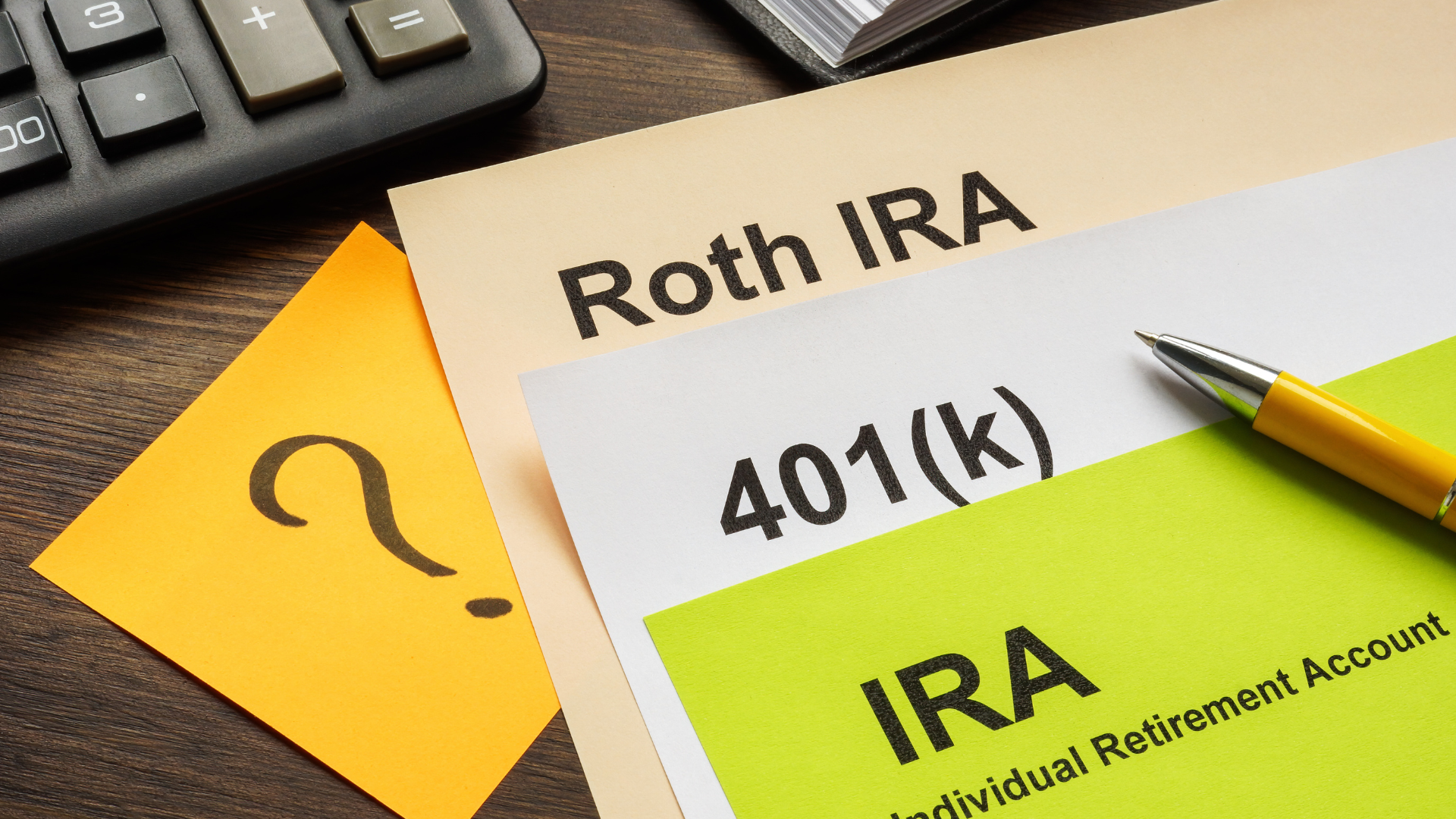
Can I Have a 401(k) and a SDIRA at the Same Time?
One of the most common questions I hear is whether you can have both a 401(k) and a Self-Directed IRA. The answer is simple.
Yes. You can have both at the same time.
Not only is this permitted under the Internal Revenue Code, but it is also a strategy many experienced investors use to maximize tax advantages, increase diversification, and accelerate long-term wealth accumulation.
There is no rule in the tax code that limits you to one retirement account. You are not forced to choose between a 401(k) and an IRA. You can maintain multiple IRAs, a 401(k), and even additional retirement vehicles simultaneously. The only limits involve annual contribution caps and certain income-based deduction rules.
There is no restriction on the number of IRAs you can own. There is also no cap on how large your retirement accounts can grow. The IRS limits how much new money you contribute each year. It does not limit how much your accounts can grow through compounding and investment performance.
That distinction matters. Retirement planning is not about picking one account type. It is about layering different account structures to create tax efficiency, diversification, and long-term flexibility.
Two Types of 401(k): Which One Do You Have?
Before going further, it is worth clarifying that not all 401(k) plans are the same. There are two primary types, and the differences matter when you are thinking about pairing a 401(k) with a Self-Directed IRA.
The standard ERISA 401(k) is the plan most employees encounter. Your employer sponsors it, ERISA governs it, and it typically comes with a menu of mutual funds, index funds, and target-date funds selected by the plan provider. Contributions come out of your paycheck, many employers offer a match, and a third-party administrator runs the plan. You generally do not get much say in what you can invest in.
The Solo 401(k), also called an Individual 401(k) or Self-Employed 401(k), is built for self-employed individuals and small business owners with no full-time employees other than themselves and a spouse. Because there is no employer plan administrator limiting your options, a Solo 401(k) can be structured to allow a much broader range of investments, including real estate, private equity, private lending, and other alternatives. That makes it a uniquely powerful complement to a Self-Directed IRA for anyone working for themselves.
Both types can be paired with a Self-Directed IRA. But the Solo 401(k) deserves special attention because of its flexibility, high contribution limits, and natural fit with alternative investing strategies.
The Advantages of Having Both a 401(k) and an IRA
When you combine a 401(k) with an IRA, especially a Self-Directed IRA, you expand your ability to build wealth in a tax-advantaged way.
The first benefit is increased contribution capacity. A 401(k) of either type allows significantly higher annual contributions than an IRA. By contributing to both, you put more tax-advantaged capital to work each year. Over decades, that gap compounds into hundreds of thousands or even millions of additional dollars.
The second benefit is broader investment options. A standard employer 401(k) limits you to whatever funds the plan provider has selected. A Solo 401(k) can be structured for alternatives, but it still operates as its own separate vehicle. A Self-Directed IRA opens the door even wider, covering real estate, private equity, venture capital, private lending, cryptocurrency, precious metals, and more. Pairing either type of 401(k) with a Self-Directed IRA creates a more diversified and resilient portfolio across both traditional and alternative assets.
The third benefit is tax diversification. A traditional 401(k) gives you a tax deduction today and defers taxes until distribution. A Roth IRA gives you tax-free growth and tax-free distributions if you meet the conditions. Holding both gives you flexibility in retirement to manage your taxable income year by year.
Finally, both account types offer meaningful asset protection. ERISA 401(k)s carry unlimited federal creditor protection. Solo 401(k)s receive strong protection in many states. IRAs are protected under federal bankruptcy law and a range of state statutes. Maintaining both accounts strengthens your overall financial position.
The Solo 401(k) Advantage for Self-Employed Investors
For self-employed individuals and small business owners, the Solo 401(k) offers advantages that make it exceptionally powerful, and an ideal companion to a Self-Directed IRA.
- Who qualifies: To open a Solo 401(k), you need self-employment income and no full-time employees other than yourself and a spouse. That includes sole proprietors, independent contractors, single-member LLC owners, and certain partnerships.
- Higher contribution capacity: A Solo 401(k) lets you contribute as both the employee and the employer. For 2026, you can defer up to $24,500 as the employee, then make a profit-sharing contribution as the employer of up to 25% of net self-employment income. The combined limit can reach $72,000, or $83,250 for those between ages 60 and 63. A high-earning self-employed person can shelter significantly more income each year than most W-2 employees.
- Investment flexibility: Unlike a standard ERISA 401(k), a properly structured Solo 401(k) can hold real estate, private loans, precious metals, cryptocurrency, and other alternative assets, similar to a Self-Directed IRA. This makes the two accounts complementary rather than redundant. Each can hold different assets, operate independently, and serve a distinct role in your overall portfolio.
- Roth option: Many Solo 401(k) plans allow Roth contributions, giving self-employed investors the ability to build tax-free retirement wealth at the 401(k) contribution level, without the income restrictions that apply to direct Roth IRA contributions.
When you combine a Solo 401(k) with a Self-Directed IRA, you are stacking two alternative-investment-friendly vehicles with separate contribution limits, separate asset pools, and complementary tax treatments.
2026 Contribution Limits: 401(k) and IRAs
For 2026, the contribution limits for 401(k) plans and IRAs are separate.
For a standard ERISA 401(k), you can defer up to $24,500 as an employee. If you are 50 or older, you can add an $8,000 catch-up contribution, bringing your total to $32,500. Those between ages 60 and 63 can contribute up to $35,750.
For a Solo 401(k), the same employee deferral limits apply. The difference is that you act as both the employer and the employee. With employer contributions included, the combined limit reaches $72,000, $80,000 for those over 50, and $83,250 for individuals between ages 60 and 63.
The annual IRA contribution limit for 2026 is $7,500, with an additional $1,100 catch-up for those 50 or older, for a total of $8,600. These limits are completely separate from your 401(k) limits. Maxing out your 401(k) does not reduce what you can put into your IRA.
One important note: the IRA limit applies across all of your IRAs combined. You cannot contribute $7,500 to a Traditional IRA and another $7,500 to a Roth IRA in the same year. The limit is aggregate.
Most Americans Have Both
Many people assume having both a 401(k) and an IRA is unusual or somehow restricted. It is not. Millions of Americans maintain both. You might have a 401(k) with your current employer, a rollover IRA from a previous job, and a Roth IRA for additional tax-free growth. Self-employed individuals may hold a Solo 401(k) and one or more IRAs at the same time.
There is no penalty for owning multiple retirement accounts. The IRS does not limit how many accounts you can have. The only real complexity is whether your Traditional IRA contribution is deductible.
Book a free call with a self-directed retirement specialist
- Review your self-directed retirement options
- Learn about investing in alternative assets
- Get all of your questions answered
The Deductibility Limitation for Traditional IRAs
If you participate in a workplace retirement plan, including a Solo 401(k), your ability to deduct a Traditional IRA contribution depends on your modified adjusted gross income, or MAGI. Solo 401(k) participants are generally treated as active participants for IRA deductibility purposes if they make contributions during the year.
For 2026, single filers covered by a workplace plan receive a full deduction up to $81,000 of MAGI, a partial deduction between $81,000 and $91,000, and no deduction at $91,000 or above. Married couples filing jointly receive a full deduction up to $129,000, a partial deduction between $129,000 and $149,000, and none at $149,000 or higher.
If neither spouse has a workplace plan, different and more favorable rules apply. A spouse without coverage who is married to someone with a plan can take a full deduction up to $242,000 of MAGI, with the phase-out ending at $252,000.
Having a 401(k) does not prevent you from contributing to a Traditional IRA. It may reduce or eliminate the deduction depending on your income. Even if your income exceeds the thresholds, you can still contribute on a non-deductible basis. The funds grow tax-deferred, and you simply do not get the upfront deduction.
Roth IRA Income Limits and the Backdoor Strategy
Roth IRAs have income limits for direct contributions. For 2026, single filers can make a full contribution if their MAGI is below approximately $153,000, with the phase-out ending at $168,000. Married couples filing jointly can contribute fully below approximately $230,000, with the phase-out running between $242,000 and $252,000.
If your income exceeds those thresholds, you cannot contribute directly to a Roth IRA. But since 2010 there has been no income limit on Roth conversions. That is what created the Backdoor Roth IRA strategy. You contribute to a Traditional IRA on a non-deductible basis and then convert the funds to a Roth IRA. If you have other pre-tax IRA balances, you need to factor in the pro-rata rule. Even so, this has become a common planning tool for high earners who also maximize their 401(k) contributions, whether through an employer plan or a Solo 401(k).
A 20-Year Growth Example
Assume you contribute $20,000 per year to a 401(k) and $7,000 per year to a Roth IRA, earning a 9% annual return over 20 years. Total contributions over that period would equal $540,000.
At a 9% return, the 401(k) would grow to approximately $1,022,000. The Roth IRA would grow to approximately $357,000. Combined, you would have roughly $1,379,000.
More than $800,000 of that represents growth, not contributions. That is what consistent investing and long-term compounding inside tax-advantaged accounts can do. For a self-employed investor using a Solo 401(k) with higher annual contributions, the compounding effect is even more significant.
The Importance of Employer Matching Contributions
For employees in a standard ERISA 401(k), employer matching is one of the best reasons to contribute. A 4% match on a $150,000 salary equals $6,000 in free money each year. Over 20 years at a 9% return, that match alone could grow to more than $300,000. Not contributing enough to capture the full match means leaving a guaranteed return on the table.
For Solo 401(k) participants, there is no separate employer match in the traditional sense. But the profit-sharing contribution serves a similar function. The ability to fund the account as both employee and employer effectively doubles the channels through which you can build retirement wealth.
Final Thoughts
You can have a 401(k), whether an employer-sponsored ERISA plan or a Solo 401(k), and a Self-Directed IRA at the same time. There is no prohibition in the tax code. In many cases, combining both is a hallmark of thoughtful retirement planning.
The only real limits are annual contribution caps and income-based deductibility rules. Roth income limits can usually be addressed through the Backdoor Roth strategy. There is no cap on how many IRAs you can own, and no limit on how large your accounts can grow.
If you maximize your 401(k), capture every dollar of available matching or profit-sharing contributions, and layer in a Self-Directed IRA, you build a far more powerful retirement structure than relying on any single account. You stack contribution limits, expand your investment universe, and create opportunities for tax-deferred or tax-free growth across multiple asset classes.
Retirement planning should not be passive. It should be intentional.
For investors seeking access to alternative assets within a retirement structure, IRA Financial brings deep experience. With more than 27,000 accounts and over $5 billion in assets under administration, we have spent more than 16 years focused exclusively on self-directed retirement strategies. We provide customized account setup, investment support, annual tax consultation, and tax reporting assistance tailored to alternative investments.
When it comes to combining a 401(k) with a Self-Directed IRA, structure matters. Experience matters.
When done correctly, having both accounts is not just allowed. It is often one of the smartest financial decisions you can make.