


The 5 Commandments to Tax-Free Wealth: A Tax Attorney's Retirement Blueprint
For more than 25 years, I have practiced tax law and helped thousands of Americans navigate the retirement system. If there is one thing I have learned, it is that building real wealth is not nearly as complicated as most people think.
Congress has already created the blueprint. The tax code is filled with incentives designed to reward Americans who save consistently, invest for the long term, and take advantage of a handful of powerful savings accounts. In many ways, the system is stacked in favor of disciplined savers. You do not need to understand every IRS rule or become a retirement expert to benefit from it. You simply need to know which accounts to use and commit to funding them year after year.
I call them the 5 Commandments to Tax-Free Wealth. Follow these five principles throughout your working life and you will put yourself in one of the strongest possible positions to achieve financial independence. No complicated tax strategies. No chasing the next hot investment. No trying to time the market. Just a straightforward, time-tested plan built around the best savings incentives the U.S. tax code has to offer.
Key Takeaways
- The five accounts that form the foundation of long-term tax-efficient wealth are the 401(k) or Solo 401(k), the Roth IRA, the 529 plan, the Trump Account, and the HSA. Used together, they cover retirement savings, education funding, childhood wealth building, and healthcare costs with some of the most favorable tax treatment available under the Internal Revenue Code.
- For 2026, a self-employed individual using a Solo 401(k) can contribute up to $72,000 annually, or up to $83,250 between ages 60 and 63, dramatically more than what most employees can save through an employer plan alone.
- The Roth IRA remains one of the greatest wealth-building tools Congress has ever created. Qualified distributions, including all investment growth, are completely tax-free. Higher-income taxpayers who cannot contribute directly can still access Roth benefits through the Backdoor Roth IRA strategy.
- The HSA is the only account in the tax code offering a true triple tax benefit: tax-deductible contributions, tax-free investment growth, and tax-free qualified withdrawals for medical expenses.
- The Trump Account allows children to begin building retirement wealth from birth, removing the earned income requirement that has historically prevented families from starting earlier.
Commandment 1: Max Out Your Workplace 401(k)
If your employer offers a 401(k), this should almost always be your first priority. It combines three powerful advantages: tax savings, long-term investment growth, and free money from your employer. Very few investment opportunities offer all three.
For 2026, the employee contribution limit is $24,500, with an additional $8,000 catch-up for those age 50 and older and an enhanced catch-up of up to $11,250 for those between ages 60 and 63. That means many Americans can contribute over $35,000 annually into their retirement account.
Never leave free money on the table. Many employers offer matching contributions. One of the most common structures is a safe harbor contribution, where employers contribute approximately 3% to 4% of compensation regardless of whether the company has a profitable year. If you earn $100,000 annually and receive a 4% safe harbor contribution, your employer puts $4,000 into your retirement every year simply because you showed up to work. That is free money, and walking away from it is one of the most costly mistakes a retirement investor can make.
Most plans today also allow participants to choose between traditional pre-tax contributions, which reduce today's taxable income, and Roth 401(k) contributions, which are made with after-tax dollars but grow tax-free. Many investors benefit from having both types of money available in retirement, giving them flexibility to manage their tax situation year by year.
Commandment 1A: If You Are Self-Employed, Use a Solo 401(k)
Business owners have an even better opportunity. If you have self-employment income and no full-time employees other than a spouse, you may qualify for a Solo 401(k), which in my opinion is one of the greatest retirement plans ever created.
Because you serve as both the employee and the employer, you can make contributions under both classifications. For 2026, combined annual contributions can reach approximately $72,000, or up to $83,250 for those between ages 60 and 63. That is dramatically more than what most employees can accumulate through employer matching alone.
A properly designed Solo 401(k) also provides checkbook control, allowing you to serve as trustee of your own plan and make investments quickly without waiting for custodian approval. It also opens the door to a much broader range of investments than a standard employer plan, including real estate, private equity, private credit, cryptocurrency, precious metals, and many other alternative assets.
Commandment 2: Build Tax-Free Wealth with a Roth IRA
If the 401(k) is the foundation of retirement savings, the Roth IRA is the crown jewel.
Qualified distributions from a Roth IRA are completely tax-free. No federal income tax on decades of investment growth. To qualify, you generally must be at least 59½ and your first Roth IRA contribution or conversion must have occurred at least five years earlier. Meet both requirements and everything inside the account, contributions and all investment gains, may be withdrawn completely free of federal income tax.
For 2026, the contribution limits are $7,500 for those under 50 and $8,600 for those 50 and older. Although these limits are smaller than a 401(k), the tax-free benefits compound enormously over decades.
The "I make too much" myth. Direct Roth IRA contributions phase out for higher-income taxpayers. But since 2010, there has been no income limit on Roth IRA conversions. Many higher-income taxpayers can still fund Roth IRAs using the Backdoor Roth IRA strategy, which generally involves making a nondeductible traditional IRA contribution and converting those funds into a Roth IRA. When properly executed, this allows many higher-income families to continue building tax-free retirement savings regardless of income.
The 401(k) and Roth IRA work beautifully together. Your 401(k) allows significant annual savings. Your Roth IRA creates a separate bucket of tax-free assets. Having both gives tremendous flexibility when managing retirement income and tax planning in retirement.
Commandment 3: Save for College with a 529 Plan
Education costs continue rising faster than inflation, and a 529 plan remains one of the most effective ways to prepare. Although contributions are not deductible for federal income tax purposes, earnings grow tax-deferred and qualified education withdrawals are generally federal income tax-free.
Unlike a retirement account, there is no annual federal contribution limit for a 529 plan. Instead, contributions are treated as gifts. For 2026, an individual can generally contribute up to $19,000 per beneficiary each year, or $38,000 for a married couple electing to split gifts, without using any of their lifetime gift and estate tax exemption. Families can also front-load up to five years of annual exclusions at once through the superfunding election, contributing significantly more in a single year.
Qualified expenses include college tuition, graduate school, community college, trade schools, required books and supplies, and certain room and board costs. Many states also provide state income tax deductions or credits for contributions.
Time is your greatest asset with a 529 plan. Starting when a child is born allows decades of tax-deferred compounding. Even modest annual contributions can grow substantially before college begins. Recent law changes also provide flexibility for unused funds, including limited opportunities to roll unused 529 assets into a Roth IRA if statutory requirements are satisfied, making the 529 an even more attractive component of a long-term family wealth strategy.
Commandment 4: Open a Trump Account for Every Child
One of the newest opportunities available to American families is the Trump Account, and I believe it represents one of the most exciting new savings opportunities for children since the introduction of the 529 plan.
For years I have advocated giving every child a retirement savings vehicle from birth. The Trump Account moves America closer to that goal. Children under age 18 can receive contributions into the account, subject to annual contribution limits. For 2026, family and private contributions are generally limited to $5,000 per child per year, indexed for inflation beginning after 2027. Eligible children born between 2025 and 2028 also receive a $1,000 federal seed contribution that does not count against the annual limit.
The earlier investing begins, the greater the long-term results. A child who starts investing during infancy has nearly six decades before reaching retirement age. That compounding runway is an extraordinary advantage that no other savings vehicle can replicate.
One feature I particularly like is the ability, subject to applicable rules, to eventually move these savings into an IRA after reaching adulthood. That means childhood savings can become lifelong retirement savings, establishing a lifetime habit of investing rather than spending the funds at age 18. That is how generational wealth begins.
Commandment 5: Never Ignore the HSA
Many people think Health Savings Accounts simply pay doctor bills. They are missing one of the best tax strategies in America.
I often describe the HSA as the only account offering a true triple tax benefit. For 2026, contribution limits are $4,400 for self-only coverage and $8,750 for family coverage, with an additional $1,000 catch-up for those age 55 and older. The triple tax advantage works as follows: contributions are generally tax-deductible, investment earnings accumulate tax-free, and qualified medical expenses can be paid completely tax-free.
Very few investment accounts provide all three benefits simultaneously.
One mistake many investors make is spending HSA money immediately. If financially possible, consider paying current medical expenses out of pocket while allowing HSA investments to continue growing. Healthcare expenses often increase significantly during retirement, and an HSA can become an incredibly valuable resource decades later. Think of it less as a spending account and more as a long-term investment account with an exceptional tax profile.
Book a free call with a self-directed retirement specialist
- Review your self-directed retirement options
- Learn about investing in alternative assets
- Get all of your questions answered
Why These Five Accounts Work Together
Each account serves a different purpose, and together they create a comprehensive financial plan. Your 401(k) or Solo 401(k) builds retirement savings through consistent contributions. Your Roth IRA creates tax-free retirement income. Your 529 plan prepares for education. Your Trump Account gives children a decades-long head start on wealth building. Your HSA prepares for healthcare while generating unmatched tax advantages.
Instead of choosing one, successful families often use all of them. Each complements the others, and the combination of tax advantages, employer contributions, tax-free growth, and decades of compounding dramatically increases the likelihood of achieving genuine financial independence.
Final Thoughts
After more than 25 years as a tax attorney, I have reached a simple conclusion: building wealth does not have to be complicated. Most Americans spend far too much time worrying about picking the perfect investment or trying to understand every complex IRS rule. You do not need to master the tax code to build substantial wealth.
You simply need to follow these five commandments. Max out your workplace 401(k) or Solo 401(k) if you are self-employed. Build tax-free wealth with a Roth IRA. Save for education with a 529 plan. Give your children a financial head start with a Trump Account. And never overlook the incredible tax benefits of an HSA.
Congress has already created the roadmap. The tax code is full of incentives designed to reward Americans who save, invest, and think long term. Those who consistently use these five accounts are taking advantage of some of the most powerful wealth-building provisions ever enacted into law. Follow these five commandments, contribute consistently, invest prudently, and give compound growth the time it needs to work.
The system is already rigged in your favor. The only question is whether you will take advantage of it.


Key Solo 401(k) Rules Under SECURE Act 2.0: What Every Business Owner Needs to Know in 2026
The SECURE Act 2.0, signed into law in December 2022, introduced the most significant changes to retirement plan rules in decades. For self-employed individuals and small business owners who rely on Solo 401(k) plans, understanding these changes is essential. Several of the most important provisions took effect in 2024 and 2025, and additional rules continue to phase in through 2026 and beyond.
As a tax attorney who has spent more than 25 years helping entrepreneurs build retirement wealth, I want to walk through the key Solo 401(k) changes that matter most for business owners in 2026. Some of these changes are highly beneficial and create significant new planning opportunities. Others require careful attention to avoid compliance issues.
Key Takeaways
- SECURE Act 2.0 introduced an enhanced catch-up contribution for participants between ages 60 and 63, allowing contributions of up to $11,250 above the standard limit in 2026, significantly higher than the standard $8,000 catch-up available to those 50 and older.
- Beginning in 2026, participants age 50 and older with prior-year FICA wages exceeding $150,000 must make all catch-up contributions as Roth contributions. This mandatory Roth catch-up rule requires Solo 401(k) plans to offer a Roth contribution feature to remain compliant.
- SECURE Act 2.0 allows Solo 401(k) plans to treat employer contributions as Roth contributions, a new option that was not previously available. This creates additional flexibility for business owners who want to maximize tax-free retirement savings.
- The student loan matching provision allows employers to make matching contributions based on qualified student loan payments, treating those payments as elective deferrals for matching purposes. This provision is now operational for Solo 401(k) plans.
- SECURE Act 2.0 also expanded emergency withdrawal provisions and introduced new rules for surviving spouses, long-term part-time employees, and automatic enrollment that business owners with employees should understand.
2026 Solo 401(k) Contribution Limits
Before reviewing the SECURE Act 2.0 changes, it helps to understand where the 2026 contribution limits stand.
| Contribution Type | 2026 Limit |
|---|---|
| Employee Elective Deferral (Under 50) | $24,500 |
| Catch-Up Contribution (Ages 50–59 and 64+) | $8,000 |
| Enhanced Catch-Up (Ages 60–63) | $11,250 |
| Maximum Annual Addition (Under 50) | $72,000 |
| Maximum Annual Addition (Ages 50–59 and 64+) | $80,000 |
| Maximum Annual Addition (Ages 60–63) | $83,250 |
| Maximum Compensation Considered | $360,000 |
These limits apply to Solo 401(k) plans and represent some of the highest retirement contribution limits available to any retirement plan participant in the United States.
The Enhanced Catch-Up Contribution for Ages 60 to 63
One of the most valuable new provisions introduced by SECURE Act 2.0 is the enhanced catch-up contribution for participants between ages 60 and 63. Beginning in 2025 and continuing through 2026, eligible participants in this age range can make catch-up contributions of up to $11,250, compared with the standard $8,000 catch-up available to participants age 50 and older.
This means a Solo 401(k) participant between ages 60 and 63 in 2026 can contribute up to $83,250 in total annual additions, including both employee and employer contributions, assuming sufficient self-employment income. For business owners in this age range who are in peak earning years and seeking to maximize retirement savings before leaving the workforce, this represents a significant planning opportunity.
This enhanced catch-up amount is indexed for inflation beginning in 2026. The $11,250 figure reflects the 2026 indexed amount, which has already been announced by the IRS.
The Mandatory Roth Catch-Up Rule
One of the more technically complex provisions introduced by SECURE Act 2.0 is the mandatory Roth catch-up rule, which took effect on January 1, 2026 after the IRS granted a two-year administrative transition period.
Under this rule, participants age 50 and older who earned more than $145,000 in FICA wages from the plan sponsor in the prior year must make all catch-up contributions as Roth contributions rather than pre-tax contributions. For 2026, the prior-year wage threshold is $150,000, reflecting inflation adjustments. This applies to catch-up contributions made under IRC Section 402(g)(1)(C).
For Solo 401(k) participants, this rule applies when the business owner is the employer of record and earns wages through a corporation. Self-employed individuals operating as sole proprietors or single-member LLCs who pay themselves through self-employment income rather than W-2 wages generally are not subject to this rule because they do not have FICA wages in the traditional sense. However, S corporation owners and other business owners who pay themselves a W-2 salary may be affected.
The practical compliance implication is significant. Solo 401(k) plans that do not currently offer a Roth contribution feature must be amended to add one before January 1, 2026 to remain compliant with the mandatory Roth catch-up requirement. Business owners whose plans do not include a Roth option should verify whether their plan documents have been updated.
Roth Employer Contributions
Prior to SECURE Act 2.0, employer contributions to 401(k) plans were required to be made on a pre-tax basis. SECURE Act 2.0 changed this by allowing plans to permit employer contributions, including profit-sharing contributions, to be designated as Roth contributions at the employee's election.
For Solo 401(k) plans, this is a significant new planning opportunity. Previously, the only way to generate Roth assets inside a Solo 401(k) was through elective Roth deferrals or an in-plan Roth conversion. Now, the employer profit-sharing contribution, which can be as large as 25% of compensation up to the annual addition limit, can also be designated as Roth.
Business owners who want to maximize tax-free retirement savings should consider whether designating employer contributions as Roth makes sense given their current and anticipated future tax situation. The tradeoff is that Roth employer contributions are not tax-deductible by the business, meaning the business pays tax on those amounts today. However, for business owners who expect higher tax rates in the future or who simply want to maximize the Roth portion of their retirement savings, this new option can be very attractive.
Not all Solo 401(k) plan documents have been updated to include this option. Business owners who want to take advantage of Roth employer contributions should confirm that their plan document supports this feature.
Student Loan Matching Contributions
SECURE Act 2.0 introduced a new provision that allows employers to treat qualified student loan payments made by employees as elective deferrals for purposes of the employer matching contribution. In other words, if an employee is making student loan payments and is therefore unable to maximize retirement plan contributions, the employer can still make a matching contribution based on the student loan payment amount.
For most Solo 401(k) plans, this provision has limited practical application because the IRA owner is typically both the employer and the sole participant. However, if a Solo 401(k) plan has been expanded to cover a spouse who has qualified student loan payments, this provision could allow matching contributions to be made based on those payments, even if the spouse is not making elective deferrals into the plan.
Business owners who employ their spouse in the business and maintain a Solo 401(k) plan that covers the spouse should review whether the student loan matching provision creates any planning opportunities.
Emergency Savings Account Provisions
SECURE Act 2.0 allowed employers to add a Pension-Linked Emergency Savings Account to defined contribution retirement plans beginning in 2024. These accounts allow non-highly compensated employees to make Roth after-tax contributions of up to $2,500 annually for emergency savings purposes, with the ability to withdraw funds without penalty.
For Solo 401(k) plans, this provision is generally not applicable because solo participants are typically highly compensated employees. However, business owners who employ workers other than themselves or their spouse should understand that SECURE Act 2.0 included numerous provisions designed to encourage emergency savings access, and some of those rules may apply depending on plan structure and employee classifications.
Surviving Spouse Rules
SECURE Act 2.0 introduced new flexibility for surviving spouses who inherit retirement assets from a deceased spouse. Under prior law, surviving spouses who were beneficiaries of a deceased participant's retirement account were generally required to begin required minimum distributions based on the participant's age had they survived. The new rules give surviving spouses the option to elect to be treated as the deceased participant for RMD purposes, allowing them to defer distributions until the year the deceased participant would have reached the RMD age.
For Solo 401(k) plan participants, this provision can be particularly meaningful for estate planning purposes. Business owners who have named their spouse as beneficiary of their Solo 401(k) plan should review how these new rules affect their estate plan.
Required Minimum Distribution Age
SECURE Act 2.0 increased the required minimum distribution starting age from 72 to 73 effective January 1, 2023. The RMD age will further increase to 75 beginning January 1, 2033.
For business owners who are still actively working and contributing to a Solo 401(k), RMDs from the Solo 401(k) plan can generally be deferred until the year of retirement, provided the plan document includes the still-working exception and the participant is not a more-than-5% owner of the business. However, once the participant retires or reaches the applicable RMD age, distributions must begin.
Business owners approaching age 73 who have not yet retired should consult with a qualified retirement plan adviser to understand their RMD obligations under the current rules.
Plan Document Compliance
Perhaps the most important action item for any Solo 401(k) plan owner is ensuring that the plan document has been updated to reflect the SECURE Act 2.0 changes. Many of the new provisions, including mandatory Roth catch-up contributions, optional Roth employer contributions, student loan matching, and emergency savings accounts, require plan document amendments to implement.
The IRS has provided guidance on the deadline for adopting SECURE Act 2.0 amendments, and plan sponsors generally have until December 31, 2026 to adopt required amendments for provisions effective before 2025. However, operational compliance, meaning actually operating the plan in accordance with the new rules, is required even before the formal amendment deadline.
Business owners who are unsure whether their Solo 401(k) plan documents are current should verify the status of their plan with their plan document provider.
Final Thoughts
SECURE Act 2.0 introduced meaningful improvements for Solo 401(k) participants, particularly around catch-up contributions, Roth flexibility, and new optional features. At the same time, it introduced compliance requirements, most notably the mandatory Roth catch-up rule, that require plan documents to be updated and administrative practices to be reviewed.
At IRA Financial, our Solo 401(k) plan documents are maintained and updated by our in-house team of tax attorneys and ERISA professionals to reflect current law, including all applicable SECURE Act 2.0 provisions. If you have questions about how these changes affect your Solo 401(k) plan or want to review your current plan structure, our team is available for a free consultation.
IRA Financial vs uDirect IRA
Both IRA Financial and uDirect IRA help investors take control of their retirement savings through Self-Directed IRAs and Solo 401(k) plans. Each provider offers access to a wide range of alternative investments, from real estate to private placements. uDirect IRA is known for straightforward, education-driven service, while IRA Financial combines that same breadth of investment access with checkbook control and a fully integrated technology platform.
Here's how they compare across pricing, investment options, technology, and reputation.
Pricing & Fees: Transparent, Flat, and Investor-Friendly
Cost is often the first consideration for investors choosing a Self-Directed IRA provider. Both companies maintain flat, straightforward pricing that doesn't scale with account value, but the transaction allowances differ in an important way.
IRA Financial | uDirect IRA | |
Setup Fee | $0 | $50 |
Annual Fee | $495 | $275 |
Asset Value Fee | $0 | $0 |
Investment Fee | $0 | $0 (6 free lifetime transactions) |
Roth Conversion Fee | $0 | $75 |
1 Year Total Cost | $495 | $325 |
5 Year Total Cost | $2,475 | $1,425 |
Pricing pulled from company website, as of the article publish date, based on 4 investments with a $200K total balance.
IRA Financial:
- Flat annual pricing: Self-Directed IRAs start at $495/year, with other plans available from $100/year
- No setup fee for custodian-controlled plans, and only a one-time establishment fee for Checkbook IRA structures
- Truly unlimited transactions at no additional cost, for the life of the account
- IRAfi Crypto platform offers low-cost trading for buying, selling, and managing crypto directly in the app
uDirect IRA:
- $50 setup fee, then a flat $275/year that doesn't scale with account value
- Includes 6 free transactions, but only for the life of the account, not per year
- Once those 6 are used, each additional transaction (checks, wires, asset acquisitions) costs $10
- $75 Roth conversion fee
Summary
uDirect IRA's lower flat fee makes it genuinely cheaper for investors who stay within their 6 lifetime free transactions, which is realistic for a buy-and-hold investor with a handful of assets. But that allowance doesn't reset, ever, so an active investor who transacts more over the years will eventually pay per transaction, while IRA Financial's flat fee includes unlimited transactions for as long as the account is open.

Winner: uDirect IRA (on price), IRA Financial (on predictability).
uDirect costs less upfront and annually, but its free-transaction allowance is fixed for the life of the account. IRA Financial costs more but never runs out of included transactions.
Investment Flexibility & Product Options
Both IRA Financial and uDirect IRA offer broad access to alternative investments, but the degree of investor control differs. IRA Financial provides direct checkbook control, while uDirect IRA follows a more traditional custodian-managed model.
IRA Financial | uDirect IRA | |
Account Type | ||
Self-Directed IRA | ||
Solo 401(k) | ||
HSA | ||
Checkbook Control | ||
ROBS Structure | ||
Platform & Investments | ||
Crypto Platform | ||
Stock Trading | ||
Compliance & Protection | ||
In-House Compliance & Tax Services | ||
IRS Audit Protection |
IRA Financial:
- Invest in real estate, private equity, notes, precious metals, crypto, and more
- Direct crypto investing through IRA Financial's integrated platform
- Full checkbook control means no custodian pre-approval needed for investments
- Supports SEP, SIMPLE, HSA, Coverdell, traditional and Roth accounts, plus ROBS for business funding
- Solo 401(k) plan available with both traditional and Roth options
uDirect IRA:
- Offers Traditional, Roth, SEP, and SIMPLE IRAs, plus Solo 401(k) plans
- Supports checkbook control through an IRA-Owned LLC structure
- Permits investments in real estate, notes, private placements, precious metals, and crypto
- Crypto held through uDirect carries a 1% transaction fee plus a 1% monthly storage fee, notably higher-cost than IRA Financial's integrated crypto platform
- No ROBS structure, HSA, or in-house compliance and audit protection services
Summary
Both providers give investors access to the same core alternative asset classes, and both support checkbook control through an LLC structure. IRA Financial goes further with HSA accounts, ROBS for business funding, and in-house compliance support, and its integrated crypto platform costs meaningfully less than uDirect's 1% transaction and monthly storage fees.
Winner: IRA Financial
Broader account types, ROBS for business funding, in-house compliance support, and lower-cost crypto access that uDirect does not match.
Technology: Built for the Modern Investor
A streamlined, mobile-first experience helps investors stay connected to their retirement accounts. Here's how IRA Financial and uDirect IRA compare in terms of technology and ease of use.
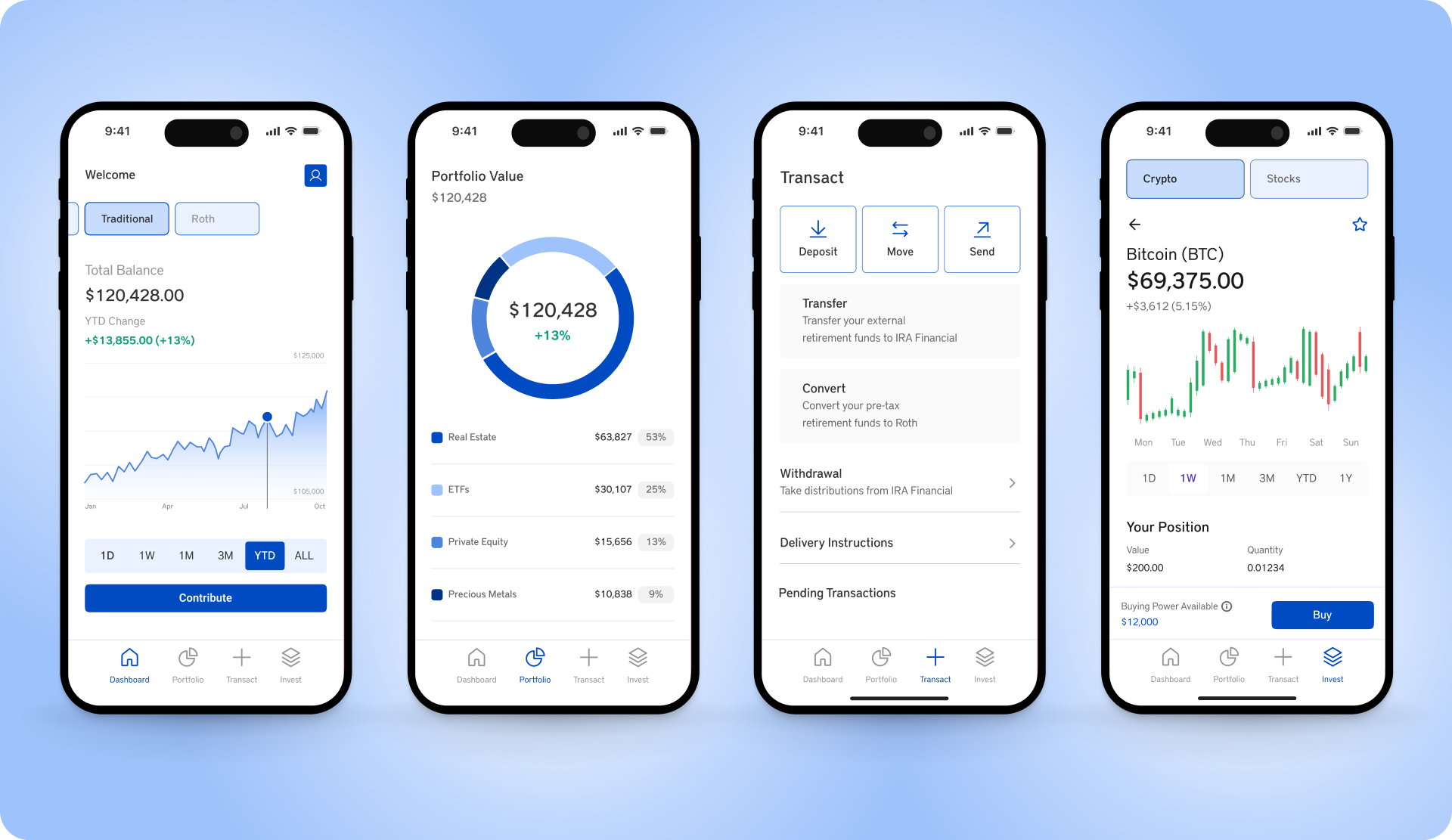
IRA Financial:
- Mobile app to open accounts, fund, invest, and manage your retirement plan
- Integrated dashboard for all investment types, including crypto and real estate
- Digital document uploads and e-signing streamline onboarding
uDirect IRA:
- Offers online account setup and secure document management
- Relies primarily on email and web portal communication for transactions
- No dedicated mobile app or in-app investment tools
Summary
uDirect IRA's digital systems are reliable and secure, but geared toward administrative support rather than investor-driven management. IRA Financial's app-based experience gives investors more direct, real-time control over their accounts.
Winner: IRA Financial.
A more modern, integrated platform built for today's investors.
Reputation & Customer Reviews: Trusted by Thousands
Reputation plays a vital role when selecting a Self-Directed IRA provider. Both IRA Financial and uDirect IRA have earned respect for professionalism and investor education.
IRA Financial | uDirect IRA | |
Trustpilot | 4.8 / 5 | N/A |
4.3 / 5 | 4.6 / 5 |
IRA Financial:
- Strong reputation for fast account setup, responsive customer service, and straightforward pricing.
- Over 3,000 5-star reviews across Google, Trustpilot, and other platforms.
- Founded by tax attorney Adam Bergman, who educates investors via weekly videos, podcasts, and blog articles.
uDirect IRA:
- Strong Google rating with a meaningful review volume: 4.6/5 from 184 reviews
- Founded in 2009, with a long-standing focus on investor education
- No presence on Trustpilot to draw a comparison from
Summary
uDirect IRA's Google reviews reflect a genuinely well-regarded, education-focused team. IRA Financial's advantage comes from a strong, consistent presence across multiple major platforms rather than concentrated on one.
Winner: IRA Financial.
Strong reviews across multiple platforms, rather than a single review source.
The Bottom Line: Why IRA Financial Is the Smarter Choice
Both IRA Financial and uDirect IRA empower investors to diversify beyond traditional assets, and uDirect's lower flat fee and education-first approach are real strengths for investors who plan to make very few transactions over the life of their account. But for investors who want unlimited transactions, broader account types, ROBS for business funding, and lower-cost integrated crypto access, IRA Financial offers more.
Book a free call with a self-directed retirement specialist
- Review your self-directed retirement options
- Learn about investing in alternative assets
- Get all of your questions answered

How to Shelter a Profits Interest from Taxation Using a Roth IRA

If you are a founder, partner, fund manager, or key employee who has been granted a profits interest in an LLC or partnership, you may be sitting on one of the most significant tax planning opportunities available under the Internal Revenue Code.
When properly structured, a profits interest held inside a Self-Directed Roth IRA can allow decades of future appreciation and income to grow and ultimately distribute completely tax-free. For entrepreneurs and investment professionals who expect their profits interest to become highly valuable, this strategy can mean the difference between paying millions in taxes and keeping those gains entirely within a retirement account.
As a tax attorney who has spent more than 25 years helping business owners and investment professionals build retirement wealth, I believe this is one of the most underutilized planning strategies available today. The rules are complex, the execution must be disciplined, and the transaction must be structured carefully. But for the right person, the long-term tax savings can be extraordinary.
Key Takeaways
- A profits interest is a type of partnership interest that entitles the holder to a share of future profits and appreciation but has no liquidation value at the time of issuance. This characteristic creates a significant Roth IRA planning opportunity.
- Because a profits interest often has little or no value at the time of grant, it may be possible for a Self-Directed Roth IRA to acquire the interest at a low cost, allowing all future appreciation to accumulate tax-free inside the retirement account.
- The IRS requires that the Roth IRA acquire the profits interest at fair market value. Rev. Proc. 93-27 and Rev. Proc. 2001-43 provide foundational guidance on how profits interests are taxed and valued. Getting the valuation right is critical.
- The prohibited transaction rules under IRC Section 4975 must be carefully analyzed before any profits interest is transferred to or acquired by a Roth IRA. If the IRA owner or other disqualified persons control the issuing entity above the 50% threshold, the transaction requires additional scrutiny.
- This strategy is not appropriate for every situation. It works best when implemented near the time of business formation or fund launch, when the profits interest has minimal current value and maximum future growth potential.
What Is a Profits Interest?
A profits interest is a type of partnership or LLC interest that entitles the holder to participate in future profits and appreciation of the entity but carries no right to receive any proceeds upon an immediate liquidation at the time of grant. In other words, if the business were sold the day after the profits interest was issued, the holder would receive nothing because there are no profits yet to share.
This definition comes directly from IRS Revenue Procedure 93-27, which established that a profits interest received by a service provider in exchange for services to a partnership is generally not taxable at the time of grant if two conditions are satisfied. First, the interest must not relate to a substantially certain and predictable stream of income. Second, the recipient must not dispose of the interest within two years.
Revenue Procedure 2001-43 further clarified that a profits interest can be structured so that its value at issuance is zero based on the current liquidation value of the entity. This means that under the right circumstances, someone can receive an interest in a business at effectively no tax cost simply because there are no current profits to share.
Founders, fund managers, real estate sponsors, key employees, and incentive compensation recipients commonly receive profits interests as part of their economic arrangement with a business or fund.
Why a Roth IRA Creates Such a Powerful Opportunity
https://youtu.be/olMIEmA8wlU
The Roth IRA is one of the most powerful tax planning vehicles available under the Internal Revenue Code. Qualified distributions are completely tax-free, including all investment appreciation. There are no required minimum distributions during the account owner's lifetime.
A profits interest fits this framework almost perfectly. At formation, a profits interest may have a near-zero fair market value. Years later, after the business or fund has grown significantly, that same interest may entitle the holder to millions of dollars in future distributions. If those economics accrue inside a Roth IRA rather than in a taxable account, the long-term tax savings can be transformative.
This is exactly the type of planning strategy I discuss in my book on Self-Directed IRAs. The concept is straightforward: identify an asset that has minimal current value but significant future growth potential, acquire that asset inside a Roth IRA at a low cost, and allow decades of tax-free compounding to work in your favor.
How the Structure Works
Step 1: Establish a Self-Directed Roth IRA. Traditional brokerage firms do not permit private partnership interest investments. A Self-Directed Roth IRA custodian such as IRA Financial is required to hold this type of alternative investment.
Step 2: Fund the Roth IRA. Depending on your income and prior Roth contributions, you may fund the Roth IRA through annual contributions, a Backdoor Roth IRA conversion, or by rolling over assets from an existing retirement account.
Step 3: Determine fair market value at issuance. This step is critical. The Roth IRA must acquire the profits interest at fair market value. Under Rev. Proc. 93-27 and Rev. Proc. 2001-43, a newly issued profits interest in a partnership or LLC often has a liquidation value of zero at issuance because there are no current profits to distribute. However, this does not mean the interest can be acquired for nothing. The fair market value must be documented and defensible.
Working with qualified tax counsel to prepare a valuation memorandum at the time of acquisition is a best practice. If the IRS were to challenge the transaction, the documentation prepared at the time of issuance will be the primary evidence supporting the value assigned.
Step 4: Issue or transfer the profits interest to the Roth IRA. Depending on the structure, the Roth IRA may receive a new class of interests directly from the entity, or it may purchase an existing profits interest from a current holder. Both approaches have different risk profiles under the prohibited transaction rules, which are discussed in detail below.
Step 5: Allow appreciation to accumulate tax-free. Once the profits interest is held inside the Roth IRA, any appreciation, distributions, and profits allocations generally flow into the retirement account. Those amounts grow tax-deferred in a Traditional IRA or potentially tax-free in a Roth IRA, depending on which account structure is used.
Critical Tax Issue: Valuation
The IRS has repeatedly scrutinized Roth IRA transactions where taxpayers attempted to shift future value into a retirement account without paying fair market value. The legal framework governing these challenges is built primarily around the economic benefit doctrine and assignment of income principles.
If the Roth IRA receives a profits interest for less than fair market value, the IRS can argue that the difference constitutes a contribution in excess of the annual limits or a taxable distribution to the IRA owner. In extreme cases, the entire Roth IRA could be treated as invalidated.
The best time to implement this strategy is at formation, when the business or fund is new and no profits have yet been generated. At that point, under the liquidation value analysis of Rev. Proc. 93-27, the fair market value of a newly issued profits interest may be minimal or zero. As profits accumulate and the entity grows in value, the fair market value of the interest increases. Once the interest has substantial value, transferring it to a Roth IRA becomes significantly more expensive and may trigger taxable income.
Timing matters. The earlier this strategy is implemented, the greater the potential benefit.
Prohibited Transaction Rules
Before implementing any profits interest Roth IRA strategy, the prohibited transaction rules under Internal Revenue Code Section 4975 must be carefully analyzed.
These rules restrict transactions between a retirement account and certain related parties called disqualified persons. Disqualified persons generally include the IRA owner, their spouse, parents, grandparents, children, grandchildren, spouses of those descendants, entities controlled by those individuals above the 50% threshold, and fiduciaries of the retirement account.
The key issue is whether the entity issuing or transferring the profits interest is controlled by disqualified persons. If the IRA owner and other disqualified persons together own more than 50% of the entity, significant prohibited transaction concerns arise. The transaction could be treated as a self-dealing prohibited transaction under IRC Section 4975(c)(1)(D) or (E), which could result in the Roth IRA being treated as distributed.
Two structural approaches can reduce prohibited transaction risk. First, if the profits interest is issued directly by the entity to the Roth IRA as part of a new class of interests at formation, rather than purchased from the IRA owner directly, the analysis is generally more favorable. Second, careful attention to the ownership structure can help keep disqualified person aggregate ownership below the 50% threshold.
This is an area where working with qualified ERISA and tax counsel before implementing the strategy is essential. The rules are technically complex and the consequences of a prohibited transaction are severe.
Book a free call with a self-directed retirement specialist
- Review your self-directed retirement options
- Learn about investing in alternative assets
- Get all of your questions answered
UBIT Considerations
Investors should also evaluate whether income allocated to the Roth IRA from a profits interest could be subject to Unrelated Business Income Tax.
In general, passive income such as dividends, interest, rents, and capital gains is excluded from UBIT. However, if the Roth IRA's profits interest receives income that is characterized as ordinary business income from an active trade or business conducted through a pass-through entity, UBIT could apply. The analysis depends heavily on the nature of the underlying business activity.
For many fund structures, particularly those where the IRA holds a limited partnership or limited membership interest that is not engaged in the active conduct of a trade or business, UBIT may not be an issue. However, for management company or general partner interests that are treated as engaged in the active conduct of a business, UBIT exposure should be carefully evaluated before implementation.
Why This Strategy Works Best at Formation
The most significant limitation of this strategy is timing. The optimal window for transferring a profits interest to a Roth IRA is at or near entity formation, when the fair market value is minimal and the future growth potential is greatest.
Once a business has generated significant profits, accumulated substantial assets, or experienced meaningful appreciation, the fair market value of a profits interest increases accordingly. At that point, the Roth IRA must pay a higher acquisition price, which reduces the potential tax benefit and may require a larger retirement account contribution or conversion to fund the transaction.
Founders and fund managers who want to take advantage of this strategy should consider implementing it at the time they establish their business or launch their fund. Waiting until the business becomes successful significantly reduces the opportunity.
Final Thoughts
The ability to shelter a profits interest inside a Self-Directed Roth IRA represents one of the most sophisticated and potentially valuable tax planning strategies available to entrepreneurs, fund managers, and investment professionals. When properly structured and implemented at the right time, it can allow decades of business appreciation and profit distributions to accumulate and ultimately distribute completely tax-free.
The strategy requires careful attention to valuation, prohibited transaction compliance, UBIT analysis, and timing. It is not appropriate for every situation, and it must be implemented with the guidance of qualified tax and ERISA counsel. But for the right person, at the right time, with the right business structure, the long-term tax savings can be extraordinary.
If you want to understand whether a profits interest Roth IRA strategy could work for your situation, IRA Financial's team of in-house tax and ERISA specialists is available for a free consultation.
IRA Financial vs Directed IRA
When it comes to investing in alternative assets with your retirement funds, both IRA Financial and Directed IRA give investors more control and flexibility than traditional institutions. Both offer checkbook control and a broad set of account types, but they differ in how their fees scale with the number of assets held and how deeply crypto and stock trading are integrated into the account.
Here's how they compare across pricing, investment options, technology, and reputation.
Pricing & Fees: Transparent, Flat, and Investor-Friendly
When it comes to retirement investing, predictable costs and transparent pricing are essential. IRA Financial's fee stays the same no matter how many assets you hold. Directed IRA's annual fee covers up to 3 assets, then adds a fee for each additional one.
IRA Financial | Directed IRA | |
Setup Fee | $0 | $50 |
Annual Fee | $495 | $595 |
Asset Value Fee | $0 | $0 |
Investment Fee | $0 | $200 |
Roth Conversion Fee | $0 | $50 (cash) / $100 (assets) |
1 Year Total Cost | $495 | $845 |
5 Year Total Cost | $2,475 | $3,225 |
Pricing pulled from company website, as of the article publish date, based on 4 investments with a $200K total balance.
IRA Financial:
- Self-Directed IRAs start at $495/year, with other plans available from $100/year
- No setup fee for a custodian-controlled plan; a one-time fee applies only for Checkbook IRA structures
- No asset-based or transaction fees, just one clear, predictable price
- IRAfi Crypto platform offers low-cost trading for buying, selling, and managing crypto directly in the app
Directed IRA:
- $50 one-time account establishment fee
- $495/year covers up to 3 alternative assets; each additional asset adds $100/year
- $50 asset processing fee for most alternative assets ($150 for real estate)
- Optional $300/year VIP Service Membership for expedited processing
Summary
Directed IRA's flat rate for the first 3 assets is competitive, but the $100/year charge for each additional asset means costs climb for investors holding a larger, more diversified portfolio. IRA Financial's fee doesn't change no matter how many assets are held.
Winner: IRA Financial.
A flat annual fee that doesn't increase as you add more assets, versus a per-asset charge once you go beyond 3 holdings.
Investment Flexibility & Product Options
Having the freedom to invest in what you know is the cornerstone of self-directed retirement. Both providers offer strong options, with checkbook control and a broad set of account types available at each.
IRA Financial | Directed IRA | |
Account Type | ||
Self-Directed IRA | ||
Solo 401(k) | ||
HSA | ||
Checkbook Control | ||
ROBS Structure | ||
Platform & Investments | ||
Crypto Platform | ||
Stock Trading | ||
Compliance & Protection | ||
In-House Compliance & Tax Services | ||
IRS Audit Protection |
IRA Financial:
- Invest in real estate, private businesses, precious metals, crypto, notes, crowdfunding, and more
- Direct crypto investing through IRA Financial's integrated platform
- Full checkbook control for both IRAs and Solo 401(k) plans
- Supports SEP, SIMPLE, Roth, and Traditional IRAs, plus ROBS for business funding
- IRA Compliance Shield provides in-house audit protection and tax consultation
Directed IRA:
- Offers a broad set of account types: Traditional, Roth, SEP, and Inherited IRAs, HSA, Coverdell ESA, Solo 401(k), and Checkbook IRA LLC
- Crypto investing runs through a linked Gemini account, a separate structure with its own annual fee and trading costs.
- Traditional investing built into the same account, covering index funds, actively managed mutual funds, dividend-paying stocks, sector ETFs, futures, bonds and T-Bills, and options, positioned as a complementary strategy alongside alternative assets
- No ROBS structure or in-house compliance and audit protection services
Summary
Both providers cover a genuinely broad set of account types. Where they diverge is business-funding structures and how crypto and compliance support are delivered: IRA Financial keeps crypto trading integrated in one account and includes in-house compliance support, while Directed IRA routes crypto through a separate Gemini-linked account and offers no equivalent in-house compliance service.
Winner: IRA Financial
ROBS for business funding and in-house compliance support that Directed IRA does not offer, plus crypto trading inside the same account rather than a separate linked platform.
Technology: Built for the Modern Investor
Ease of use matters, especially for investors managing alternative assets. Both companies have invested in digital solutions.
IRA Financial:
- All-in-one app to open accounts, fund, invest, and manage your retirement plan
- Integrated dashboard for all investment types, including crypto and real estate
- Secure document upload and digital signing eliminate paper forms
Directed IRA:
- Online applications and digital document management through the Directed Trust Company portal
- Crypto trading requires logging into a separate, linked Gemini account rather than a single dashboard
- Limited mobile app functionality compared to IRA Financial's app experience
Summary
Directed IRA's technology handles document management and account administration well, but IRA Financial's platform keeps every feature, including crypto trading, inside a single mobile-first experience.
Winner: IRA Financial.
A more modern, integrated digital experience, without needing to manage a separate linked account for crypto.
Reputation & Customer Reviews: Trusted by Thousands
Reputation reflects client experience, responsiveness, and expertise, all critical for managing self-directed assets.
IRA Financial | Directed IRA | |
Trustpilot | 4.8 / 5 | 2.8 / 5 |
4.3 / 5 | 4.9 / 5 |
IRA Financial:
- Strong reputation for fast account setup, responsive customer service, and straightforward pricing.
- Over 3,000 5-star reviews across Google, Trustpilot, and other platforms.
- Founded by tax attorney Adam Bergman, who educates investors via weekly videos, podcasts, and blog articles.
Directed IRA:
- Strong Google rating at real scale: 4.9/5 from 1,278 reviews
- Founded by attorney Mat Sorensen, author of the best-selling Self Directed IRA Handbook
- Trustpilot presence is minimal, only 3 reviews, too small a sample to draw conclusions from
Summary
Directed IRA's Google reviews are genuinely excellent and backed by real scale, a legitimate strength. IRA Financial's advantage comes from consistency across multiple platforms rather than strength concentrated on just one.
Winner: IRA Financial.
Strong reviews across multiple platforms at scale, rather than strength concentrated on a single review site.
The Bottom Line: Why IRA Financial Is the Smarter Choice
Both IRA Financial and Directed IRA give investors access to a broad set of self-directed account types, and Directed IRA's strong Google reputation and flat pricing for smaller portfolios are real strengths. Directed IRA has also expanded its traditional investing options, now offering index funds, actively managed mutual funds, dividend-paying stocks, sector ETFs, futures, bonds and T-Bills, and options alongside its alternative assets. But for investors who want a fee that doesn't grow with each additional asset, ROBS for business funding, in-house compliance support, and crypto trading built into the same account, IRA Financial offers more.
Book a free call with a self-directed retirement specialist
- Review your self-directed retirement options
- Learn about investing in alternative assets
- Get all of your questions answered

Why Self-Directed IRA Fees Really Matter
When investors evaluate retirement accounts, they typically focus on investment performance. They compare returns, asset classes, and market opportunities. They spend countless hours researching stocks, real estate, private equity, cryptocurrency, and other alternative investments.
What many overlook, however, is one of the most important factors influencing long-term retirement success: fees.
Every dollar paid in fees is a dollar that is no longer invested and no longer compounding for your future. As a tax attorney who has spent decades helping investors build retirement wealth through self-directed retirement accounts, I have seen firsthand how seemingly small fees can quietly erode retirement savings over time.
Key Takeaways
- Fee leakage, the ongoing reduction of retirement assets through recurring fees, is largely invisible but compounds against you over time. A modest 1% annual asset-based fee can cost hundreds of thousands of dollars over a 30 or 40-year retirement horizon.
- With a Self-Directed IRA, the investor identifies the investment, performs due diligence, negotiates the terms, and assumes the risk. The custodian's role is administrative. An asset-based fee that grows as your account grows does not reflect that division of work.
- Flat-fee pricing aligns the cost with the actual services being provided rather than the value of assets in the account, allowing investors to keep more of their gains and benefit more fully from long-term compounding.
- When evaluating a Self-Directed IRA provider, look beyond the setup fee. Asset valuation fees, transaction fees, wire fees, and account termination fees can significantly increase the true annual cost of maintaining an account.
Why Retirement Account Fees Deserve More Attention
Most investors understand that earning an extra 1% or 2% annually can significantly impact retirement outcomes. What many fail to recognize is that paying an extra 1% or 2% in fees can have the exact opposite effect.
Compounding is one of the most powerful forces in investing. When investment gains remain in a retirement account, those gains generate additional gains. Over time, this creates exponential growth. Unfortunately, fees compound as well. Every dollar removed from an account through fees not only reduces current account value but also eliminates all the future growth that dollar could have generated. This is commonly referred to as fee leakage, and it is largely invisible. Investors may not notice a $1,000 or $2,000 annual fee, but over decades, those fees can grow into hundreds of thousands of dollars of lost retirement wealth. The longer the investment horizon, the more damaging fee leakage becomes.
The Hidden Cost of Percentage-Based Fees
Many financial institutions charge fees based on a percentage of assets under management. The larger the account becomes, the larger the fee, even though the amount of administrative work required to maintain the account generally does not change.
Consider two fee structures applied to an account that begins with $100,000 and earns an average annual return of 10%.
| Investment Period | 1% Asset-Based Fee | $500 Flat Fee | Difference |
|---|---|---|---|
| 10 Years | ~$24,000 | $5,000 | $19,000 |
| 15 Years | ~$50,000 | $7,500 | $42,500 |
| 20 Years | ~$95,000 | $10,000 | $85,000 |
| 25 Years | ~$170,000 | $12,500 | $157,500 |
| 30 Years | ~$295,000 | $15,000 | $280,000 |
| 40 Years | $840,000+ | $20,000 | $820,000+ |
These figures reflect only fees paid. The actual economic impact is even greater because every dollar paid in fees also loses the opportunity to compound and generate future returns. Over a retirement lifetime, the difference can be staggering.
Why Flat Fees Make Sense for Self-Directed Investors
In a traditional wealth management relationship, an assets-under-management fee may be justified. If an advisor is selecting investments, managing a portfolio, monitoring performance, and providing ongoing investment advice, there is at least a rationale for tying compensation to account growth.
A Self-Directed IRA is fundamentally different.
With a Self-Directed IRA, the investor is doing the work. The investor identifies the opportunity, performs due diligence, negotiates the terms, assumes the risk, and makes the investment decision. The custodian's role is to administer the account, maintain records, process transactions, and satisfy IRS reporting requirements. Those administrative responsibilities generally do not become more complex simply because an account grows from $100,000 to $1 million.
Consider two Self-Directed IRA investors. One account remains at $100,000. The other invests in real estate, private equity, or Bitcoin and grows to $2 million. Under an asset-based fee model, the second investor pays tens of thousands of dollars more annually for essentially the same custodial services. The custodian did not find the investment, negotiate the deal, contribute capital, or assume any investment risk. Yet it participates in the upside simply because the asset appreciated.
That structure is difficult to justify. Every dollar paid in unnecessary fees is a dollar that can no longer compound for retirement. Over 10, 20, 30, or 40 years, that fee leakage can cost investors hundreds of thousands of dollars. Flat-fee pricing solves this problem by aligning the fee with the actual services being provided, not the value of the assets in the account.
Why Fees Matter Even More for Alternative Assets
Fee considerations become particularly important when investing in alternative assets. Many Self-Directed IRA investors own real estate, private equity, venture capital, cryptocurrency, mortgage notes, precious metals, and private businesses. These investments often involve long holding periods and significant appreciation potential.
An asset-based fee structure can become increasingly expensive as those investments grow in value. An investor who purchases a private investment for $100,000 that appreciates to $1 million may find that annual percentage-based fees increase dramatically despite no meaningful increase in administrative complexity. This is one reason many experienced alternative asset investors pay close attention to fee structures before selecting a retirement account provider.
Book a free call with a self-directed retirement specialist
- Review your self-directed retirement options
- Learn about investing in alternative assets
- Get all of your questions answered
Looking Beyond the Advertised Fee
When evaluating a Self-Directed IRA provider, look beyond the initial setup fee. Some providers charge asset valuation fees, transaction fees, wire fees, annual maintenance fees, asset-based custody fees, and account termination fees. Understanding the complete fee structure is critical. A provider with a low setup fee may ultimately become significantly more expensive if recurring fees increase as account values grow.
Investors should always ask for a complete breakdown of all fees before opening an account, including whether any fees increase as account values grow and how total fees compare with alternative providers.
Focus on What You Can Control
No investor can control market performance, interest rates, or inflation. But every investor can control fees.
While selecting quality investments remains important, minimizing unnecessary fee leakage may be one of the easiest ways to improve long-term retirement results. The impact of a lower fee structure may not be obvious in the first year. Over 10, 20, 30, or 40 years, however, the difference can be substantial.
Most investors spend their time searching for the next great investment opportunity. Far fewer spend the same amount of time evaluating what may be one of the biggest drags on long-term retirement wealth. As a tax attorney, I have always believed that retirement planning is not simply about maximizing returns. It is about maximizing the amount of wealth that ultimately remains in your retirement account.
At IRA Financial, we have always embraced a flat-fee model because we believe investors should keep as much of their hard-earned retirement wealth as possible. When our clients win, they should keep the benefits of that success. The purpose of a Self-Directed IRA is to empower investors to take control of their retirement and build wealth through their own investment decisions. Escalating asset-based custody fees that grow simply because your investments performed well work against that purpose.
The goal of retirement planning is not merely to accumulate assets. It is to maximize the wealth available when you need it most. The less money that leaves your account in unnecessary fees, the more money remains working for you. And over a lifetime of investing, that difference can be enormous.

IRA Financial vs The Entrust Group
For investors seeking greater control over their retirement portfolios with alternative assets, such as real estate, private equity, precious metals, and cryptocurrencies, selecting the right Self-Directed IRA or Solo 401(k) provider is essential. The Entrust Group has built a strong reputation over more than 40 years in the industry, while IRA Financial offers a modern, flexible approach built around flat pricing and integrated technology.
This comparison examines fees, product options, technology, and reputation to help investors make an informed decision.
Pricing & Fees: Transparent, Flat, and Investor-Friendly
Understanding the fee structure is critical for retirement investors, as costs can accumulate over time and impact overall returns. IRA Financial uses a single flat annual fee, while The Entrust Group charges an asset-value-based recordkeeping fee plus a separate charge for every purchase, sale, or exchange.
IRA Financial | The Entrust Group | |
Setup Fee | $0 | $50 |
Annual Fee | $495 | $329 |
Asset Value Fee | $0 | $255 |
Investment Fee | $0 | $420 |
Roth Conversion Fee | $0 | $0 |
1 Year Total Cost | $495 | $1,054 |
5 Year Total Cost | $2,475 | $3,390 |
Pricing pulled from company website, as of the article publish date, based on 4 investments with a $200K total balance.
IRA Financial:
- Self-Directed IRAs start at $495/year, with other plans available from $100/year
- No setup fee for a custodian-controlled plan; a one-time fee applies only for Checkbook IRA structures
- No asset-based or transaction fees, just one clear, predictable price
- IRAfi Crypto platform offers low-cost trading for buying, selling, and managing crypto directly in the app
The Entrust Group:
- $50 one-time account establishment fee
- Annual recordkeeping fee of $329/year for two or more assets, plus 0.17% of total asset value over $50,000
- $105 fee for the purchase, sale, or exchange of most alternative assets ($175 for real estate)
- Recordkeeping fees are capped at $2,299/year regardless of account size
Summary
The Entrust Group's asset-value-based recordkeeping fee combined with a per-transaction charge on every purchase or sale adds up quickly for investors holding several assets. For an investor with 4 assets on a $200,000 balance, Entrust costs more than double what IRA Financial charges in year one, and the gap grows further over 5 years.
Winner: IRA Financial.
A single flat annual fee with no per-transaction charges and no cost that climbs as the account's asset value grows.
Investment Flexibility & Product Options
The range of investment options and account structures available can significantly affect portfolio diversification and long-term flexibility.
IRA Financial | The Entrust Group | |
Account Type | ||
Self-Directed IRA | ||
Solo 401(k) | ||
HSA | ||
Checkbook Control | ||
ROBS Structure | ||
Platform & Investments | ||
Crypto Platform | ||
Stock Trading | ||
Compliance & Protection | ||
In-House Compliance & Tax Services | ||
IRS Audit Protection |
IRA Financial:
- Full investment freedom: real estate, private equity, precious metals, notes, startups, and crypto
- Direct crypto investing through IRA Financial's integrated platform
- Checkbook IRA and Solo 401(k) options for maximum control, with the LLC formed for you as part of the service
- Supports SEP, SIMPLE, Roth, and Traditional IRAs, plus ROBS for business funding
The Entrust Group:
- Offers Self-Directed IRAs, Solo 401(k)s, HSAs, and Coverdell ESAs, a broader set of tax-advantaged account types than most competitors
- Supports checkbook control through an IRA LLC, but Entrust explicitly does not create or sell LLCs, investors must set one up independently
- No ROBS structure, integrated stock trading, or in-house compliance and audit protection services
Summary
The Entrust Group offers a genuinely broad set of account types, including HSAs and Coverdell ESAs that not every custodian supports. Where IRA Financial pulls ahead is in business-funding structures like ROBS, fully integrated crypto and stock trading, and handling LLC formation directly rather than leaving that step to the investor.
Winner: IRA Financial
Broader business-funding options and a fully integrated platform, including LLC formation for checkbook control, that Entrust leaves to the investor to arrange independently.
Technology: Built for the Modern Investor
An intuitive, integrated platform can save time and reduce errors, especially for investors handling multiple alternative assets.
IRA Financial:
- Newly-updated mobile app and account dashboard with clean UI/UX and modern functionality.
- Offers a fully digital on-boarding experience, automated compliance, and secure document storage.
- Streamlined tools for crypto, transfers, and checkbook control in one place
The Entrust Group:
- Functional online portal for account management
- Documentation process is more traditional and may involve additional paperwork
- Support is available but less integrated with technology
Summary
Entrust has a reliable system for managing Self-Directed IRAs, but IRA Financial's technology-driven approach reduces administrative hurdles and gives investors faster, more efficient control.
Winner: IRA Financial.
Modern platform enhances efficiency and investor confidence.
Reputation & Customer Reviews: Trusted by Thousands
Longevity and reliability are key considerations for custodians of retirement accounts, though online review sentiment can tell a different story than years in business alone.
IRA Financial | The Entrust Group | |
Trustpilot | 4.8 / 5 | 1.8 / 5 |
4.3 / 5 | 4.4 / 5 |
IRA Financial:
- Strong reputation for fast account setup, responsive customer service, and straightforward pricing.
- Over 3,000 5-star reviews across Google, Trustpilot, and other platforms.
- Founded by tax attorney Adam Bergman, who educates investors via weekly videos, podcasts, and blog articles.
The Entrust Group:
- One of the oldest Self-Directed IRA custodians in the U.S., founded in 1981
- Solid Google rating with a meaningful review volume
- Trustpilot reviews skew heavily negative, with recent complaints citing high fees and slow response times
Summary
The Entrust Group's decades of experience and solid Google rating are real credentials, but its Trustpilot reviews reveal a notable gap in day-to-day client sentiment. IRA Financial holds a strong, consistent rating across every major platform.
Winner: IRA Financial.
Consistently strong ratings across platforms, without the sharp platform-to-platform swing Entrust shows between Google and Trustpilot.
The Bottom Line: Why IRA Financial Is the Smarter Choice
Both The Entrust Group and IRA Financial offer secure paths for investing in alternative assets through self-directed retirement accounts. Entrust's decades of experience and broad account type support, including HSAs and Coverdell ESAs, are genuine strengths for investors who value that history. But for investors who want lower, more predictable fees, business-funding structures like ROBS, and a fully integrated platform that handles LLC formation directly, IRA Financial offers more.
Book a free call with a self-directed retirement specialist
- Review your self-directed retirement options
- Learn about investing in alternative assets
- Get all of your questions answered

How to Buy Mortgage Notes With a Self-Directed IRA in 2026
Most Self-Directed IRA investors are familiar with investing in rental real estate, private funds, precious metals, and cryptocurrency. However, one of the most overlooked investment opportunities available through a Self-Directed IRA is mortgage note investing.
Mortgage notes can offer attractive yields, recurring income, and the security of real estate collateral without the responsibilities of property ownership. In today's higher interest rate environment, many investors are once again turning to mortgage notes as an alternative to traditional fixed-income investments.
As a tax attorney who has spent decades helping retirement investors diversify beyond Wall Street, I have seen mortgage notes become a valuable component of many retirement portfolios. When structured properly, mortgage note investments can generate tax-deferred income inside a Traditional IRA or potentially tax-free income inside a Roth IRA.
Key Takeaways
- A mortgage note investment turns your Self-Directed IRA into the lender. Instead of purchasing real estate directly, your IRA purchases the right to receive future principal and interest payments from a borrower, secured by real property.
- Interest income generated by a mortgage note held inside an IRA is generally not subject to current taxation. It grows tax-deferred in a Traditional Self-Directed IRA or potentially tax-free in a Roth Self-Directed IRA.
- Unlike leveraged real estate investments, mortgage note investments generally do not trigger Unrelated Debt-Financed Income tax because the IRA is acting as the lender rather than the borrower.
- The prohibited transaction rules under IRC Section 4975 apply to mortgage note investing. Your IRA generally cannot lend money to, or purchase notes from, disqualified persons including the IRA owner, their spouse, parents, children, or entities they control.
- The two structures available for mortgage note investing through a Self-Directed IRA are the full-service custodian-controlled IRA and the Self-Directed IRA LLC with checkbook control. Both offer the same tax advantages but differ in control, speed, and administrative requirements.
What Is a Mortgage Note?
A mortgage note is a legal agreement in which a borrower promises to repay money borrowed from a lender. The note typically outlines the principal amount, interest rate, repayment schedule, maturity date, and default provisions. In most cases, the note is secured by real estate through a mortgage or deed of trust, which gives the lender certain rights against the property if the borrower fails to make payments.
When investing in mortgage notes through a Self-Directed IRA, your IRA essentially becomes the lender. Instead of purchasing real estate directly, your IRA purchases the right to receive future payments from the borrower. Those payments consist of principal and interest and flow directly back into the IRA.
Mortgage notes can be secured by residential real estate, commercial real estate, vacant land, multifamily properties, construction projects, and seller-financed transactions. Because the investment is backed by real property, many investors view mortgage notes as offering a balance between income generation and collateral protection.
Why Mortgage Notes Are Becoming More Popular in 2026
The mortgage note market has experienced renewed interest in recent years due to several significant economic trends.
Interest rates remain substantially higher than they were during the ultra-low-rate environment of 2020 through 2022. Higher borrowing costs have increased demand for alternative lending and private financing solutions. Private credit has also emerged as one of the fastest-growing investment sectors globally, with investors seeking yield increasingly looking beyond traditional bonds and into asset-backed lending opportunities such as mortgage notes.
Additionally, certain segments of the mortgage market have begun experiencing increased delinquency levels. While overall mortgage performance remains relatively healthy, rising delinquencies have created opportunities for investors interested in purchasing both performing and non-performing notes. As a result, Self-Directed IRA investors have access to a broader range of mortgage note opportunities than they have seen in years.
Why Mortgage Notes Work Well in a Self-Directed IRA
Mortgage notes can be particularly attractive retirement investments because they generally generate passive interest income. From a tax perspective, interest income earned by an IRA is generally not subject to current taxation. The income grows tax-deferred in a Traditional IRA or potentially tax-free in a Roth IRA.
Unlike leveraged real estate investments, mortgage note investments generally do not trigger Unrelated Debt-Financed Income because the IRA is acting as the lender rather than the borrower.
Many investors appreciate mortgage notes because they offer predictable cash flow, real estate-backed collateral, no property management responsibilities, no tenant issues, diversification from stocks and bonds, and tax-advantaged growth. For retirement investors seeking income-producing investments without directly owning property, mortgage notes can be an attractive solution.
Types of Mortgage Notes
Performing Notes. A performing note is one where the borrower is making payments as agreed. These notes typically provide consistent monthly income and generally involve less risk. Investors often purchase performing notes to generate predictable cash flow within their retirement accounts.
Non-Performing Notes. A non-performing note is one where the borrower has stopped making payments. These notes are often purchased at significant discounts and may provide opportunities for greater returns, but they require substantially more due diligence, legal oversight, and patience. Investors in non-performing notes may seek to modify the loan, negotiate repayment terms, reinstate the loan, foreclose on the property, or acquire the underlying real estate. Non-performing notes are generally better suited for experienced investors.
First-Lien Notes. A first-position mortgage has priority over all junior liens. If foreclosure becomes necessary, the first-position lender generally gets paid before any subordinate lienholders. For many Self-Directed IRA investors, first-lien residential notes represent the most conservative approach to mortgage note investing.
Second-Lien Notes. Second mortgages are subordinate to first mortgages. While second-position notes may offer higher yields, they also carry additional risk because the first-position lender has priority in a foreclosure scenario.
Book a free call with a self-directed retirement specialist
- Review your self-directed retirement options
- Learn about investing in alternative assets
- Get all of your questions answered
Two Ways to Purchase Mortgage Notes Through a Self-Directed IRA
Full-Service Custodian-Controlled Self-Directed IRA. Under this structure, a special IRA custodian such as IRA Financial serves as the custodian and handles all investment transactions on behalf of the IRA. The note is titled in the name of the IRA custodian for the benefit of the IRA owner. For example: IRA Financial Trust Company FBO John Smith IRA. All principal and interest payments flow back to the IRA through the custodian, and the custodian handles all required IRS administration including filing Forms 1099-R and 5498. This approach is best suited for investors making less frequent investments who prefer additional custodian oversight.
Self-Directed IRA LLC with Checkbook Control. Under this structure, a limited liability company is created, funded, and owned entirely by the IRA, with the IRA owner serving as manager. Because the investor controls the LLC directly, they can execute mortgage note transactions, sign documents, and send funds without waiting for custodian approval on every transaction. The note is titled in the name of the LLC rather than the IRA directly. This structure is particularly well suited for mortgage note investing because notes often require quick action, multiple transactions, and ongoing payment management. The IRA LLC structure was affirmed by the Tax Court in Swanson v. Commissioner, 106 T.C. 76 (1996), and later confirmed by the IRS in Field Service Advice Memorandum 200128011.
Important Tax Rules to Understand
One of the biggest advantages of mortgage note investing is that the tax rules are generally straightforward. Interest income generated by a mortgage note is generally exempt from current taxation while inside the IRA. However, investors must still comply with the prohibited transaction rules under Internal Revenue Code Section 4975.
These rules prohibit an IRA from engaging in transactions with disqualified persons, including the IRA owner, the owner's spouse, parents, grandparents, children, grandchildren, and certain entities controlled by these individuals. Your IRA generally cannot lend money to your child, purchase a note from your spouse, or acquire a mortgage secured by property owned by a disqualified person. Violating these rules can result in the entire IRA being deemed distributed, triggering taxes and potentially significant penalties.
As I often tell clients, the investment itself is rarely the problem. Most prohibited transactions occur because investors unknowingly engage in transactions with family members or businesses they control.
Due Diligence Tips for Mortgage Note Investors
Verify the collateral. Never purchase a mortgage note without understanding the underlying property. Review the property value, condition, title reports, tax records, insurance coverage, and existing liens before committing IRA funds.
Focus on loan-to-value ratios. The lower the LTV, the larger the equity cushion protecting the lender. A $150,000 loan secured by a $300,000 property provides significantly more protection than a $270,000 loan on the same asset.
Review payment history. A borrower's payment history often tells a more complete story than the interest rate alone. A note yielding 8% with a strong payment history may be far more attractive than a note yielding 12% with repeated delinquencies.
Understand foreclosure laws. Foreclosure procedures vary dramatically by state. Some states allow relatively efficient processes while others may involve lengthy judicial proceedings. Before purchasing a note, understand the legal costs, timelines, and procedures that may apply if the borrower defaults.
Obtain independent due diligence. Never rely solely on information provided by the seller. Independent verification of property values, title status, taxes, insurance, and payment history can help avoid costly mistakes.
Keep proper records. Retain copies of all promissory notes, mortgages or deeds of trust, assignments, payment histories, insurance records, and title reports. Proper documentation is particularly important for IRA compliance purposes.
Potential Risks of Mortgage Note Investing
Like any investment, mortgage notes involve risk. Potential risks include borrower default, property value declines, foreclosure costs, bankruptcy proceedings, title defects, insurance issues, and market illiquidity. Mortgage notes are generally less liquid than publicly traded securities, and investors should be prepared to hold notes for extended periods. For this reason, note investing is often best viewed as a long-term retirement strategy rather than a short-term trading opportunity.
Final Thoughts
Mortgage notes continue to represent one of the most compelling opportunities available to Self-Directed IRA investors. In a higher-rate environment, they can provide attractive income, diversification, and real estate-backed security while avoiding many of the management challenges associated with direct property ownership.
From a tax attorney's perspective, the key to successful mortgage note investing is not simply finding the highest yield. It is understanding the collateral, conducting thorough due diligence, maintaining compliance with the prohibited transaction rules, and ensuring the investment is properly structured through the IRA. When done correctly, mortgage notes can provide a powerful combination of income, asset protection, and tax-advantaged growth that can help investors build long-term retirement wealth.

IRA Financial vs Rocket Dollar
For investors looking to diversify their retirement portfolios with alternative assets, such as real estate, precious metals, private companies, and cryptocurrencies, selecting the right Self-Directed IRA or Solo 401(k) provider is critical. Each provider offers unique features, fee structures, and account management tools that can significantly impact your retirement strategy.
Two well-known names in the self-directed space are IRA Financial and Rocket Dollar. Both offer checkbook control and access to alternative assets, but they differ in how their account types are priced. IRA Financial offers a standard Self-Directed IRA, a Checkbook IRA, and a Solo 401(k) as distinct account types, each with its own transparent pricing, while Rocket Dollar bundles checkbook control and Solo 401(k) access into its higher-cost tiers. This comparison looks at IRA Financial and Rocket Dollar across pricing, product options, technology, and reputation, helping investors make an informed decision.
Pricing & Fees: Transparent, Flat, and Investor-Friendly
When it comes to retirement investing, predictable costs and transparent pricing are essential. High or unclear fees can eat into investment returns over time, particularly for those investing in alternative assets like real estate or private equity. To compare equivalent capabilities, this table uses IRA Financial's Checkbook IRA pricing against Rocket Dollar's Platinum tier, since both include checkbook control.
IRA Financial | Rocket Dollar | |
Setup Fee | $999 | $900 |
Annual Fee | $495 | $600 |
Asset Value Fee | $0 | $0 |
Investment Fee | $0 | $0 |
Roth Conversion Fee | $0 | $0 |
1 Year Total Cost | $1,494 | $1,500 |
5 Year Total Cost | $3,474 | $3,900 |
Pricing pulled from company website, as of the article publish date, based on 4 investments with a $200K total balance.
IRA Financial:
- Checkbook IRA setup fee of $999, then a flat $495/year, with no transaction or asset-based fees
- A standard, custodian-directed Self-Directed IRA is also available with no setup fee, for investors who don't need checkbook control
- IRAfi Crypto platform with low trading costs for buying, selling, and trading crypto directly in the IRA Financial app.
Rocket Dollar:
- Three pricing tiers: Silver ($360 setup + $30/month) offers a Self-Directed IRA only, with no checkbook control
- Gold ($600 setup + $40/month) adds Checkbook IRA w/ Trust
- Platinum ($900 setup + $50/month) adds Checkbook IRA w/ LLC and Solo 401(k) access, the tier most comparable to IRA Financial's Checkbook IRA
- No asset-based fees or per-investment fees on any tier, though their custodian, Digital Trust, may charge separate transaction or asset-related fees depending on the specific investment
Summary
Comparing tiers with equivalent capabilities tells a closer story than pricing alone might suggest: IRA Financial's Checkbook IRA costs slightly more upfront than Rocket Dollar's Platinum tier, but a lower annual fee brings the total cost close over time, with IRA Financial coming out ahead by a modest margin over 5 years.
Winner: IRA Financial.
A lower annual fee holds the edge over 5 years once both platforms' checkbook-control and Solo 401(k) tiers are compared directly, though the year-one costs are nearly identical.
Investment Flexibility & Product Options
A self-directed retirement account should allow you to invest in a wide range of assets without unnecessary restrictions. Having multiple options gives investors the flexibility to diversify and optimize returns. Both IRA Financial and Rocket Dollar support checkbook control and a broad set of alternative assets, but IRA Financial includes several account types and services that Rocket Dollar does not offer at any tier.
IRA Financial | Rocket Dollar | |
Account Type | ||
Self-Directed IRA | ||
Solo 401(k) | ||
HSA | ||
Checkbook Control | ||
ROBS Structure | ||
Platform & Investments | ||
Crypto Platform | ||
Stock Trading | ||
Compliance & Protection | ||
In-House Compliance & Tax Services | ||
IRS Audit Protection |
IRA Financial:
- Offers all the traditional SDIRA investments, including real estate, private lending, startups, precious metals, as well as direct crypto investing.
- Integrated platform for crypto, checkbook control, real estate, and more under one roof.
- Stock, ETF, bond, and options trading powered by Interactive Brokers - available as a $100/year add-on, fully integrated inside your IRA Financial account.
- Advanced structures like Solo 401(k) plans, SEP & SIMPLE IRAs, HSA & Coverdell accounts, and ROBS structures for business funding.
- IRA Compliance Shield ($299/year): in-house audit protection, tax consultation, deal reviews, prohibited transaction pre-clearance, and UBIT/UDFI modeling.
Rocket Dollar:
- Offers Self-Directed IRAs and Solo 401(k) plans, including Traditional and Roth accounts, though checkbook control and Solo 401(k) access are only available on their Gold and Platinum tiers, not their base Silver plan
- Supports alternative assets such as real estate, private equity, and cryptocurrencies through an extensive partner network
- Stock and bond trading is not well supported inside a standard Rocket Dollar account; investors are advised to keep a separate brokerage IRA for public securities
- No ROBS structure, HSA, or in-house compliance and audit protection services
Summary
Rocket Dollar covers the fundamentals of checkbook-controlled alternative investing well, and its partner network gives investors curated access to deals. IRA Financial goes further with business-funding structures like ROBS, HSA accounts, integrated stock trading, and in-house compliance support.
Winner: IRA Financial
More account types, integrated stock trading, and in-house compliance support that Rocket Dollar does not offer.
Technology: Built for the Modern Investor
An intuitive platform can save time and reduce errors when managing retirement accounts, especially when handling multiple alternative investments. Technology and support matter for both experienced and first-time self-directed investors.
IRA Financial:
- Newly-updated mobile app and account dashboard with clean UI/UX and modern functionality.
- Offers a fully digital on-boarding experience, automated compliance, and secure document storage.
- In-house crypto trading, real-time dashboards, and checkbook control in a single portal.
Rocket Dollar:
- Online platform for account setup, funding, and investment tracking
- Functional but may require customer support for complex transactions
- Limited integration for alternative asset documentation
Summary
Rocket Dollar provides a functional platform, but IRA Financial's technology and support reduce administrative burdens, making it easier to invest efficiently and confidently across a range of asset types.
Winner: IRA Financial.
Smooth, integrated platform enhances efficiency and investor confidence.
Reputation & Customer Reviews: Trusted by Thousands
Trust and reliability are crucial when choosing a custodian for retirement accounts, particularly for alternative assets. Reputation can reflect both longevity in the industry and the quality of support offered to clients. Both IRA Financial and Rocket Dollar have positive track records, though their review presence looks different depending on the platform.
IRA Financial | Rocket Dollar | |
Trustpilot | 4.8 / 5 | 3.3 / 5 |
4.3 / 5 | 4.9 / 5 |
IRA Financial:
- Strong reputation for fast account setup, responsive customer service, and straightforward pricing.
- Over 3,000 5-star reviews across Google, Trustpilot, and other platforms.
- Founded by tax attorney Adam Bergman, who educates investors via weekly videos, podcasts, and blog articles.
Rocket Dollar:
- Strong Google rating at meaningful scale: 4.9/5 from 381 reviews
- Very limited presence on Trustpilot (only 2 reviews), too small a sample to draw conclusions from
- Known for enabling alternative asset investing and strong cryptocurrency support
Summary
Rocket Dollar's Google reviews are genuinely excellent and backed by a real sample size, a legitimate strength. Where IRA Financial pulls ahead is consistency across multiple platforms rather than being concentrated on just one.
Winner: IRA Financial.
A large, consistent review base across multiple platforms, rather than strength concentrated on a single review site.
The Bottom Line: Why IRA Financial Is the Smarter Choice
Both Rocket Dollar and IRA Financial offer options for self-directed retirement accounts and alternative asset investing. Rocket Dollar's Silver plan is a genuinely strong low-cost entry point for investors who want checkbook control without a lot of complexity. But for investors who want broader account types, integrated stock trading, in-house compliance support, and a platform with a larger, more established review base, IRA Financial offers more.
Book a free call with a self-directed retirement specialist
- Review your self-directed retirement options
- Learn about investing in alternative assets
- Get all of your questions answered

Carried Interest in Your Roth IRA: What Investment Professionals Need to Know
For private equity managers, venture capital sponsors, real estate syndicators, and hedge fund managers, a carried interest is often the most valuable economic asset they will ever create. A successful carry can generate millions of dollars in long-term gains over the life of a fund. The challenge is that those gains are generally taxable when received.
But what if some or all of that carried interest could be legally owned by a Roth IRA?
If properly structured, a carried interest held inside a Self-Directed Roth IRA can potentially generate decades of tax-free growth and ultimately produce tax-free distributions. For the right investment professional, it may be one of the most powerful retirement planning strategies available under the Internal Revenue Code.
The strategy is not new. Congress has never prohibited a Roth IRA from owning a carried interest or profits interest. However, the transaction sits at the intersection of partnership taxation, retirement account rules, valuation principles, and the IRS prohibited transaction rules under Internal Revenue Code Section 4975. The structure must be carefully implemented.
Two legal principles are central to getting this right. First, the Roth IRA must acquire the carried interest at fair market value. Second, the Roth IRA owner and other disqualified persons generally should own less than 50% of the entity selling or issuing the carried interest. Get those two issues wrong and the strategy could be challenged by the IRS. Get them right and the Roth IRA may become one of the most tax-efficient places to hold future carried interest economics.
Key Takeaways
- A carried interest held inside a Self-Directed Roth IRA can potentially grow and distribute completely tax-free if the Roth IRA rules are satisfied, making it one of the most powerful tax planning strategies available to fund managers and sponsors.
- The Roth IRA must acquire the carried interest at fair market value. The best time to structure the transaction is near fund formation, when the carry often has little or no liquidation value because no profits yet exist.
- The Roth IRA owner and all disqualified persons combined should generally own less than 50% of the entity issuing or transferring the carried interest to avoid prohibited transaction risk under IRC Section 4975.
- Three primary structures exist for allocating a carried interest to a Roth IRA: having the Roth IRA invest in the general partner entity, having the Roth IRA purchase the carry directly from the general partner, or issuing a special class of interests directly to the Roth IRA. Each carries different risks.
- UBIT analysis is highly fact-specific. Carried interest allocations that retain capital gain character may not generate UBIT, but leverage at the fund level can create UDFI exposure that must be evaluated before implementation.
What Is a Carried Interest?
A carried interest is a profits interest granted to the sponsor, general partner, or manager of an investment fund. Unlike a capital interest, which represents ownership based on contributed capital, a carried interest represents the right to receive a share of future profits after investors receive their invested capital back and, in many cases, a preferred return.
In a typical private equity, venture capital, private credit, or real estate fund, investors receive 80% of the profits while the sponsor receives 20% through the carried interest. The carried interest holder often contributes little or no capital but participates in the upside generated by successful investments.
Because the carried interest is contingent on future performance, it often has very little value when the fund is initially formed. However, if the fund performs well, the value can become substantial. This unique characteristic is precisely what creates the Roth IRA planning opportunity.
Under current law, investment fund managers often report income from carried interest at the long-term capital gains rate. This has generated some controversy since some argue that a carried interest functions more like compensation and should be taxed accordingly. Regardless of that debate, the opportunity to hold the carry inside a Roth IRA remains an attractive and legitimate planning strategy.
Why a Roth IRA Creates a Powerful Tax Opportunity
A Roth IRA is one of the most valuable tax planning vehicles available. Unlike a Traditional IRA, where future distributions are generally taxable, qualified Roth IRA distributions are completely tax-free. There are also no required minimum distributions during the Roth IRA owner's lifetime.
A carried interest fits the Roth IRA profile almost perfectly. At inception, a carried interest may have minimal current value. Years later, it may generate significant profits from successful exits, refinancings, recapitalizations, or portfolio company sales. If those economics accrue inside a Roth IRA, the long-term tax savings can be extraordinary.
Why a Self-Directed Roth IRA Is Required
Traditional brokerage firms generally do not permit private carried interest investments. To invest in private funds or hold a carried interest, a Self-Directed Roth IRA is required. A Self-Directed Roth IRA allows the account to own alternative assets, including private equity, venture capital, private credit funds, and partnership interests, subject to IRS rules.
In some cases, the Roth IRA invests directly into the carry vehicle. In others, the Roth IRA owns a special purpose LLC, often referred to as a checkbook control IRA LLC, which then holds the carried interest. This structure can simplify administration but must be set up correctly to avoid prohibited transactions.
Book a free call with a self-directed retirement specialist
- Review your self-directed retirement options
- Learn about investing in alternative assets
- Get all of your questions answered
Three Ways to Structure a Carried Interest in a Roth IRA
The 2014 Government Accountability Office report on IRAs identified several approaches for allocating a carried interest to a Roth IRA. Each has different risk profiles.
Option 1: Roth IRA Invests in the General Partner Entity
By having the Roth IRA own interests in the general partner or management entity, any profits interest allocated to that entity would pass through proportionally to the Roth IRA. The risk here is twofold. First, an argument can be made that the management company is engaged in an active trade or business, which could subject the carried interest passed through to the Roth IRA to the Unrelated Business Income Tax at up to 37%. Second, if the Roth IRA owner and other disqualified persons together own more than 50% of the general partner, significant prohibited transaction concerns arise. This approach requires careful analysis before implementation.
Option 2: Roth IRA Purchases the Carried Interest from the General Partner
Under this structure, the general partner or fund manager sells some or all of the carried interest directly to the Roth IRA. The transaction shifts ownership of the carry from the general partner to the retirement account. The critical issues are valuation and prohibited transaction compliance. The Roth IRA must pay fair market value, and the ownership structure of the selling entity must be carefully reviewed to avoid prohibited transaction exposure.
Option 3: Issuing a Special Class of Interests Directly to the Roth IRA
This approach is generally considered the cleanest and carries the least prohibited transaction risk. Rather than having the Roth IRA transact with the general partner entity, a new class of partnership interests is issued directly to the Roth IRA at formation.
For example, the general partner establishes a fund and creates two classes of interests. The standard limited partner class receives the normal investment return. A second class, often called Class B, is issued to the Roth IRA at a lower initial value because it is subject to a different distribution waterfall that only produces returns upon a highly successful capital event. If the fund performs exceptionally well, the Class B interests receive the carried interest economics. If the fund underperforms, the Class B interests may produce no return at all.
Because the Class B units are priced to reflect their increased risk and subordinated position, they can be acquired by the Roth IRA at a relatively low initial value. This structure also reduces direct transaction risk with the management entity because the Roth IRA is investing in the fund itself rather than purchasing from the general partner.
The key requirement is that the Class B units must be priced to accurately reflect their risk profile. The lower price must be justified by the terms of the distribution waterfall, not by an artificial attempt to shift future value into the Roth IRA at below-market pricing.
The Critical Requirement: Fair Market Value
When evaluating any carried interest Roth IRA strategy, valuation is the first issue I focus on as a tax attorney. The IRS has repeatedly challenged transactions where taxpayers attempted to shift future value into a Roth IRA without paying fair market value.
The best time to structure the transaction is generally near fund formation. At that stage, the carried interest often has little or no liquidation value because investors have not yet received returns and future profits remain speculative. A carried interest at inception frequently has a fair market value near zero under liquidation methodology.
The Roth IRA cannot receive the carried interest for free, nor can it purchase the interest at an artificially depressed price. The transaction must be conducted at fair market value, and that valuation should be documented contemporaneously. Obtaining a third-party valuation or a defensible valuation memorandum at the time of acquisition is a best practice.
Prohibited Transaction Rules
The IRS prohibited transaction rules under Internal Revenue Code Section 4975 do not restrict what a retirement account can invest in. They restrict who the retirement account can transact with.
A disqualified person is generally defined as the IRA owner, their lineal descendants, their spouse, and any entity controlled by such persons at more than 50% in the aggregate. If the general partner or fund management entity is owned more than 50% by the Roth IRA holder, their lineal descendants, and their retirement accounts combined, significant prohibited transaction concerns arise.
Even if aggregate ownership falls below 50%, self-dealing and conflict-of-interest type transactions must be carefully analyzed under the specific facts and circumstances of each situation.
For most investment funds, the limited partners own 90% or more of the LP interests, which significantly limits the applicability of the prohibited transaction rules and is one reason the Class B interest structure is often viewed as the most defensible approach.
UBIT Considerations
One of the most frequently asked questions involves Unrelated Business Income Tax. The answer depends on the nature of the carried interest and the underlying fund investments.
Many practitioners take the position that carried interest allocations that retain capital gain character should not generate UBIT because capital gains are generally excluded from unrelated business taxable income under the Internal Revenue Code. However, if leverage is used at the fund level, debt-financed income issues may arise under the Unrelated Debt-Financed Income rules, creating UBIT exposure even on otherwise clean carried interest allocations.
The UBIT analysis is highly fact-specific and should be completed before implementing any Roth IRA carried interest strategy. When UBIT exposure is a concern, some investors choose to interpose a C Corporation blocker between the Roth IRA and the fund. The corporation pays tax at the 21% corporate rate, and dividends to the Roth IRA are generally not subject to UBIT. This approach trades certainty for added complexity and some tax drag, but for certain strategies it may be appropriate.
Understanding the Actual Risk Profile
A proper understanding of the risk involved helps place this strategy in perspective.
If the IRS were to challenge a Roth IRA carried interest transaction as a prohibited transaction, the consequence under Internal Revenue Code Section 408(e) is generally that the IRA is treated as having been distributed as of the first day of the year in which the violation occurred. The value of the IRA investment becomes taxable as a distribution.
This is where proper valuation becomes particularly important. In most cases, a newly created carried interest has very little current fair market value at inception. The Roth IRA may invest $5,000, $10,000, or $25,000 to acquire a carry that could eventually generate millions of dollars of future profits. Even if the IRS were to challenge the transaction, the taxable amount at issue would typically be the modest fair market value at the time of acquisition, not the future appreciation.
This does not mean the rules should be ignored. Proper valuation, documentation, and prohibited transaction analysis remain essential. But it does help frame the risk-reward profile of a well-structured transaction realistically.
Final Thoughts
The ability to allocate a carried interest to a Roth IRA is a genuine and significant tax planning opportunity for fund managers, sponsors, and syndicators. When properly structured, the future economics of a successful carry can accumulate and distribute completely tax-free inside a retirement account.
Two issues require the most careful attention: valuation and the prohibited transaction rules. The Roth IRA must acquire the carried interest at fair market value, ideally near fund formation when that value is at its lowest. And the ownership structure of the entity issuing or selling the carry must be carefully designed to avoid prohibited transaction exposure.
Before implementing any carried interest Roth IRA strategy, investors should work with qualified tax and ERISA counsel to ensure the transaction is properly structured and documented. The opportunity is significant, but the execution must be disciplined.