


The Rollins Case & The Self-Directed IRA Prohibited Transaction Lesson
Rollins v. Commissioner is an important case in the Self Directed IRA LLC context because it illustrates how one can engage in a prohibited transaction with an entity even if the entity is not a disqualified entity per se. The Rollins case also is important for examining whether a potential transaction could be considered an indirect prohibited transaction under Internal Revenue Code (IRC) 4975.
The Facts of the Rollins Case
The facts in Rollins are as follows: Mr. Rollins owned his own CPA firm. He was sole trustee of its 401(k) plan. Mr. Rollins caused his plan to lend funds to three companies in which he was the largest stockholder (9% to 33%), but not controlling, stockholder. The companies had 28, 70, and 80 other stockholders respectively. Mr. Rollins made the decision for the companies to borrow from his 401(k) plan. The loans were demand loans, secured by each company’s assets. The interest rate was market rate or higher. Mr. Rollins signed loan checks for his plan and signed notes for borrowers. All loans were repaid in full.
Mr. Rollins acknowledged that he is a disqualified person with regard to the plan because he owns Rollins, the CPA Firm, but he contends that (1) none of the corporations that were the borrowers was a disqualified person, (2) none of the loans was a transaction between him and the plan, and (3) he “did not benefit from these loans, either in income or in his own account."
Download the PDF for the Rollins Case: T.C. Memo. 2004-260
Mr. Rollins further claimed that no prohibited transaction occurred because: (1) the interest rate was above market interest and was paid, (2) the collateral was safe and secure and the principle was repaid, and (3) the plan’s assets were thereby diversified and thus the plan’s portfolio’s risk level was “significantly lowered."
The IRS Position
On the other hand, the IRS took the position that Mr. Rollins's ownership interest in these companies created a conflict of interest between the plan and the companies, resulting in dividing his loyalties to these entities. This conflicting interest as a disqualified person who is a fiduciary brought petitioner within the prohibition against dealing “with the income or assets of a plan in his own interest or for his own account” - I.R.C. § 4975(c)(1)(E).
The Tax Court held that a IRC Section 4975(c)(1)(D) indirect prohibition did not require an actual transfer of money or property between the plan and the disqualified person. The fact that a disqualified person could have benefited because of the use of plan assets was sufficient. The Tax Court held that the transactions were uses by Rollins or for his benefit, and were assets of the plan. These assets of the plan were not transferred to Rollins. For each of those transactions, however, Rollins sat on both sides of the table. Rollins made the decisions to lend the plan’s funds, and Rollins signed the promissory notes on behalf of the borrowers.
Understanding the Prohibited Transaction Rules
One of the more interesting parts of the Rollins case was the Tax Court’s emphasis that as the taxpayer, the burden of proof as to whether an indirect prohibited transaction had occurred is the responsibility of the taxpayer. In other words, at its core, the Rollins case is a "burden of proof" case that illustrates the breadth of the application of 4975(c)(1)(D) as well as the difficulty of meeting that burden of proof. Mr. Rollins was not a majority owner of any of the borrowers, but he was the largest shareholder for each company. Further, he also signed the notes for each borrower.
Would the same decision have been made if Mr. Rollins was not the largest shareholder or had not, as the Court put it, “sat on both sides of the table” (e.g., by not signing the notes on behalf of the borrowers)? It’s not entirely clear if that would have influenced the Court since it was still Mr. Rollins’ burden (as the disqualified person) to prove that the transaction did not enhance or was not intended to enhance the value of his investments in the borrowers. That seems to be a very tough burden to meet. Moreover, as the Court noted, the fact that a transaction is a good investment for the plan has nothing to do with the problem.
The lesson is that caution should be exercised whenever a disqualified person is sitting on both sides of the table!
Conclusion
In general, one can use a Self-Directed IRA to transact with a business that they own a majority share of. However, the Rollins case is a good example of the type of argument the IRS could make if they believe the Self-Directed IRA made the investment and the investment did not exclusively benefit the retirement account. In other words, an IRA investor should not make any investment that in anyway directly or indirectly benefits themselves or any disqualified person personally.
In the Rollins case, if Rollins had better facts and was able to show that the companies had other loan options or did not need the loan to survive, the IRS would have had a far tougher time in proving their case that Mr. Rollins engaged in a self-dealing IRS prohibited transaction. It is all important to note that Mr. Rollins has the burden of proving by a preponderance of the evidence that the loans did not constitute uses of the plan’s income or assets for his own benefit.
The Rollins case is a great example of the importance of working with a company that has the expertise to structure a Self-Directed IRA investment without triggering the IRS prohibited transaction rules.


Using a Self-Directed IRA for Promissory Notes
IRA Financial's Self-Directed IRA allows you to use your retirement funds to invest in promissory notes and loans directly from your mobile device through our app or directly through your computer. With our Self-Directed retirement plans you no longer need a third-party IRA custodian involved in every aspect of your investment transaction. Furthermore, you can rollover, deposit, or transfer funds between your investment and IRA seamlessly and without delay.
Benefits of Investing in Promissory Notes/Hard Money Loans
In general, a note (or promissory note as it’s often called) is simply a promise to pay. If you lend money to a third party, a document is created that dictates the terms of the loan that says the borrower will pay back the lender. A note can either be secured or unsecured. Some examples of common notes are:
- Mortgage Loans
- Personal Loans
- Business Loans
- Real Estate Loan (Hard Money Loans)
- Treasury Notes
- Peer-to-Peer Loans
When you open a Self-Directed IRA with IRA Financial you can invest in a wide range of alternative investments for a flat annual fee. While some companies limit you to precious metals and cryptos, IRA Financial allows you to invest in what you know.
Learn More: Self-Directed IRA For Real Estate
Related: Alternative Investments in an IRA
Secured or Unsecured Notes
When it comes to notes, it’s important to understand the idea of secured vs. unsecured notes.
A secured note essentially means that if someone defaults on the loan, the lender receives something in return as payback. The note is “collateralized.” In the case of a mortgage, the loan is collateralized against the actual home. If you default on your mortgage payments, the bank will foreclose on the property and take ownership.
On the other hand, if you fail to repay a non-secured-backed note, the lender has no legal recourse against the borrower. No collateral is repossessed or foreclosed.
Therefore, when making note investments with a self-directed IRA, it is important to consider whether the loan will be secured or unsecured. A secured loan offers the borrower more security and protection in the case of a borrower default.
Hard Money Loans
A hard money loan is simply a loan that is backed or secured by an asset, such as real estate. For example, a real estate developer who wants to develop a property seeks out investors to help finance the project. Since 2008, for many small real estate developers or general partners, acquiring bank financing in these circumstances still remains quite difficult.
Hence, the real estate developer or general partner may then look to secure a loan from a hard money lender, such as a self-directed IRA investor who is willing to give them the money that is secured by the underlying real estate asset(s) connected with the real estate project. If the borrower defaults on their loan, the lender would have the legal rights to the real estate secured by the loan.
Peer-To-Peer Loans
The Peer-to-peer lending industry has increased in popularity significantly over the last 10 years. Peer-to-peer lending platforms such as Lending Club and Prosper allow investors to invest in notes offered by the site.
Under a traditional peer-to-peer lending platform, borrowers are matched directly with investors through a lending platform. Investors can see and select exactly which loans they want to fund. Peer-to-peer loans are most commonly personal loans or small business loans. The majority of peer-to-peer loans are not secured, or asset-backed.
Small Business Loans
When a small business or start-up business needs working capital or seed capital, it is common to look for investors to either invest in the company in the form of equity (stock) or debt (loan). In most cases, if a small business cannot acquire financing through a bank, they may have to seek out private investors, such as self-directed IRA investors. Small business loans can either be secured or unsecured.
Tax Advantages
The advantage of using retirement funds to invest in notes/loan investments is that all the income and gains generated by the debt investment would not be subject to any tax or penalty. Instead of paying tax on the returns, such as interest, associated with the debt investment, tax is paid at a later date, leaving the investment to grow unhindered. Using a self-directed IRA to make a loan or invest in a debt instrument is tax advantageous. The tax on the interest payments can be deferred in the case of a pretax IRA or exempted permanently in the case of a Roth IRA.
In addition, self-directed IRA investments are made when a person is earning a higher income and is taxed at a higher tax rate. Withdrawals are made from an investment account when a person is earning little or no income and is taxed at a lower rate.
Read More: Tax Deferral vs. Tax Free
Why Use an IRA to Invest in Notes/Loans?
Unfortunately, none of the major financial institutions will allow you to use IRA or 401(k) plan funds to invest in Notes/Loans or essentially anything outside of Wall Street. The reason for this is simple: banks do not make money when you invest in non-traditional equities, such as private loans. They make money when you buy stock, mutual funds, and other financial products they market. As a result, a large number of individuals are turning to a Self-Directed IRA to invest in notes or other debt instruments.
Unrelated Business Taxable Income
In general, almost all retirement account investments generating passive income will not be subject to Unrelated Business Taxable Income (UBTI) or Unrelated Debt Finance Income (UDFI) Tax.
The UBTI tax is only triggered if:
- Retirement account uses margin to buy stock
- Retirement account invests in an active business through a pass-through entity, such as an LLC
The UDFI tax is triggered if:
- An IRA uses a non-recourse loan (real estate acquisition financing to purchase real estate)
- Exemption for 401(k) plans
- IRC 514(c)(9)
The UBTI & UDFI Trigger the Same Tax Rate
Because the UBTI and UDFI trigger the same tax rate, which is a maximum of 37% for 2024, if you plan to invest into loan/debt related investments using a self-directed IRA and the underlying investment will not involve an investment into a business operated via a pass-through entity, such as an LLC, has debt or margin, then the UBTI tax rules will likely not be triggered.
Your IRA Financial assigned specialist will help you understand the potential application of the UBTI/UDFI tax rules and potentially reduce or eliminate it.
Read More: How to Calculate Tax on UDFI
Act Quickly on Investments
With a Pocket IRA for notes/loans, you will have the power to act quickly on a potential investment opportunity. When you find an investment that you want to make with your IRA funds, as manager of the Checkbook IRA LLC, simply write a check or wire the funds straight from your Self-Directed IRA LLC bank account. The Pocket IRA for notes/loans allows you to eliminate the delays associated with an IRA custodian, enabling you to act quickly when the right investment opportunity presents itself. In addition, with the Pocket IRA structure, all income and gains from IRA investments will generally flow back to your IRA LLC tax-free. Because an LLC is treated as a pass-through entity for federal income tax purposes and the IRA, as the member of the LLC, is a tax-exempt party pursuant to Internal Revenue Code Section 408, all income and gains of the IRA LLC will flow-through to the IRA tax-free!
How Does Investing in Notes/Loans Work?
IRA Financials Self-Directed IRA is an IRS approved structure that allows one to use his or her retirement funds to make debt and other investments tax-free and without custodian consent. The process is simple and can be completed in a few easy steps:
- Establish a Self-Directed IRA with IRA Financial & Capital One online through our mobile app. You will need to decide if you want a traditional Self-Directed IRA or an IRA LLC.
- Your IRA cash/assets can be rolled over to IRA Financial Trust tax-free directly from our mobile app. Alternatively, you can fund your new Self-Directed IRA directly with your bank account. In 2024, individuals under 50 can contribute $7,000 per year. Individuals age 50+ can add $8,000 to their Self-Directed IRA annually.
- If you pursue a traditional IRA, you can begin investing directly from our app. However, if you pursue an IRA LLC, there are a few additional steps you will need to take:
- As manager of the LLC, you will open a bank account for the LLC at any local bank. IRA Financial will draft an LLC Operating Agreement identifying you as manager of the LLC and the IRA as the sole member.
- You, as manager of the LLC, will then have checkbook control over all the assets/funds in the IRA LLC to make the debt/note investment. Because the LLC is owned 100% by an IRA, it will be treated as a disregarded entity for tax purposes. There is no need to file a federal income tax return and all income and gains will flow back to the IRA without tax.
With IRA Financial's Self-Directed IRA, you will have the power to act quickly on a potential investment opportunity. When you find an investment that you want to make with your IRA funds, as manager of the Checkbook IRA LLC, simply write a check or wire the funds straight from your Self-Directed IRA LLC bank account. The Pocket IRA for notes and loans allows you to eliminate the delays associated with an IRA custodian, enabling you to act quickly when the right investment opportunity presents itself.
In addition, with the Self-Directed IRA structure, all income and gains from your IRA investments will generally flow back to your IRA LLC tax-free. Because an LLC is treated as a pass-through entity for federal income tax purposes and the IRA, as the member of the LLC, is a tax-exempt party pursuant to Internal Revenue Code Section 408, all income and gains of the IRA LLC will flow-through to the IRA tax free!
Read More: Promissory Note Checklist
Most Popular Debt Investments
The following debt investments have been popular with our self-directed IRA clients in 2019:
- Hard money loans to real estate investors - secured
- Hard money loans to real estate investors - unsecured
- Private business loans
- Peer-to-peer loan platforms
- Mortgage notes

3 Tips to Protect Your IRA From Creditors
Protect Your IRA
For many Americans, their retirement account is often their most valuable asset. There are approximately $65 million IRAs totaling over $13 trillion in IRAs (individual retirement accounts). Additionally, there are over $33 trillion in qualified retirement funds.
How can you protect your IRA from creditors? First, it’s important to remember that creditor protection can depend on whether you have entered into bankruptcy protection or not.
Most often, if an individual IRA holder is not under bankruptcy protection, state law will generally dictate to what degree the IRA will be protected from a creditor attack. In the case of bankruptcy, the 2005 Bankruptcy Abuse Protection Act generally offers a $1 million exemption for IRAs.
Here are three tips to remember to protect your IRA from creditors.
1. Is Bankruptcy an Option?
It's extremely important to decide whether to elect for bankruptcy protection. This is not a decision you can take lightly. We recommend that you consult with a bankruptcy attorney before you make the decision. With the Bankruptcy Act, your IRA may receive greater protection from creditors inside of bankruptcy than outside of bankruptcy.
If your state has opted into the Act, the law provides debtors in bankruptcy with an exemption for retirement assets in:
- Qualified plans
- Qualified annuities
- Tax sheltered annuities
- Self-employed plans
Additionally, the law exempts all assets in an IRA that are attributable to rollovers from a retirement plan described above. If you have a traditional IRA or Roth IRA that contains assets that are not attributable to a rollover from another type of retirement plan (i.e., the assets are from amounts you contributed directly to the IRA), then you may be allowed an exemption of up to $1,512,360 million total for the assets in those contributory IRAs.
2. State of Residence
Your state of residency may dictate whether your IRA is protected from creditors outside of bankruptcy. In bankruptcy, your state of residence is also relevant in determining the scope of creditor protection you may receive. This is because some states have opted out of the 2005 Bankruptcy Act.
Whether you are a resident of California, New York or Florida may impact how your individual retirement account is protected from creditors inside or outside of bankruptcy.
Find out whether your state has opted into the 2005 Bankruptcy Act.
Read More: Asset & Creditor Protection by State
3. Self-Directed IRA LLC
The general rule in all states is that creditors cannot take the assets of an LLC to pay off personal debts or liabilities of the LLC's owners. In other words, if you (IRA owner) owns 100% of an LLC, a creditor of the LLC cannot go after your IRA assets outside of the LLC.
This is one of the benefits of using an LLC that your IRA completely owns.
Related: Why Hasn't my CPA Heard of a Self-Directed IRA?
Charging Order
A "charging order" allows an entity to place a lien and seize money from an individual who owes, but is also owner of an LLC—for example, the individual retirement account. It is usually one of the only ways a creditor can receive income or profits from an LLC that may otherwise be distributed to the LLC member/debtor. Creditors with a charging order can only obtain the owner-debtor's financial rights. They cannot participate in the management of the LLC.
In a single-member LLC, foreclosure on the debtor's interest may occur in addition to the grant of a charging order. This allows the proceeds to be used to satisfy the creditor's judgment claim. In other words, a Self-Directed IRA LLC can be helpful in protecting your IRA from creditors, although a charging order can threaten an IRA LLC and its assets.
However, when you form a Self-Directed IRA LLC, it could provide an even greater shield against creditor attacks. Nevada LLC law states that the charging order is the exclusive legal procedure that personal creditors of Nevada LLC members can use to get at their LLC ownership interest. Therefore, unlike some other states, Nevada doesn't permit an LLC owner's personal creditors to foreclose on the owner's LLC ownership interest. Additionally, creditors cannot get a court to order for the LLC to be dissolved and its assets sold. As a result, Nevada is seen as a favorable state for individual IRA investors seeking maximum asset creditor protection.
Related: Solo 401(k) Assets & Creditor Protection
Get in Touch
Do you still have questions on how to protect your IRA from creditors? Contact IRA Financial Group directly at 800-472-0646. We're here to assist you. Additionally, you can connect with an IRA specialist by filling out the contact us form.
IRA Transfer and Rollover Rules
IRAs are very flexible retirement plans, far more than defined contribution plans, such as a 401(k). An IRA owner can transfer funds directly from one IRA to another at anytime without tax or penalty. Furthermore, one can take an IRA distribution anytime without restriction, subject to income tax and a 10% early distribution penalty (if applicable), but nonetheless still have the flexibility to do so. On the flip side, one will generally need a plan triggering event, such as reaching the age of 59 1/2 or termination of employment, to gain access to 401(k) funds for purposes of rollover of distribution.
This follow will explain the IRA transfer and rollover rules, the difference between the two, and when you can execute them.
IRA Transfer Rules
One can transfer funds (cash) or assets (such as stocks or real estate), from one IRA to another IRA at anytime without limitations. IRA-to-IRA transfers are tax free and can be done anytime. An IRA transfer can be direct or indirect.
A direct transfer is between IRA custodians (financial institutions). For example, moving your IRA at Schwab to an IRA at Fidelity. A direct transfer can be done as many times as you wish during the year with no limitation.
An indirect transfer occurs when the IRA funds are first sent to the IRA owner before re-contributing them to a different IRA within 60 days. During the 60-day period, the IRA owner is free to use the funds for any purpose without limitation. However, if the IRA owner fails to return the funds within that time period, the portion of the IRA cash or assets not returned would be subject to income tax and a 10% early withdrawal penalty if applicable. If the IRA owner withdrew cash he or she must return cash and not an in-kind asset. Indirect transfers can only be done once every 12 months.
IRA Rollover Rules
To permit tax-free transfers of retirement savings from one type of investment to another, as well as to increase the portability of qualified plan rights for employees moving from one job to another, Congress included a complicated web of rollover provisions in ERISA. These provisions cover transfers from one IRA to another, transfers from qualified pension, profit-sharing, stock bonus, and annuity plans to IRAs, and transfers from IRAs to qualified plans. In general, a rollover of retirement funds to an IRA is tax free. Rollovers can either be direct or indirect. A direct rollover can be done without limit, whereas an indirect rollover can only be done once every 12 months
The IRA rollover rules are essentially the same as the transfer rules. The main difference between a transfer and rollover is that an IRA transfer is solely between IRAs, whereas a rollover is between and an IRA and another retirement plan, such as a 401(k). Note: a Roth IRA cannot be rolled into a 401(k) plan.
When one wishes to rollover funds from a 401(k) plan or other defined contribution plan to an IRA, there are plan restrictions that must be respected. In general, you need a triggering event to roll funds out of a 401(k) plan, which typically consists of one of the following: you are over the age of 59 1/2, you leave your job, or the company terminates the plan. If funds are rolled directly from a 401(k) plan to an IRA, there is no tax or penalty. Furthermore, there may be a 20% withholding tax on 401(k) funds that are being indirectly rolled over.
Self-Directing Your IRA
Whether you are rolling over a former employer 401(k) plan, or transferring IRA funds from a different custodian, the process if the same when you wish to self-direct your retirement funds. Obviously, you need to first decide on a custodian that allows for alternative investments, such as IRA Financial. Once you choose a custodian, you can then follow the instructions discussed here to get your new Self-Directed IRA funded.
Remember, you cannot invest in alternatives, such as real estate and precious metals, without the proper custodian. You cannot simply go to your bank and expect to make any investment you wish! Due your research before choosing a custodian. Make sure they allow the investments you wish to make.
IRA Transfer and Rollover Rules - Conclusion
The IRA transfer and IRA rollover are basically one-in-the-same. The end result is moving funds from one retirement plan to another. If you are eligible to move funds, you may do so directly without much help, or indirectly, if you wish to access those funds for a small period of time.
There are two main reasons for moving funds. First, you separate from your job and wish to move 401(k) funds out of a former employer plan. A Rollover IRA is probably your best choice. Secondly, you may want to make different investments than what your current provider offers. This is where self-direction comes into play.
So long as you follow these basic guidelines, most retirement investors will have the ability to move his or her funds wherever they wish and make the investments they want.

Qualified Purchaser, Accredited Investor & the Self-Directed IRA
In the case of some of the more popular Self-Directed IRA investments, such as private equity, hedge funds, venture capital, real estate, private placements, and private stock, being an accredited investor or qualified purchaser may determine whether your Self-Directed IRA would be permitted to invest in the deal. This article will explore how the qualified purchase and accredited investor rules work and then apply how those rules could impact the type of investments that an investor could potentially make with a Self-Directed IRA.
Who is a Qualified Purchaser?
In general, certain investments will require an investor to either be a qualified purchaser or an accredited investor. For example, an investor who satisfies the qualified purchaser or accredited investor rules would be able to invest in certain investments that are not registered with the SEC. These rules are aimed to protect investors from more sophisticated and illiquid investments into non-publicly traded securities, such as an interest in a private equity fund not listed on a public exchange.
A qualified purchaser is basically a person or a family business that holds investments with a value exceeding $5 million. However, the investments that go towards determining the $5 million value cannot include a primary residence, nor property used in the normal conduct of business. Moreover, it is common for an individual or entity who is a qualified purchaser to hold $25 million or more in assets under the qualified purchaser exemption rules. Additionally, a trust can also be a qualified purchaser status if it has assets with a value of $5 million or more and is owned by at least two close members of a familial unit.
The Benefit of Being a Qualified Purchaser
Under the 1940 Investment Company Act, privately held corporations or trusts engaged in the business of pooling capital from investor in securities. The primary advantage of of marketing a fund only to qualified purchasers is that the fund would be exempt from regulation under the "40 Act." Hence, any investment company that are solely targeting qualified purchaser investors would be exempt from tedious regulation under the 40 Act.
Qualified Purchasers and The Investment Company Act of 1940
Privately held capital firms are considered investment companies under the 1940 Investment Company Act (“the ‘40 Act”) rules when they seek to raise capital from the public where qualified purchasers are not the only owners of their outstanding securities.
The ‘40 Act considers qualified purchasers to be those who meet the criteria outlined above. This, in turn, means funds selling only to qualified purchasers are exempt from regulation under the ’40 Act. In other words, investment companies are not required to observe certain SEC requirements when they choose to work exclusively with qualified purchasers. Thus, the primary advantage of being a qualified purchaser is one would have the ability to invest in a diverse and wide range of investments that are far broader than those investments available to accredited investors.
What is an Accredited Investor?
Under Rule 501(a) of the Securities Act of 1933, an accredited investor is one who has a net worth exceeding $1 million dollars, individually or jointly as a married couple. The $1 million amount excludes one's primary residence. Additionally, one can satisfy the accredited investor rules if one has earned at least $200,000 ($300,000 if married filing jointly) in income for two consecutive years immediately prior to the year in question where accreditation is sought. Additionally, an individual can be deemed an accredited investor by having a FINRA Series 7, Series 65, or Series 82 financial securities license
The primary benefit of satisfying the accredited investor rules is that one can invest in most investment funds and private placements. That is because funds that are offering for sale unregistered securities, such as private equity funds, private placements, real estate funds, are allowed to sell only to accredited investors, who according to the SEC are in a better financial position to handle the risk associated with a non-publicly traded investment.
Read More: Can My Self-Directed IRA be an Accredited Investor?
Interplay Between Qualified Purchaser & Accredited Investor Rules
In general, all qualified purchasers will satisfy the accredited investor rules, but not all accredited investors will satisfy the qualified purchaser rules. The reason is because a qualified purchaser must have at least $5 million in net worth, excluding a primary residence, which is higher than the $1million threshold for an accredited investor. Furthermore, being a qualified purchaser will offer an investor even greater investment optionality than an accredited investor. For example, certain large and highly successful investment funds will only allow qualifying purchaser investors and will not open the fund to accredited investors.
Self-Directed IRA & Qualified Purchasers/Accredited Investors
Since an IRA is a retirement account and not a natural person, the SEC will look to the IRA owner to determine whether the IRA can make the investment in satisfaction of the qualified purchaser or accredited investor rules. In other words, the IRA itself does not have to have over $1 million in assets to be deemed an accredited investor or over $5million to be a qualified purchaser. The IRA owner would be the one responsible for satisfying the net worth test or the annual income requirement.
Making a Self-Directed IRA Investment as a Qualified Purchaser/Accredited Investor
Now that you hopefully understand the rules and requirements involving in determining whether you are a qualified purchaser or accredited investor, it is important to identify whether the IRA investment into a fund or private placement could be subject to tax.
In general, when it comes to using a Self-Directed IRA to make investments, in almost all cases, all income and gains would be exempt from federal income tax. This is because an IRA is exempt from tax pursuant to Internal Revenue Code Section 408. Furthermore, IRC 512 exempts most forms of investment income generated by an IRA from taxation. Some examples of exempt types of income include interest from loans, dividends, annuities, royalties, most rentals from real estate, and gains/losses from the sale of real estate.
However, a tax known as the unrelated business taxable income (UBTI) tax can, in limited circumstances, trigger up to a 37% income tax on an IRA in the following limited investment scenarios:
- Income from the operations of an active trade or business – i.e. a restaurant, gas station, store, etc.
- Business income generated via a passthrough entity, such as an LLC or partnership.
- Using a nonrecourse loan to purchase a property (in the case of an IRA)
- Using margin on a stock purchase
In the case of an accredited investor or qualified purchaser making a Self-Directed IRA investment into an investment fund, if the fund will be using leverage or investing in businesses operating via a passthrough entity, such as an LLC, the income from the fund could be subject to the UBTI tax when allocated to the IRA investor.
The IRA Financial Qualified Purchaser/Accredited Investor Difference
IRA Financial “literally” wrote the book on the Self-Directed IRA. Our founder, Adam Bergman, Esq, has written 8 books on self-directed retirement plans and over the last 15+ years has helped over 24,000 clients invest over $3.2 billion in alternative assets.
IRA Financial is one of the only Self-Directed IRA providers that can help a qualified purchaser or accredited investor navigate the UBTI rules and customize the investment in the most tax efficient manner, whether it involves using a C Corporation blocker, foreign blocker corporation, re-structuring the investment, or applying various tax optimization strategies, IRA Financial is the leading provider for sophisticated qualified purchaser or accredited investors seeking to make a Self-Directed IRA investment.

The Self-Directed IRA Trust
Over the years there has been interest by Self-Directed IRA investors to gain checkbook control without the cost of using an LLC. Most states charge moderate LLC filing fees and annual fees, and some states, like California, impose a high annual franchise fee on all CA LLCs ($800). For this reason, some CA residents have looked for an alternative to using an LLC to gain checkbook control. For some states, like FL, which do not have any state income tax, using a trust can be an alternative to using an LLC for a Self-Directed IRA, however, the investor would not be able to avail themselves of any limited liability protection, which is important for many real estate investors. Plus, almost all states, even those that do not have a state income tax, require trusts to file a state tax return, on top of the IRS Form 1041.
- For most Self-Directed IRA, an LLC is better than a trust
- LLCs offer protection for your investments
- Trusts have annual filing requirements
Over ten years ago, IRA Financial was one of the first Self-Directed IRA providers to offer clients the ability to use a trust instead of an LLC for checkbook control IRA investments. However, there are a number of important reasons why an LLC makes far more sense in the Self-Directed IRA context than a trust.
Before I get into the advantages and disadvantages of using a trust versus an LLC with a Self-Directed IRA, it is important to understand some basic trust terms.
What is a Self-Directed Trust?
A trust is a legal vehicle that allows a third party, a trustee, to hold and direct assets in a trust fund on behalf of a beneficiary. You need three parties to legally have a trust:
- Grantor
- Trustee
- Beneficiary
The trust is not filed with the state but is simply an agreement between three parties
Can an IRA be a Grantor of a Trust?
It appears that an IRA can be a grantor of a trust. The grantor is the party contributing the asset to the trust. The trustee is the party that manages the trust’s assets, and the beneficiary is the party that receives the income or assets of the trust.
In the case of a Self-Directed IRA, the IRA trust company, the custodian for the benefit of the IRA, will be the grantor and beneficiary of the trust and the IRA owner will be the trustee. The trust agreement would details the terms of the trust and its rules.
Type of Grantor Trusts
Trusts can generally be revocable or non-revocable. In the case of a Self-Directed IRA, the trust would be revocable.
Federal Tax Treatment
A grantor trust is taxed similarly to a single-member LLC and there would be no federal income tax liability, except that it still has a federal income tax filing requirement – Form 1041. The income or assets of the trusts are reported by the grantor, in this case, the IRA, which is a tax-exempt party. However, unlike a single-member LLC, where no federal income tax return is required to be filed, for a grantor trust, IRS Form 1041 must be filed on an annual basis. The IRS Form 1041 does not have to be completed in full, but it must be partly completed and submitted to the IRS annually.
State Tax Treatments
Depending on the state where the trust is formed, trustee resides, or where trust assets are located, the state may impose state taxation on the trust, plus require a trust return. The complexities involved in the state tax treatment of trusts is one of the main reasons why using a trust for self-directed IRA purposes is unpopular. For example, California will impose state tax and require the trust to file a state return if the trustee resides in California or if the trust as California source income. The same goes for the state of New York. Some states, like Florida that do not have a state tax regime, will not impose any state tax or filing on a Florida trust, but the trust will still have a federal tax filing requirement under IRS Form 1041.
The difficulty with the state taxation of trusts is that every state is different, and every state has different trust rules and taxation principles. Whereas, the state rules surrounding LLCs are far more uniform and consistent. It is for this reason that LLCs are seemingly a better option than trusts for most self-directed IRA investors.
Advantages of using a Trust vs a Self-Directed IRA LLC
The main advantage of using a trust versus an LLC for a Self-Directed IRA investor is the ability to gain checkbook control without having to incur costs for state LLC establishment. A trust is not a legal entity formed under state law and can be created by simply having an agreement between three parties: a grantor, trustee, and beneficiary. In addition, the trust can have its own EIN and can use a bank account managed by the trustee to make self-directed IRA investments. However, the majority of states have moderate LLC filing and annual fees, and most are under $150. Furthermore, the state with the highest LLC annual fees, California, will also impose similar fees and filing obligations on California state trusts.
Disadvantages of using a Trust vs an LLC
The two primary disadvantages of using a trust versus an LLC for a Self-Directed IRA investor are (i) loss of limited liability protection, and (ii) annual tax filing obligations.
The advantage of using an LLC to make investments is that the LLC protects all assets outside of the LLC from creditor attack. Hence, a creditor of an IRA LLC can only attack the IRA assets in the LLC and not any of the IRA owner’s other IRA assets. Whereas, a trust does not offer any limited liability protection, although it does offer better privacy since it is quite difficult to identify the grantor or beneficiaries of a trust since the trust agreement is not filed with any state authority.
Because each state generally has its own trust rules and tax regime, using a trust puts a lot of administrative responsibility on the trustee of the trust, the IRA owner, to make sure the trust is satisfying all state trust reporting and filing requirements.
Conclusion
In general, an IRA can be the grantor of a trust and a trust can technically be used as a vehicle for a Self-Directed IRA investor to gain checkbook control. However, the federal and state trust tax rules and requirements and the lack of limited liability protection make the LLC the smarter choice for most Self-Directed IRA investors.
For more information, please contact one of our IRA experts @ 800.472.0646.

Solo 401(k) Asset & Credit Protection Benefits
Retirement accounts have become many Americans' most valuable assets. That means it is vital that you have the ability to protect them from creditors, such as people who have won lawsuits against you. In general, the asset/creditor protection strategies available to you depend on the type of retirement account you have (i.e. Traditional IRA, Roth IRA, or 401(k) qualified plan, etc.), your state residency, and whether the assets are yours or have been inherited. Solo 401(k) Asset and Creditor Protection, also known as Solo 401(k) Bankruptcy Protection, can help protect your assets in your 401(k).
Federal Protection for 401(k) Qualified Plans for Bankruptcy
Effective for bankruptcies filed after October 17, 2005, the following rules give protection to a debtor’s retirement funds in bankruptcy by way of exempting them from the bankruptcy estate. The general exemption found in section 522 of the Bankruptcy Code, 11 U.S.C. §522, provides an unlimited exemption for retirement assets exempt from taxation for Section 401(a) (tax qualified retirement plans—pensions, profit-sharing and section 401(k) plans). Thus, ERISA qualified plans as well as Solo 401(k) plans are afforded full bankruptcy exemption. What this means is that if a participant of a 401(k) Plan declares bankruptcy, his or her 401(k) plan assets will be exempt from the bankruptcy proceeding and could not be attached by the bankruptcy’s estates creditors.
Federal Protection for 401(k) Plan Qualified Plan Funds Outside of Bankruptcy
In the case of a debtor who is not under the jurisdiction of the federal bankruptcy court but rather has become involved in a state law insolvency, enforcement, or garnishment proceeding, the 2005 Bankruptcy Act is inapplicable and the ERISA rules and state laws would govern.
Title I of ERISA requires that a pension plan provide that benefits under the plan may not be assigned or alienated; i.e., the plan must provide a contractual “anti‑alienation” clause. For the anti-alienation clause to be effective, the underlying plan must constitute a “pension plan” under ERISA. Such a plan is any “plan, fund or program which...provides retirement income to employees.” ERISA §3(2)(A).. Therefore, a plan that does not benefit any common-law employee is not an ERISA pension plan. As a result, a Solo 401(k) Plan is not treated as an ERISA Plan.
In addition to the ERISA protection, the Internal Revenue Code Section 401(a)(13(A) provides that “[a] trust shall not constitute a qualified trust under this section unless the plan of which such trust is a part provides that benefits provided under the plan may not be assigned or alienated. Thus, a retirement plan will not attain qualified status unless it precludes both voluntary and involuntary assignments.
Note - neither ERISA nor Code protections apply to assets held under individual retirement arrangements, simplified employee pension plans, government plans, or most church plans.
Furthermore, ERISA section 514(a) provides that ERISA supersedes state laws insofar as such laws relate to employee benefit plans. The ERISA anti-alienation and preemption provisions combine to make state attachment and garnishment laws inapplicable to an individual’s benefits under an ERISA-covered employee benefit plan.
Exceptions
There are a number of exceptions to ERISA’s and the Code’s anti‑alienation provisions:
- Qualified domestic relations orders (“QDROs”), as defined in Internal Revenue Code Section 414(p), may be exempted (Internal Revenue Code §401(a)(13)(B); ERISA §206(d)(3)). This means that retirement plan assets are a marital asset subject to division in divorce and attachment for child support.
- Up to 10 percent of any benefit in pay status may be voluntarily and revocable assigned or alienated (Internal Revenue Code §401(a)(13)(A); Treas. Reg. §1.401(a)-13(d)(1); ERISA §206(d)(2)).
- A participant may direct the plan to pay a benefit to a third party if the direction is revocable and the third party files acknowledgment of lack of enforceability (Treas. Reg. §1.401(a)-13(e)).
- Federal tax levies and judgments are exempted. The Treasury Regulations under Code section 401(a)(13) provide that plan benefits are subject to attachment by the IRS in common law and community property states.
In addition to the statutory exceptions noted above, several court decisions have held that an individual’s retirement plan benefits may be subject to attachment for federal criminal penalties or restitution arising from a crime
Solo 401(k) Plans
A debtor’s plan benefits under a pension, profit-sharing, or section 401(k) plan are generally safe from creditor claims both inside and outside of bankruptcy due to ERISA and the Code’s broad anti-alienation protections. However, case law and Department of Labor Regulations have held that such a plan that benefits only an owner (and/or an owner’s spouse) are not ERISA plans, thus voiding the anti-alienation protections generally afforded to ERISA plans. Thus, state law will govern the protection afforded to Solo 401(k) Plans outside the bankruptcy context.
State Law Protection of Solo 401(k) Plan Assets Outside of Bankruptcy
Because case law and Department of Labor Regulations have held that such a plan that benefits only an owner (and/or an owner’s spouse) are not ERISA plans, thus voiding the anti-alienation protections generally afforded to ERISA plans, state law will govern the protection afforded to Solo 401(k) Plans outside the bankruptcy context.
The following table will provide a summary of state protection afforded to Solo 401(k) Plans from creditors outside of the bankruptcy context.
| State | State Statute | Special Statutory Provision | State Solo 401(k) Plan Exemption from Creditors |
| Alabama | Ala. Code §19-3B-508 | Yes | |
| Alaska | Alaska Stat. §09.38.017 | The exemption does not apply to amounts contributed within 120 days before the debtor files for bankruptcy. | Yes |
| Arizona | Ariz. Rev. Stat. Ann. § 33-1126C | The exemption does not apply to amounts contributed within 120 days before a debtor files for bankruptcy. | Yes |
| Arkansas | Ark. Code Ann. §16-66-220 | Yes16-66-220. Pension and profit-sharing plans.(a)(1) A person's right to the assets held in or to receive payments, whether vested or not, under a pension, profit-sharing, or similar plan or contract, including a retirement plan for self-employed individuals, or under an individual retirement account or an individual retirement annuity, including a simplified employee pension plan, is exempt from attachment, execution, and seizure for the satisfaction of debts unless the plan, contract, or account does not qualify under the applicable provisions of the Internal Revenue Code of 1986. (2) A person's right to the assets held in or to receive payments, whether vested or not, under a government or church plan or contract is also exempt unless the plan or contract does not qualify under the definition of a government or church plan under the applicable provisions of the federal Employee Retirement Income Security Act of 1974. [FN1] (b)(1) Contributions to an individual retirement account that exceed the amounts deductible under the applicable provisions of the Internal Revenue Code of 1986 and any accrued earnings on such contributions are not exempt under this section unless otherwise exempt by law. (2) However, the limitations of subdivision (b)(1) of this section do not apply to an individual retirement account established pursuant to and qualifying under § 408(A) of the Internal Revenue Code. | |
| California | Cal. Civ. Proc. Code § 704.115 | YesBut only to the extent necessary to provide for the support of the judgment debtor when the judgment debtor retires and for the support of the spouse and dependents of the judgment debtor, taking into account all resources that are likely to be available for the support of the judgement debtor when the judgment debtor retires. | |
| Colorado | Colo. Rev. Stat. §13-54-102 | Yes | |
| Connecticut | Conn. Gen. Stat. §52-321a | Yes | |
| Delaware | Del Code Ann. § 10-4915 | Yes | |
| D.C. | D.C. Code § 15-501(a)(9) & (10) | Yes | |
| Florida | Fla. Stat. Ann. §222.21 | Yes | |
| Georgia | Georgia Code Ann. § 44-13-100(a)(2.1) | Yes | |
| Hawaii | Hawaii Rev. Stat. § 651-124 | The exemption does not apply to contributions made to a plan or arrangement within three years before the date a civil action is initiated against the debtor. | Yes |
| Idaho | Idaho Code §§ 11-604A, 55-1011 | Yes | |
| Illinois | I.L.C.S. § 5/12-1006 | Yes | |
| Indiana | Ind. Code Ann. § 55-10-2(c)(6) | Yes | |
| Iowa | Iowa Code Ann. § 627.6(8)(e), (f) | YesShould apply to Solo 401(k) – statute referenced in case. | |
| Kansas | Kan. Stat. Ann. § 60-2308 | Yes | |
| Kentucky | Ky. Rev. Stat. Ann. § 427.150(2)(f) | The exemption does not apply to any amounts contributed to an individual retirement account if the contribution occurred within 120 days before the debtor filed for bankruptcy. The exemption also does not apply to the right or interest of a person in individual retirement account to the extent that right or interest is subject to a court order for payment of maintenance or child support. | Yes |
| Louisiana | La. Rev. Stat. Ann. §§ 20:33(1), 13:3881(D) | Yes | |
| Maine | Me. Rev. Stat. Ann. Tit. 14, § 4422(13)(E) | Exempt only to the extent reasonably necessary for the support of the debtor and any dependent. | Yes |
| Maryland | Md. Code Ann. Cts. & Jud. Proc. § 11-504(h)(1) | Yes | |
| Massachusetts | Mass. Gen. L. Ch. 235 § 34A; 236 § 28 | The exemption does not apply to an order of court concerning divorce, separate maintenance or child support, or an order of court requiring an individual convicted of a crime to satisfy a monetary penalty or to make restitution, or sums deposited in a plan in excess of 7% of the total income of the individual within 5years of the individual's declaration of bankruptcy or entry of judgment. | Yes |
| Michigan | Mich. Comp. Laws Ann. §§ 600.5451(1), 600.6023(1)(k) | The exemption does not apply to amounts contributed to an individual retirement account or individual retirement annuity if the contribution occurs within 120 days before the debtor files for bankruptcy. The exemption also does not apply to an order of the domestic relations court. | No |
| Minnesota | Minn. Rev. Stat. Ann. § 550.37(24) | Protection limited to $60,000 (adjusts for inflation). | Yes |
| Mississippi | Miss. Code Ann. § 85-3-1(e)Applies to solo 401(k) plans | Yes | |
| Missouri | 513.430 | Exemption limited to extent reasonably necessary for support. | Yes |
| Montana | Mont. Code Ann. §§ 19-2-1004, 25-13-608, 31-2-106 | Yes | |
| Nebraska | Neb. Rev. Stat. § 25-1563.01Should apply to Solo 401(k) Plans unless plan established within two years of action | Yes, unless plan established within two years of action. | |
| Nevada | Nev. Rev. Stat. § 21.090(1)(q) | The exemption is limited to $500,000 in present value held in an IRA or Solo 401(k) Plan. | Yes |
| New Hampshire | N.H. Code Ann. § 511:2, XIX | Yes | |
| New Jersey | N.J. Stat. Ann. § 25:2-1(b) | Yes | |
| New Mexico | N.M. Stat. Ann. §§ 42-10-1, 42-10-2 | Yes | |
| New York | N.Y. Civ. Prac. L. and R. § 5205(c) | Yes | |
| North Carolina | N.C. Gen. Stat. § 1C-1601(a)(9) | Yes | |
| North Dakota | N.D. Cent. Code § 28-22-03.1(3) | Retirement funds that have been in effect for at least one year, to the extent those funds are in a fund or account that is exempt from taxation under section 401, 403, 408, 408A, 414, 457, or 501(a) of the Internal Revenue Code of 1986. The value of those assets exempted may not exceed one hundred thousand dollars for any one account or two hundred thousand dollars in aggregate for all account. | Yes |
| Ohio | Ohio Rev. Code Ann. § 2329.66(A)(10)(b) and (c) | Questionable.The statute seems to exclude pension and other similar plans, but does seemingly carve out profit sharing plans for the exclusion. | |
| Oklahoma | 31 Okla. St. Ann. § 1(A)(20) | Yes | |
| Oregon | 2017 ORS 18.345 | Yes | |
| Pennsylvania | 42 Pa. C.S. §§ 8124(b)(1)(vii), (viii), (ix) | 100%, except for amounts (1) contributed within 1 year (not including rollovers), (2) contributed in excess of $15,000 in a one-year period, or (3) deemed to be fraudulent conveyances. | Yes |
| Rhode Island | R.I. Gen. Laws § 9-26-4(11), (12) | No protection for non-ERISA qualified plans. | No |
| South Carolina | S.C. Code Ann. § 15-41-30(12) | IRA exemption limited to the extent reasonably necessary for support. For Solo 401(k) Plans, not limited to the extent reasonable necessary for support. | Yes |
| South Dakota | S.D. Cod. Laws §§ 43-45-16S.D. Cod. Laws §§ 43-45-17 | Exempts “certain retirement benefits” up to $1,000,000. | Yes |
| Tennessee | Tenn. Code Ann. § 26-2-105 | Distributions 100% exempt to the extent they are on account of age, death, or length of service and debtor has no right or option to receive other than periodic payments at or after age 58. | Yes |
| Texas | Tex. Prop. Code § 42.0021 | Yes | |
| Utah | Utah Code Ann. § 78-23-5(1)(a)(xiv) | The exemption does not apply to amounts contributed or benefits accrued by or on behalf of a debtor within one year before the debtor files for bankruptcy. | Yes |
| Vermont | 12 Vt. Stat. Ann. § 2740(16) | Yes | |
| Virginia | Va. Code Ann. § 34-34 | Limited to interest in one or more plans sufficient to produce annual benefit of up to $25,000 (pursuant to actuarial table in statute). | Yes |
| Washington | Wash. Rev. Code § 6.15.020 | Yes | |
| West Virginia | §38-10-4 | Principal 100% protected. Exemption for distributions limited to the extent reasonably necessary for support. | Yes |
| Wisconsin | Wisc. Stat. Ann. § 815.18(3) | Applies to solo 401(k) plans but limited to the extent reasonably necessary for the support of the debtor and the debtor’s dependents. | Yes |
| Wyoming | Wy. Stat. Ann § 1-20-110(a)(i), (ii). No statutory exemption for IRAs. – only mentions retirement plans | No statutory exemption for IRAs. – only mentions retirement plans. | Yes |
Asset Protection Planning
The different federal and state creditor protection afforded to 401(k) qualified plans and IRS inside or outside the bankruptcy context presents a number of important asset protection planning opportunities.
If, for example, you have left an employer where you had a qualified plan, rolling over assets from a qualified plan, like a 401(k), into an IRA may have asset protection implications. For example, if you live in or are moving to a state where IRAs are not protected from creditors or have in excess of $1million dollars in plan assets and are contemplating bankruptcy, you would likely be better off leaving the assets in the company qualified plan.
Note - If you plan to leave at least some of your IRA to your family, other than your spouse, the assets may not be protected from your beneficiaries’ creditors, depending on where the beneficiaries live. IRA assets left to a spouse would likely receive creditor protection if the IRA is re-titled in the name of the spouse. However, you will likely be able to protect your IRA assets that you plan on leaving to your family, other than your spouse, by leaving an I.R.A. to a trust. To do that, you must name the trust on the IRA custodian Designation of Beneficiary Form on file.
The Solo 401(k) Asset & Creditor Protection Solution
By having and maintaining a Solo 401(k) Plan, the people to whom you owe money - as a result of normal debt, bankruptcy or a civil court judgment – will likely not be able to reach your Solo 401(k) assets to satisfy the debt. However, Solo 401(k) Plan assets are not federally protected from divorce settlements or federal tax liens. As illustrated above, most states will afford Solo 401(k) Plans full protection from creditors outside of the bankruptcy context.

Airbnb in Your IRA - Will it Trigger UBTI?
As you are probably aware by now, you can use retirement funds to invest in real estate. Of course, you must adhere to all the IRS rules, especially UBTI, when doing so. A lot depends on the type of property you own, how you earn income from it, and what type of plan you are investing with. Holding an Airbnb in your IRA has become more popular. Many investors are looking into short-term rental options, as opposed to annual commitments. Both types of investments offer the investor many advantages.
Investing in Real Estate with an IRA
Real estate has always been the most popular alternative asset for self-directed retirement account investors. These types of accounts, such as the Self-Directed IRA and Solo 401(k) plan, allow one to use retirement funds however you see fit. By self-directing, you are control of your investment decisions and not limited to what a bank or other financial institution offers. So long as you don't run afoul of the IRS rules, you have greater flexibility than just investing in the usual stocks, bonds and mutual funds.
Why is Real Estate so Popular?
For one, everyone needs a place to live, work and even build on. Plus, there's only so much land to develop on this great planet. Eventually, the demand will far outweigh the supply, making it a great investment. Real estate, and other alternatives, also provide diversity in your retirement holdings. As the saying goes, don't put all your eggs in one basket. Investing everything in the stock market is not the smartest decision you can make. On the other hand, neither is putting all of your retirement funds into one real estate property.
Of course, real estate is not without its risks. Everyone remembers the housing crash just over a decade ago. However, smart investors didn't panic. Instead, they started buying up even more properties at a much better price. They new that real estate would bounce back and it quickly did.
There's also a myriad of real estate investment options, whether it be commercial or residential. For those looking for a steady stream of income, a rental, even a short-term rental like Airbnb, is very popular. Some might look into fix and flips, while others will buy and hold. Investing in raw land for future development may suit other investors.
Lastly, real estate is a hard asset, unlike stocks, which are considered "paper" assets. It's great for one's mindset that you can physically see and touch an investment. You also have the power to improve your property personally. Upgrading the appliances will help you receive more rent in an income property. Landscaping will raise the asking price of your flip house. Sweat equity is something real estate investors know all about.
Holding an Airbnb in Your IRA
Airbnb, along with other platforms like VRBO, have become increasingly popular across the globe. The next logical step is to look at these properties as retirement assets. Weekly and/or monthly rentals have the potential to bring in more income than an annual renter. The downside is that you need to keep the space occupied most of the time to keep the money coming in. Of course, there may be more expenses, as the rental needs to be cleaned after each stay. Having a full-time might be a better option for many people. However, an Airbnb property can pay huge dividends.
This is especially true if you are in a desired area. Live close to the beach? Maybe you are near a theme park or arena. Perhaps, you are on the outskirts of a major city, where you can charge a little more per stay. As mentioned earlier, you need to stay within the IRS rules.
The first rules, especially when real estate is involved, are the prohibited transaction rules. Specifically, it's important to note the disqualified persons facet of the Internal Revenue Code (IRC). Essentially, any investment (including an Airbnb property) cannot involve a disqualified person. Your Self-Directed IRA is the only thing that can benefit from the investment held within. Disqualified people include yourself (the IRA owner), your spouse, your lineal ascendants and descendants and entities controlled by such persons.
A disqualified person cannot benefit from an IRA-owned asset, including real estate. This means one cannot utilize the Airbnb property, nor can they earn a salary doing work for such property. Some examples:
- You cannot personally live in a property your IRA owns.
- You're not allowed to rent it out to your father, daughter or their spouses.
- You can't hire your son-in-law to manage the property.
What About UBTI?
Unrelated Business Taxable Income, or UBTI, is a tax imposed on certain investments made with retirement funds, which includes real estate. This tax, which can go as high as 37%, can make an investment tax-inefficient. In regards to real estate, the UBTI can apply in different scenarios. The first one, is when you borrow money to purchase a property. Also, if your real estate investments go far enough to make it a business, you might get hit with the tax. There is one other situation where the UBTI comes into play when holding an Airbnb in your IRA.
The IRS does not offer much guidance on the use of Self-Directed IRAs and short-term rentals, such as Airbnb, especially with respect to the UBTI rules.
Payments for the use or occupancy of rooms and other space that render services to the occupant don’t constitute rent from real property.
Rent from Real Property:
- The use or occupancy of rooms in hotels, boarding houses, or apartment houses furnishing hotel services,
- Tourist camps or tourist homes
- Motor courts or motels,
- Occupancy of space in parking lots, warehouses, or storage garages
Generally, services are considered rendered to the occupant if they are primarily for his/her convenience. Supplying maid service is an example of this kind of service. However, furnishing of heat and light, cleaning public entrances, exits, stairway and lobbies, etc. are not.
Therefore, it may appear that as long as you do not provide daily maid services or other convenience features like a daily breakfast, the investment should not be treated as a hotel or motel type of income stream. As a result, it may generate rental income that’s exempt from the UBTI tax rules.
Internal Revenue Code 469
An argument can be made that under IRC 469 – the rental income can be deemed active and not a passive investment if the average rental activity is less than seven days. Although, IRC 469 applies to the ability to take deductions under the passive activity loss rules, an argument can potentially be made that if under 469 the activity is deemed active, it could be subject to the UBTI tax
However, on the flip side, Schedule E, which is only required to be filed if the activity is passive and not active (Schedule C), does not have a day threshold as well and only focuses on level of ancillary activity. Hence, when doing short-term rentals with your Self-Directed IRA, it is important to be mindful of the potential application of the IRC 469 rules and the seven day threshold. Unfortunately, there is no direct guidance from the IRS under IRC 512 on short-term rentals.
As always, be sure to speak with a UBTI expert before engaging in such investments. Remember, the IRA Financial blog is for educational purposes, and you should always consult with a financial advisor before making any investment.
Should You Hold an Airbnb in Your IRA? - Conclusion
Of course, this can only be answered by each individual investor and their financial goals. Real estate will always be a popular investment. Short-term rentals, like Airbnb, are here to stay. Those with a prime location, can earn some serious income for their retirement plan. Of course, you have to be wary of the IRS rules to make sure the tax benefits of the IRA are not compromised.
If you have any questions about an Airbnb in your IRA, or about the UBTI rules, feel free to give us a call at 800.472.0646 today!

Flipping a Home in a Self-Directed IRA – A Case Study
Flipping homes in a Self-Directed IRA has quickly become one of the most popular investment concepts. The primary advantage of signing a retirement account, such as an IRA or 401(k), to buy and sell real estate is that all the income and gains from the real estate flipping transaction will go back to the IRA tax-free.
This article will use a case study to explore how one can use their retirement funds to generate tax-free gains from a real estate flipping transaction.
Facts
Jen is 47 years old and has been looking to get involved in the passive real estate investing space. Jen has an IRA of $175,000 at a traditional financial institution. Jen is also in the process of leaving her current employer for a new job. She has $125,000 in her former employer's 401(k) plan. Jen lives in the Dallas area and has been noticing several homes for sale in her neighborhood. After generating some solid returns in the stock market over the last several years, Jen is looking to gain some added diversification by gaining more exposure to real estate.
After spending some time online, Jen found a home in her neighborhood that she thought was priced right. Jen believed that if she put some money into landscaping and did some other internal improvements, she could flip the home at a higher price. Jen had some personal savings, but most of her savings were tied up in her retirement account. After doing some online searches Jen quickly discovered that she could set up a Self-Directed IRA and use her retirement funds to purchase the home tax-free. Best of all, the gains from the real estate flip would go back to the Self-Directed IRA without tax.
What is a Self-Directed IRA?
A Self-Directed IRA is essentially an IRA that allows for alternative asset investments, such as real estate or even cryptocurrency. Traditional financial institutions do not allow IRAs to invest in IRS approved alternative assets, such as real estate, because their focus is on earning fees through traditional investments.
When it comes to making investments with a Self-Directed IRA, the IRS generally does not tell you what you can invest in, only what you cannot invest in. The types of investments that are not permitted to be made using retirement funds is outlined in Internal Revenue Code Section 408 and 4975. These rules are generally known as the “Prohibited Transaction” rules. Other than life insurance, collectibles, and transactions that involve or directly or indirectly benefit the IRA holder or a “disqualified person,” one can use their IRA to make the investments. A “disqualified person” is generally defined as the IRA holder and any of his or her lineal descendants and/or any entities controlled by such persons.
Hence, so long as the real estate investment does not directly or indirectly benefit a “disqualified person,” it is a permissible Self-Directed IRA investment.
The IRS has always permitted real estate to be held inside IRA retirement accounts. Investments with a Real Estate IRA are fully permissible under the Employee Retirement Income Security Act of 1974 (ERISA). Real estate is one of the most popular Self-Directed IRA investments. IRS rules permit you to engage in almost any type of real estate investment, aside generally from any investment involving a disqualified person.”
Why Should Jen Flip Real Estate Using a Self-Directed IRA?
The concept of tax deferral is based on the principle that income and gains generated within a pretax retirement account are not taxed in the year they are earned. Instead, taxes are deferred until funds are withdrawn. This allows your investments to grow without the drag of current taxation.
For example, consider Jen, who begins contributing to a Self-Directed IRA at age 22. If she contributes $365 annually through age 70 and earns an 8% annual return, her account would grow to approximately $193,210. Assuming a 25% income tax rate, the same investment in a taxable account would grow to only $99,265 due to ongoing tax liability on investment gains.
This example highlights the power of tax deferral. By allowing earnings to compound without annual taxation, a Self-Directed IRA can significantly increase long-term retirement savings.
Where Can I Open a Self-Directed IRA?
IRAs were created in 1974 by ERISA. When IRAs were created, ERISA did not distinguish between an IRA that invested in traditional or alternative assets, such as real estate. When it comes to making investments with a Self-Directed IRA, the IRS generally does not tell you what you can invest in, only what you cannot invest in. The types of investments that are not permitted to be made using retirement funds is outlined in Internal Revenue Code Sections 408 and 4975. These rules are generally known as the “Prohibited Transaction” rules. Other than life insurance, collectibles, and transactions that involve or directly or indirectly benefit the IRA holder or a “disqualified person,” one can use their IRA to make the investments. A “disqualified person” is generally defined as the IRA holder and any of his or her lineal descendants and/or any entities controlled by such persons. Note – siblings are not considered “disqualified persons.”
Traditional financial institutions do not allow IRAs to invest in IRS-approved alternative assets, such as real estate, because their focus is on earning fees through traditional investments. Hence, the birth of the Self-Directed IRA industry. Today, the Retirement Industry Trust Association (RITA) estimates anywhere between 4-7% of all IRAs are invested in alternative assets. Accordingly, the Self-Directed IRA is the only way one can purchase alternative assets in an IRA.
Rollover Rules & The Self-Directed IRA
There are two general ways to fund an IRA: (i) IRA contribution and (ii) IRA transfer/rollover.
IRA Contribution
The first is making an IRA contribution. In 2026, one can contribute up to $7,500 or $8,600 if over the age of 50 to an IRA or Roth IRA, subject to certain income limitations. In order to make an IRA contribution, one must have earned income. Passive income, such as capital gains, does not count as earned income.
IRA Transfer/Contribution
To permit tax-free transfers of retirement savings from one type of investment to another, as well as to increase the portability of qualified plan rights for employees moving from one job to another, Congress permitted the transfer of IRA funds between IRAs and the rollover of 401(k) funds to IRA under certain circumstances. In general, a rollover of retirement funds to an IRA is tax-free. Rollovers can either be direct or indirect. A direct rollover can be done without limit, whereas an indirect rollover can only be done once every 12 months.
IRA Transfer
A rollover from one traditional IRA to another Traditional IRA is called a transfer and can be done without limit. A transfer occurs between IRAs and a rollover occurs when one of the retirement accents involved is not an IRA. For example, moving funds from a 401(k) plan to an IRA is treated as a direct rollover, whereas, moving funds between IRAs is called a transfer. A transfer of IRA funds can be done in cash or in-kind.
401(k) Rollover
In general, to move funds from a 401(k) plan to an IRA, a “triggering event” is required. Common triggering events include: (i) reaching age 59½, (ii) separating from service, meaning leaving your employer, or (iii) plan termination. Some plans may also allow in-service distributions, depending on their specific rules.
If funds are transferred directly from a 401(k) plan to an IRA, known as a direct rollover, the transaction is not subject to taxes or penalties. However, if the distribution is paid directly to the participant, known as an indirect rollover, the plan is required to withhold 20% for federal taxes. To avoid taxes and penalties, the full distribution amount, including the withheld 20%, must be redeposited into an IRA within 60 days.
In Jen’s case, she can fund a Self-Directed IRA using $175,000 from her existing IRA and $125,000 from her former employer’s 401(k) plan.
If Jen is under age 59½ and still employed with the company sponsoring the 401(k), she may not have access to those funds unless the plan permits an in-service distribution. If no such option is available, she could consider a 401(k) loan, if allowed by the plan. The loan amount is generally limited to the lesser of $50,000 or 50% of the account balance. The loan must typically be repaid within five years, unless used to purchase a primary residence. The interest rate is set by the plan and is often based on the prime rate plus a margin.
How to Buy Real Estate in a Self-Directed IRA
On top of having the advantage of sheltering Self-Directed IRA income and gains to tax, establishing a Self-Directed IRA is also a great way to better diversify your retirement savings, gain the ability to hedge against inflation, invest in assets you know and trust, as well as gain exposure to potentially lucrative investments, such as real estate, investment funds, as well as cryptos.
The following are the two most common Self-Directed IRA structures.
On top of having the advantage of sheltering Self-Directed IRA income and gains to tax, establishing a Self-Directed IRA is also a great way to better diversify your retirement savings, gain the ability to hedge against inflation, invest in assets you know and trust, as well as gain exposure to potentially lucrative investments, such as real estate, investment funds, as well as cryptos.
- Self-Directed IRA – Full-Service
- Self-Directed IRA LLC – “Checkbook Control”
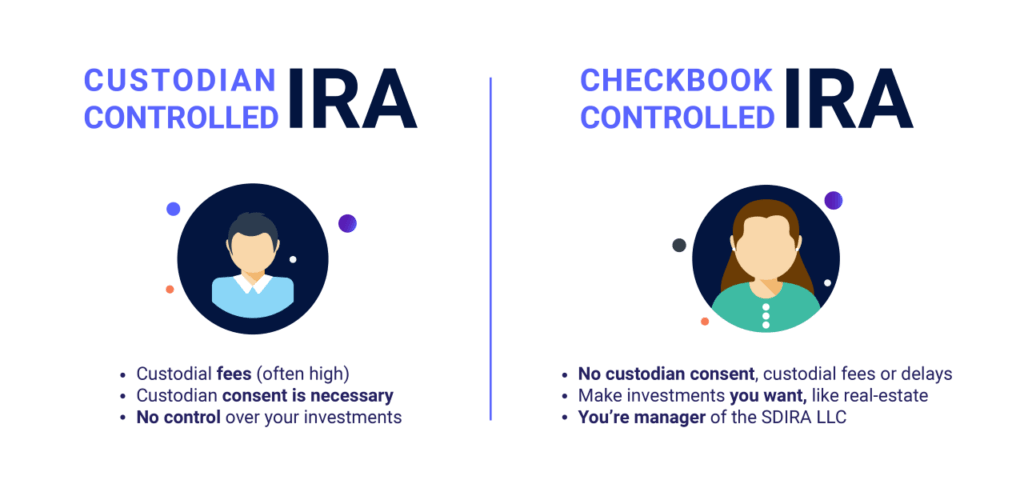
With a Self-Directed IRA with checkbook control, an IRA is set-up with a Self-Directed IRA custodian, such as IRA Financial. The IRA is then invested into a special purpose limited liability company (“LLC”), which IRA Financial can help you establish. The Self-Directed IRA LLC is then managed by the IRA owner providing the IRA owner with “checkbook control” over the IRA funds. With a “checkbook control” Self-Directed IRA LLC, the manager of the Self-Directed IRA LLC will have the authority to make investment decisions without the involvement of the custodian. Plus, a Self-Directed IRA LLC will offer the IRA owner with limited liability protection over IRA investments. Moreover, all Self-Directed IRA investments will be titled in the name of the LLC offering the IRA owner more privacy. without needing the consent of an IRA custodian. With a Self-Directed IRA LLC with “Checkbook Control’ you will be able to buy real estate by simply writing a check.
All types of IRAs can be transferred tax-free to a Self-Directed IRA LLC. A Self-Directed IRA with “checkbook control” is popular with IRA investors seeking to invest in alternative assets, such as rental properties, fixes and flips, tax liens, or cryptocurrencies that require a high frequency of transactions.
Thus, Jen would have the option of using a Self-Directed IRA or a Self-Directed IRA LLC with “checkbook control” to do her real estate deal. For real estate investors who will be engaged in a higher frequency of activity, such as a flipper, who will need to engage and pay multiple third parties as part of the real estate improvement process, the use of the “checkbook control” LLC is a far more popular choice. In addition to gaining more control over the real estate rehab process, Jen would also get limited liability protection and a greater degree of privacy. Whereas, if Jen was buying a piece of land to hold or investing in a real estate passive fund, the use of the IRA LLC would be far less important.
Real Life Example of Buying Real Estate in a Self-Directed IRA
Real estate is the most popular investment class for Self-Directed IRA investors. The reason for this is that real estate is a tangible asset that is easy to understand. Real estate is also proven to be a great way to hedge against inflation as well as a key investment diversification tool.
Buying real estate with a Self-Directed IRA is quite simple and easy. Below is the steps Jen took to buy and sell real estate in her Self-Directed IRA. Continue reading and you will see how Jen’s real estate investment turned out.
Jen locates a real estate property and performs her diligence. She makes an offer to purchase the property. The offer is made in her name with the right to assign to her Self-Directed IRA. Jen establishes a Self-Directed IRA with IRA Financial IRA Financial initiates the tax-free IRA transfer for Jen.
She initiates the former employer 401(k) plan rollover to her new Self-Directed IRA. Jen is notified by IRA Financial when the IRA and former employer 401(k) funds arrive at IRA Financial. Since Jen elected to use a Self-Directed IRA LLC with “checkbook control,” Jen provides IRA Financial with the LLC details, such as proposed name and address in the state. Since the real estate would be located in Texas, IRA Financial recommends that Jen establish the LLC in Texas.
Jen notifies her real estate agent that she wishes to purchase the real estate in the name of an LLC. IRA Financial establishes the Texas LLC for Jen, which she calls Applesouth Investments LLC. Jen elects to be the manager of the LLC giving her checkbook control. IRA Financial also acquires a Tax ID# for the LLC and prepares an LLC operating agreement.
Jen elects to open a bank account at Capital One, a banking partner of IRA Financial. Jen is free to open the LLC bank account at any local bank of her choice, but she likes the fact that IRA Financial can establish her LLC bank account in minutes without her having to step foot in a bank.
At Jen’s direction, IRA Financial sends the $300,000 of IRA funds into the new LLC bank account. Jen provides all the LLC-related info to her real estate agent for closing.
At closing, Jen signs the real estate purchase documents as manager of the LLC. Title to the real estate is in the name of Applesouth Investments LLC. The purchase price of the home is $242,000.
After closing, Jen starts using her IRA funds from the Applesouth Investments LLC bank account to pay the contractor and other service providers. In all Jen, spends $35,000 on improvements to the home. Six months later, Jen puts the home up for sale for $385,000 and sells it for $380,000.
In six months, using her Self-Directed IRA, Jen made $103,000 tax free. Jen sold the property for $380,000 and she was able to buy the property for $242,000 and sent $35,000 on improvements. If Jen used personal funds, she would have had to pay ordinary income tax on the $103,000 of gain since she held the property less than 12 months. She is now looking for her next real estate project and has $103,000 more funds to spend in order to generate an even bigger tax-free gain.
Tips For Using a Self-Directed IRA to Flip Real Estate
- The deposit and purchase price for the real estate property should be paid using IRA funds or funds from a non-disqualified third party.
- No personal funds or funds from a “disqualified person” should be used.
- All expenses, repairs, and taxes incurred in connection with the Self-Directed IRA Plan real estate investment should be paid using retirement funds – no personal funds should be used.
- If additional funds are required for improvements or other matters involving the real estate investments, all funds should come from the Self-Directed IRA or a non “disqualified person.”
- If financing is needed for a real estate transaction, only non-recourse financing should be used. A non-recourse loan is a loan that is not personally guaranteed and whereby the lender’s only recourse is against the property and not against the borrower.
- No services should be performed by the IRA owner or “disqualified person” in connection with the real estate investment. In general, other than typical trustee type of services (necessary and required tasks in connection with the maintenance of the plan), no active services should be performed by the IRA owner or a “disqualified person” with respect to the real estate transaction.
- Title of the real estate purchased should be in the name of the IRA custodian for the benefit of the IRA owner. For example, IRA Financial Trust Company FBO John Doe IRA. However, in the case of a Self-Directed IRA LLC, the title to the real estate would be in the name of the LLC.
- Keep good records of income and expenses generated by the real estate investment.
- All income, gains, or losses from a Self-Directed IRA real estate investment should be allocated back to the IRA.
- Make sure you perform adequate diligence on the property you will be purchasing especially if it is in a state, you do not live in
- Make sure you will not be engaging in any self-dealing real estate transaction that would involve buying or selling real estate that will personally benefit you or a “disqualified person.”
Conclusion
Using a Self-Directed IRA to flip real estate is one of the best legal hidden tax-shelters. Most real estate investors are aware of the 1031 exchange solution. However, the Self-Directed IRA essentially provides a real estate investor with the same tax-free advantages. The case of Jen highlighted the major tax advantages one can enjoy using a Self-Directed IRA to flip real estate, along with investment diversification and the ability to invest in a hard asset you can trust. Today, establishing a Self-Directed IRA is easier and more cost-effective than ever before. The whole process will take just a few days and the set-up and ongoing fees can be paid using either IRA or personal funds. Best of all, companies such as IRA Financial charge annual low flat fees so as your IRA assets grow in value, you will still pay the same low annual fee. What are you waiting for? Join Jen and the millions of other Self-Directed IRA investors who have gained the freedom to take control of their retirement funds to invest in almost anything they want tax-free.
Contact Us

What is a Non-Recourse Loan and How does it Work?
Since the creation of IRAs in 1974, real estate has become a popular investment category for millions of retirement account investors. Many IRA or 401(k) investors will use their retirement funds to purchase real estate directly with account funds. However, with real estate prices rising over the last several years, more investors have looked to borrowing funds to buy properties. What is a non-recourse loan and how does it affect retirement account investments?
- When borrowing funds to make a retirement account investment, the loan must be non-recourse
- A Self-Directed IRA or Solo 401(k) can be used to make alternative asset investments
- When using an IRA to finance a property, be aware of the UBTI tax
Recourse & Non-Recourse Real Estate Loans
What is a Recourse Loan?
The most common type of real estate loan is a recourse loan. It is a loan personally guaranteed by the borrower. Almost all residential mortgages are recourse loans. Having a recourse loan means that if there is a default, the lender can attempt to cure it by not only seizing the underlying real estate but also pursuing the individual borrower personally. The recourse mortgage is what caused many borrowers to declare bankruptcy in the 2008 financial crisis because the equity they had in the real estate investment collapsed which forced the lenders to pursue the individual borrowers personally. Today, most residential, and commercial mortgages are still recourse.
The IRS and Retirement Account Recourse Loans
Internal Revenue Code (IRC) Section 4975 prohibits the IRA owner from personally guaranteeing a retirement account loan. Specifically, 4975(c)(1)(B) holds that a disqualified person cannot lend money or use any other extension of credit with respect to a retirement account.
As a result, in the case of a Self-Directed IRA, one could not use a standard loan, such as a mortgage, as part of an IRA transaction since that would trigger a prohibited transaction. This leaves the Self-Directed IRA investor with only one financing option – a non-recourse loan.
Related: Self-Directed IRA for Real Estate
What is a Non-Recourse Loan?
A non-recourse loan is a loan that is not guaranteed by the borrower. The lender is securing the loan by the underlying asset or real estate that the loan will be used for. Hence, if the borrower is unable to repay the loan, the lender’s only remedy is against the underlying asset and not the borrower personally.
Below are some common characteristics of a non-recourse loan:
- The loan cannot be personally guaranteed by the borrower. Verify loan documents that this is the case.
- Most non-recourse lenders will require at least 30% equity down; others will want at least 40%.
- Expect to pay a higher interest rate for a non-recourse loan since the lender is taking more risk.
- Many lenders will not do a non-recourse loan associated with a real estate project in certain states (such as New York and Vermont) that have very pro-tenant rules, which make foreclosure difficult.
- Do your diligence on the nonrecourse lender and don’t be afraid to shop your deal around. (For Self-Directed IRA and Solo 401(k) real estate investors, IRA Financial has a number of non-recourse lenders that our clients work with.)
In general, a non-recourse loan is far more difficult to secure than a traditional recourse loan or mortgage.
Tax Treatment of Using a Non-Recourse Loan
Most investments made with a retirement plan will be tax-deferred (or tax-free in the case of a Roth account). However, the use of a non-recourse loan in connection with an IRA or 401(k) investment could trigger a tax known as UBTI, Unrelated Business Taxable Income.
In general, if non-recourse debt financing is used, the portion of the income or gains generated by the debt-financed asset will be subject to the UBTI tax. For example, if an individual invests 80% IRA funds and borrows 20% using a nonrecourse loan, 20% of the income or gains generated by the investment would be subject to the UBTI tax.
As stated earlier, the IRS allows IRA and 401(k) plans to use non-recourse financing only. The rules covering the use of non-recourse financing by an IRA can be found in IRC Section 514 which requires debt-financed income to be included as unrelated business taxable income, which generally triggers a maximum tax of 37% tax in 2023.
401(k) Exception
When one uses non-recourse financing to invest in real estate with a 401(k), there is no UBTI tax, pursuant to IRC Section 514(c)(9). To take advantage of this exception, generally, you need to be self-employed to be eligible for a Solo 401(k) plan. The reason for this is that most traditional 401(k) providers do not allow for alternative investments. A Solo 401(k) allows you the freedom to invest in just about anything you want, including real estate.
Conclusion
An investor looking to invest in real estate with retirement funds who also wishes to use leverage to purchase the property, or another asset may only use a non-recourse loan. The procedures for acquiring a non-recourse loan are essentially the same as a mortgage. However, since the borrower is not personally guaranteeing the loan, the lender will require more cash down and will generally charge a higher interest rate.
It's up to you as the investor to weigh the pros and cons when using leverage to make a real estate investment. The more retirement funds you use, the less tax you will owe from the income generated by the financed investment. Alternatively, if you are self-employed, you can completely avoid the UBTI tax.