


What is the UBTI Tax Rate?
The UBTI tax rate is in existence to prevent tax-exempt entities from competing unfairly with taxable entities. Tax-exempt companies are subject to UBTI tax when their income comes from trade or business that has no relation to its tax-exempt status.
Unrelated business taxable income is the “gross income derived by any organization from any unrelated trade or business regularly carried on by it.” Typically, an exempt organization will not be taxed on its income from activities that are charitable or educational. Such income is exempt even when the activity is a trade or business.
However, to prevent tax-exempt entities from competing unfairly with taxable entities, tax-exempt entities are subject to the UBTI tax. This is the case when the entity derives its income from a trade or business that has no relation to its tax-exempt status.
IRC 501 allows tax exemption to several organizations, such as non-profits. However, if the organization engages in activity unrelated to its business, and generates income from said activity, it may be liable for UBTI tax.
UBTI Tax - A Dual Purpose
As you can see, UBTI has a dual purpose:
- Prevent tax-exempt businesses from competing unfairly with taxable organizations
- Prevents tax-exempt businesses from engaging in business unrelated to their primary business objectives
Many tax advantages come with an IRA. One example is tax-free gains until you make a distribution. Most passive income investments will not be seen as UBTI. However, funds you generate from income that is UBTI taxable and goes back into the IRA, are subject to UBTI tax. For example, the operation of a gas station by an LLC or partnership that a Self-Directed IRA LLC owns will likely be subject to UBTI tax.
Related: How to Avoid Unrelated Business Tax
Understand the Difference: UBTI tax and UDFI
UBTI also applies to unrelated debt-financed income (UDFI). "Debt-financed property" refers to borrowing money to purchase real estate. In a case like this, the income attributable to the financed portion of the property will be taxed. Gain on the profit from the sale of the leveraged assets is also UDFI unless the debt is paid off more than 12 months before it's sold.
There are a few exceptions to UBTI tax. They relate to the central importance of investment in real estate. Some examples include:
- Dividends
- Interest
- Annuities
- Royalties
- Most rentals from real estate
- Gains/losses from the sale of real estate
The rental income you generate from the real estate that is "debt-financed" loses the exclusion. That portion of income becomes subject to UBTI. As a result, if the IRA borrows money to finance the purchase of real estate, the portion of rental income attributable to the debt is taxable as UBTI.
Related: How to Avoid UBTI Taxes on Real Estate
UBTI Tax on the Solo 401(k) Plan
Internal Revenue Code Section 511 taxes “unrelated business taxable income” at the UBTI Tax Rate applicable to corporations or trusts, depending on the organization's legal characteristics. Generally, UBTI is:
- Gross income from an organization's unrelated trades or businesses
- Less deductions for business expenses
- Losses
- Depreciation,
- Similar items directly connected therewith
Almost all Solo 401(k) investments generating passive income will not be subject to UBTI or UDFI.
- In sum, UBTI is triggered for a Solo 401(k) if:
- The Solo 401(k) uses margin to buy stock and the net income is above $1,000
- The Solo 401(k) invests in an active business through a pass-through entity, such as an LLC, and the net income is above $1,000. Note – if the pass-through income is passive and not considered a trade or business, such as rental income, then the Solo 401(k) plan would not be subject to the UBTI tax.
The UBTI rates listed below will apply in these instances.
Solo 401(k) for Real Estate
A major advantage of using a Solo 401(k) plan for real estate investments with leverage is that IRC 514(c)(9) exempts a 401(k) plan from the UBTI tax when using leverage (loan must be non-recourse as per IRC 4975). Whereas an IRA that uses a non-recourse loan to acquire real estate would be subject to the UBTI on debt related income above $1,000.
When using the Self-Directed IRA in a transaction that will trigger the UBTI tax, the IRA is taxed at the trust tax rate because an individual retirement account is considered a trust. For 2024, a Self-Directed IRA subject to UBTI is taxed at the following rates:
- $0 - $2,550 = 10% of taxable income
- $2,551 - $9,150 = $255 + 24% of the amount over $2,550
- $9,151 - $12,500 = $1,839 + 35% of the amount over $9,150
- $12,501 + = $3,011.50 + 37% of the amount over $12,500
Real Estate UBTI Implications
There is no formal guidance regarding UBTI implications for a Self-Directed real estate IRA. However, there is a lot of guidance on UBTI implications for real estate transactions by tax-exempt entities.
Commonly, gains and losses on dispositions of property will not be included unless the property is inventory or property that's up for sale to customers in the ordinary course of an unrelated trade or business. The exclusion covers gains and losses on dispositions of property used in an unrelated trade or business as long as the property was never on sale to customers.
Common Transactions that May be Unrelated Business Activity:
- The use of non-recourse loans to buy real estate with a Self-Directed IRA. Note: an exception exists for a Solo 401(k) plan using a non-recourse loan for the acquisition of real estate property.
- Investment in an active business (i.e., restaurant) operated through a pass-through entity, like an LLC, using a Self-Directed IRA or Solo 401(k) Plan
- Making an investment in a private equity firm operating active businesses through pass-through entities, such as an LLC using a Self-Directed IRA or Solo 401(k) plan
- An investment in master limited partnerships (MLPs) through a pass-through entity using a Self-Directed IRA or Solo 401(k) plan
- Investing in an investment fund that is using debt for investment purposes using a Self-Directed IRA or Solo 401(k) plan.
Related: Smart Ways to Avoid UBTI with Your Self-Directed IRA Investment
Get in Touch
Do you still have questions regarding the UBTI tax and how it may affect you? Contact IRA Financial at 800-472-0646. You can also fill out the form to speak with an on-site tax specialist.
Did You Know?
The IRS taxes “unrelated business taxable income” at the UBTI Tax Rate applicable to trusts or corporations, depending on the organization’s legal characteristics. Reach out to our specialists now for more information!


Does UBTI Apply to Margin Use for Option Trading?
In general, almost all retirement account investments generating passive income will not be subject to Unrelated Business Taxable Income (UBTI), such as capital gains, interest, dividends, royalties, and rental income. However, in the case of option trading involving puts, calls, and other securities lending transactions, a question arises as to whether those type of transactions will trigger the UBTI tax.
- UBTI tax is triggered for specific retirement account investments
- In determining if the tax applies, you must distinguish between the purchase of securities using margin, and options and other lending transactions
- The borrowing of cash to make a stock investment will trigger UBTI
What is UBTI?
There are essentially only three types of transactions that could trigger the UBTI tax. Because the maximum UBTI tax rate is 37%, it is important to determine whether your self-directed investment will trigger the tax before making the investment.
UBTI is triggered when one:
- uses margin or a nonrecourse loan to buy stock or an investment asset;
- invests in an active business through a pass-through entity, such as an LLC; and
- uses a recourse loan to purchase real estate (exemption for 401(k) plans). This is known as Unrelated Debt Financed Income (UDFI), which triggers the same UBTI tax
Calculating UBTI
Internal Revenue Code Section 511 taxes UBTI at the rates applicable to corporations or trusts, depending on the organization’s legal characteristics:
For 2023, a retirement plan subject to UBTI is taxed at the following rates:
- 10%: $0 – $2,900
- 24%: $2,901 – $10,550
- 35%: $10,551 – $14,450
- 37%: $14,451 and higher
If one triggers the UBTI tax, the IRA must file IRS Form 990-T by April 15 and pay the tax due from the retirement plan.
Security Lending Transactions
It is well established that the purchase of securities on margin gives rise to UDFI income (Henry E. & Nancy Horton Bartels Trust for the Benefit of the University of New Haven v. United States, 209 F.3d 147, 156 (2d Cir. 2000)). However, in Rev. Rul. 95-8, 1995-1 C.B. 107, the IRS has stated that neither the gain attributable to the decline in the price of the stock sold short nor the income earned on the proceeds of the short sale held as collateral by the brokerage firm constituted debt-financed income.
In addition, section 514(c)(8) provides that payments with respect to securities loans are deemed to be derived from the securities loaned, not from collateral security or the investment of collateral security from such loans and would not constitute debt-financed income. Furthermore, an obligation to return collateral security is not treated as acquisition indebtedness.
Short Sales
In GCM 39615 (March 12, 1987), the IRS reviewed purchases and sales of stock index futures and the underlying stock pursuant to a stock arbitrage investment program. The IRS held that the futures contracts, some of which constituted short sales, were "themselves property, albeit intangible." Hence, the IRS concluded that the trading gains and losses from the stock index futures would be excluded from UBIT under Section 512(b)(5). In addition to the potential for gain from short sales, institutional short sellers are often entitled to interest income earned on the investment of short sale proceeds. This interest income, however, is unambiguously excluded from UBTI under Section 512(b)(1).
The IRS also held that income or gain connected with short sales does not become subject to tax by virtue of the "acquisition indebtedness" rules contained in Section 514. The IRS ruled that the borrowing of securities by the short seller does not create an indebtedness for federal income tax purposes. Similarly, the cash sale proceeds arising from the short sale are treated as sales proceeds and do not arise from an indebtedness. Hence, the short seller has borrowed securities and engaged in a property transaction and has not created an indebtedness for Federal income tax purposes.
Option Terminations
In the case of a lapse of termination of an option, Section 512(b)(5) excludes from UBTI all gains or losses recognized from the lapse or termination of options to buy or sell securities.
Commodity Futures
In G.C.M. 39620 (Apr. 3, 1987), the IRS ruled that gains and losses from commodity futures contracts are excluded from UBTI under Section 512(b)(5). The IRS held that the obligation of a holder of a long position to pay for the commodity on delivery did not constitute indebtedness because neither the seller for the buyer held the property at the time of entering into the contract. In essence, the purchase of a long futures contract entailed no borrowing of money in the traditional sense.
Interest Rate Swaps
Pursuant to Treas. Reg. § 1.512(b)-1(a)(1), the IRS has held that interest rate swap transactions, known as notional principal contracts, shall not be subject to the UBTI tax rules.
Conclusion
When it comes to determining whether the UBTI tax would apply to a securities lending transaction, it is important to distinguish between a transaction involving the purchase of securities, such as stocks, on margin, versus options and various other lending transactions. The borrowing of cash to purchase stock will be deemed margin and will trigger the tax. Whereas Section 512(b)(5) excludes from UBTI all gains or losses recognized, in connection with the lapse or termination of options to buy or sell securities. This includes transactions involving short sales and commodity futures contracts.

What is Unrelated Business Taxable Income (UBTI)?
The tax advantage of an IRA is that income is tax-free until distributed. In general, an exempt organization is not taxed on its income from an activity that is substantially related to the charitable, educational, or other purpose that is the basis for the organization's exemption. Such income is exempt even if the activity is a trade or business. However, to prevent tax-exempt entities from competing unfairly with taxable entities, tax-exempt entities are subject to unrelated business taxable income (UBTI) when their income is derived from any trade or business that is unrelated to its tax-exempt status.
What is UBTI?
UBTI is defined as “gross income derived by any organization from any unrelated trade or business regularly carried on by it” reduced by deductions directly connected with the business. An exempt organization that is a limited partner, member of a LLC, or member of another non-corporate entity will have attributed to it the UBTI of the enterprise as if it were the direct recipient of its share of the entity's income which would be UBTI had it carried on the business of the entity.
Related: Tax Requirements for a Self-Directed IRA
Debt-Financed Property
UBTI also applies to unrelated debt-financed income (UDFI). “Debt-financed property” refers to borrowing money to purchase the real estate (i.e., a leveraged asset that is held to produce income). In such cases, only the income attributable to the financed portion of the property is taxed; gain on the profit from the sale of the leveraged assets is also UDFI (unless the debt is paid off more than 12 months before the property is sold).
There are some important exceptions from UBTI: those exclusions relate to the central importance of investment in real estate - dividends, interest, annuities, royalties, most rentals from real estate, and gains/losses from the sale of real estate. However, rental income generated from real estate that is “debt financed” loses the exclusion, and that portion of the income becomes subject to UBTI. Thus, if the IRA borrows money to finance the purchase of real estate, the portion of the rental income attributable to that debt will be taxable as UBTI.
Related: UBTI and Real Estate Investing
Regularly Carried on Business
For an IRA, any business regularly carried on or by a partnership or LLC of which it is a member is an unrelated business. For example, the operation of a shoe factory, the operation of a gas station, or the operation of a computer rental business by an LLC or partnership owned by the Self-Directed IRA LLC would likely be treated as an unrelated business and subject to UBTI.
Although there is little formal guidance on UBTI implications for self-directed real estate IRAs, there is a great deal of guidance on UBTI implications for real estate transactions by tax-exempt entities. In general, Gains and losses on dispositions of property (including casualties and other involuntary dispositions) are excluded from UBTI unless the property is inventory or property held primarily for sale to customers in the ordinary course of an unrelated trade or business. This exclusion covers gains and losses on dispositions of property used in an unrelated trade or business, as long as the property was not held for sale to customers.
In addition, subject to a number of conditions, if an exempt organization acquires real property or mortgages held by a financial institution in conservatorship or receivership, gains on dispositions of the property are excluded from UBTI, even if the property is held for sale to customers in the ordinary course of business. The purpose of the provision seems to be to allow an exempt organization to acquire a package of assets of an insolvent financial institution with assurance that parts of the package can be sold off without risk of the re-sales tainting the organization as a dealer and thus subjecting gains on re-sales to the UBIT.
Learn More: UBIT and House Flipping
IRA Unrelated Business Taxable Income Rules
When it comes to using a Self-Directed IRA to make investments, most investments are exempt from federal income tax. This is because an IRA (individual retirement account) is exempt from tax pursuant to Internal Revenue Code 408 and Section 512. However, you should be aware of the UBTI rules.
The Internal Revenue Codes exempt most forms of investment income an IRA generates from taxation. Some examples of exempt income include:
- Interest from loans
- Dividends
- Annuities
- Royalties
- Most rentals from real estate
- Gains/losses from the sale of real estate
However, the IRS set forth rules in the 1950s to prevent charities, and later IRAs, from engaging in an active trade or business. Charities and IRAs had an unfair advantage due to their tax-exempt status.
IRA investors can find the UBIT rules under Internal Revenue Code Sections 511-514. These rules are classified as the Unrelated Business Taxable Income rules.
If you trigger the UBIT rules, the income you generate from activities will generally be subject to close to a 40% tax for 2024. Note – an IRA investing in an active trade or business using a C Corporation will not trigger the UBIT tax.
UBTI Rules (Unrelated Business Taxable Income Rules)
UBIT rules generally apply to the taxable income of “any unrelated trade or business…regularly carried on” by an organization subject to the tax. The regulations separately treat three aspects of the quoted words. “Trade or business,” “regularly carried on,” and “unrelated.”
Read More: How to Avoid Unrelated Business Taxable Income
Trade or Business
In defining “unrelated trade or business,” the regulations start with the concept of “trade or business” by Internal Revenue Code Section 162. This allows deductions for expenses paid or incurred “in carrying on any trade or business.”
Although Internal Revenue Code Section 162 is a natural starting point, the case law under that provision does little to clarify the issues. Expenses that individuals incur in profit-oriented activities not amounting to a trade or business are deductible under Internal Revenue Code Section 212. Therefore, it is rarely necessary to decide whether an activity conducted for profit is a trade or business.
The few cases on the issue under Internal Revenue Code Section 162 generally limit the term “trade or business” to profit-oriented endeavors involving regular activity by the taxpayer.
“Regularly Carried On”
The UBIT rules in connection with an IRA only apply to income of an unrelated trade or business that is “regularly carried on” by an organization. Whether a trade or business is regularly carried on is determined in light of the underlying objective to reach activities competitive with taxable businesses.
The requirement is then met by activities that “manifest a frequency and continuity, and are pursued in a manner generally similar to comparable commercial activities of nonexempt organizations.”
Short-term activities are exempt if comparable commercial activities of private enterprises are usually conducted on a year-round basis. For example, a sandwich stand that an exempt organization operates at a state fair would be exempt.
However, a seasonal activity is regularly carried on if its commercial counterparts also operate seasonally. For example, a horse racing track.
Intermittent activities are similarly compared with their commercial rivals and are ordinarily exempt if they don’t have promotional efforts typical of commercial endeavors.
Moreover, if an enterprise is conducted primarily for beneficiaries of an organization’s exempt activities (i.e., a student bookstore), casual sales to outsiders are ordinarily not a “regular” trade or business.
Before determining whether an activity is seasonal or intermittent, the relevant activity must be identified and quantified, a step that is often troublesome.
The type of income that generally could subject a Self Directed IRA to UBTI or UBIT is income from the following sources:
- Income from the operations of an active trade or business – i.e. a restaurant, gas station, store, etc.
- Business income generated via a pass-through entity, such as an LLC or partnership
- Using a non-recourse loan to purchase a property
- Using margin on a stock purchase
Contact IRA Financial
Do you still have questions regarding UBTI/UBIT rules in an IRA that were not covered in this article? We can answer your questions directly at 800-472-0646.

401(k) Rollovers & Possible Tax Consequences
One of the major differences between an IRA and a 401(k) plan, from the perspective of the individual retirement account holder, is that an IRA owner can take a distribution at any time, whereas a 401(k)-plan participant is limited. Under certain circumstances, a 401(k) rollover can be performed. Are there any tax consequences that you should be aware of? It depends on the situation. This article will discuss situations that allow you to rollover your 401(k) plan to a new IRA provider and the potential tax consequences of failing to follow the plan triggering event rule.
- To perform a 401(k) rollover, first, you must satisfy a plan triggering event
- 401(k) funds can be rolled over to another retirement plan once this happens
- Depending on how you roll over the funds, there may be tax consequences you should be aware of
401(k) Plan Triggering Event Requirement & Rollovers
In general, for a 401(k) plan participant to transfer his or her 401(k) funds to an IRA or another retirement plan, a plan-triggering event would need to be satisfied. It is hard for many 401(k) plan participants to believe that they do not have control over their current employer plan funds. The following are the most common triggering events:
- Reach the age of 59 1/2
- Leave your job
- Plan is terminated
- Rolled funds into 401(k) plan
- Hardship distribution
In sum, if a 401(k) plan participant is under the age of 59 1/2 and continues to be employed by the employer that sponsored the 401(k) plan, the individual will likely not be able to perform a rollover.
401(k) Plan Rollover to a Traditional IRA
If a plan participant satisfies a plan triggering event, the individual will have the ability to rollover funds to an IRA tax-free. A direct rollover means the funds are transferred directly from the 401(k) plan to an IRA. A direct rollover can be done in cash or in-kind, by rolling over the asset directly, such as stock or real estate.
A direct rollover to an IRA is not subject to any withholding tax. However, once every twelve months, a 401(k) plan participant who can satisfy a plan-triggering event, may engage in an indirect rollover.
Unlike a direct rollover, with an indirect rollover, the funds are transferred from the 401(k) plan to the retirement account owner, who will have sixty days to use the funds for any purpose without tax or penalty. The funds must then be rolled into an IRA or another retirement plan within that period. If the retirement account holder misses the deadline, the entire amount of the indirect rollover will be deemed subject to tax, and a 10% penalty if the individual is under the age of 59 1/2.
One thing to consider, in the case of an indirect rollover, a 20% withholding tax would apply even if you intended to roll it over later to another retirement plan. If you do roll it over and want to defer tax on the entire taxable portion, you'll have to add funds from other sources equal to the amount withheld. Note – the 20% withholding tax does not apply to direct rollovers.
Related: How to Transfer my IRA to IRA Financial
401(k) Plan Rollover to a Roth IRA
A 401(k) plan participant that has satisfied a triggering event can rollover funds to a Roth IRA. There are two scenarios in which this can occur.
First, a 401(k) plan participant that has pretax funds can elect to roll the funds to a traditional IRA, and then convert the Traditional IRA to a Roth. A conversion is subject to income tax on the fair market value of the assets converted.
Secondly, a plan participant who has Roth 401(k) funds can rollover those funds tax-free to a Roth IRA. The rollover can be direct or indirect. However, an indirect Roth IRA rollover can only be done once every 12 months and is subject to the aforementioned sixty-day rule.
Conclusion
The most common way to move funds from a 401(k) plan to an IRA or Roth IRA is via a direct rollover. Almost $500 billion each year is rolled over from 401(k) plans to IRAs. For those with pretax 401(k) funds that want to do a direct rollover to a Roth IRA, the rollover must first technically go to a traditional IRA and then can be converted to a Roth. Most companies, such as IRA Financial, will only charge for the Roth IRA, in the case of a conversion scenario.
There are two instances where you should be aware of tax consequences. The Roth conversion, and the indirect rollover route. You should plan accordingly before moving your funds from one plan to another.

How Much Do I Need to Start a Self-Directed IRA?
Over the last several years, as a result of technology and more industry efficiency, opening a Self-Directed IRA is now easier and more cost-effective than ever. Thanks to new digital investment options, such as cryptocurrencies, fractional real estate, crowdfunding, and private placements, millions of retirement investors are establishing Self-Directed IRA structures with far less money than you would think. So how much do you need to start a Self-Directed IRA account?
- Starting a Self-Directed IRA is easier than ever with the IRA Financial app
- We offer a low annual fee and no hidden charges
- Investment options are available for every budget in today’s marketplace
What is a Self-Directed IRA?
A Self-Directed IRA is essentially an IRA that allows for alternative asset investments, typically assets you cannot invest in with a regular IRA. Since the creation of IRAs in 1974, the Internal Revenue Code does not prohibit IRAs from investing in alternative assets. However, just because an investment is allowed, doesn’t mean it is offered by your IRA custodian.
The only investments you cannot make are life insurance, collectibles, and a transaction involving a disqualified person. But since you don’t have the freedom to invest with a regular financial institution, you must look for the right Self-Directed IRA provider, such as IRA Financial.
How Much do I Need to Start a Self-Directed IRA?
With IRA Financial, you can open a Self-Directed IRA with no setup fee and a flat $495 annual custodian fee. There are no asset-based or standard transaction fees, so you keep more of your returns as your account grows.
You can get started for free on our app, and the annual fee can be paid with IRA funds or by credit card once your account is funded.
Why Should You Set Up a Self-Directed IRA?
The primary advantage of a Self-Directed IRA is that one can use retirement funds to better diversify his or her retirement portfolio, as well as invest in an asset you better understand. A mounting number of IRA owners are concerned with the fact that most of their personal and retirement savings are tied into equities, such as stocks, and want the opportunity to diversify into other asset classes.
Of course, the tax advantages of the plan are numerous. All assets, both traditional and alternative, held inside an IRA are not taxable. Taxes are deferred until you withdraw from the plan. Alternatively, if you have a Roth IRA, all qualified distributions are tax-free at retirement.
How to Fund a Self-Directed IRA
There are three primary ways to establish and fund a Self-Directed IRA: (i) contributions, (ii) transfers, and (iii) rollovers. Depending on your situation, you may able to choose one, or multiple options.
Contributions
In 2026, one can contribute up to $7,500, plus an additional $1,100 if you are at least age 50 to a Self-Directed IRA. One must have sufficient earned income to be eligible to make contributions. Passive income, such as capital gains or rental income, are not treated as earned income and cannot be considered for contributions.
Traditional, or pretax, IRAs are funded with, you guessed it, pretax money. For most people, the money contributed to the plan are not treated as taxable income. However, if you earn too much during the year, you will not receive that deduction.
On the other hand, Roth IRAs are funded with after-tax money. There is no immediate tax benefit, but as we mentioned earlier, distributions are tax free. In order to receive tax-free Roth funds, you must be at least 59 1/2 years of age and have any Roth opened for at least five years.
Transfers
A transfer is essentially moving funds from one type of plan to the same type (like IRA to IRA). One can transfer fund or assets, such as stocks or real estate, from an IRA to a Self-Directed IRA anytime without limitations. IRA to IRA transfers are tax-free and can be done anytime.
However, an indirect transfer, where IRA funds are first transferred to the IRA holder before being re-transferred to a Self-Directed IRA can only occur once every twelve months. In addition, the IRA owner has only 60 days to use the funds before they must be returned to a retirement plan. Any funds not moved into a plan are treated as a taxable distribution.
Rollovers
The Self-Directed IRA rollover rules are very similar to the IRA transfer rules. The main difference between an IRA transfer and a rollover is that a rollover is between and IRA and non-IRA retirement account, such as a 401(k) plan.
Keep in mind, you can only roll over “old” retirement funds. Plan funds you have at a current job generally need a triggering event to be moved. The most popular ones are reaching the age of 59 1/2, separating from your employer, or if the plan gets terminated. Once one of these events happens, you are free to move your funds wherever you want, including rolling them over to a Self-Directed IRA.
Starting a Self-Directed IRA
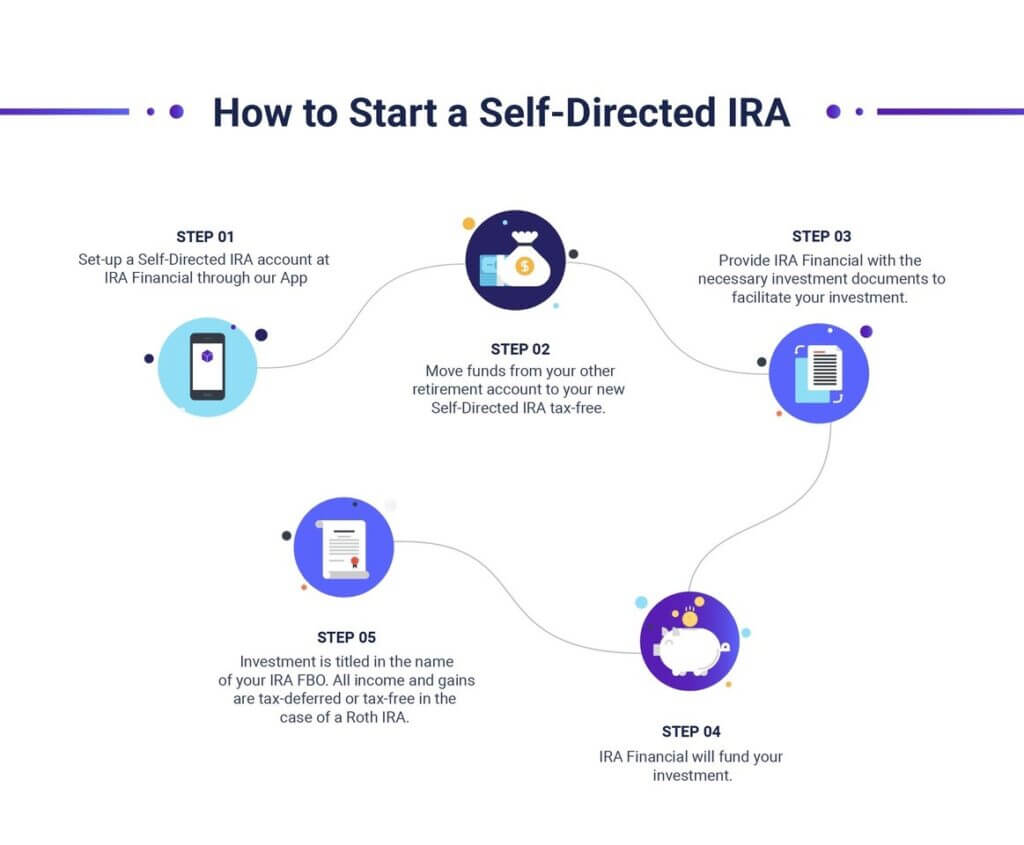
Setting up a Self-Directed IRA is now easier than ever with the use of the IRA Financial app. No longer do you need to visit a bank or other financial institution. You can now do it right from your smart device or personal computer.
How Long Does it Take to Open an Account?
After logging into the app, you start the process of opening the account.
- The application will go into a queue to be reviewed. A new account specialist will call you within 3-5 business days if items are missing, filled out incorrectly, or need further follow-up.
- Once the application is complete and correct, an account number will be assigned within an additional 3-5 business days. The account number will be emailed to you by newaccounts@irafinancial.com.
- The transfer form will be submitted to the Transfer Department, or instructions to complete a rollover or contribution will be emailed to you with your account number.
- Once we receive the funds they will be ready for investing.
- An investment authorization form is to be completed and required investment documentation must be provided/uploaded so that IRA Financial can fund the investment.
Conclusion
Starting a Self-Directed IRA with IRA Financial is now simpler and more cost effective than ever. Our industry leading app makes opening an account super quick and easy. The ability to gain investment diversification and generate tax-advantaged gains is the primary reason the Self-Directed IRA has become so popular with retirement savers. Our flat annual fee model allows you to invest with the confidence that as your account goes up in value, you will still pay the same annual fee. Plus, with no hidden fees, investing is efficient and worthwhile.

What is the Rollover Business Startup Solution?
ROBS Solution, or the Rollover Business Start-up (aka Rollover as Business Startups), is an IRS and ERISA approved structure. It allows you to invest funds from your retirement account into a new business/franchise. You can remove funds from a Traditional 401(k) or IRA Plan to purchase a new or existing business or franchise tax-free and penalty-free.
The ROBS arrangement typically involves rolling over a prior IRA or 401(k) plan account into a newly established 401(k) plan, which a start-up C Corporation business sponsors. You then invest the rollover funds in the stock of the new C Corporation.
If you’re an entrepreneur, you’ll benefit in many ways by using the Rollover Business Startup Solution retirement option. With the Rollover Business Startup Solution, you:
Won’t take on debt: You can always invest more money into your business which is crucial for start-ups. Remember, a ROBS isn’t a loan, therefore there’s no debt to repay.
Won’t pay penalties or taxes: With the Rollover Business Startup Solution, you can withdraw funds from your retirement plan before 59 ½ without incurring taxes or penalties.
Receive Funding: Your credit score doesn’t matter, and typically other factors that may go against you aren’t considered. Your business receives funding when it needs funding. If you’re passionate about starting your business and you have a significant retirement “nest egg”, turn this into capital for your new business venture. The ROBS solution allows you to kick-start your new business by accessing the money in your retirement account.
Benefits of The Rollover Business Startup Solution
With the ROBS Solution at IRA Financial, you can do the following:
- Use your retirement funds to invest in a new business tax-free!
- Use your retirement funds to purchase a business or franchise tax-free!
- Use your retirement funds to finance a new or existing business tax-free!
- Earn a reasonable salary from your new or existing business.
- Help grow your business.
- Recapitalize and/or expand your business.
- Maintain a qualified retirement plan and help save for the future.
- Diversify your retirement investment portfolio by investing in your own business as well as stocks and mutual funds.
- Attract and retain quality employees by offering a benefit not commonly found in small business.
- Take advantage of high contribution limits under a 401(k) Plan.
- Enjoy tax benefits generated by using a 401(k) Plan.
- Private Business Funding without consent
- Work directly with our tax and ERISA professionals to establish an IRS and ERISA compliant structure that works best for you and your business.
Read More: Pros and Cons of Rollover Business Startups
How Does the Rollover Business Startup Solution Work?
The structure typically involves the following steps:
1. An entrepreneur or existing business owner establishes a new C Corporation.
2. The C Corporation adopts a prototype 401(k) plan that specifically permits plan participants to direct the investment of their plan accounts into a selection of investment options. This includes employer stock, also known as “qualifying employer securities.”
3. Next, the entrepreneur elects to participate in the new 401(k) plan and, as permitted by the plan, directs a rollover or trustee-to-trustee transfer of retirement funds from another qualified retirement plan into the newly adopted 401(k) plan.
4. Then, the entrepreneur directs the investment of his or her 401(k) plan account to purchase the C Corporation’s newly issued stock at fair market value. In other words, the amount that the entrepreneur wishes to invest in the new business.
5. Finally, the C Corporation utilizes the proceeds from the sale of stock to purchase an existing business or to begin a new venture.
Read More: Can I Buy a Business with my Retirement Account?
What are the Requirements for Rollover Business Startups?
In order to establish a ROBS solution, there are three main requirements:
- There needs to be a U.S. based business.
- The U.S. business needs to be established as a C Corporation.
- The C Corporation must establish a 401(k) plan.
Only a U.S. business can establish a 401(k) plan. The reason a C Corporation and a 401(k) plan must be used and not an LLC or an IRA, is that pursuant to IRC 4975(d)(13), a 401(k) plan must purchase “qualifying employer securities” or C Corporation stock in order to satisfy the exception to the prohibited transaction rules under IRC 4975(d)(13).
The advantages of using a ROBS solution to finance an existing business is that you can use IRA rollover or 401(k) funds to finance an existing business without seeking outside capital or debt.
In addition, establishing a 401(k) plan for your business will allow you to make high tax-deductible contributions – $69,000 ($76,500 if you are at least age 50) for 2024 and even borrow up to $50,000 for any purpose. Moreover, below are some great reasons to establish a 401(k) plan for your business, in addition to using the ROBS solution:
Advantages of Establishing a 401(k) Plan:
- Up to a $5,000 Tax Credit!
- Current tax deduction for business owner
- Shelter earnings from tax
- Grow assets through the power of tax deferral
- Asset and creditor protection
- Retain key employees
- Help employees save for retirement
Read More: Top Businesses Using ROBS Solution
5 Advantages of the Rollover Business Startup Solution
Save Money
The primary advantage of establishing a ROBS solution is the ability to use your retirement funds to invest in a business you have a personal involvement with. You're able to invest retirement funds into the business without having to take a taxable distribution and a 10% early distribution penalty if under 59 1/2. As a result, the ROBS solution can save you close to 45% of the distribution amount.
For example, if you're under 59 1/2 and you want to use $100,000 of retirement funds to fund a business, you have the option to take a taxable distribution of that amount. But you will likely pay approximately 45% of the 100,000 in tax to the IRS when declaring the distribution on their tax return. That's a whopping $45,000.
Of course, the tax rate can lower depending on whether you're in a lower income tax bracket. It can also decrease if the retirement funds you need are insignificant.
Nevertheless, a ROBS solution saves you from paying tax and potentially a 10% penalty on that amount.
Invest in Yourself
The ROBS solution allows you to invest your retirement funds in yourself rather than Wall Street. Of course, not all businesses are successful. According to Bloomberg, close to 80% of new businesses fail in the first 18 months. Therefore, investing your retirement funds in a new business is certainly risky. However, it is a risk that you are legally permissible to take as per the Internal Revenue Code.
Using retirement funds to invest in your business is not for everyone. However, for those entrepreneurs who prefer to invest in themselves rather than Wall Street, the ROBS solution is an option.
Diversification
There is a growing sentiment among financial advisors that in order to protect your retirement funds from a market downturn, you must diversify your retirement funds. This belief grew after the 2008 financial crisis.
You cannot eliminate investment risk completely, but you can manage your level of risk. If you invest your retirement funds in different types of investments, such as stocks, real estate, and even private businesses, you can better protect your retirement funds.
Also, diversification may enable a retirement portfolio to grow both when markets boom and returns crumble in one sector. Work with a financial planner and tax professional when looking at investment options. This is especially important when using your retirement funds to buy a business.
Earn a Salary
In order to participate in a 401(k) plan, you must be an employee of a business that adopted the plan. This is why, if you own Apple or IBM stock yet do not work for these companies, you can’t participate in their 401(k) plan.
In order to be eligible to participate in the corporation 401(k) Plan, you must become a W-2 employee of the C corporation. It’s important for many entrepreneurs to earn a salary and be involved in a business. For these individuals, the ROBS solution is the better option in comparison to the Self-Directed IRA.
Benefit from having a 401(k) Retirement Plan
One of the best ways for you to save toward your own retirement and ensure your future security is through an employer-sponsored 401(k) plan. Below are some advantages of offering and participating in a 401(k) Plan.
- Matching Contributions: Many employers will match a portion of your savings. It's like passing up free money if you don't participate. A safe harbor 401(k) Plan is a popular type of 401(k) plan for small businesses. It offers employees who participate in the plan a 3% matching contribution by the employer. Thus, if the employee earns $40,000 in salary during the year and contributes 3% of the salary of $1,200 to the 401(k) plan, the employer contributes an additional $1,200 (3% of the salary) to the individual 401(k) plan account.
- Retaining employees: For most businesses offering retirement benefits, it is worthwhile for small businesses to compete for talented workers by implementing 401(k) benefits. Offering 401(k) plan benefits is a great way to retain key employees. In general, when potential hires are considering multiple job offers, they'll compare those offers on corporate culture, growth opportunities, and benefits packages.
- Easy Administration: 401(k) Plan administration is now easier and more cost-effective than ever with Internet options available to small employers. In addition, IRA Financial Group offers record-keeping and third-party administration services for your plan. This allows you to spend more time focusing on your business and less on your plan.
- You Can Participate: You are eligible to participate in the company 401(k) plan if you are an owner or an employee of the company that sponsors the 401(k) plan. Current regulations allow plan participants to contribute up to $23,000 of their income on a pretax basis each year, or $30,500 if at least age 50 in 2024. Therefore, in addition to your tax savings for offering the plan and providing matching contributions, you'll receive tax savings for participating in the plan.
How to Remain IRS Compliant with Rollover Business Startup (ROBS)
When you make the choice to employ the structure for a business/franchise, there are criteria you must adhere to and things you should never do with the structure. Below is a list of what you should do to stay IRS compliant and benefit most from the Rollover for Business Startup.
1. Maintain an Active Business
Ensure that you run an active operating business/company. It cannot be a passive business, such as certain real estate ventures, nor can it shift into one. Additionally, your business must be legal on a federal level in order to employ the ROBS solution. For example, marijuana is not legal on a federal level, therefore you may not be able to fund your business with the Rollover for Business Startup Solution. ROBS providers are not likely to move forward with such a business, because the IRS has not yet approved it.
2. Be an Active Employee
In order to stay IRS compliant, your business must provide a legitimate service, and you must be an employee of that business. You can earn a salary, but not before the business derives compensation. At that point, you can earn a “reasonable” salary for your position. You can work with a ROBS provider, such as IRA Financial, to determine what a “reasonable” salary is, or you can perform a basic market salary comparison. It does not matter what role you choose in the company, but it must be active. For example, you cannot be a passive investor in your brother’s company. The amount of hours you work annually is not set, but 1,000 hours is a good baseline.
3. Offer 401(k) Plan to Employees
It’s important to give your employees the option of participating in an employer-sponsored 401(k) plan, and you should never make it difficult for them. Plus, all employees must have the same investment options. If it is available to owners, it must be available to all employees.
When you offer a 401(k) plan, you increase your chance of hiring individuals best equipped for the job, and you better retain key employees. Additionally, you receive tax benefits by offering a 401(k) plan, and participating in one.
4. Be Aware of ROBS Audit Risk
Though the ROBS structure is completely legal, they are quite complicated to set up on your own. If you don’t set it up properly, or fail to maintain the allowed structure, you can face an IRS audit. If the IRS deems that the rules were broken, then the entire amount of the transaction may be taxed. Note that there is less than a one percent chance that your ROBS will be audited. IRA Financial ensures that you’re ROBS structure will be completed. and maintained properly.
5. File Your Rollover for Business Startup Documents Annually
One thing you must remember to do is file all the necessary documents and tax returns for your business every year. Generally, you must file your corporate taxes on your own. Other forms, such as the 5500, will be completed and returned by your plan administration service. Failure to file these documents annually will lead to unnecessary tax consequences.
To be clear, all the responsibilities you have as a business owner will be there. In addition, when using the Rollover for Business Startup to invest in a business, you must make sure all rules are followed. The tax bill may be hefty if you don’t. IRA Financial will always make sure this doesn’t happen to you!
Watch this – How Long Does the ROBS Process Take?
6. What Happens When You Close or Sell the Business?
In the unfortunate event that you have to close the business, or if you decide to sell it, you must take appropriate measures to close out your Rollover for Business Startup. As mentioned above, all taxes (including State if they are owed) must be submitted for the final year of operating the business. Further, you must now close the 401(k) plan set up for the business.
There are basically two ways to close the 401(k): 1) insolvency and 2) stock buy back. When your stocks become valued at $0, they are insolvent. You must distribute the plan assets to those who participated and thus dissolves the plan. If you buy back the stock that the 401(k) has in the business, you then must deposit the funds from the sale back into the plan. You can then distribute those funds to the plan participants.
There are a few other maintenance issues to resolve, but the final thing you must do is file the last Form 5500 for the business. Again, this is generally prepared and submitted by your administration team. 1099 forms may also be needed to report all distributions from the plan. IRA Financial will prepare and/or help you submit all the required paperwork so that you are not hit with any penalties.
Why Use IRA Financial for the Rollover Start Up Solution
IRA Financial was founded by a group of top law firm tax and ERISA professionals who have worked at some of the largest law firms in the country, including White & Case LLP and Dewey & LeBoeuf LLP. The legality of using retirement funds to purchase employer corporate stock as your Business Funding Solution is firmly established in the Internal Revenue Code and under ERISA law. Although codified under law, the IRS has been concerned that a number of promoters marketing this type of structure have not had the expertise to develop a structure that is fully compliant with IRS and ERISA rules and regulations. With this in mind, the IRA Financial’s in-house retirement tax professionals spent the last two years carefully studying IRS materials and guidance in order to design an IRS and ERISA compliant structure for using retirement funds to acquire or invest in a business tax-free!
The Rollover for Business Startups (ROBS) Solution was developed to specifically address and solve each of the non-compliant areas addressed by the IRS creating a business acquisition and funding solution that is in full compliance with IRS and ERISA rules and procedures. Unlike our competitors who have been offering this type of structure for many years, which according to the IRS, a significant portion have been found to be non-compliant, the IRA Financial has patiently waited for clear IRS guidance before offering a business acquisition structure that would be fully compliant with IRS and ERISA rules and procedures. Because the IRS has stressed the importance of compliance when using retirement funds to purchase a business, it is crucial to work with a company that is operated by a team of in-house tax and ERISA professionals to ensure the structure satisfies IRS and ERISA rules and procedures.
We have developed a process that ensures speed and compliance, by using standardized procedures that work via phone, e-mail, fax, and mail. Your funds will typically be ready for investment into your new or existing business within 14-21 days.
Rollover Business Startup Solution Funding Services
The services we offer to get you started with the ROBS solution include the following:
- Establishment of “C” Corporation
- Articles of Incorporation
- By-Laws
- Organizational Meeting Minutes
- Stock Certificates
- Employment Agreement
- Federal Tax Identification Number
- Provide corporate record book and stock certificates. Draft Stock subscription agreement and stock purchase agreement.
- Establishment of 401(k) Plan
- The Adoption Agreement Plan
- Basic Plan Document Agreement
- The Summary Plan Description
- IRS Opinion Letter
- Notice to Employees
- Resolution Adopting Plan
- Retain third-party administrator (when needed)
- Process ERISA Fidelity Bond (when needed)
- Retain independent Appraisal for corporate stock valuation
- Completion of IRS Form 5500
- Direct access to our on-site tax and ERISA professionals
Rollover for Business Startup Conclusion
Getting started with ROBS is only the beginning. Whether you used your retirement funds to start a new business or invest in an existing one, you must make sure to follow all IRS rules. Failure to do so will lead to unnecessary taxes and penalties. Here at IRA Financial, we will guarantee that this does not happen to you. If a question arises, our experts will work diligently to get you the correct answer and keep you IRS-compliant.
Do not hesitate to get in touch with us via our contact page or by calling 800.4720646. We are here every weekday from 9am-7pm. We are always available for all of our clients’ needs, big or small.
Did You Know?
A C Corporation is a legal entity where the owners, shareholders, or stakeholders are taxed separately from the entity. C corporations offer shareholders limited liability protection (LLP).

Using a Solo 401(k) to Avoid UBIT for a Real Estate Investment Fund
Internal Revenue Code (IRC) Section 514 requires debt-financed income to be included in Unrelated Business Taxable Income, also known as UBIT or UDFI. For Self-Directed IRA or 401(k) investors seeking to use retirement funds to invest in real estate investment funds, the tax becomes a major investment hurdle. However, an exemption to the tax exists under IRC Section 514(c)(9) for 401(k) plans, but not IRAs. However, there are several rules surrounding the application of the rule for exempting income attributable to the use of debt financed income for 401(k) investors.
- UBIT is a tax that applies to certain retirement account investments
- UDFI, a type of UBIT, is the most common and occurs when using leverage in a real estate investment
- Internal Revenue Code Section 514(c)(9) offers a UBIT exemption for 401(k) plans
Why was IRC Section 514 Enacted?
In the years immediately following World War II, many charitable foundations purchased commercial real estate under sale-leaseback arrangements, borrowing the necessary funds from institutional lenders and leasing the property back to the seller for a period approximating the estimated economic life of the structure. Under pre-1950 law, the charity received the rent tax-free and could therefore pay off the acquisition debt more rapidly than a taxable competitor. From the seller's standpoint, a sale-leaseback was similar to a mortgage, but under the accounting practices prevailing at the time, the obligation to the lessor did not have to be recognized on the lessee's balance sheet. If the sales price was less than its adjusted basis for the property, the seller claimed a loss deduction.
The Treasury argued before Congress that the charities, which ordinarily made only nominal down payments and borrowed the funds for the acquisition without recourse, were effectively trading on their tax exemptions. Congress responded in 1950 with the enactment of the statutory predecessor of § 514, which treated the rent under certain “business leases” as unrelated business income if the charity effected the acquisition with borrowed funds.
What is UBTI and UDFI?
Almost all retirement account investments generating passive income will not be subject to UBIT or Unrelated Debt Finance Income (UDFI) tax. The UDFI is part of the UBTI family and triggers the same UBTI tax. However, since a retirement account is treated as tax-exempt, such as a charity pursuant to IRC Section 501, the UBIT tax rules will apply to retirement accounts in certain instances.
In summary, UBTI is triggered if:
- Retirement account uses a nonrecourse loan to buy an asset, such as stock
- Retirement account invests in an active business through a pass-through entity, such as an LLC
Whereas UDFI is triggered if:
- An IRA uses a nonrecourse loan (real estate acquisition financing) to purchase real estate.
For 2023, the UBIT maximum tax rate is 37%, however, this does not apply if a retirement account generates less than $1,000 of net UBIT income during the year. The UBIT tax rate is subject to the trust and estate income tax rates:
In 2023 the trust income tax rates are as follows:
- 10%: $0 – $2,900
- 24%: $2,901 – $10,550
- 35%: $10,551 – $14,450
- 37%: $14,451 and higher
Hence, the 37% maximum tax rate makes UBIT a major issue for certain investors.
The 514(c)(9) UDFI Exemption
Under IRC Section 514, if an exempt organization, such as a charity or a retirement account, owns “debt-financed property,” some portion of each item of gross income from the property, and a like portion of all related deductions, are included in unrelated business taxable income. Property is debt-financed if it is held to produce income, its use is not substantially related to the organization's exempt purposes, and there is acquisition indebtedness with respect to the property. Because a retirement account does not have an exempt purpose like a charity, all debt-financed income generated by the IRA or 401(k) investment would be potentially subject to the UDFI rules.
The term “acquisition indebtedness” generally includes any liability incurred before, contemporaneously with, or after the acquisition or improvement of the property if it arose because of the acquisition or improvement or if the need for the indebtedness was foreseeable at the time of the acquisition or improvement.
However, under IRC Section 514(c)(9), an exemption to the UDFI rules exist for a 401(K) plan that satisfies the following conditions:
Except as provided in subparagraph (B) of Code Section 514, as per Code Section 514(c)(9)(A), the term “acquisition indebtedness” does not include indebtedness incurred by a qualified organization (a charity or a retirement account) in acquiring or improving any real property. For purposes of this paragraph, an interest in a mortgage shall in no event be treated as real property.
Code Section 514(c)(9)(B) holds that the exception to the UDFI would not apply if:
- (i) the price for the acquisition or improvement is not a fixed amount determined as of the date of the acquisition or the completion of the improvement.
- (ii) the amount of any indebtedness or any other amount payable with respect to such indebtedness, or the time for making any payment of any such amount, is dependent, in whole or in part, upon any revenue, income, or profits derived from such real property.
- (iii) the real property is at any time after the acquisition leased by the qualified organization to the person selling such property to such organization or to any person who bears a family relationship.
- the real property is acquired by a qualified trust from, or is at any time after the acquisition leased by such trust to, any person who—
- (I) bears a relationship which is described in subparagraph (C), (E), or (G) of section 4975(e)(2) to any plan with respect to which such trust was formed, or
- (II) bears a relationship which is described in subparagraph (F) or (H) of section 4975(e)(2) to any person described in sub-clause (I);
- any person described in clause (iii) or (iv) provides the qualified organization with financing in connection with the acquisition or improvement; or
(vi) the real property is held by a partnership unless the partnership meets the requirements of clauses (i) through (v) and unless—
- (I) all of the partners of the partnership are qualified organizations,
- (II) each allocation to a partner of the partnership, which is a qualified organization, is a qualified allocation (within the meaning of section 168(h)(6)), or
- (III) such partnership meets the requirements of subparagraph (E).
The above portion of IRC Section 514(c)(9) that was put in bold was done for the purpose of illustrating that a 401(k) that invests in a real estate partnership that has acquisition indebtedness would be able to avail themselves of the exemption under 514(c)(9) so long as the partnership allocation is a qualified allocation. As per IRC Section 168(h), the term “qualified allocation” means any allocation to a tax-exempt entity which— (i) is consistent with such entity’s being allocated the same distributive share of each item of income, gain, loss, deduction, credit, and basis and such share remains the same during the entire period the entity is a partner in the partnership, and (ii) has substantial economic effect within the meaning of section 704(b)(2).
Therefore, a 401(k) can be a partner in a partnership with non-retirement account owners and still qualify for the UBTI exemption under Code Section 514(c)(9) so long as the allocation of income, gains, or losses is qualified. Note – Code Section 514(c)(9)(vi), which is bolded above, uses the term “or” versus "and” when identifying the three requirements for a partnership holding real estate to be covered by the UBTI exemption under 514(c)(9). It is for this reason, why using a 401(k) to invest in a real estate partnership using leverage is so tax beneficial. If the same investment was done with an IRA, the IRA could be subject to up to a 37% tax on a portion of the income or gains from the real estate partnership.
Who is Eligible for a Solo 401(k)?
Unfortunately, not everyone is eligible to establish a Solo 401(k), which can be adopted by a sole proprietor or any type of business entity. In general, to be eligible to benefit from the Solo 401(k) plan, one must meet just two eligibility requirements:
- The presence of self-employment activity
- The absence of full-time employees
A Solo 401(k) plan can be established with “self-directed” features, allowing it the opportunity to invest in alternative assets, such as a real estate investment fund. In addition, the plan has high annual contribution limits, a $50,000 tax-free loan option, powerful Roth options, and strong asset and creditor protection.
Hence, if one has a full-time or part-time business that has no full-time employees other than their business partner or spouse, the entity would be eligible to establish a Solo 401(k) plan and take advantage of the UBIT exception under IRC Section 514(c)(9).
If one is eligible to establish a Solo 401(k) plan, one can rollover pretax IRA or former employer 401(k) funds into the plan tax-free to fund the real estate investment and also make direct contributions up to the annual limits.
Conclusion
The UBIT exemption under IRC Section 514(c)(9) is one the major reasons why the Solo 401(k) plan has become such a popular retirement plan for self-employed real estate investors. Whether one is using a nonrecourse loan to buy real estate directly or via a real estate investment fund, gaining the ability to invest retirement funds using leverage without triggering UBIT is a powerful tax planning tool for many real estate investors.

Backdoor Roth vs. Mega Backdoor Roth
Many retirement savers are not aware that that a massive Roth contribution option for the self-employed or small business owner known as the “Mega Backdoor Roth" is available and that is even more popular than the "Backdoor Roth IRA." This article will explore how the two types differ and explain how they each work. We'll also dive into the rules of the strategies which will ensure you understand what you need to do.
- The Backdoor Roth is a strategy that allows anyone, regardless of income, to get retirement funds into the popular after-tax plan
- While the Backdoor Roth IRA is good, self-employed individuals have an advantage of using the Mega Backdoor Roth 401(k)
- So long as you follow the rules, you can have a tax-free retirement
The Roth IRA vs. Mega Backdoor Roth IRA
In 2026, the most one can contribute to a Roth IRA is $7,500 or $8,600 if at least age 50. In general, if you are single and earn more than $168,000 or married and filing jointly and earn more than $252,000, you are not permitted to make Roth IRA contributions.
The main reason behind this rule change was to increase tax revenue after the financial crisis of previous years. Roth conversions generate immediate taxation on the amount of the conversion. Consequently, the Backdoor Roth IRA conversion strategy was born.
Why is the Roth IRA so Popular?
Three words: Tax-Free Retirement. If you like paying taxes, the Roth IRA is not for you. A Roth is funded with after-tax money. So long as you meet the requirements, you will never owe taxes on that money (or the income it generates) ever. This is the opposite of a traditional, or pretax, IRA. Contributions are made before your income is taxed. Therefore, you get an immediate tax break on whatever you contribute. However, distributions, including the earnings, will be taxable.
As mentioned, there are requirements to receive tax-free Roth money, but there are only two. First, you must be at least age 59 1/2. Easy enough, since retirement money shouldn't be touched until later in life. Secondly, any Roth must have been open for at least five years. You cannot fund a Roth and expect to pull the money out, tax-free, in a year or two. This shouldn't be an issue since time is on your side when accumulating retirement wealth.
Another great facet of the Roth IRA is that there are no required minimum distributions. Once you reach age 73, you must start withdrawing from your pretax IRA, no matter if you need the money or not. There is no such requirement for a Roth. It's not mandatory to ever distribute those funds. They can continue to grow for as long as you want. If you're lucky enough to not need those funds, you can pass them along to your beneficiaries, untouched.
Related: The Roth IRA Five-Year Rule Explained
How Does the Backdoor Roth IRA Work?
As we stated in the opening, if you earn too much money, you cannot contribute to a Roth IRA. Let's amend that to: you cannot directly contribute to a Roth IRA. This is where the "backdoor" comes in. The Backdoor Roth IRA is a strategy that allows you to contribute to a pretax IRA, and then convert to Roth. Because of the income limitations of an IRA, you will not receive a tax deduction on these contributions. If you left those funds right there, your distributions would also be taxable. So why do it?
The only reason one would generally contribute after-tax funds to a traditional IRA is to convert them to Roth. With the Backdoor Roth strategy, you would immediately convert the contribution to Roth. Because there would be no earnings on those funds, no taxes would be due.
Here's how it works for someone just starting out:
- Open both a traditional and Roth IRA
- Make an after-tax contribution to the traditional IRA
- Work with your IRA custodian to complete the conversion
- The conversion would be reported on IRS Form 1099-R as a zero-tax conversion
The Backdoor Roth IRA can be done per person, so a married couple can go up to $13,000 or $15,000 if they are both age 50 or older.
Related: Can I do a Backdoor Roth every year?
The Mega Backdoor Roth 401(k)
The Mega Backdoor Roth 401(k) allows self-employed individuals to move significantly more money into a Roth account than a Roth IRA permits.
With a properly structured Solo 401(k), you can contribute up to $70,000 in 2025, or $77,500 if age 50 or older, depending on income.
A Solo 401(k) allows:
- Employee deferrals up to $23,500 ($31,000 if 50+)
- Employer profit-sharing contributions (generally up to 25% of compensation)
- After-tax contributions, which can be converted to Roth
The ability to make after-tax contributions and convert them to Roth is what makes the Mega Backdoor strategy possible.
This approach works best with a Solo 401(k) because these plans are not subject to certain nondiscrimination tests that apply to larger employer plans, making it easier for business owners to maximize contributions.
To qualify, you must have self-employment income and no full-time employees other than a spouse.
Solo 401(k) Plan After-Tax Contribution Mechanics
After-tax 401(k) contributions are separate from employee deferrals and employer profit-sharing contributions. Because of this, they allow you to contribute beyond the standard pre-tax or Roth limits, up to the overall annual cap. These contributions are not tax-deductible, but they can be converted to Roth under the Mega Backdoor strategy.
For example, in 2025, an individual under age 50 earning $90,000 in self-employment income could contribute up to the full $70,000 annual Solo 401(k) limit, if the plan allows after-tax contributions.
By contrast, if contributing only through traditional pre-tax or Roth employee deferrals and employer profit-sharing, the total would typically be significantly lower based on income and compensation limits.
How Does it Work?
IRS Notice 2014-54 opened the door to the Mega Backdoor Roth 401(k) strategy because it allowed for funds to be distributed from a 401(k) plan separately without a pro rata formula requirement. Below are the steps one can take to make these types of contributions:
- Establish a Solo 401(k) plan.
- Establish two bank accounts for the plan. In addition, if you expect to make pretax employee deferral contributions, it is suggested that a separate bank account also be opened for accounting simplicity purposes.
- Make a contribution into the plan’s after-tax bank account.
- Transfer those funds to the Roth plan bank account using the backdoor.
- (optional)You can then move those funds to a Roth IRA if you wish.
- The plan administrator will need to file IRS Form 1099-R in January of the following year to report the tax-free conversion.
Related: Beginner’s Guide to Alternative Investments
Deadline for making a Mega Backdoor Roth Contribution
The deadline for making a contribution is the date the adopting employer files its tax return, including extensions. Because the contribution is in after-tax funds, it does not impact the individual’s federal income tax return (IRS Form 1040).
Conclusion
Although both strategies share many similarities, do not get confused by the Backdoor Roth IRA and the Mega Backdoor Roth 401(k). The both seem almost too good to be true; thankfully they are 100% legal.
Anyone who is otherwise eligible can engage in Backdoor Roth IRA - even if you are over the income thresholds for directly contributing to a Roth. However, you must satisfy the eligibility requirements to open a Solo 401(k) and utilize the Mega Backdoor, which is the obvious winner here for the sheer amount of annual contributions you can make.
One thing to remember is where you open your Solo 401(k) matters. Not all providers will offer a way through the backdoor, so it's important to know the option is available if you need it.
Pay attention to the rules and work with the right professionals if you wish to employ either strategy. A tax nightmare can arise if you miss a step or try to withdraw funds too early. If you wish to learn more, please fill out a contact form with any questions and we can help you on your way to a tax-free future!

Tax-Deferral vs. Tax-Free - Which is Better?
Tax-Deferral vs. Tax-Free
When it comes to saving for retirement, there are two ways to fund the account(s). You either use pretax (traditional plans) or after-tax (Roth plans) funds. This is true for both 401(k) plans and IRAs. So, what's the difference between tax-deferred vs. tax-free retirement funds?
- Saving with a retirement plan come with certain tax benefits
- Traditional plans receive an upfront tax break, while Roth plans allow for tax-free distributions
- The younger you are, the more you can take advantage of the power of the Roth
Tax Deferral
When you invest in a traditional retirement plan, you are using pretax money. Essentially, your contributions are withdrawn before they are taxed. For example, if you have a workplace 401(k) plan, your contributions are taken out before you receive your paycheck. Let's say your gross income is $1,000 per week and you want to contribute $100 to your traditional 401(k). That $100 is sent to your 401(k) first (leaving you with $900 of taxable income). Now, that $900 is taxed based on your tax bracket and you then receive your paycheck, minus taxes and your 401(k) contribution. You receive an immediate tax break and the taxes are deferred until you withdraw from your 401(k).
Learn More: How do Self-Directed IRA's Work?
Advantages of Tax Deferral
Obviously, the main advantage of tax-deferred accounts is the ability to lower your tax bill in a given year. Since your tax bracket is based on your earned income for the year, any traditional contributions that lessen your income will be taken from the highest bracket. To simplify, let's say your annual salary is $100,000 and you are single. That puts you in the 24% tax bracket in 2023. Since the cutoff for the 22% tax bracket is $95,375, $4,625 of your income will be taxed at the 24% rate. However, if you were to contribute at least that much money into a pretax, or tax-deferred, account, you will fall back into the 22% bracket entirely.
The other significant advantage is the ability to pay taxes at a lower rate during retirement. This is especially true if you are at your peak earnings potential, in which you'll see your highest tax rates. With a tax-deferred account, you can hold off on paying those higher rates and wait until you start take distributions during retirement, when your tax hit will be significantly less. Note: you must wait until you reach age 59 1/2 to withdraw from your retirement plan to avoid the early withdrawal penalty.
Tax-Free
Who doesn't like the words "tax free?" When it comes to retirement accounts, tax-free refers to your withdrawals. As we stated earlier, you need to fund a Roth plan to reap the tax-free rewards. A Roth IRA or Roth 401(k) plan is funded with after-tax money. As opposed to a traditional plan, you don't get an immediate tax break. Using our example from above, if you earn $1,000 per week, the entire amount will be taxed. The Roth plan will be funded after the taxes are calculated. However, your retirement account will grow tax-free and you will never pay taxes on qualified distributions from a Roth plan.
To be a qualified distribution, the Roth must have been opened for at least five years, and you must be at least age 59 1/2. Withdrawals of earnings before both conditions are met will lead to tax and penalties. Note that contributions to a Roth can be withdrawn at any time without tax or penalty.
Advantages of Tax-Free
Tax-free distributions is the number one advantage of Roth plans. Not only are withdrawals of your contributions tax-free, but also any earnings from your investments. For example, if you contribute $50,000 to a Roth IRA throughout your working years and it grows to $1,000,000, the entire million will be tax free, not just the $50k in contributions! Taxes must be paid on the entire balance of a traditional plan that are withdrawn.
While traditional plans offer you an immediate tax break, you might not need it when you first start working. Often, when you enter the workforce, you will be in a lower tax bracket. The tax break is not as important for you if this is the case. Rather, you can pay taxes now at a lower rate and then enjoy the tax-free benefits later in life. Generally speaking, a Roth plan offers greater benefits over the long run.
One last thing to consider is that you can choose to let the Roth grow for as long as you wish. However, traditional plans start requiring withdrawals once you reach a certain age. In 2023, if you are at least age 73, you must start taking RMDs, required minimum distributions. The IRS wants its cut after all. RMD rules do not apply to Roth accounts since no taxes are due to the IRS. Therefore, you can let the assets grows unhindered for as long as you wish.
Did you know that you can purchase Real Estate in a Roth IRA and move in the rental property at 59 1/2? Learn more: Using a Roth IRA to Invest in Real Estate
Tax-Deferral vs. Tax-Free: Which Should You Choose?
Everyone's situation and retirement goals are different, so there's no one right answer to this question. However, there are a few things you should consider:
- If you are younger and have not reached your earnings potential, a Roth plan is typically the better choice. On the other hand, if you're currently in a high tax bracket, the tax break of the traditional plan might be better.
- Required Minimum Distributions - You are required to take mandatory distributions from traditional IRAs and 401(k) plans once you reach age 73. If you plan on utilizing your retirement funds throughout your golden years, this is perfectly acceptable. However, if you are in a comfortable financial situation and don't really need those funds and wish to leave them to a beneficiary (such as your child), a Roth is much better. Roth plans are a great estate planning tool since you are never required to withdraw from the account.
- Since Roth plans are funded with after-tax money, you are allowed to withdraw contributions at any time, tax- and penalty-free. This can come in handy if you are in dire straights for some cash. You will be penalized most of the time when you withdraw funds from a traditional account before the age of 59 1/2.
- One last thing to consider is your adjusted gross income (AGI). If you earn too much money, you cannot directly contribute to a Roth IRA. However, you can use the Backdoor Roth solution to get money into a Roth.
Conclusion
Whichever route you plan on taking, it's imperative that you save for retirement. The earlier you start and the more you contribute, the better you will be in the long run. There really is no right or wrong answer when choosing between tax-deferred vs. tax-free savings. Saving is the real key here. If you have any questions about the differences laid out, please contact us @ 800.472.0646.

How to Make Crowdfunding Investments with Retirement Funds
Crowdfunding is an approach for entrepreneurs and small businesses to raise capital from a number of investors in order to fund their business. Traditionally, entrepreneurs and small businesses in need of capital would turn to banks and venture capital firms, a method that takes a lot of time and money to present the business plan, market research, etc. Also, there is no guarantee of success.
The traditional method was also quite limiting, as it forced entrepreneurs to rely on a handful of integral players, putting fewer eyes on their business and in some cases the wrong eyes. Today, crowdfunding platforms not only provide a vast resource of investors to fund their business but facilitates entrepreneurs in finding the right investors. It also helps the investor find the right business venture to fund.
- Crowdfunding is a popular way to gain capital for startups
- Investments can be risky, so it's important to do your due diligence
- Investing with retirement funds allows for tax-free gains from your investment
Considerations of Crowdfunding Investments
As with any investment, there are some risks to take into consideration prior to investing in a startup. It is possible for several years to go by before an investor sees a return on his/her investment. An even more unfavorable outcome is the investor may not yield any return on his/her investment if the business fails to perform. By receiving capital through equity crowdfunding, it is more likely for a business not to perform than through traditional means, such as a venture capital firm. Venture capitalists offer more than financial support but have business management experience to help guide startups toward success.
Of course, there are also the benefits to consider, such as the ability to invest modestly on a business or project that is of personal interest to the investor. Furthermore, if the startup grows, the investor's cut will most likely appreciate in value. If the business owner decides to sell to another firm, such as Facebook's acquisition of the virtual reality headset Oculus Rift in 2014, the investor may yield a return far more substantial than their original investment.
SEC Loosens Federal Restrictions
Today almost anyone can fund a startup through an equity crowdfunding platform. Back in 2015, the Securities Exchange Commission (SEC) loosened the rules with a regulatory amendment called Regulation A+. Prior to this, only accredited investors (an individual who owned more than $1 million in assets, excluding their place of residence, or has maintained an income greater than $200,000 for at least two years) were able to invest in equity crowdfunding startups. Regulation A+ allowed individuals with an annual income or net worth less than $100,000 to invest a maximum of 5% (or $2,000 - whichever is greater) of their yearly income or net worth. Individuals who earn greater than $100,000 were able to invest 10%.
Benefits of Crowdfunding for Investors
The most tax-advantageous method to purchase investments is with the use of retirement funds. A Self-Directed IRA or Solo 401(k) for self-employed or small business owners allows you to generate tax-deferred or tax-free gains on your investments. Additionally, the IRS only states the types of transactions you cannot make with your retirement account, which are very few.
Crowdfunding is a legal and lucrative investment when using a self-directed retirement plan.
1. More Stable than Traditional Investments
Investors who are intimidated by the stock market volatility can find more security in the crowdfunding sector, as it is not linked to the financial markets. Therefore, during times of economic instability, the crowdfunding sector remains stable and often performs better than traditional assets.
As previously stated, crowdfunding offers stability through diversification. Rather than making a huge purchase for one investment option, you can invest funds into multiple business ventures. In the event that one investment performs poorly, you have several more investments to fall back on.
Related: Beginners Guide to Alternative Investments
2. Profitable for Investors with Small Capital
If you are interested in using your funds, whether personal or with a retirement plan, but don’t have much capital to invest, crowdfunding is a good place to start.
Unless you are interested in funding a crowdfunding real estate investment which demands a high cost of financial support, you can invest as little as $20 to one or multiple business ideas that appeal to you. As a result, the crowdfunding sector may be good for Millennials who are just establishing their careers, interested in investing, but do not wish to invest in the stock market.
3. Retirement Portfolio Diversification
Most investors know of the risks associated with investing in one investment class, like the stock market. To mitigate risk, investors must allocate their funds in a variety of investments, which is more possible with a self-directed retirement plan, such as the Self-Directed IRA or Solo 401(k) if using retirement funds for investments.
The crowdfunding sector offers retirement portfolio diversification by allowing investors to fund multiple companies. As with any investment, crowdfunding for investors requires plenty of due diligence of the borrower and his/her business plan.
If you are an entrepreneur, crowdfunding is an excellent source to receive the capital required to get your business off the ground. For investors, it’s a low-risk investment with the potential to yield high returns and avoid getting involved in an investment you don’t know or understand.
Learn More: The Importance of Diversifying Your Retirement Fund
Benefits of Crowdfunding for Entrepreneurs
Over the years, hundreds of crowdfunding platforms (like Kickstarter) have emerged, reinventing how entrepreneurs reach out to investors to receive the funding and sponsorship needed to begin their business ventures or take it to the next level. All of this can be achieved without banks or venture funds. Additionally, crowdfunding does much of the work for entrepreneurs, as the platforms provide investor updates, bookkeeping and more.
1. Financial Protection
Starting a business is a difficult process that comes with many financial challenges. Crowdfunding offers a form of financial protection, first through the process of market validation. It helps entrepreneurs and small business owners better determine whether the target market will like the product/service they are offering.
Furthermore, entrepreneurs with a good business idea in need of capital can utilize crowdfunding platforms to avoid using personal funds and potentially going into debt. It also protects them from giving up a part of their business to cover expenses to stay afloat. Through reward-based crowdfunding, entrepreneurs simply have to offer rewards to investors rather than shares in their company.
2. Better than Banks
Securing a loan through a bank is one of the most difficult challenges entrepreneurs faces. Securing a bank loan has become less frequent, and even if entrepreneurs are approved for a loan, they do not always receive the maximum funds they applied for. Through crowdfunding, you can choose a platform for your particular niche, ultimately increasing the chances of obtaining funds.
For example, Kickstarter allows you to choose from a variety of categories to share your business idea. Many platforms allow you to get creative in how you share the message behind your business, which is key in finding investors. A good presentation helps them relate to your message.
Let’s not forget, this approach is duplicates as a marketing strategy, as it brings more eyes to your business, thus the potential for more referrals through social media channels and unique visitors to your website.
3. It’s Completely Free to Use
This is a crowd favorite among entrepreneurs and small businesses: there is no fee to participate, and no risk for entrepreneurs who set goals they may not reach. If you are unable to reach your goal, simply return the funds to the donors without receiving a penalty.
How to Make Equity Crowdfunding Investment
If you are interested in equity crowdfunding, also known as investment crowdfunding, you can get started by establishing a Self-Directed IRA. This individual retirement account allows investors to diversify their asset investments by purchasing alternative assets. The Internal Revenue Code (IRC) does not describe what you can purchase with this type of retirement plan, only the investments you cannot make. These are known as the prohibited transaction rules. You can find more information on the IRC prohibited transaction rules by downloading our free Self-Directed IRA info kit, but prohibited transactions include life insurance and collectibles (art, stamps, etc.). Outside of these few prohibited assets, retirement investors can invest in virtually anything, like funding a startup through an equity investment platform.
Self-Directed IRA Provided by Banks
Most banks and financial institutions that claim to sell Self-Directed IRAs do not allow clients to purchase alternative asset investments. They limit investors to the investments they sell, such as bank CDs, stocks, mutual funds, etc. However, a Self-Directed IRA custodian permits both traditional and alternative asset investments. Most financial advisors will recommend that you diversify your investments, so they do not move in the same direction, which makes the Self-Directed IRA the perfect solution for retirement investors.
Using a retirement plan to make investments, such as a Self-Directed IRA is more advantageous than using personal funds. With an IRA, you can defer taxes on the income and gains the investment yields until you take a qualified distribution. This allows the investment to grow unhindered over the years.
At IRA Financial, we do not offer investment advice. We do not tell clients what they should or should not invest in, such as equity crowdfunding, only the types of investments that are possible with a Self-Directed IRA. However, equity crowdfunding can offer investors the ability to grow retirement wealth through alternative means. As with any investment, it is important to perform due diligence on the startup of interest as well as the entrepreneur's background.