


How to Complete a Self-Directed IRA Rollover
In general, a Self-Directed IRA may be funded by a transfer from another IRA account or through a Self-Directed IRA Rollover from an eligible defined contribution plan. Eligible defined contribution plans include qualified 401(k) retirement plans under Internal Revenue Code Section 401(a), 403(a), 403(b), and governmental 457(b) plans.
What is the most Common Way to Fund a Self-Directed IRA?
Transfers and rollovers are types of transactions that allow movements of assets between like IRAs – Traditional IRA to Self-Directed IRA and Roth IRA to Self-Directed Roth IRA. An IRA transfer is the most common method of funding a Self-Directed IRA LLC or Self-Directed Roth IRA.
Read More: How Do Self-Directed IRAs Work?
IRA Transfers to a Self-Directed IRA with a Traditional IRA
An IRA-to-IRA transfer is one of the most common methods of moving assets from one IRA to another. A transfer usually occurs between two separate financial organizations, but a transfer may also occur between IRAs held at the same organization. If an IRA transfer is handled correctly the transfer is neither taxable nor reportable to the IRS. With an IRA transfer, the IRA holder directs the transfer, but does not actually receive the IRA assets. Instead, the transaction in completed by the distributing and receiving financial institutions. In order for the IRA transfer to be tax-free and penalty-free, the IRA holder must not receive the IRA funds in a transfer. Rather, the check must be made payable to the new IRA custodian. Also, there is no reporting or withholding to the IRS on an IRA transfer.
The retirement tax professionals at the IRA Financial will assist you in funding your Self-Directed IRA LLC by transferring your current pretax or after-tax IRA funds to your new Self-Directed IRA or Self-Directed Roth IRA structure tax- and penalty-free.
Read More: The Self-Directed Roth IRA Secret
How the Self-Directed IRA Transfer Works
Your assigned retirement tax professional will work with you to establish a new Self-Directed IRA account at a new FDIC and IRS approved IRA custodian. The new custodian will then, with your consent, request the transfer of IRA assets from your existing IRA custodian in a tax- and penalty-free IRA transfer. Once the IRA funds are either transferred by wire or check tax-free to the new IRA custodian, the new custodian will be able to invest the IRA assets into the new IRA LLC “checkbook control” structure. Once the funds have been transferred to the new IRA LLC, you, as manager of the IRA LLC, would have “checkbook control” over your retirement funds so you can make traditional as well as non-traditional investments tax-free and penalty-free.
Can I Move a 401(k) Plan to a Self-Directed IRA?
The 2001 Economic Growth and Tax Relief Reconciliation Act expanded the rollover opportunities between employer-sponsored retirement plans, such as 401(k) Plans and IRAs. Since 2002, individuals may rollover both pretax and after-tax 401(k) plan fund assets from a 401(a), 403(a), 403(b), and governmental 457(b) plans into a Traditional IRA tax-free and penalty-free.
In general, in order to rollover qualified retirement plans to a traditional IRA there must be a plan-triggering event. A plan-triggering event is typically based on the plan documents, but they generally include the following: (i) the termination of the plan, (ii) the plan participant reaching the age of 59 1/2, or (iii) the plan participating leaving the employer. If you have a triggering event, you can move your 401(k) funds into a Self-Directed IRA.
A Direct Rollover to a Self-Directed IRA
A direct Self-Directed IRA rollover transpires when a plan participant, who has access to his or her retirement funds, moves the eligible qualified retirement plan funds to an IRA custodian. In other words, a direct rollover is between a qualified retirement plan and an IRA, whereas, a transfer is between IRA financial institutions. In general, employer 401(k) plan providers must offer the direct rollover option if it is reasonable and anticipated that the total amount of eligible rollover distributions to a recipient for the year would be more than $200.
How to Complete a Direct Rollover
Your assigned retirement tax professional will work with you to establish a new Self-Directed IRA account at a new FDIC and IRS approved IRA custodian. With a direct rollover from a defined contribution plan, the plan participant must initiate the direct rollover request. What this means is that the plan participant must request the movement of 401(k) plan funds to the new IRA custodian, not the IRA custodian, like with an IRA transfer. Your assigned retirement tax professional will assist you in completing the direct rollover request form which will allow you to move your 401(k), 403(a), 403(b), 457(b), or defined benefit plan assets to your new IRA account.
A direct Self-Directed IRA rollover may be accomplished by any reasonable means of direct payment to an IRA. Regulations state that the reasonable means may include wire, mailing the check to the new IRA custodian, or mailing the check made out to new IRA custodian to the plan participant.
Related: Pros and Cons of a Self-Directed IRA
Reporting a Direct Rollover
When an individual directly rolls over a qualified retirement plan distribution to a Traditional IRA, the employer is generally required to report the distribution on an IRS Form 1099-R, using Code G in Box 7, Direct rollover and rollover contribution. The receiving IRA administrator would them be required to report the amount as a rollover distribution in Box 2 of IRS Form 5498.
Rollover Chart
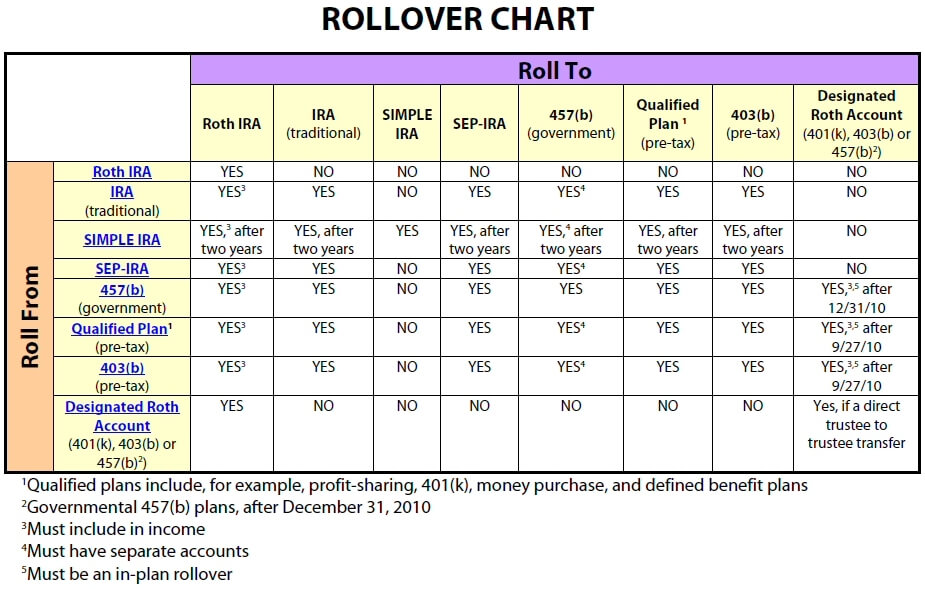
An Indirect Rollover to a Self-Directed IRA
An indirect Self-Directed IRA rollover occurs when the IRA assets or qualified retirement plan assets are moved first to the IRA holder or plan participant before they are ultimately sent to an IRA custodian.
60-Day Rollover Rule
An individual has sixty (60) days from receipt of the eligible rollover distribution to roll the funds into an IRA. The 60-day period starts the day after the individual receives the distribution. Usually, no exceptions apply to the 60-day time period. However, in cases where the 60-day period expires on a Saturday, Sunday, or legal holiday, the individual may execute the rollover on the following business day.
An individual receiving an eligible rollover distribution may rollover the entire amount received or any portion of the amount received. The amount of the eligible rollover distribution that is not rolled over to an IRA is generally included in the individual’s gross income and could be subject to a 10% early distribution penalty if the individual is under the age of 59 1/2.
How the 60-Day Rollover Works with a Self-Directed IRA
The retirement tax professionals at the IRA Financial Group will assist you in rolling over your 60-day eligible rollover distribution to a new FDIC and IRS approved IRA custodian. Once the 60-day eligible rollover distribution has been deposited with the new IRA custodian within the 60-day period, the new custodian will be able to invest the IRA assets into the new IRA LLC checkbook control structure. Once the funds have been transferred to the new IRA LLC, you, as manager of the IRA LLC, would have checkbook control over your retirement funds so you can make traditional as well as non-traditional investments.
Related: Self-Directed IRA Investments
60-Day Rollover from an Employer Retirement Plan
In general, when a plan participant requests a distribution from an employer qualified retirement plan. IRS rules require the employer to withhold 20% from the amount of the eligible rollover distribution. If an individual receives an eligible rollover distribution and then elects to rollover the assets to an IRA custodian within 60 days, the individual can make up the 20% withheld by the employer retirement plan provider for federal income tax purposes.
Employer sponsored retirement plans are required to withhold at a rate of 20% on all eligible rollover distributions of taxable funds or assets, unless the participants elect to directly rollover the distribution to an IRA or to another eligible retirement plan. In other words, when taking an indirect rollover from an employer qualified retirement plan, the employer is required to withhold 20% of the eligible rollover distribution. The 20% withholding requirements is not applicable for IRA-to-IRA transfers or for direct rollover distributions.
Reporting Indirect Rollovers
When an individual takes a distribution from an employer sponsored retirement plan, such as 401(k) Plan, the employer should make the individual, even if the individual intends to roll the funds over to an IRA. The employer would be required to withhold 20% from the eligible rollover distribution since the funds will be rolled to the plan participant and not directly to the IRA or qualified retirement plan custodian. The employer (payer) would report the indirect distribution on IRS Form 1099-R, using the applicable distribution Code (1,4, or 7). If the funds are deposited with an IRA custodian within 60-days, the receiving IRA custodian would report the rollover assets on the IRS Form 5498 as a rollover contribution in Box 2.
Self-Directed IRA Transfer & Rollover Experts
The retirement tax professionals at the IRA Financial will assist you in determining how best to fund your Self-Directed IRA or Self-Directed Roth IRA LLC structure. Whether it’s by IRA transfer or direct or indirect Self-Directed IRA Rollover, each client of the IRA Financial Group will work directly with an assigned retirement tax professional to make sure his or her Self-Directed IRA LLC structure is funded in the most tax efficient manner.
Learn More:
Real Estate Investing with a Self-Directed IRA


What is Fair Market Value in a Self-Directed IRA?
Pursuant to Internal Revenue Code Section 408, an IRA must be established by a “trustee.” A trustee is defined as either a bank, financial institution or state-chartered trust company authorized to administer IRAs. The institution used to administer an IRA is also known as an IRA custodian. An IRA custodian that is responsible for the IRA administration, which includes complying with all IRS filing requirements, including fair market value assessments.
- Every IRA needs to submit the fair market value of its assets
- IRS Form 5498 is used by your custodian to submit the information
- The value of each asset is determined on December 31 of the previous year
IRS Form 5498
One of the most important roles of an IRA custodian is completing the IRS Form 5498. It must be filed with the IRS by May 31 of the following year for each IRA maintained by the IRA custodian during the previous year. The IRA custodian is required to file IRS Form 5498, not the IRA owner.
The form provides the IRS with a snapshot of the IRA based on the information as of December 31 of the previous year. In general, the IRS Form 5498 provides the IRS with the following information:
- Fair market value of IRA as of 12/31
- Amount of IRA of Roth contribution
- Amount of rollover
- Amount of RMD, if any
- Fair market value of certain specified alternative assets
- Indication if the IRA invested in the following assets:
- Stock or other ownership interest in a corporation that is not readily tradable on an established securities market.
- Short- or long-term debt obligation that is not traded on an established securities market.
- Ownership interest in a limited liability company or similar entity (unless the interest is traded on an established securities market).
- Real estate.
- Ownership interest in a partnership, trust, or similar entity (unless the interest is traded on an established securities market).
- Option contract or similar product that is not offered for trade on an established option exchange.
- Other asset that does not have a readily available FMV
In sum, IRS Form 5498 will provide an overview of some of the key details involving the IRA for the previous year. However, it does not provide the IRS with the specific investment, such as stock in Company X. Instead, it provides the IRS with just the category of investment made by the IRA.
Tips on How to Value Your Self-Directed IRA
The Fair Market Value of a Self-Directed IRA is the price at which the asset would change hands between a willing buyer and a willing seller, neither being under any compulsion to buy or to sell and both having reasonable knowledge of relevant facts about the asset. The Fair Market Value may be an estimate of the value.
However, it is good practice to have a qualified independent third-party provide that estimated value. In other words, the value provided to the IRA custodian to compete IRS Form 5498 is not the price you paid for the IRA-owned asset(s), but the value of all IRA-owned assets as of December 31 of the previous year.
Self-Directed IRA LLC & Valuation
In the situation where the IRA owner has established a Self-Directed IRA LLC to make investments, when valuing the IRA, the IRA owner would provide the pro rata value of the entire LLC, including all LLC assets, as part of the IRA value.
For example, if the IRA owner invested $200,000 for 100% of an LLC and the LLC purchased two homes for $200,000, which are now worth $325,000, the IRA owner would provide the IRA custodian with a value of $325,000 for the LLC.
IRA is Part-Owner
If the Self-Directed IRA is a partial owner of an asset, the Fair Market Value used must reflect only the portion of the asset which is owned by your account.
IRA with Debt
If your IRA asset includes a loan or debt, the Fair Market Value of the IRA must include the amount of debt as part of the value. For example, if you use $100,000 in a Self-Directed IRA, and then acquire a $100,000 nonrecourse loan to buy a property for $200,000, the value of the IRA, for purposes of IRS Form 5498, is $200,000 and not the $100,000 of IRA funds used.
IRA with no Value Information
There are times when the IRA owner is not provided the necessary investment valuation information needed to provide to the IRA custodian. This often occurs in private investment fund-type investments that are not subject to the mark-to-market rules, such as private equity or venture capital funds. In these cases, it is common for the IRA owner to use the amount initially invested as the valuation provided to the IRA custodian.
IRA Valuation & RMDs
In the case of an IRA owner that is over the RMD age, which is currently age 73, and is required to take an annual distribution from his or her IRA in the aggregate, it is important that the IRA owner have a third-party certify the valuation of the IRA since the value will have a direct taxable impact. For example, IRA Financial requires all our IRA owners who are required to take RMDs to have a third-party certify the value being provided.
IRA Valuation & IRS Audit
A common question from IRA owners, is whether an extreme change in IRA valuation will trigger an IRS audit. For example, if an IRA was valued at $100,000 in 2021, and now, in 2024 it is valued at $950,000. The answer is no one knows. IRAs are typically audited by the Small Business/Self-Employed division and, thus, it is unclear how IRS Form 5498 fits into their audit process.
In addition, the IRA audit activity on IRAs tends to focus on IRA owners above the RMD age since a discrepancy in IRA valuation has a direct tax impact, whereas, if the IRA owner is under the RMD age, an undervalued IRA does not have an impact.
Conclusion
When providing a Fair Market Value for your Self-Directed IRA, it is important to remember that the value provided should not be what the IRA paid for the asset, but its worth as of December 31 of the previous year. Also, if you are above RMD age, it is extra important that the IRA Fair Market Value provided to the IRA custodian be accurate.
Whereas, for investors under RMD age, providing an accurate value of the IRA is important and should still be handled with care, although, you will have more flexibility in this regard. Remember to report the value to your IRA custodian in a timely matter, in order to submit Form 5498 before the deadline.

Beneficiary Forms: Self-Directed IRA & Solo 401(k)
IRA Financial is recognized as the leading facilitator of Self-Directed IRA and Solo 401(k) plans. As a result, we have come across many scenarios pertaining to Self-Directed IRA and Solo 401(k) plan beneficiary forms. It's important to know the rules so that your wishes upon your passing are followed. Read more to prepare your finances better.
- A beneficiary is the person or entity that will inherit the benefits of your retirement plan
- You should name at least one beneficiary for your retirement plan(s)
- Certain situations could cause confusion when it's time to distribute your plan funds
What is a Beneficiary?
An IRA or 401(k) beneficiary can be any person or entity the owner chooses to receive the benefits of a retirement account after he or she dies. Beneficiaries of a retirement account or traditional IRA must include in their gross income any taxable distributions they receive. In general, one can designate a primary beneficiary as well secondary beneficiaries.
Primary vs. Secondary Self-Directed IRA or Solo 401(k) Beneficiary
The primary beneficiary is the first party or parties that will receive the IRA funds upon the IRA owner’s death. While, a secondary beneficiary or beneficiaries would only receive the IRA or 401(k) assets if the all primary beneficiaries are no longer alive. In addition, an IRA owner can identify one or more primary or secondary beneficiaries, but the allocation percentage should equal 100%.
The primary beneficiary is most commonly a spouse. Whereas, the secondary beneficiary are typically children. However, for individuals that are not married or do not have children, they can basically nominate any individual, charity, or third-party they desire as primary or secondary beneficiary for their IRA or 401(k).
However, if the IRA owner resides in a community property state, community property law can dictate who gets your IRA after death. The following states are community property states:
- Arizona
- California
- Idaho
- Louisiana
- Nevada
- New Mexico
- Texas
- Washington
- Wisconsin
Therefore, if an IRA owner resides in a community property state, the Self-Directed IRA owner or Solo 401(k) plan participant must take the community property state rules into account when naming a retirement account beneficiary. For example, In a community property state, an IRA owner would need the consent of the spouse in order to identify a non-spouse as primary beneficiary of the retirement account.
Who Holds the Beneficiary Form?
In the case of a Self-Directed IRA, the IRA custodian, such as IRA Financial, will hold the IRA beneficiary form. Hence, if you need to revise the beneficiary form you will need to contact the IRA custodian. Whereas, in the case of a Solo 401(k) plan, the plan administrator would hold the beneficiary form. For example, as trustee and plan administrator, the individual business owner would generally be responsible for holding the beneficiary form. Although, with respect to an employer 401(k) plan with multiple employees, the plan record keeper or third-party administrator would generally be responsible for holding the beneficiary form.
The John Jones Self-Directed IRA Beneficiary Story
One of our clients (who we will call John Jones), worked at a privately owned construction company in a southern state for 22 years. The tradesman turned supervisor named Janet Jones, his wife of 38 years, was the beneficiary of his 401(k) account in the event he died before her.
As fate would have it, Janet died first, so John updated his account paperwork, naming their three adult children as beneficiaries of the 401(k) retirement plan. Eventually he got remarried to Betty Murphy, and was on the verge of retiring. Six weeks later, at the age of 67, John Jones died.
The Rightful Beneficiary
When Mr. Jones’ children from his first marriage tried to claim the assets, believing they were named on the most recent beneficiary form, they were rebuffed by the 401(k) administrator, who then asked a court to determine the rightful owner of the money.
Under the terms of the company’s 401(k) plan, if an employee dies, the employee’s spouse has the right to the account assets, unless the spouse waives that right in writing (the priority for spouses springs from federal law).
Betty Murphy Jones had never signed such a waiver.
The new Mrs. Jones filed a motion for summary judgment, and the matter eventually ended up in federal district court, which awarded the approximately $250,000 in the account to her, disinheriting the children.
“I think John would be shocked,” said the lawyer representing the children, who are currently appealing. Neither the plan administrator nor Betty Murphy Jones would comment.
Beneficiary Rules
Here are some key rules governing retirement accounts, and lessons on how to navigate the rules as families grow and change:
Rule No. 1
With 401(k)s, your spouse is the presumed beneficiary of your account upon your death—regardless of who is listed on the beneficiary form—unless he or she previously consented to your naming someone else beneficiary. These plans are governed by the federal Employee Retirement Income Security Act, also known as ERISA. Under this law, plans can provide for spousal rights to kick in immediately, or no later than a year after the marriage.
This general rule cannot easily be circumvented with a prenuptial agreement. Only a spouse can waive the right to 401(k) plan assets—those who are engaged cannot.
If you are contemplating remarrying and are concerned about providing for children from a prior marriage, consider rolling your 401(k) to an IRA, where you have more latitude to name beneficiaries of your choosing.
Rule No. 2
If you are single when you die, your 401(k) assets pass to the person designated on your beneficiary form—regardless of what your will says or what other agreements you made before your death.
Rule No. 3
Inconsistencies Between Will & IRA Beneficiary Form
Surprisingly, it is the IRA beneficiary form that eclipses a last will and testament in the case of a conflict. Most people would think that a signed will would end up trumping an IRA beneficiary form provided by a bank or financial institution. However, that line of reasoning is incorrect. The beneficiary designation is a legally binding document and will circumvent the will. In other words, no matter what your will says and what your current relationship is with your primary beneficiary at death, the IRA beneficiary form will direct who receives the IRA funds on death even it is in conflict with your will and estate plan. As you can imagine, this can cause some nightmare type probate scenarios for the deceased IRA owner’s family.
Tips for Preventing IRA Beneficiary Disputes
Below are several tips every Self-Directed IRA holder or Solo 401(k) plan participant should consider when completing a beneficiary form:
- Review your retirement account beneficiary form each year with the IRA custodian or plan administrator and make sure it properly reflects your estate planning intentions
- Share your retirement account beneficiary form with your estate planning attorney prior to the drafting of your will
- Talk to your spouse or primary beneficiary about your estate plans, in general terms.
- Keep a copy of your IRA or 401(k) beneficiary form with your will in a safe and secure place
- Provide your primary beneficiary with information on the IRA custodian and investments made so they have the relevant information in the case of death
- If you are going through a divorce, separation, or dispute with your primary beneficiary, you should consider changing the retirement account beneficiary form immediately, even if it is only temporary.
- If you are married and thinking of naming a primary beneficiary that is not your spouse, you may want to receive written consent from your spouse in order to avert any potential future litigation
With over 60 million IRAs totaling over $32 trillion dollars in retirement funds, it is important that every retirement account owner understand the importance of having an accurate and updated retirement account beneficiary form. Failure to do so, can lead to some nightmarish probate scenarios.
IRA Financial will take care of setting up your entire IRS compliant Self-Directed IRA or Solo 401(k) Plan. Our certified specialists can handle the process by phone, email, fax, or mail – whichever means is most convenient. This process typically takes between 7-21 days to complete, the timing largely depending on the state of formation and the custodian holding your retirement funds.
Our tax and ERISA attorneys are on site, which will reduce the set-up time and cost of establishment. Most importantly, each client of IRA Financial is assigned a tax attorney to help with the establishment of the retirement plan. You will find that our fee for this service is significantly less than other companies that perform the same or similar services.
Get in Touch
If you are currently in a similar predicament as the Jones’ children and would like assistance, contact IRA Financial directly at 800-472-0646.

Self-Directed Coverdell ESA vs. the 529 Plan
With the price of education soaring in this country, it is more important than ever for parents and family members to think about saving for educational costs for their children or loved ones. The good news is that Congress has come up with two types of specific educational savings plan that can help Americans better save for education costs, including elementary, secondary, college, and even graduate school.
This article will explore the advantages and disadvantages of the Coverdell Education Savings Account (ESA) and the 529 plan. Both plans have great tax and savings benefits, but have different eligibility requirements, as well as distinct restrictions. Hence, it is important that everyone understands the power of saving for education via a Coverdell or 529 plan, and fully comprehends which plan may be the better fit.
- With education costs at an all-time high, Americans need ways to save
- Tax-advantaged accounts, such as the Coverdell ESA and 529 Plan, offers one the ability invest funds earmarked for education
- Although the plans are similar, each have their own advantages (and drawbacks)
The Coverdell ESA
A Coverdell ESA is custodial account set up solely for paying qualified education tuition and expenses for the designated beneficiary of the account. Like an IRA, the account must be set up with a bank, financial institution, or state-chartered trust company, such as IRA Financial. The savings benefit associated with a Coverdell applies not only to qualified higher education expenses, such as a university, but also to qualified elementary and secondary education expenses.
Who Can Set Up a Coverdell?
A Coverdell account can only be established by a beneficiary that is under the age of 18. In other words, the account must be established for the sole benefit of the child. Coverdell assets are not revocable. As discussed above, the Coverdell must be established by a custodian, such as IRA Financial, much like an IRA.
How Much can I Contribute to a Coverdell Annually?
The primary purpose of making contributions to a Coverdell is to help finance the beneficiary's qualified education expenses. Contributions must be made in cash and are not tax deductible. For both 2023 and 2024, the maximum contribution amount is $2,000. There's no limit to the number of accounts that can be established for a particular beneficiary under the age of 18, however, the total contribution to all accounts on behalf of a beneficiary in any year may not exceed $2,000.
In addition, to make an annual Coverdell contribution, one’s income must be below $110,000 for a single taxpayer and $220,000 for a married couple filing jointly. Coverdell contributions must be made by April 15.
What Investments Can I Make with a Coverdell?
A Coverdell account may be self-directed just like an IRA. Therefore, other than life insurance, collectibles, and certain transactions involving a “disqualified person” under Internal Revenue Code Section 4975, the Coverdell is permitted to make any investment. For example, a Coverdell may invest in stock, bonds, real estate, gold, cryptos, private business investments, and much more. Also, like an IRA, all income and gains from the investment would flow back to the Coverdell without tax. This is known as tax-deferral.
Coverdell Distributions
Distributions from a Coverdell must always be paid to the beneficiary and must only be used for qualified education purposes. They cannot come back to the individual that made the contributions or set up the account. Unspent Coverdell funds remaining in the account when the beneficiary reaches the age of 30 must be distributed at that time, subject to tax and a 10% penalty on the account growth if he or she does not have qualified education expenses in that year. However, the Coverdell beneficiary can be changed to another family member below the age of 30 without triggering tax or penalty.
The 529 Plan
A 529 Savings plan is also known as a “qualified tuition program.” Unlike a Coverdell, which is a federal savings plan, a 529 plan is a state-sponsored savings plan that provides a few tax benefits. There are two main types of 529 plans: Section 529 prepaid programs and Section 529 savings programs. The 529 prepaid plan is not as popular as it is currently only offered in 10 states.
Who Can Set Up a 529 Plan?
Unlike a Coverdell plan which has income restrictions, anyone can establish a 529 plan; there are no income restrictions. One of the primary advantages of a 529 plan is its flexibility. It has only minor limitations, offer tax benefits like a Coverdell, and is designed to help families pay for college, as well as elementary and secondary school tuition, but not expenses.
How Much Can I Contribute to a 529 Plan?
Unlike an IRA or a Coverdell, the IRS does not set annual contribution limits for 529 Plans. Conversely, the annual contribution limits for 529 plans are set by the state. In general, contribution limits for 529 plans typically range from $250,000 to around $500,000 per beneficiary. In other words, the total amount of contributions that can be made to a beneficiary’s 529 plan is capped in the aggregate by the state. This is a lifetime contribution limit and not an annual limit. In addition, earnings from the contributions can exceed the state annual contribution limit. It is also important that the state annual contribution limit is per child.
What Investments Can I Make with a 529 Plan?
Unlike a Coverdell, a 529 plan cannot be self-directed; the states require that a 529 plan can only be invested in traditional investments, such as stocks, bonds, ETFs, and mutual funds. To this end, 529 plans are typically professionally managed by experienced investment managers at large financial institutions.
How do 529 Plan Distributions Work?
A 529 plan works much the same way as a Roth IRA and Coverdell. All contributions to a 529 plan are after-tax and are not tax deductible. All income and gains generated by the investments are not subject to tax, which allows the plan account to grow at a faster rate since the gains are not subject to tax.
Like a Coverdell, all 529 plan funds must be used to pay for qualified education costs, specifically tuition and expenses for higher education costs, but only education costs for elementary or secondary education.
Beginning in 2024, the SECURE Act 2 allows unused funds from a 529 plan to be transferred to a Roth IRA tax- and penalty-free. However, there are several limitations to keep in mind. The total lifetime amount eligible for transfer from a 529 plan to a Roth IRA is $35,000 per beneficiary. The Roth IRA must be established in the name of the 529 beneficiary. Annual contribution limits apply to transfers. For 2024, the contribution limit for IRAs, including Roth IRAs, is $7,000.
Which Plan is Best for Me?
Now that you have a solid understanding of the primary advantages of both the Coverdell and 529 Plan, below are some important considerations to keep in mind:
- If you have income above the Coverdell income threshold, then you will be limited to selecting the 529 plan.
- If you wish to make annual contributions of greater than $2,000, the 529 plan will be your best option.
- If you wish to make contributions for a beneficiary over the age of 18, then the 529 plan is better.
- If you wish to invest the educational saving funds in alternative assets, then you must go with the Coverdell.
- If you live in a state that offers a state tax deduction for 529 plan deductions, such as California, that might be better for you.
- If you are focused on saving for elementary and secondary education and are concerned with saving for tuition and related expenses, then Coverdell may be a better option since the 529 plan only covers tuition for elementary and secondary education.
Conclusion
Using a tax deferred plan to save for your child or loved one’s education costs makes the most tax sense, whether one can contribute under $2,000 a year or more, both the Coverdell and 529 plan offer tax efficient ways to build savings to cover educational costs from elementary through college and beyond. For those savers focused on gaining the opportunity to make alternative asset investments, IRA Financial is one of the few companies that offer self-directed options for Coverdell plans.
Although, for individuals seeking to make more meaningful annual contributions to an educational savings plan, the 529 plan becomes the more attractive option, especially if your state of residence offers a state tax deduction for plan contributions.

How to Lower Your Bitcoin IRA Custodial Fees
As a tax attorney and author of the leading book on Bitcoin IRA, How to Use Retirement Funds to Purchase Cryptocurrencies, I am often asked about the benefits of using a Self-Directed IRA or Solo 401(k) plan to buy Bitcoin or other cryptocurrencies.
If you're a Bitcoin investor, you want to invest in Bitcoin and other cryptocurrencies without high commissions. It's likely that you also want control over the private key, which is vital to the purchase and holding of cryptocurrencies securely.
Now there is a great way to invest in Bitcoin, reduce your Bitcoin IRA custodial fees and control your private key - simply reduce the middle man.
- Bitcoin and other cryptos still remain a popular alternative investment choice among retirement savers
- There are several ways you can use retirement funds to invest
- The direct exchange solution is the best way to lower Bitcoin IRA custodial fees
Bitcoin IRA Investors
The price of Bitcoin has fluctuated wildly since the start of COVID, and as of December 2022 sits at around $16,500. But Bitcoin isn’t alone – most cryptocurrency, such as Litecoin and Ethereum, have also fluctuated madly over the last several year. However, as a result of the fallout from the FTX cryptocurrency exchange and the ongoing crypto winter, many Bitcoin and crypto investors are waiting for the right time to jump back into the crypto market.
Many IRA investors understand that an IRA is able to purchase cryptocurrencies, such as Bitcoin without triggering the prohibited transaction rules. The IRS confirms that cryptocurrencies will be treated as property for federal income tax purposes as per IRS Notice 2014-21. As a result, just like stocks and real estate, you can purchase Bitcoin with your retirement funds.
So the question becomes, what are the best ways to lower Bitcoin IRA custodial fees?
There are generally three ways you can purchase Bitcoin with IRA funds:
- The broker/custodian controlled approach
- Wallet Control IRA LLC solution
- Direct Exchange Solution
Each structure has both advantages and disadvantages of using them.
1. Bitcoin IRA Broker/Custodian Controlled
With the Bitcoin IRA Broker/Custodian Controlled approach, you must purchase the cryptocurrency through brokers associated with a Bitcoin IRA facilitator. Typically, a cryptocurrency investor will open a Self-Directed IRA account with a custodian.
You, the IRA investor, will then transfer or rollover your retirement funds tax-free to the new IRA custodian. The custodian will then transfer the funds to a broker who will purchase the cryptocurrencies for the IRA investor. The cryptocurrencies are typically purchased by phone. In this structure, you will be limited to investing in the cryptocurrencies the broker offers.
When the broker purchases the cryptocurrencies, they are stored in a digital wallet, and that typically requires multiple signature verification. However, you do not control the cryptocurrency wallet or the associated private key.
Additionally, if you want to sell or exchange the cryptocurrency, this requires interaction with the broker. You cannot complete this online. Furthermore, you have to pay commissions on each side of the transaction.
Will this structure help lower your Bitcoin IRA custodial fees? Let us take a look at the advantages and disadvantages of using a Bitcoin IRA broker/custodian.
Advantages
- Very Hands-off
- No need to interact with cryptocurrency exchanges
Disadvantages
- High fees – commissions can range from 5%-15% of IRA funds invested.
- You have no control over the cryptocurrency wallet.
- No access to wallet private key.
- You lack the ability to trade cryptocurrencies 24/7, which is how the cryptocurrency market operates.
- All cryptocurrency trades must go through the broker, which is typically done by phone and only during business hours.
- IRA custodian fees are based on the value of the IRA assets invested.
If you wish to lower your Bitcoin IRA custodial fees, as you can see, the high fees associated with a broker or custodian make it an unpractical option.
2. Wallet Control IRA LLC
The Wallet Control IRA LLC allows you to establish an IRA account with a self-directed IRA custodian. You then roll over your retirement funds tax-free to the new custodian. The IRA assets will then be transferred to a newly established limited liability company (LLC) tax-free in exchange for 100% interest in the newly established LLC.
The LLC will be wholly owned by the IRA, and you become the manager. Since the individual retirement account owns 100% of the LLC, it is a disregarded entity for tax purposes. The advantage of this is that all income and gains from the cryptocurrency investment flow back to the IRA without tax.
You, as manager of the LLC, will then open a cryptocurrency exchange account at the exchange of your choice. Next, you will link the account to the IRA that the LLC bank account owns. The IRA LLC funds will then be wired to the cryptocurrency exchange account, which is to be opened in the name of the LLC. You now have the ability to invest in Bitcoin and other cryptocurrency, as well as trade the cryptos anytime. In addition, by using a Wallet Control IRA LLC solution you will be able to open an account at a foreign crypto exchange in the name of the LLC and purchase XRP and other cryptos not available on many U.S. exchanges.
Probably the biggest advantage of buying and holding cryptos in a Wallet Control IRA LLC solution is that you will have the ability to hold the cryptos you purchase inside a digital or hard wallet that you hold off the internet. You control the wallet, because you’re the manager of the LLC. In light of the FTX bankruptcy and some of the lingering macro crypto exchange problems surfacing, more and more crypto IRA investors are looking for a way to hold their crypto private keys for security purposes.
Let’s take a look at whether the Wallet Control IRA LLC structure will help reduce the cost of your IRA custodian fees.
Advantages
- You can invest in all cryptocurrencies.
- Provides the ability to control costs by selecting cryptocurrency exchange of your choice.
- You’re in control of the cryptocurrency wallet and control over private key.
- Ability to buy, sell, or exchange cryptocurrencies at anytime, including XRP, through a PC or mobile application.
- Flat low annual IRA custodian fee – no asset valuation fees.
Disadvantages
- LLC set-up cost
- There’s more involvement on your part – you must open the cryptocurrency exchange and control the crypto wallet
From a financial perspective, this structure is more preferable than using a broker or custodian. However, keep in mind that the LLC set-up cost can be as high as $1,000. If you’re willing to set up an LLC and wish to lower fees associated with Bitcoin investments, we recommend the Wallet Control IRA LLC over a Bitcoin broker or custodian.
3. Direct Exchange Solution
IRA Financial has a partnership with leading crypto exchange Bitstamp that allows our clients to have their IRA or 401(k) funds invested directly into the exchange without the need for a broker or LLC.
Bitstamp was founded in 2011 and aims to bring secure access to crypto to all corners of the world. Bitstamp supports 65+ cryptocurrencies.
Bitstamp operates under a payment institution license in the EU, BitLicense in New York, and we’re subject to regular audits by the Big Four, the four largest accounting firms in the world. Bitstamp is building the financial infrastructure of tomorrow through transparency for all. As others are keeping an eye on us, you don’t have to. 98% of Bitstamp’s assets are stored offline, crime insurance against theft or fraud, and 2 Factor Authorization.
Bitstamp is present in over 100 countries, with offices in UK, Luxembourg, USA, Singapore, and Slovenia. Now catering to over 4 million customers across the globe.
How Does the IRAFI-Bitstamp Crypto Solution work?
Best and cheapest way to buy
Step 1: Open an IRA or Solo 401(k) account at IRA Financial Trust.
Step 2: Move IRA or 401(k) funds to new IRA Financial account tax free.
Step 3: Funds are moved From IRA Financial to Bitstamp
Step 4: Begin buying and selling cryptos 24/7 on your own without the need for any broker or the use of an LLC on the IRA Financial app.
With the Direct Exchange Account solution, you control the purchase and sale of Bitcoin (and other cryptocurrencies) directly. In other words, you do not need a costly broker or LLC. In addition, the cryptos will be held in the name of the IRA custodian. This will be in the benefit of the IRA holder. As a result, it’s much cleaner from a tax reporting perspective.
Advantages
- No requirement to use broker
- No requirement to use LLC
- Ability to buy, sell, or exchange cryptocurrencies at anytime through a PC or mobile application
- Flat low annual IRA custodian fee – no asset valuation fees
Disadvantages
- You can only purchase the most popular cryptocurrencies.
- The cryptos must be held on the Bitstamp exchange.
Which Structure will Save You More?
If you want to use your IRA funds to invest In Bitcoin and other cryptocurrency, you have options. From a cost perspective, the Direct Exchange solution is seemingly the most cost effective solution to lower any Bitcoin IRA fees. However, if you want total freedom, the LLC solution may be the best way to invest.
Get in Touch
Do you still have question about how you can lower your Bitcoin IRA custodial fees that we did not cover in this article? Feel free to contact IRA Financial directly at 800-472-0646. You can also fill out a contact form to speak with a self-directed retirement specialist.

Excess Roth IRA Contributions - Are They Worth the Risk?
In almost all cases, the penalties for violating IRS rules end up overriding any potential value derived from the transaction. The one exception may be the act of making excess Roth IRA contributions.
With a Traditional IRA, contributions are tax deductible and earnings grow tax-deferred until they are distributed. If a distribution is taken before the IRA holder reaches the age of 59 1/2, a 10% early distribution penalty applies in addition to tax on the amount of the distribution. Moreover, a Traditional IRA is subject to required minimum distributions when the IRA holder reaches the age of 73. Whereas, in the case of a Roth IRA, contributions are after-tax and not tax deductible, but so long as the Roth IRA holder is over the age of 59 1/2 and the Roth IRA has been open and funded for at least five years, all Roth IRA distributions are tax-free and are not subject to the required minimum distribution rules.
In general, an excess Roth IRA contribution occurs if one:
- Contributes more than the contribution limit.
- Makes a regular IRA contribution to a traditional IRA at age 73 or older.
- Makes an improper rollover contribution to an IRA.
The taxation on excess contributions differs if the excess contribution is made to a Traditional or Roth IRA.
Over Contributing to a Roth IRA
In the case of a Traditional IRA, excess contributions would be subject to a 6% tax per year as long as the excess amounts remain in the IRA. In addition, if the IRA holder is under the age of 59 1/2, a 10% early distribution penalty would apply to the amount of the excess contribution. Furthermore, the excess contribution would be subject to income tax, although the earnings generated from the excess contributions would remain in the Traditional IRA.
For a Roth IRA, excess contributions would be subject to a 6% tax per year as long as the excess amounts remain in the Roth IRA. However, unlike a Traditional IRA, there would be no 10% early distribution penalty or tax on the excess contribution amount. Moreover, the earnings from the excess Roth IRA contributions would remain in the Roth IRA.
The tax on an excess IRA contribution cannot be more than 6% of the combined value of all IRAs as of the end of the tax year. In other words, the 6% tax is payable each year that the excess contribution has not been withdrawn or applied toward an allocable contribution for a future year.
Learn More: Converting a Traditional IRA to a Roth IRA
How to Avoid the Roth IRA Excess Contributions Tax
Withdraw the excess contributions from the IRA by the due date of the individual income tax return (including extensions); and withdraw any income earned on the excess contribution.
In addition, an individual can apply an excess contribution to a traditional IRA to a later year by the amount that the maximum deductible amount for the later year exceeds the amount contributed to an IRA (including a Roth IRA) for that year. However, an individual cannot reduce an excess contribution by applying it against an earlier year for which less than the maximum amount allowable was contributed.
Read This: What You Need To Know Before Establishing A Roth IRA For Your Kids
The Strategy
A strategy that has been gaining some popularity as of late surrounds the concept of making excess contributions to a Roth IRA in order to generate additional tax-free returns in the Roth IRA. Since the 6% excise tax only applies to the amount of the Roth IRA excess contribution and no 10% penalty or income tax would apply to the amount of the excess contribution, in addition to the earnings on the excess contribution remaining in the Roth IRA and able to grow tax-free, the idea is that the 6% excise tax on the excess Roth IRA contribution will end up being considerably less than if the investment was made with personal funds subject to the individual income tax rates.
Hence, the excess Roth IRA contribution strategy is based on the notion that paying a 6% tax on excess contributions to a Roth IRA, while gaining the tax advantage of having the earnings from the excess contribution remain in the Roth IRA so it can grow tax-free, is a great deal compared to making the same investment with personal funds and having to pay income tax on the earnings and gains.
The IRS has not yet publicly commented on how they will specifically attack the Roth IRA excess contribution strategy, but it is conceivable that the IRS could end up imposing additional penalties. The IRS would receive notification of the IRA excess contributions through its receipt of Form 5498 from the bank or financial institution where the IRA or IRAs were established.
Making inadvertent excess contributions to an IRA occurs frequently and is typically corrected before the filing of the individual’s income tax return. However, purposely violating the IRA excess contribution rules to receive a tax benefit is not advisable and could lead to an IRS audit.
Contact Us
If you feel you have made excess Roth IRA contributions, please contact us @ 800.472.0646 so we can help you correct the mistake!

What is a Solo 401(k) Prohibited Transaction?
The Internal Revenue Code (IRC) & ERISA does not describe what a Solo 401(k) Plan can invest in, only what it cannot invest in. Internal Revenue Code Sections 408 & 4975 prohibits Disqualified Persons from engaging in certain type of transactions. The purpose of these rules is to encourage the use of qualified retirement plans for accumulation of retirement savings and to prohibit those in control of Solo 401(k) qualified retirement plans from taking advantage of the tax benefits for their personal account. In the following, you will learn about the Solo 401(k) Prohibited Transaction Rules.
Who is a “Disqualified Person?"
The IRS has restricted certain transactions between the Solo 401(k) plan and a “disqualified person." The rationale behind these rules was a congressional assumption that certain transactions between certain parties are inherently suspicious and should be disallowed.
The definition of a disqualified person (IRC Section 4975(e)(2)) extends into a variety of related party scenarios, but generally includes the plan participant, any ancestors or lineal descendants of the Plan Participant, and entities in which the Plan Participant holds a controlling equity or management interest. In essence, under Code Section 4975, a disqualified person means:
- A fiduciary (e.g., the Solo 401k Plan Participant, or person having authority over making 401(k) plan investments),
- A person providing services to the plan (e.g., the trustee or custodian),
- An employer, any of whose employees are covered by the plan (this generally is not applicable to Solo 401k Plans but does include the owner of a business that establishes a qualified retirement plan),
- An employee organization any of whose members are covered by the plan,
- A 50 percent owner of C or D above,
- A family member of A, B, C, or D above (family members include the fiduciary’s spouse, parents, grandparents, children, grandchildren, spouses of the fiduciary’s children and grandchildren (but not parents-in-law),
- An entity (corporation, partnership, trust or estate) owned or controlled more than 50 percent by A, B, C, D, or E. Whether an entity is a disqualified person is determined by considering the indirect stockholdings/interest which would be taken into account under Code Sec. 267(c), except that members of a fiduciary's family are the family members under Code Sec. 4975(e)(6) (lineal descendants) for purposes of determining disqualified persons.
- A 10 percent owner, officer, director, or highly compensated employee of C, D, E, or G,
- A 10 percent or more partner or joint venturer of a person described in C, D, E, or G.
Note: brothers, sisters, aunts, uncles, cousins, step-brothers, step-sisters, and friends are NOT treated as disqualified persons.
Solo 401(k) Prohibited Transaction Rules
The types of prohibited transactions can be best understood by dividing them into three categories: Direct Prohibited Transactions, Self-Dealing Prohibited Transactions, and Conflict of Interest Prohibited Transactions.
Direct Prohibited Transactions
Subject to the exemptions under Internal Revenue Code Section 4975(d), a “Direct Prohibited Transaction” generally involves one of the following:
4975(c)(1)(A): The direct or indirect Sale, exchange, or leasing of property between a Plan and a “disqualified person”
Example 1: Joe sells an interest in a piece of property owned by his Plan to his son.
Example 2: Beth leases real estate owned by her Solo 401k Plan to her daughter.
Example 3: Mark uses his Solo 401k Plan funds to purchase an LLC interest owned by his mother.
4975(c)(1)(B): The direct or indirect lending of money or other extension of credit between a Plan and a “disqualified person”
Example 1: Ted lends his wife $70,000 from his Plan.
Example 2: Mary personally guarantees a bank loan to her Solo 401k Plan to purchase real estate.
Example 3: Dan uses his Solo 401k Plan funds to lend an entity owned and controlled by his father $18,000.
4975(c)(1)(C): The direct or indirect furnishing of goods, services, or facilities between a Solo 401k Plan and a “disqualified person”
Example 1: Andrew buys a piece of property with his Solo 401k Plan funds and hires his father to work on the property.
Example 2: Rachel buys a condo with her Solo 401k Plan funds and personally fixes it up.
Example 3: Betty owns an apartment building with her Plan and hires her mother to manage the property.
4975(c)(1)(D): The direct or indirect transfer to a “disqualified person” of income or assets of a Plan
Example 1: Ken is in a financial jam and takes $32,000 from his Plan to pay a personal debt.
Example 2: John uses his Solo 401k Plan to purchase a rental property and hires his friend to manage the property. The friend then enters into a contract with John and transfers those funds back to John.
Example 3: Melissa invests her Solo 401k Plan funds in a real estate fund and then receives a salary for managing the fund.
Self-Dealing Prohibited Transactions
Subject to the exemptions under Internal Revenue Code Section 4975(d), a “Self-Dealing Prohibited Transaction” generally involves one of the following:
4975(c)(1)(E): The direct or indirect act by a “Disqualified Person” who is a fiduciary whereby he/she deals with income or assets of the Plan in his/her own interest or for his/her own account
Example 1: Debra who is a real estate agent uses her Solo 401k Plan funds to buy a piece of property and earns a commission from the sale.
Example 2: Ben wants to buy a piece of property for $120,000 and would like to own the property personally but does not have sufficient funds. As a result, Ben uses $110,000 from in his Solo 401k Plan and $10,000 personally to make the investment.
Example 3: Nancy uses her Solo 401k Plan funds to invest in a real estate fund managed by her son. Heidi’s father receives a bonus for securing Nancy’s investment.
Conflict of Interest Prohibited Transactions
Subject to the exemptions under Internal Revenue Code Section 4975(d), a “Conflict of Interest Prohibited Transaction” generally involves one of the following:
4975(c)(i)(F): Receipt of any consideration by a “Disqualified Person” who is a fiduciary for his/her own account from any party dealing with the Plan in connection with a transaction involving income or assets of the Plan.
Example 1: Jason uses his Solo 401k Plan funds to loan money to a company in which he manages and controls but owns a small ownership interest in.
Example 2: Cathy uses her Plan to lend money to a business that she works for in order to secure a promotion.
Example 3: Eric uses his Solo 401k Plan funds to invest in a fund that he manages and where his management fee is based on the total value of the fund’s assets.
Statutory Exemptions
Congress created certain statutory exemptions from the prohibited transaction rules outlined under IRC Section 4975(c). For these certain transaction, Congress believed there is a legitimate reason to permit them. For these transactions, Congress has issued a blanket statutory exemptions permitting these transactions assuming that certain requirements specified are satisfied.
Below is a list of some of the statutory exemptions that apply to Solo 401(k) plans:
- Any contract with a disqualified person for office space, legal, accounting or other services necessary for the operation of the Plan as long as reasonable compensation is paid. Note – this exemption does not apply to a Plan fiduciary (the Plan trustee) as per Treasury Regulation Section 54.4975-6(a)(5).
- The provision of ancillary services to a Solo 401(k) plan by a bank trustee.
- receipt by a disqualified person of any benefit to which he may be entitled as a participant or beneficiary in the plan, so long as the benefit is computed and paid on a basis which is consistent with the terms of the plan as applied to all other participants and beneficiaries.
S Corporation Stock
Because of the shareholder restrictions imposed on “S” Corporations, an Solo 401(k) cannot own stock in an S Corporation. Note – a Solo 401(k) can own stock in a “C” Corporation.
Plan Asset Rules
The Department of Labor’s (DOL) Plan Asset Rules essentially define when the assets of an entity are considered ‘Plan" assets. Under the rules, 401(k) qualified plans are frequently viewed as pension plans subjecting them to the Plan Asset Rules. Under the Plan Asset Rules, if the aggregate plan ownership of an entity is 25% or more of all the assets of the entity, then the equity interests and assets of the “investment entity” are viewed as assets of the investing plan for purposes of the prohibited transactions rules, unless an exception applies. Also, if a Solo 401(k) or group of related qualified plans owns 100% of an “operating company," the operating company exception will not apply and the company's assets will still be treated as plan assets.
In summary, the Plan Asset Rules can be triggered if:
- 100% of an “operating company” is owned by one or more 401(k) plans and disqualified persons, in which case all the assets of the “operating company” are deemed Plan assets (assets of the 401(k)), or
- If 25% or more of an “investment company” is owned by 401(k) plans and disqualified persons, in which case all the assets of the “investment company” are deemed Plan Assets (assets of the 401(k)). In determining whether the 25% threshold is met, all 401(k) owners are considered, even if they are owned by unrelated individuals.
Exceptions to the DOL Plan Asset Regulations
The Plan Asset look-through rules do not apply if the entity is an operating company or the partnership interests or membership interests are publicly offered or registered under the Investment Company Act of 1940 (e.g., REITs). They also do not apply if the entity is an “operating company,” which refers to a partnership or LLC that is primarily engaged in the real estate development , venture capital or companies making or providing goods and services, such as a gas station, unless the “operating company” is owned 100% by a 401(k) qualified plan or IRA and/or disqualified persons. In other words, if a 401(k) owns less than 100% of an LLC that is engaged in an active trade or business, such as a restaurant or manufacturing plant, the Plan Asset Rules would not apply. However, the plan investment may still be treated as a prohibited transaction under IRC Section 4975. In addition, the Unrelated Business Taxable Income may apply to subject to the 401(k) to tax on the income or gains generated from the operating business.
Note: The fact that a transaction does not trigger the Plan Asset Rules does not mean that the transaction may not be deemed a prohibited transaction. In other words, a transaction that does not fall under the Plan Asset Rules can still be treated as a prohibited transaction pursuant to IRC Section 4975.
The following are a number of examples that demonstrate the scope of the Plan Asset Rules.
Example 1: A general partner of a hedge fund wishes to invest his Solo 401(k) plan in the hedge fund he manages. If the percentage of 401(k) ownership, including what it would be after the General Partner invests his Solo 401(k) in the fund, equals or exceeds 25% of the equity interests, then the fund's assets are considered "plan asset." That means that a transaction between the general partner, as a disqualified person, and the fund, could be deemed a prohibited transaction because the assets of the fund are viewed as assets of his plan, since a disqualified person cannot transact with the assets of his plan. Accordingly, the General Partner cannot receive personal benefits from his 401(k) investment into the fund. Thus, the General Partner would not be permitted to receive any management fees associated with the ownership interest in the fund because he would be receiving a personal benefit from his Solo 401(k). Note – the General Partner’s plan investment in the fund may also be deemed a direct or indirect prohibited transaction under IRC Section 4975.
Example 2: Jane ‘s Solo 401(k) plan owns 100% of ABC, LLC, which operates a retail store. ABC, LLC makes a loan to Jane. The loan is subject to the Plan Asset Rules and will also be considered a prohibited transaction. Note – any income generated by ABC, LLC that is allocated to the plan would also likely be subject to the Unrelated Business Income tax.
Example 3: Steve’s Solo 401(k) owns 15% of ABC, LLC, an investment company. Allan’s IRA owns 20% of ABC, LLC. Steve and Allan are unrelated. Since a 401(k) qualified plan and an IRA (Plans) own greater than 25% of ABC, LLC, an “investment company," assets of ABC, LLC are Plan Assets and deemed owned by each plan. Thus, if ABC, LLC makes a loan to Steve’s father, the loan would be a prohibited transaction.
Example 4: Robert’s Solo 401(k) plan invests in ABC, LLC, which will purchase a gas station, an “operating company." Robert will take an annual salary of $50,000 to run the gas station. The payment of the salary would be a self-dealing indirect prohibited transaction. Note – any income generated by the gas station that is allocated to the plan would also likely be subject to the Unrelated Business Income tax.
Determining Whether a Specific Transaction is a Prohibited Transaction
Through an arrangement between the IRS and the Department of Labor (DOL), it is the DOL’s responsibility to determine whether a specific transaction is a prohibited transaction and to issue prohibited transaction exemptions. When the IRS discovers what appears to be a prohibited transaction in an individual’s IRA, it turns the matter over to the DOL to make the determination. The DOL reviews the situation and responds to the IRS, which in turn responds to the taxpayer. If the IRA grantor wants to apply for a prohibited transaction exemption, he or she must apply to the DOL. The DOL has the authority to issue prohibited transaction exemptions. Some, known as “prohibited transaction class exemptions” (PTCEs), are available for anyone’s reliance, while others, called “individual prohibited transaction exemptions” (PTEs), are issued only to the applicant.

How to Correctly Achieve Retirement Portfolio Diversity
Asset allocation has been a proven investment strategy for half a century. You can choose from several retirement plans, including the popular choice of an employer-sponsored retirement plan. However, very few plans offer the virtues of diversification as a Self-Directed retirement plan, such as the Solo 401(k) for owner-only businesses, and the Self-Directed IRA for everyone else. In this article, we will explain how retirement investors can achieve retirement portfolio diversity the right way.
Why is Investment Diversity Important?
While investors may know the importance of diversification, not all know how to achieve retirement portfolio diversity correctly. But before we get into that, what is diversification and why is it so important?
Let us explain:
Diversification is a risk mitigation strategy. It combines a wide variety of investments within a portfolio (for example, a retirement portfolio) that have different correlation aspects, or in other words, do not move in the same direction. That way, as one investment falls, the other investment may rise.
Brad Blazar, a contributor to Real Assets Adviser and alternative investment expert, explains the premise of investment diversification. "When some investments zig, the others will zag...balancing the portfolio's volatility over time and providing more stable, predictable returns."
Blazar goes on to say that "zig-zag" refers to the non-correlation of assets. For example, if the US equities markets are underperforming, the real estate sector may be on the rise.
"The fact that one sector is doing well while another is lagging tends to mitigate downside risk," explains Blazar, "and more evenly balance long-term returns."
How You Can Benefit with a Self-Directed Retirement Plan
Investors who establish a Self-Directed retirement plan with a passive custodian will be able to invest in popular asset categories, such as stocks and bonds, but also mitigate risk with alternative investments, such as private equity, precious metals, and hard assets, like real estate and gold. Ultimately, you have a greater chance of achieving retirement portfolio diversity.
Whereas, if you establish a Self-Directed retirement plan at a bank or financial institution, your asset allocation will be limited to the financial products they sell. This includes stocks, bonds, mutual funds, and ETFs. If you wish to invest in cryptocurrency, you would not be able to do so with most banks/financial institutions because they do not sell cryptocurrency. Additionally, if you want to invest in real estate, or have rental income, your local bank will not allow you to have these investments in your retirement account.
Asset Allocation - It's a Tricky Practice
The Wrong Way to Diversify Your Investments
A fairly common misconception among investors is, that by owning hundreds of different stocks or owning several mutual funds, they have achieved retirement portfolio diversification.
"What [industry experts] find is a tremendous overlay of similar holdings," says Blazar. "[Investors] might have two or three mutual funds...thinking that having three provides greater diversification."
However, this is not the way to achieve retirement portfolio diversity correctly. And here's why:
By purchasing, for example, two funds in the same sector, both funds will essentially own the same securities, says Blazar. For example, Fund A may hold Apple, and Fund B may hold Microsoft. Fund A and Fund B hold virtually the same securities because they are within the same sector. Now here's how you should diversify your retirement portfolio:
Correctly Achieve Retirement Portfolio Diversity
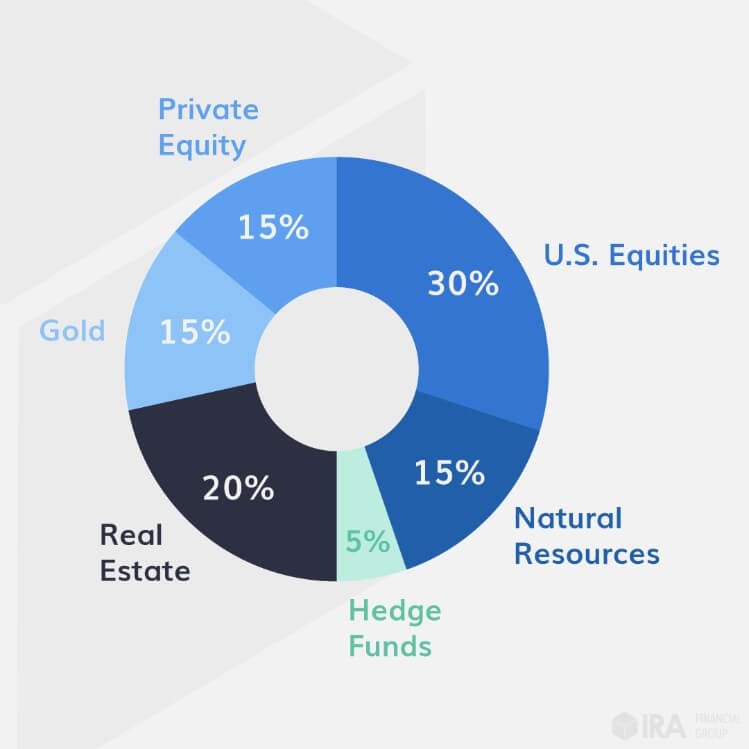
True diversification comes from the types of investments you purchase. Rather than investing in three mutual funds, purchase only one. Utilize your additional retirement funds to invest in real estate, private equities, natural resources, etc.
Blazar also recommends looking to the "Endowment Model" for systemic risk management. The endowment model illustrates the importance of using retirement funds, such as a Self-Directed IRA to purchase stocks and mutual funds, but also asset classes outside of this sector (real estate, cryptocurrency, venture capital, etc.). This will reduce the risk of correlation, thus your retirement portfolio has a greater chance of performing successfully.
Steps to Achieve Retirement Portfolio Diversity Correctly:
- Invest in multiple sectors - Don't purchase multiple mutual funds, instead, diversify into other investments, such as precious metals, tax liens, or real estate.
- Avoid Banks and Financial Institutions - If you want true control over the types of investments you can make with your retirement funds, such as the ability to make alternative investments, re-consider working with a bank, such as Wells Fargo, or a financial institution, like Fidelity.
- Establish a Self-Directed retirement plan - It is possible to achieve retirement portfolio diversity correctly with a flexible plan that allows for traditional and alternative investments, like the Solo 401(k) or Self-Directed IRA.
Related: Open a Self-Directed IRA Online
*Before opening a Self-Directed IRA, we recommend that you check fees, and what alternative investments the company offers. IRA Financial offers a true Self-Directed IRA, allowing you countless investment options. We also charge a flat fee per year, with no transaction fees or account valuation fees.
Self-Directed IRA and Solo 401(k) Retirement Plans
At IRA Financial, we offer two self-directed retirement plans that give investors the freedom to use their retirement funds to make almost any type of investment:
- Solo 401(k), which is uniquely designed for owner-only businesses and individuals who generate some form of self-employment income.
- Self-Directed IRA, which allows all other investors to utilize retirement funds for both traditional and non-traditional investments in a tax-advantaged manner.
With both self-directed retirement plans, you have the ability to effectively allocate your assets in a wide range of classes and categories. Learn more about the Solo 401(k) if you're self-employed. If you are not self-employed, discover the advantages of the Self-Directed IRA.
Work with IRA Financial
When you work with IRA Financial, we will guide you through the IRS-prohibited transaction rules so you do not risk being taxed or penalized for engaging in a transaction under IRC sections 408 and 4975.
Learn the prohibited transaction rules of the Solo 401(k) plan and the Self-Directed IRA.
The professionals at IRA Financial do not sell investments or offer investment advice, but we will ensure that your Self-Directed retirement plan remains IRS-compliant, giving you the freedom to yield high returns on your investments stress-free.

Solo 401(k) vs. Self-Directed IRA
In terms of choosing the Solo 401(k) vs. Self-Directed IRA LLC, participants should choose the Solo 401(k) plan if eligible. The robust features of the Solo 401(k) plan offer more advantages than the Self-Directed IRA, which we explain in this article.
- If you have self-employment income, the Solo 401(k) is the far better choice
- Anyone with earned income can contribute to a Self-Directed IRA
- The Solo 401(k) offers numerous advantages to the Self-Directed IRA, including higher contribution limits, a loan option, and UBTI exemption
Solo 401(k) vs. Self-Directed IRA
A Self-Directed IRA and a Solo 401(k) are both retirement accounts that allow you to invest in traditional and alternative investments. Anyone with an income can open a Self-Directed IRA. However, only those who are self-employed can open a Solo 401(k). Aside from eligibility, a Solo 401(k) allows you to take out a loan tax-free! In addition to these benefits, you can contribute more with a Solo 401(k) than a Self-Directed IRA. Some providers only allow Self-Directed IRAs to have a checkbook IRA. However, IRA Financial is one of the few providers that also allows Solo 401(k) holders the ability to have a checkbook IRA.
If eligible, a Solo 401(k) remains the ideal retirement plan for many individuals. If you are self-employed with no full-time employees, keep reading to learn how you can benefit from a Solo 401(k). However, if you do not have self-employment activities, there are some solutions. You can still open a Self-Directed IRA. You can also take a side job in the gig economy to provide you with Self-Employment income.
Read more: Pros and Cons of a Self-Directed IRA
What is a Solo 401k?
A Solo 401(k) plan is an IRS-approved retirement plan, which is suited for business owners who do not have any employees, other than themselves and their spouse. The “one-participant 401(k) plan” or individual 401(k) Plan is not a new type of plan.
Before the Economic Growth and Tax Relief Reconciliation Act of 2001 (EGTRRA) became effective in 2002, there was no compelling reason for an owner-only business to establish a Solo 401(k) Plan because the business owner could generally receive the same benefits by adopting a profit-sharing plan or a SEP IRA. After 2002, EGTRRA paved the way for an owner-only business to put more money aside for retirement and to operate a more cost-effective retirement plan than a Traditional IRA or 401(k) Plan.
Read More: What is a Self-Directed IRA LLC?
Several options are specific to Solo 401k plans that make the Solo 401(k) plan a far more attractive retirement option for a self-employed individual than a Self-Directed IRA for a self-employed individual. However, it is important to note, that you must be eligible for a Solo 401(k). To determine your eligibility, use our free AI-based tool to identify what type of Self-Directed Retirement Plan is right for you!
Solo 401(k) Contributions
2023: Employee Deferrals Under 50: $22,500
2024: Employee Deferral Under 50: $23,000
2023: Employee Deferrals Over 50: $30,000
2024 - Employee Deferrals Over 50: $30,500
2023 Max Aggregate Contribution Amount (Employee Deferrals + Employer Contributions) Under50: $66,000
2024: Max Aggregate Contribution Amount (Employee Deferral + Employer Contributions) Under 50: $69,000
2023 Max Aggregate Contribution Amount Employee Deferrals + Employer Contributions) Over 50: $73,500
2024 Max Aggregate Contribution Amount Employee Deferrals + Employer Contributions) Over 50: $76,500
Benefits of Opening a Solo 401(k) vs. a Self-Directed IRA
1. Reach your Maximum Contribution Amount Quicker
A Solo 401(k) Plan includes both an employee and profit-sharing contribution option, whereas, a Self-Directed IRA has a much lower annual contribution limit.
Under the 2022 Solo 401(k) contribution rules, a plan participant under the age of 50 can make a maximum employee deferral contribution in the amount of $20,500. That amount can be made in pretax or after-tax (Roth). On the profit sharing side, the business can make a 25% (20% in the case of a sole proprietorship or single member LLC) profit sharing contribution up to a combined maximum, including the employee deferral, of $61,000.
For plan participants age 50 or older, an individual can make a maximum employee deferral contribution in the amount of $27,000. That amount can be made in pretax or after-tax (Roth). On the profit sharing side, the business can make a 25% (20% in the case of a sole proprietorship or single member LLC) profit sharing contribution up to a combined maximum, including the employee deferral, of $67.5,000.
Whereas, a Self-Directed IRA allows an individual with earned income during the year to contribute up to $6,000 or $7,000 if the individual is at least age 50.
2. Tax-Free Loan Option
With a Solo 401(k) Plan you can borrow up to $50,000 or 50% of your account value, depending on which is less. The loan can be used for any purpose. With a Self-Directed IRA, the IRA holder is not permitted to borrow even $1 dollar from the IRA without triggering a prohibited transaction.
3. Use Non-recourse Leverage and Pay No Tax
With a Solo 401(k) Plan, you can make a real estate investment using non-recourse funds without triggering the Unrelated Debt Financed Income Rules and the Unrelated Business Taxable Income (UBTI or UBIT) tax (IRC 514). However, the non-recourse leverage exception found in IRC 514 is only applicable to 401(k) qualified retirement plans and does not apply to IRAs. In other words, using a Self-Directed SEP IRA to make a real estate investment (Self-Directed Real Estate IRA) involving non-recourse financing would trigger the UBTI tax.
4. Open the Account at Any Local Bank
With a Solo 401(k) Plan, the 401(k) bank account can be opened at any local bank or trust company. However, in the case of a Traditional Self-Directed IRA, a special IRA custodian is required to hold the IRA funds. At IRA Financial we offer the ability to open a Solo 401(k) online.
5. No Need for the Cost of an LLC
With a Solo 401(k) Plan, the plan itself can make real estate and other investments without the need for an LLC, which depending on the state of formation could prove costly. Since a 401(k) plan is a trust, the trustee on behalf of the trust can take title to a real estate asset without the need for an LLC.
6. Better Creditor Protection
In general, a Solo 401(k) Plan offers greater creditor protection than a Traditional IRA. The 2005 Bankruptcy Act generally protects all 401(k) Plan assets from creditor attack in a bankruptcy proceeding. In addition, most states offer greater creditor protection to a Solo 401k-qualified retirement plan than a Traditional Self-Directed IRA outside of bankruptcy.
7. Easy Administration
With a Solo 401(k) Plan, there is no annual tax filing or information returns for any plan that has less than $250,000 in plan assets. The plan offers affordable and easy administration. In the case of a Solo 401(k) Plan with greater than $250,000, a simple 2-page IRS Form 5500-EZ is required to be filed. The tax professionals at the IRA Financial will help you complete the IRS Form.
8. IRS Approved
The Solo 401(k) Plan is an IRS-approved qualified retirement plan. IRA Financial's Solo 401(k) Plan comes with an IRS opinion letter which confirms the validity of the plan and is a safeguard against any potential IRS audit.
9. Open Architecture Plan
IRA Financial's Solo 401(k) Plan is an open architecture, self-directed plan that will allow you to make traditional as well as alternative asset investments, such as real estate by simply writing a check. As trustee of the Solo 401(k) Plan, you will have "checkbook control" over your retirement assets and make the investments you want when you want.
The Solo 401(k) plan is unique and so popular because it is designed explicitly for small, owner only businesses. The many features of the plan discussed above is why it appealing and popular among self-employed business owners. Choosing a Solo 401(k) vs. Self-Directed IRA LLC makes sense if you are eligible.
However, if you are not eligible for the plan, the Self-Directed IRA is the better option. When comparing the Self-Directed IRA to the Traditional IRA, you receive greater control and more investment freedom. Regardless of eligibility, the investments you can make with a Self-Directed Solo 401(k) and a Self-Directed IRA are the same. Enjoy the freedom to invest in what you know, while taking full control over your retirement.
Learn More:
Did You Know?
The Solo 401(k) is ideal for businesses with only an owner and a spouse as employees. It has a higher contribution limit when compared with a Self-Directed IRA and offers several other advantages. Contributions can be made by the employee and a spouse working for the business. Contact IRA Financial for more information and to get started.

Can I Open a Solo 401(k) if I Have Job?
If you have a full-time job, but have a side business that earns self-employment income, then you will likely be able to adopt a Solo 401(k) Plan. Having a full-time job does not affect your ability to open a retirement plan for your self-employment income. Of course, you must meet the eligibility requirements to fund a Solo.
- Having a full-time job does not disqualify you from opening your own Solo 401(k)
- In order to start a Solo 401(k) plan, you must meet the eligibility requirements
- The Solo 401(k) is the best plan for the self-employed, regardless if you have another full-time job
Solo 401(k) Plan Eligibility
To be eligible to benefit from the Solo 401(k) plan, an individual must meet just two eligibility requirements:
(1) The presence of self-employment activity.
(2) The absence of full-time employees.
Presence of Self-Employment Activity
As long as you have some sort of self-employment business activity that generates income or has the potential to earn income, a Solo 401(k) can be adopted by that business. In other words, there must be anticipation of business activity. The business does not have to be a huge revenue-producing business; it just needs to have the intent to generate revenues and earn a profit. For example, the business could be a start-up that is working on producing a widget or in the process of selling a service. In addition, the business can take any of the following forms – sole proprietorship, LLC, corporation, or partnership.
Absence of Full-Time Employees
Prior to the SECURE Act, employers generally could exclude certain part-time employees (i.e., employees who have not satisfied a requirement that they have 1,000 hours of service in a year) when providing a plan to their employees. This is an important provision for many Solo 401(k) plans which could now be forced to adopt an ERISA 401(k) plan. The SECURE Act generally required 401(k) plans (other than collectively bargained plans) to have a dual eligibility requirement under which an employee must complete either a one-year of service requirement (with the 1,000-hour rule) or three consecutive years of service where the employee completes at least 500 hours of service.
Hence, in order to establish a Solo 401(k) plan, the business could not have any full-time employees who work more than 1000 hours in a year or 500 hours in three consecutive years. A business owner or the spouse of owner is not deemed an employee for purposes of the ERISA plan testing rules.
Related: Solo 401(k) Investment Options
Solo 401(k) Plan Set-Up Rules
Now that you have a solid understanding of the eligibility rules for establishing a Solo 401(k), let’s spend some time discussing the rules involved in establishing a plan for a side business.
As noted above, an individual that has a side business can establish a Solo 401(k), even if they have access to a 401(k) plan through an employer. The IRS controlled group rules dictate that so long as the two businesses are not affiliated and you and/or your lineal descendants do not own more than 80% of both businesses, the two businesses will not be deemed one business for purposes of ERISA.
For example, if you have a job with Google and do landscaping on the side, the two entities are completely separate, and you are allowed to start your own Solo 401(k) for your landscaping venture.
Solo 401(k) Contribution Rules
Pursuant to Internal Revenue Code (IRC) Section 402, the 401(k) employee deferral rules are per individual and not per plan.
A Solo 401(k) plan consists of two components: (i) employee deferrals and (ii) employer profit sharing contributions. First, there is the elective deferral which is the contribution you make as the employee. The second type of contribution for a Solo 401(k) is the employer contribution, which is a percentage of your self-employment income or your schedule C if you’re a single member LLC or sole proprietor.
Employee deferrals are 100% elective. The due date for making employee deferrals is based on the type of business that adopted the plan. Sole proprietors and single member LLCs have until the filing of the 1040 tax return to make deferrals. Whereas, owner/employees of partnerships and corporations must elect to make employee deferral contributions by December 31.
If one has access to a 401(k) plan at work and wishes to set-up a Solo 401(k) plan for a side business, the 2022 employee deferral limit is the maximum amount of employee deferrals that can be contributed in a given year. This is the case even if both businesses are wholly unrelated. Essentially, whatever you contribute as an employee to one plan lessens the amount you can contribute to the other.
Whereas, in the case of employer profit sharing contributions, IRC Section 404 holds that they are plan- and not individual-dependent. Thus, so long as the controlled group rules do not apply, one could benefit from employer contributions from multiple plans.
Related: Solo 401(k) and the Gig Economy
Conclusion
A Solo 401(k) plan is perfect for any sole proprietor, consultant, or independent contractor that operates a business with no employees. It is best suited for self-employed individuals or small business owners who have no other full-time employees and are not employed by any business owned by them or their spouse (an exception applies if your full-time employee is your spouse).
Having a side business or being part of the gig economy is not only a great way to make extra income but it also provides one the opportunity to establish a Solo 401(k) plan and take advantage of all its benefits, including high annual contribution options, a $50,000 loan feature, and the ability to invest in alternative assets, such as real estate.