


Can You Invest in Trading Cards With Your Retirement Funds in 2026? A Tax Lawyer's Analysis of Whether a ROBS Structure May Provide the Answer
Key Takeaways:
- IRA rules generally block retirement accounts from buying trading cards directly and treat any such purchase as a taxable distribution
- A ROBS structure lets a retirement plan buy stock in a C corporation that runs a trading card business, instead of buying the cards themselves
- Neither the IRS nor the courts have ruled on whether a ROBS-funded trading card corporation causes the retirement plan to be treated as owning collectibles
- Because this area of tax law is unsettled, get experienced tax and legal guidance before using retirement funds this way
Trading cards are no longer just childhood collectibles. Over the last decade, baseball, basketball, football, soccer, Pokemon, Magic: The Gathering, and other rare cards have evolved into a legitimate alternative asset class, with auction records falling, institutional investors entering the market, and professional grading turning a hobby into a sophisticated marketplace. Some of the rarest cards now sell for hundreds of thousands, even millions, of dollars, and investors increasingly view them the way they view fine art, rare automobiles, or precious metals: assets with limited supply, strong demand, and real long-term appreciation potential.
As the father of two sons who are passionate about trading cards, and a tax attorney who has spent more than twenty-five years helping clients use Self-Directed IRAs and Solo 401(k) plans to invest in alternative assets, I'm increasingly asked a simple question.
Can I use my retirement funds to invest in trading cards?
The answer, unfortunately, is not simple.
If you own a Self-Directed IRA, the Internal Revenue Code generally prohibits your IRA from purchasing collectibles directly, and trading cards almost certainly fall within that prohibition. That part of the law is relatively clear.
A more interesting question is what happens if your retirement funds don't purchase trading cards directly at all. What if your retirement plan instead invested in the stock of a C corporation that operates a legitimate trading card business, through a Rollovers as Business Startups ("ROBS") structure? Would the retirement plan own collectibles, or would it simply own corporate stock while the corporation owned the cards? Surprisingly, neither the IRS nor the courts have directly answered that question.
As with many areas of tax law, the answer requires looking beyond a single Code section, and instead understanding how the IRS collectibles rule under Section 408(m), the prohibited transaction rules under Section 4975, qualified employer securities under Section 4975(d)(13), corporate law principles, and the Department of Labor's Plan Asset Regulation all interact. In my view, while there is no published authority specifically approving a ROBS-funded trading card business, the structure presents one of the strongest legal frameworks for analyzing whether retirement funds may participate in this rapidly growing industry.
Why Investors Want to Use Retirement Funds
One of the biggest advantages of investing through a retirement account is the favorable tax treatment Congress created to encourage Americans to save. A Traditional IRA lets gains compound tax-deferred, so every dollar that would otherwise go to taxes keeps earning returns year after year. A Roth IRA can be even better: qualified distributions, including decades of appreciation, may come out completely tax-free. Solo 401(k) plans offer similar advantages with much larger contribution limits for self-employed owners.
That tax-efficient compounding is exactly why so many retirement investors have expanded beyond stocks and mutual funds into real estate, private equity, cryptocurrency, precious metals, private lending, and privately held businesses. Trading cards have increasingly entered that conversation: like fine art, they derive value from scarcity, condition, and collector demand rather than corporate earnings, making them an appealing diversification tool for a long-term portfolio.
Unfortunately, Congress imposed one important limitation. Unlike real estate or privately held businesses, collectibles generally cannot be purchased directly by an IRA, which is a rule worth understanding in more detail.
Why an IRA Generally Cannot Purchase Trading Cards Directly
The starting point is Internal Revenue Code Section 408(m), the IRS collectibles rule. Congress enacted it because it wanted retirement accounts used for retirement savings, not personal enjoyment, and was concerned that taxpayers could buy art, antiques, or jewelry inside an IRA and enjoy those assets while keeping favorable tax treatment. Section 408(m) generally provides that if an IRA acquires a collectible, the amount invested is treated as a taxable distribution in the year of purchase, and depending on the owner's age, that deemed distribution may also trigger a 10% early distribution penalty.
Section 408(m) defines collectibles broadly: works of art, rugs, antiques, most metals and gems (subject to statutory exceptions for certain precious metals), stamps, alcoholic beverages, and other tangible personal property the IRS specifies. The statute does not name trading cards specifically, but baseball, basketball, football, Pokemon, and Magic: The Gathering cards would almost certainly be treated as collectibles. So if a Self-Directed IRA simply bought a rare Mickey Mantle rookie card or a valuable Pokemon card directly, there is a substantial risk the IRS would treat it as a taxable distribution.
Many investors stop the analysis there and conclude retirement funds simply cannot touch this market, and from a direct-ownership standpoint, that's correct. But the precise wording of the statute matters: Section 408(m) prohibits an IRA from acquiring a collectible, but it does not expressly prohibit an IRA or qualified plan from purchasing stock of a corporation that, in turn, owns collectibles. That distinction matters because corporations are separate legal entities under both state corporate law and federal tax law. A shareholder owns shares of stock, not the corporation's underlying assets; if you own Apple stock, you don't personally own Apple's buildings or patents. The same principle applies to a closely held corporation: if a C corporation buys trading cards, it is the corporation, not its shareholders, that owns those cards.
That raises the real question: could a retirement plan invest in the stock of a C corporation that acquires, grades, markets, and sells trading cards, rather than purchasing the cards directly? The idea is straightforward in concept, but it leaves a practical question unanswered: how would a retirement plan actually get money into a newly formed corporation's stock in the first place, without that transaction creating its own tax problems? That is where ROBS comes in. ROBS is not a workaround invented for this article. It is an existing, IRS-recognized structure that entrepreneurs have used for decades to move retirement savings into a new operating business, whether a restaurant, a franchise, or a manufacturing company. Because that mechanism already exists and already works for other kinds of operating businesses, the natural next question is whether it works the same way for a business built around trading cards. Answering that means moving past Section 408(m) alone and into the rules governing ROBS transactions, prohibited transactions, qualified employer securities, and the Department of Labor's Plan Asset Regulation.
How a ROBS Structure Works
A Rollovers as Business Startups ("ROBS") arrangement is an IRS-recognized method of using qualified retirement funds to capitalize a new business without triggering taxes or early distribution penalties, provided it's properly structured and operated. Unlike a Self-Directed IRA, which typically purchases an investment directly, a ROBS structure involves an employer-sponsored qualified retirement plan and generally follows four steps.
First, a new C corporation is formed, because only a C corporation can issue "qualified employer securities" that a qualified retirement plan can purchase under the ROBS framework. Second, the corporation adopts a new qualified 401(k) plan. Third, the individual rolls over funds from an existing eligible retirement account into that new plan, a qualified rollover that is generally tax-free. Finally, the 401(k) plan purchases newly issued shares of stock in the C corporation, and the corporation receives cash in exchange to operate its business.
That distinction is critical: the retirement plan is not purchasing inventory, equipment, or trading cards. It is purchasing qualified employer securities, namely stock issued by the C corporation. The corporation then uses that capital to run its business, whether that's a restaurant, a franchise, a manufacturing company, or, potentially, a trading card business that buys, grades, markets, and sells collectible cards. From a legal standpoint, the retirement plan owns shares of corporate stock. The corporation owns the trading cards.
That stock-versus-assets distinction rests on a basic principle of corporate law: a shareholder owns shares, not the corporation's underlying assets, whether the corporation manufactures cars, owns real estate, or, in this case, holds trading cards. But because the shareholder here is a retirement plan, the question doesn't end with ordinary corporate law. ERISA and the Department of Labor apply their own separate test for deciding when a retirement plan is treated as owning only stock versus owning a company's underlying assets, called the Plan Asset Regulation. That regulation, more than Section 408(m) itself, is where the real complexity of this issue lives.
The Plan Asset Rules: The Most Overlooked Issue
Most articles on this topic stop after quoting Section 408(m) and conclude retirement accounts simply cannot own trading cards. That's incomplete, because whenever a qualified retirement plan invests in a business, the Plan Asset Regulation asks a further question: does the plan own only the stock of the company, or is it treated as owning the company's underlying assets? As a general rule, a retirement plan that purchases stock owns the stock, not the corporation's assets, so if the corporation later buys trading cards as inventory, the corporation, not the plan, is the legal owner.
The Operating Company Exception
The Plan Asset Regulation generally does not look through investments in bona fide operating companies; it focuses on entities whose principal purpose is holding investment assets for passive investors. A corporation that actively runs a trading card business, buying collections, grading cards, marketing, and regularly buying and selling in the ordinary course of business, is conducting an active business, which is a very different situation from an entity formed solely to warehouse collectibles for passive investment. That distinction strengthens the argument that the corporation should be respected as a separate legal entity whose assets belong to the corporation, not the retirement plan.
The 100% Ownership Rule
The analysis gets more complicated when a qualified retirement plan owns all of a corporation's outstanding stock. The Plan Asset Regulation contains a provision that, in certain circumstances, treats an entity's assets as assets of the investing plan when benefit plan investors own all of the equity, which raises the question of whether that also means the plan has "acquired" collectibles under Section 408(m). The answer is far from clear. To my knowledge, neither the IRS nor the Department of Labor has applied the 100% look-through rule to a ROBS-funded trading card corporation, and no court has addressed how Section 408(m) and the Plan Asset Regulation interact here. That silence cuts both ways: it doesn't make the structure automatically permissible, but there is also no authority saying a plan that owns stock in a bona fide operating C corporation should automatically be treated as owning every asset the corporation holds.
In my opinion, the better reading of the Code, the Plan Asset Regulation, and corporate law principles is that a properly structured ROBS transaction involving a bona fide operating C corporation should be analyzed differently from an IRA buying trading cards directly. A qualified retirement plan that acquires stock of a C corporation acquires qualified employer securities, not the corporation's underlying assets, and that distinction is fundamental to both corporate law and the ROBS structure. This isn't about exploiting a loophole; it's about applying established legal principles to a fact pattern the IRS hasn't yet addressed.
Why the Prohibited Transaction Rules Don't Prevent a Properly Structured ROBS Transaction
Some readers may wonder whether Section 4975's prohibited transaction rules block a retirement plan from purchasing stock of a corporation owned by the plan participant, since Section 4975 generally prohibits a plan from buying property from, selling property to, or otherwise transacting with a disqualified person. But Congress specifically carved out an exception for this: Section 4975(d)(13), by reference to ERISA Section 408(e), lets an eligible individual account plan acquire qualified employer securities, provided the stock is bought for adequate consideration and no commission is paid. That exemption is the legal foundation for every properly structured ROBS transaction, and it's why thousands of entrepreneurs have used ROBS to capitalize restaurants, franchises, and other businesses over the past several decades.
The more interesting question isn't whether acquiring employer stock violates Section 4975 (it doesn't, assuming the ROBS is properly maintained), but what assets the retirement plan is considered to own after the corporation is funded. If the plan owns only qualified employer securities and the corporation separately owns and operates a bona fide trading card business, the analysis shifts toward the interaction between Section 408(m), corporate law, and the Plan Asset Regulation.
What About UBIT?
One more tax question deserves a direct answer: does running an active trading card business inside a retirement structure trigger Unrelated Business Income Tax (UBIT)? For many retirement-funded business strategies, the answer is yes. If a Self-Directed IRA or 401(k) owns a pass-through entity, such as an LLC or partnership, that actively operates a trade or business, the income from that business is generally treated as Unrelated Business Taxable Income under Internal Revenue Code Sections 511 through 514, and the retirement account itself owes tax on that income, reported on Form 990-T.
A properly structured ROBS transaction avoids that problem for a different reason. The retirement plan doesn't own a pass-through interest in the business. It owns stock in a C corporation. The corporation itself pays corporate income tax on its trading card business profits, currently at a flat 21% federal rate. Dividends the corporation later pays to the 401(k) plan are generally excluded from Unrelated Business Taxable Income under Section 512(b)(1), regardless of how active the underlying business is. That is one of the real advantages of the ROBS structure over a Self-Directed IRA directly owning an operating business, and it applies the same way whether the C corporation sells software, runs a restaurant, or operates a trading card business.
When a ROBS Structure Presents the Strongest Legal Argument
To my knowledge, there is no published Revenue Ruling, Private Letter Ruling, Treasury Regulation, Tax Court decision, or other IRS guidance directly answering this question. In my opinion, the strongest legal argument exists where the following factors are present:
- The retirement plan acquires only qualified employer securities through a properly structured ROBS transaction.
- The C corporation operates a bona fide trading card business rather than simply holding collectibles for passive investment.
- The corporation follows all corporate formalities and maintains separate books, records, bank accounts, and business operations.
- Trading cards are purchased, graded, insured, marketed, stored, and sold exclusively by the corporation.
- No retirement plan participant or other disqualified person receives any personal use or personal benefit from the trading cards.
- The corporation is respected as a separate legal entity under applicable corporate law principles.
Those facts present the strongest argument that the retirement plan owns corporate stock, not the underlying trading cards. That said, investors should approach this area with caution: the absence of IRS guidance doesn't mean a structure is automatically permissible, and it doesn't mean it's prohibited either. It simply means there's uncertainty, and whenever tax law is unsettled, the right move is to avoid aggressive shortcuts and build a structure supported by existing statutory language, established corporate law principles, and sound business practices.
Book a free call with a self-directed retirement specialist
- Review your self-directed retirement options
- Learn about investing in alternative assets
- Get all of your questions answered
Conclusion
Trading cards have become far more than childhood collectibles. Today they represent a sophisticated, multi-billion-dollar industry that combines investing, e-commerce, grading, live auctions, and social media, and many people now view them as a legitimate alternative asset class and business opportunity.
The IRS collectibles rules generally prevent IRAs from purchasing trading cards directly, but that doesn't end the discussion. A properly structured ROBS transaction raises a different legal question, because the retirement plan purchases stock of a C corporation rather than acquiring trading cards directly, and whether that distinction removes the transaction from the scope of Section 408(m) has never been directly addressed by the IRS or the courts. In my opinion, a bona fide operating trading card business funded through a properly structured ROBS arrangement presents the strongest legal framework for analyzing this issue under current law. Because the law remains unsettled, investors should proceed carefully and get experienced tax and legal guidance before implementing any such strategy.


IRA Financial vs. Pango Financial
Pango Financial markets its DreamSpark plan as the most cost-effective ROBS option in the industry, and their setup fee is competitive. But pricing is only part of the picture. When you're rolling over your retirement savings to fund a business, the quality of the legal framework, compliance support, and ongoing administration behind your plan matters just as much as what you pay upfront.
Here's how IRA Financial and Pango Financial compare across the factors that matter most.
What is ROBS?
A Rollover as Business Startups (ROBS) is a legal structure that allows you to use funds from a 401(k) or traditional IRA to finance a new or existing business without paying taxes or early withdrawal penalties. The process works by rolling your retirement funds into a new 401(k) plan sponsored by a C-Corporation you establish. That plan then purchases stock in the corporation, giving your business the capital it needs to operate or grow. Because the funds are invested rather than withdrawn, no taxes or penalties are triggered. You're using your own money to invest in your own business, debt-free. A ROBS is not a loan, so there are no interest payments or repayment schedules to worry about. It does, however, require strict compliance with IRS and Department of Labor regulations, which is why choosing an experienced provider is one of the most important decisions you'll make in the process.
Pricing and Fees: What You'll Actually Pay
Pango positions itself as the low-cost provider in the ROBS space. Their setup fee is the lowest among the major providers, but their monthly administration fee brings the total cost closer to the middle of the pack.
IRA Financial | Pango | |
Setup Fee | $3,500 | $4,695 |
Annual Fee | $1,200 per year | $1,548 per year |
IRS Audit Protection | Included | Not stated publicly |
1 Year Total Cost | $4,700 | $6,243 |
5 Year Total Cost | $9,500 | $12,435 |
Pricing pulled from company websites as of the article publish date.
IRA Financial
- $3,500 one-time setup fee covers C-Corp formation, 401(k) plan creation, and full documentation.
- $1,200 per year flat annual fee with no monthly billing and no surprises.
- IRS audit protection is included in the annual fee.
- No hidden fees or tiered pricing structures.
Pango Financial
- $4,695 setup fee, marketed as the lowest in the industry, though IRA Financial's is lower.
- $129 per month ($1,548 per year) ongoing plan maintenance fee.
- Includes 12 months of registered agent services in the setup fee.
- 24/7 online account management access.

Winner: IRA Financial.
Pango claims to be the lowest-cost ROBS provider, but IRA Financial's $3,500 setup fee and $1,200 annual fee beat Pango at every timeframe. Simpler billing and a lower total cost.
Setup Process and Speed: Getting Funded
Both providers handle the full ROBS setup, including C-Corp formation, 401(k) plan creation, fund rollover, and stock issuance. Pango has invested in technology tools to support the process. IRA Financial keeps it specialist-led and fully in-house.
IRA Financial
- Streamlined three-step process: open your account, work with a ROBS specialist, and establish your C-Corp and 401(k).
- Fully digital onboarding with no paper-heavy process.
- All documentation, fund transfer coordination, and compliance setup handled in-house.
- ROBS specialists are available throughout the process to answer questions and ensure proper execution.
Pango Financial
- ROBS Compatibility Checker is a digital pre-qualification tool to assess fit before committing.
- 24/7 online account management access from day one.
- Onboarding and compliance specialists guide setup from start to finish.
- Registered agent services included for the first year.
Pango's digital tools add a layer of convenience to the pre-qualification and onboarding process. IRA Financial's specialist-led approach keeps a human expert involved at every step, which matters when executing a structure as technically precise as ROBS.
Winner: IRA Financial.
Digital tools are useful, but ROBS setup requires human expertise. IRA Financial's specialist-led process keeps an experienced ROBS professional involved at every stage.
Compliance and Ongoing Support: Staying Protected
This is where the comparison sharpens. ROBS requires ongoing IRS and DOL compliance, and the depth of support behind your plan determines your exposure if something goes wrong.
IRA Financial
- IRS audit protection is included, with dedicated support if your plan is ever examined.
- ROBS specialists are available for ongoing compliance questions throughout the life of your plan.
- Annual plan administration is handled by an in-house team.
- The company was founded by a tax attorney with deep expertise in ERISA and retirement plan law.
Pango Financial
- In-house compliance specialists handle ongoing plan administration and regulatory filings.
- Form 5500 preparation, compliance testing, and plan reconciliation are included in the monthly fee.
- The team monitors ERISA, IRS, and DOL updates proactively.
- No explicit audit protection guarantee or audit defense program is mentioned publicly.
Pango handles the standard ongoing compliance requirements. However, their public materials do not describe an explicit audit protection or defense program, which is a notable gap compared to IRA Financial and other providers in this space.
Winner: IRA Financial.
Pango handles routine compliance, but IRA Financial adds explicit audit protection and the backing of a tax attorney-founded firm. When an IRS examination happens, that difference matters.
Experience and Credentials: Who's Behind the Plan?
Pango is a newer entrant in the ROBS space. IRA Financial brings a track record built on legal expertise and a much larger client base.
IRA Financial
- Founded by Adam Bergman, a tax attorney with decades of experience in self-directed retirement accounts and ERISA law.
- 27,000+ clients served across ROBS, Solo 401(k), SDIRA, and other retirement structures.
- In-house legal and compliance team with no outsourcing of plan management or legal review.
- Extensive free educational resources including weekly videos, podcasts, and articles led by Adam Bergman directly.
Pango Financial
- A+ BBB rating with strong client satisfaction scores (4.8 out of 5 on Trustpilot from 121 reviews).
- IFA and ASPPA member, reflecting industry association credentials.
- Smaller operation with a more limited public track record compared to larger providers.
- Positions itself as a technology-forward, cost-effective alternative.
Pango's client satisfaction scores are genuinely strong, and their BBB rating reflects well on day-to-day service. But with a smaller client base and less publicly documented history, IRA Financial offers more confidence for entrepreneurs making a significant retirement fund rollover.
Winner: IRA Financial.
Strong client satisfaction scores are a good sign for Pango, but IRA Financial's 27,000+ client track record, tax attorney leadership, and explicit audit protection make it the more credentialed choice.
The Bottom Line: Why IRA Financial Is the Smarter Choice
Pango Financial offers competitive pricing and a clean digital experience. Their client satisfaction scores are strong and their compliance team handles the fundamentals. But IRA Financial beats Pango on setup cost, annual fees, audit protection, and the depth of legal expertise behind your plan.
For entrepreneurs who want the most protection and the lowest total cost, IRA Financial is the clear choice.
Book a free call with a ROBS retirement specialist
- Learn how to fund your business using your retirement savings
- Review your ROBS 401(k) options with a specialist
- Get all of your questions answered

SEP IRA Contribution Calculation Guide: Examples for Different Net Incomes in 2026
SEP IRAs look simple from the outside.
One account, one contribution rate, no employee elections to manage.
But the contribution calculation itself is more nuanced than most people expect, particularly for self-employed owners whose net earnings shrink as deductions are applied. The IRS has a specific method to handle that, and knowing how it works is the difference between contributing the right amount and dealing with a correction later.
Key Takeaways:
- What a SEP IRA contribution is actually based on
- Why self-employed calculations work differently than employee calculations
- Step-by-step examples at different net income levels
- How business structure changes the calculation
- The most common errors and how to catch them early
What a SEP IRA Contribution Is Based On
A SEP IRA allows employers to contribute a percentage of compensation for eligible participants. That percentage applies cleanly for W-2 employees but becomes recursive for self-employed owners. Contribution estimates run high when calculations start from gross income instead of the IRS-defined compensation base.
The difference is straightforward at the top level. Employees use W-2 wages. Self-employed owners use net earnings after deductions. Because of that difference, self-employed owners must adjust for self-employment tax and contribution deductions before arriving at the number the IRS allows them to use.
SEP IRA Contribution Limits in Plain Terms
The IRS sets two constraints each year: a percentage limit of compensation and an annual dollar cap. For 2026, SEP IRA contributions cannot exceed the lesser of 25% of compensation or $72,000, an increase from $70,000 in 2025. The underlying contribution formula remains unchanged even as the maximum dollar amount is periodically updated.
For most scenarios, the percentage limit is what binds first, especially for lower and mid-six-figure incomes. The $72,000 dollar cap matters most for high earners whose percentage-based calculation would otherwise exceed it.
One important distinction worth noting: SEP IRAs do not allow elective salary deferrals or catch-up contributions. If the ability to make additional contributions beyond the employer contribution matters to you, a Solo 401(k) offers both.
Read more: IRS Announces 2026 401(k) and IRA Contribution Limits
How SEP IRA Contributions Work for Employees
Employee contributions are based on fixed W-2 compensation, so the calculation is straightforward. Start with W-2 compensation, apply the employer's chosen contribution percentage, and stop if the annual IRS cap is reached.
Example: Employee earning $80,000
| Step | Calculation |
|---|---|
| W-2 wages | $80,000 |
| Contribution rate | 25% |
| SEP contribution | $20,000 |
The employee calculation works cleanly because the contribution does not reduce the W-2 wages it is applied to. Self-employed calculations are different precisely because they do adjust the income they are based on.
Why Self-Employed SEP Calculations Are Different
Self-employed owners calculate SEP contributions from net earnings that shrink as deductions are applied. To keep the math consistent, the IRS uses a reduced effective rate rather than applying the stated percentage directly to net earnings.
The step-by-step process is:
- Start with net profit from Schedule C or pass-through income
- Subtract the deductible portion of self-employment tax
- Apply the adjusted SEP rate
- Confirm the result stays under the 2026 annual dollar cap of $72,000
Each step alters the income figure used in the next calculation. That is why the order matters and why skipping steps produces overcontributions.
Adjusted SEP Contribution Rates Explained
When the stated SEP rate is 25%, the effective rate for self-employed owners becomes 20%. Other rates adjust proportionally.
| Stated SEP Rate | Adjusted Self-Employed Rate |
|---|---|
| 25% | 20% |
| 20% | 16.67% |
| 15% | 13.04% |
These adjustments exist because the contribution reduces the same net earnings it is calculated from. Using the adjusted rate produces the correct number in one step without having to recalculate repeatedly.
Book a free call with a self-directed retirement specialist
- Review your self-directed retirement options
- Learn about investing in alternative assets
- Get all of your questions answered
Examples: SEP IRA Contributions at Different Net Incomes
The examples below assume a sole proprietor with no other retirement plan contributions and the SEP percentage set at the maximum allowed rate. Numbers are rounded and actual tax filings may introduce small variations.
Example 1: $50,000 net income
| Step | Amount |
|---|---|
| Net income | $50,000 |
| SE tax deduction (approx.) | $3,500 |
| Adjusted base | $46,500 |
| SEP contribution (20%) | $9,300 |
Example 2: $100,000 net income
| Step | Amount |
|---|---|
| Net income | $100,000 |
| SE tax deduction (approx.) | $7,100 |
| Adjusted base | $92,900 |
| SEP contribution (20%) | $18,580 |
Example 3: $200,000 net income
| Step | Amount |
|---|---|
| Net income | $200,000 |
| SE tax deduction (approx.) | $14,100 |
| Adjusted base | $185,900 |
| SEP contribution (20%) | $37,180 |
Example 4: $400,000 net income (dollar cap kicks in)
| Step | Amount |
|---|---|
| Net income | $400,000 |
| SE tax deduction (approx.) | $14,100 |
| Adjusted base | $385,900 |
| SEP contribution at 20% | $77,180 |
| 2026 dollar cap | $72,000 |
| Actual maximum contribution | $72,000 |
At this income level, the percentage-based calculation produces $77,180, but the 2026 annual dollar cap of $72,000 limits the actual contribution. Any net income above approximately $360,000 will hit the cap before the percentage limit does.
How Business Structure Changes the Calculation
Your business entity determines which income the IRS treats as compensation for SEP purposes, and that directly affects how contributions are calculated.
| Business Type | Compensation Used |
|---|---|
| Sole proprietor | Net earnings |
| Partnership | Guaranteed payments |
| S-corporation | W-2 wages only |
| C-corporation | W-2 wages |
This distinction surprises many S-corporation owners. SEP contributions can only be based on W-2 wages, not on pass-through distributions. If your S-corp pays you a modest salary and takes the rest as distributions, your SEP contribution limit is based solely on that salary figure, not the total income you received from the business.
Common SEP IRA Calculation Errors
These mistakes happen repeatedly because what feels like income to a business owner is not always the number SEP rules allow you to use.
- Using gross revenue instead of net earnings
- Skipping the self-employment tax adjustment
- Applying the full stated percentage to self-employed income without adjusting
- Forgetting the annual dollar cap for high earners
- Mixing S-corporation wages and distributions in the calculation
Each mistake pushes the contribution calculation above the allowed amount, which the IRS later adjusts through corrections or penalties.
A Quick Sanity Check Before Filing
Before finalizing contributions, a simple check can catch obvious problems. Divide your SEP contribution by net earnings. If the result exceeds 20% for self-employed income, recheck the math. If you run an S-corporation, confirm the number is based on W-2 wages only.
This check works as an early filter by identifying contribution numbers that clearly fall outside allowed ranges before they become a filing issue.
Where SEP IRAs Fit Best in 2026
SEP IRAs reward simplicity. They work best when income is high, employee counts are low, and contribution flexibility is less of a priority than ease of administration.
They lose appeal when you want Roth contribution options, need employee deferral flexibility, or have income that varies sharply year to year. A Solo 401(k) often serves those situations better.
Rather than starting with contribution limits, start with your own behavior and business situation.
How stable is your income year to year? Do you want the ability to make employee deferrals? Will required employer contributions scale comfortably if you hire?
The answers to those questions point toward or away from a SEP more reliably than running the contribution math in isolation.

IRA Financial vs Madison Trust Company
Choosing the right Self-Directed IRA (SDIRA) provider isn't just a financial decision, it's a foundational step in building the future you envision. Whether you're investing in real estate, private businesses, or other alternative assets, the custodian you select plays a critical role in how smoothly, securely, and cost-effectively your investment journey unfolds.
Two commonly compared providers are IRA Financial and Madison Trust Company. Both offer access to alternative investments, but the similarities end there. Here's a closer look at how the two companies compare across pricing, product offerings, technology, and reputation.
Pricing & Fees: Transparent, Flat, and Investor-Friendly
When evaluating self-directed retirement account providers, fees are often the deciding factor, especially for investors managing multiple assets. IRA Financial's flat, transparent fee model ensures you know exactly what you're paying, with no surprises. Madison Trust uses a per-asset quarterly custodial fee structure, which means costs rise as you hold more investments.
IRA Financial | Madison Trust | |
Setup Fee | $0 | $50 |
Annual Fee | $495 | $916 (4 assets) |
Asset Value Fee | $0 | $0 |
Investment Fee | $0 | $75/investment |
Roth Conversion Fee | $0 | $100 |
1 Year Total Cost | $495 | $1,266 |
5 Year Total Cost | $2,475 | $4,930 |
Pricing pulled from company website, as of the article publish date, based on 4 investments with a $200K total balance.
IRA Financial:
- IRA Financial offers flat, transparent annual fees starting at $495/year for a Self-Directed IRA, with other plans available starting as low as $100 annually.
- No asset-based fees, no transaction fees, and no hidden charges, what you see is what you pay.
- Their IRAfi Crypto platform offers low trading fees for buying, selling, and trading crypto through the integrated app.
Madison Trust:
- $50 setup fee, then a quarterly custodial fee of $139 for the first asset plus $30/quarter for each additional asset held.
- $75 fee charged every time an investment is placed, including reinvestments (higher for real estate).
- $100 fee if you convert or recharacterize a Roth IRA.
Summary
Madison Trust's per-asset, per-quarter fee structure means costs climb the more investments you hold, and the $75 investment fee applies every time money moves into a new asset. For an investor holding 4 assets on a $200,000 balance, Madison Trust costs nearly 4 times what IRA Financial charges over 5 years.

Winner: IRA Financial.
A single flat annual fee with no per-asset charges, no per-investment fees, and no cost that climbs as your portfolio grows.
Product & Service Offerings: Integrated vs. Partnered
Choosing the right custodian depends on the types of investments you want to make and how much support you need getting there. IRA Financial and Madison Trust both give investors access to alternative assets, but Madison Trust relies on a sister company for some of its core features.
IRA Financial | Madison Trust | |
Account Type | ||
Self-Directed IRA | ||
Solo 401(k) | ||
HSA | ||
Checkbook Control | ||
ROBS Structure | ||
Platform & Investments | ||
Crypto Platform | ||
Stock Trading | ||
Compliance & Protection | ||
In-House Compliance & Tax Services | ||
IRS Audit Protection |
IRA Financial:
- Offers all the traditional SDIRA investments, including real estate, private lending, startups, precious metals.
- Integrated platform for crypto, checkbook control, real estate, and more under one roof.
- Stock, ETF, bond, and options trading powered by Interactive Brokers - available as a $100/year add-on, fully integrated inside your IRA Financial account.
- Advanced structures like Solo 401(k) plans, SEP & SIMPLE IRAs, HSA & Coverdell accounts, and ROBS structures for business funding.
- IRA Compliance Shield ($299/year): in-house audit protection, tax consultation, deal reviews, prohibited transaction pre-clearance, and UBIT/UDFI modeling.
Madison Trust:
- Covers Traditional, Roth, SEP, and SIMPLE IRAs, plus real estate, private placements, promissory notes, and precious metals.
- Checkbook control and Solo 401(k) access come through its sister company, Broad Financial, not in-house.
- Crypto access through CryptoFlex IRA requires setting up a dedicated LLC and an external Titan Bank checking account, rather than trading directly in your account.
- No ROBS structure, HSA, or Coverdell accounts.
- No in-house compliance, tax consultation, or IRS audit protection services.
Summary
Madison Trust covers the core alternative asset classes, but several of its key features, checkbook control, Solo 401(k)s, and crypto, run through a separate sister company and require extra setup steps rather than living inside the same account. IRA Financial keeps everything, including crypto trading, in a single integrated platform.
Winner: IRA Financial
More account types, in-house compliance support, and crypto and checkbook control that don't require setting up a separate entity or bank account to use.
Technology: Built for the Modern Investor
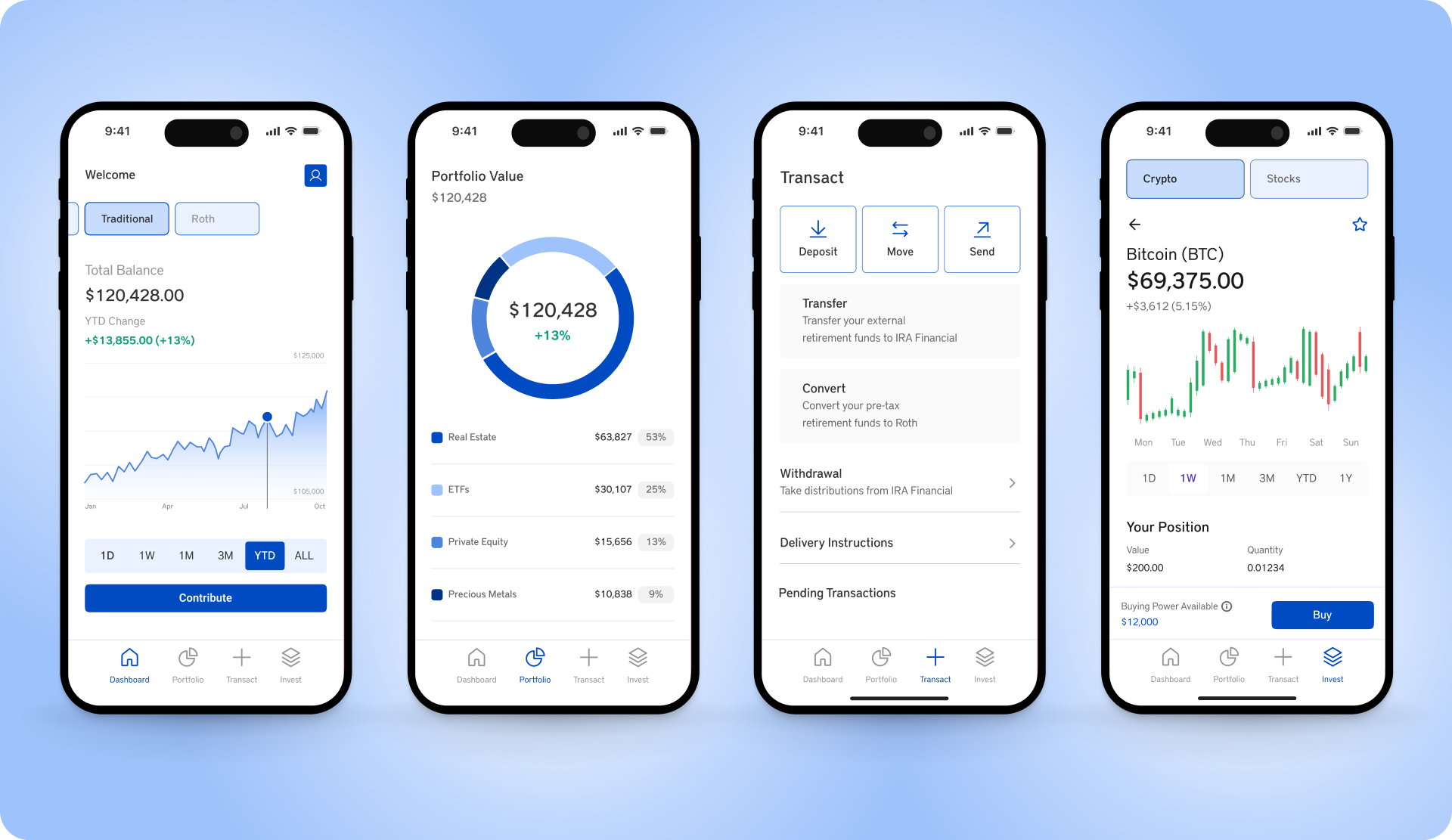
Technology plays a critical role in managing self-directed retirement accounts, especially for investors who want fast access to their funds, real-time updates, and secure digital platforms. IRA Financial and Madison Trust have both invested in tech-driven solutions, but their approaches reflect different priorities. IRA Financial emphasizes mobile-first, streamlined tools with its proprietary apps like the IRA Financial app and IRAfi Crypto, built for investors who want control on the go. Madison Trust focuses more on its online client portal, offering broad functionality but with a more traditional, desktop-centered user experience.
IRA Financial:
- Newly-updated mobile app and account dashboard with clean UI/UX and modern functionality.
- Offers a fully digital on-boarding experience, automated compliance, and secure document storage.
- In-house crypto trading, real-time dashboards, and checkbook control in a single portal.
Madison Trust:
- Web-based platform.
- No dedicated mobile app.
- Crypto and checkbook control require coordinating with a separate company (Broad Financial) rather than managing everything in one place.
Summary
Madison Trust's portal handles the basics of account administration, but investors who want crypto trading or checkbook control need to work across two companies rather than one platform. IRA Financial's technology keeps every feature, from real-time dashboards to crypto trading, under a single login.
Winner: IRA Financial.
One platform, one login, everything integrated, versus a web portal that hands off key features to a separate company.
Reputation & Customer Reviews: Trusted by Thousands
Reputation matters when trusting a custodian with your retirement assets. Both IRA Financial and Madison Trust have built track records in the self-directed space.
IRA Financial | Madison Trust | |
Trustpilot | 4.8 / 5 | 3.3 / 5 |
4.3 / 5 | 4.8 / 5 |
IRA Financial:
- Strong reputation for fast account setup, responsive customer service, and straightforward pricing.
- Over 3,000 5-star reviews across Google, Trustpilot, and other platforms.
- Founded by tax attorney Adam Bergman, who educates investors via weekly videos, podcasts, and blog articles.
Madison Trust:
- Strong Google rating, with reviewers citing helpful, responsive support.
- Does not maintain a meaningful presence on Trustpilot.
Summary
Both companies show strong reviews on Google, and Madison Trust's rating is genuinely competitive there. IRA Financial's edge comes from having a strong, consistent presence across multiple major platforms rather than just one.
Winner: IRA Financial.
Strong reviews across multiple platforms, not concentrated on a single review site.
The Bottom Line: Why IRA Financial Is the Smarter Choice
Both IRA Financial and Madison Trust give investors access to self-directed retirement investing, and Madison Trust's Google reviews reflect a genuinely responsive support team. But for an investor who wants a single flat fee, features that don't require coordinating with a separate company, and a fully integrated platform, IRA Financial offers more.
Whether you're looking to invest in real estate, trade crypto, or fund a new business with your retirement account, IRA Financial is designed to support every part of your retirement strategy, efficiently, affordably, and under one roof.
Book a free call with a self-directed retirement specialist
- Review your self-directed retirement options
- Learn about investing in alternative assets
- Get all of your questions answered

The Real Estate Investor’s Tax-Free Retirement Bundled Solution
For the real estate investor, the goal is straightforward: cash flow, appreciation, and tax shelter. But while most investors focus on the physical asset, the most successful ones focus on the legal vehicle that holds it.
Whether you are a full-time fix-and-flipper, a landlord with a growing rental portfolio, or a W-2 employee with a passion for private lending, there is a specific blueprint to make your real estate gains grow tax-free. By bundling a Self-Directed IRA or Solo 401(k) with a Self-Directed Roth IRA, HSA, and Coverdell ESA, you can build a real estate portfolio inside accounts that the IRS cannot touch.
Key Takeaways:
- Why the Solo 401(k) is the most powerful account for self-employed real estate investors
- How the UDFI exemption gives Solo 401(k) investors a significant advantage over IRA investors on leveraged real estate
- Why the Self-Directed Roth IRA is the long-term exit strategy for tax-free gains
- How the HSA functions as a stealth retirement account with triple tax advantages
- How the Coverdell ESA can participate in real estate deals to fund education tax-free
The W-2 Starting Point: Max Out Your Employer Match First
If you are currently employed by a company that offers a 401(k), the first move is simple: capture your full employer match. Most companies offer a 3% to 5% match, which is an immediate 100% return on that portion of your contribution. No rental property delivers that kind of day-one return. Once the match is secured, the accounts below are where your additional retirement capital belongs.
The Solo 401(k): The Most Powerful Account for Self-Employed Real Estate Investors
If you have any self-employment income, whether from a 1099 consulting arrangement, a Single-Member LLC, or a small business with no full-time employees, the Solo 401(k) is the single most powerful retirement tool available to you. In 2026, the contribution limits allow you to shield more income than ever before.
2026 contribution limits
The Solo 401(k) allows you to contribute in two capacities:
- Employee deferrals: Up to $24,500, which can go into a Traditional (pre-tax) or Roth (tax-free) account
- Employer contributions: Your business can contribute an additional 25% of W-2 compensation or approximately 20% of net self-employment income
| Age | Total Annual Limit |
|---|---|
| Under 50 | $72,000 |
| Age 50 to 59 | $80,000 (includes $8,000 catch-up) |
| Age 60 to 63 | $83,250 (SECURE 2.0 enhanced catch-up of $11,250) |
Read more: Key Tax Benefits of a Solo 401(k)
The participant loan feature
Unlike an IRA, the Solo 401(k) includes a plan loan provision. You can borrow up to 50% of your account value or $50,000, whichever is less, for any purpose. The loan is tax-free and penalty-free as long as it is repaid within five years, or up to 15 years for a primary residence. The interest rate is typically Prime plus 1%, and you pay that interest back to your own account rather than to a bank.
Checkbook control
IRA Financial's Solo 401(k) plans provide checkbook control. Your plan trust opens a dedicated bank account that you control as trustee. When a real estate deal comes across your desk, you write a check or wire the funds directly. There is no custodian approval required, no processing delay, and no missed opportunity. For real estate investors who need to move quickly on properties or fund private notes, this is not a convenience feature. It is a practical necessity.
The Mega Backdoor Roth
For those aiming for maximum tax-free accumulation, the Mega Backdoor Roth allows you to reach the $72,000 limit entirely in Roth. By making after-tax contributions above the $24,500 deferral cap and immediately converting them to Roth, you can move tens of thousands of dollars into a tax-free environment every year regardless of income level.
The UDFI exemption: the real estate edge
This is one of the most important and least-known advantages of the Solo 401(k) for real estate investors. Under Internal Revenue Code Section 514(c)(9), the Solo 401(k) is specifically exempt from Unrelated Debt-Financed Income (UDFI) tax on real property acquired with debt.
Here is what that means in practice. If you buy a $500,000 rental property inside your Solo 401(k), putting $100,000 down from the plan and financing the remaining $400,000 with a non-recourse loan, 100% of the rental income and 100% of the future capital gains are tax-deferred or tax-free. If you had used a Self-Directed IRA for the same transaction, roughly 80% of your profits would be subject to UBIT at trust tax rates reaching 37%, significantly eroding your returns. For leveraged real estate, the Solo 401(k) is structurally superior to an IRA.
Read more: Using a Solo 401(k) to Avoid UBIT for a Real Estate Investment Fund
The Self-Directed IRA: The Entry Point for Rollover Capital
If you are not self-employed but have an old 401(k) from a previous employer or an existing Traditional IRA, the Self-Directed IRA is your entry point into alternative asset investing. It is not a different kind of IRA under the tax code. It is a Traditional or Roth IRA held by a specialized custodian that permits alternative assets. A tax-free rollover or transfer moves your money out of the stock market and into physical real estate.
Why you cannot buy real estate at a traditional brokerage
The reason major brokerage firms do not support real estate inside an IRA is not a matter of law. It is a matter of business model. Traditional custodians are structured to sell mutual funds, stocks, and ETFs. They are not equipped to handle deed processing, property expense payments, or the specialized compliance requirements of physical real estate. IRA Financial removes those artificial restrictions.
Same rules, more freedom
A Self-Directed IRA follows the exact same IRC rules as any other IRA. The same contribution limits apply ($7,500, or $8,600 for those age 50 and older in 2026). The same prohibited transaction rules apply. You cannot buy a property from a disqualified person or rent an IRA-owned property to a family member. What changes is only what you can invest in.
With IRA Financial's checkbook control structure, your IRA owns a specialized LLC that you manage. When you find a deal at a foreclosure auction or from a motivated seller, you write a check from the IRA LLC bank account directly. No custodian sign-off, no processing window, no missed deals.
Book a free call with a self-directed retirement specialist
- Review your self-directed retirement options
- Learn about investing in alternative assets
- Get all of your questions answered
The Self-Directed Roth IRA: The Long-Term Exit Strategy
While a Traditional SDIRA gives you a tax deduction today, the Self-Directed Roth IRA is the ultimate tool for generating long-term tax-free wealth. You pay taxes on the seed, but you never pay taxes on the harvest.
In a Traditional IRA, the IRS is a silent partner in every deal. Every time you collect rent or flip a house, they own a portion of that profit that they will collect at distribution. In a Roth IRA, you own 100% of the growth.
The best of both worlds
You can and should have both a Traditional and a Roth IRA simultaneously. While the total contribution is shared across all IRAs ($7,500 for those under 50 and $8,600 for those 50 and older in 2026), holding both allows you to direct specific deals into pre-tax accounts and others into tax-free accounts based on your expectations for appreciation.
The 2026 income limits and the Backdoor Roth
Direct Roth IRA contributions phase out between $242,000 and $252,000 for married couples filing jointly in 2026. If your income exceeds those limits, the Backdoor Roth IRA is the solution. By making a non-deductible contribution to a Traditional IRA and immediately converting it to a Roth, you bypass the income cap entirely. IRA Financial's tax team works through the pro-rata rules with clients to ensure the conversion is handled correctly.
The 5-year rule and age 59½
To take qualified tax-free distributions of earnings, two conditions must be met. The account must have been open for at least five tax years, with the clock starting January 1 of the year of the first contribution or conversion. And you must be at least 59½. Contributions can always be withdrawn at any time for any reason without tax or penalty since they were already taxed.
Supplementing your 401(k)
A common misconception is that having a 401(k) prevents you from also having an IRA. It does not. You can max out your employer's 401(k) employee deferral up to $24,500 in 2026 and still contribute the full $7,500 to a Self-Directed Roth IRA in the same year, stacking over $32,000 annually into retirement accounts even as a W-2 employee.
The HSA: The Triple Tax Advantage Stealth IRA
The Health Savings Account is arguably the most tax-advantaged account in the entire IRS code. Most people treat it as a medical rainy-day fund. Used correctly, it functions as a powerful stealth retirement account with a triple tax advantage no other account can match.
Eligibility
To contribute to an HSA, you must be enrolled in a High Deductible Health Plan (HDHP), not enrolled in Medicare, and not claimed as a dependent. For 2026, the IRS defines an HDHP as a plan with a minimum deductible of $1,700 for individuals or $3,400 for families.
2026 contribution limits
- Individual coverage: $4,400
- Family coverage: $8,750
- Catch-up (age 55 and older): an additional $1,000
The triple tax advantage
- Tax-deductible contributions: Every dollar you put in reduces your taxable income for the year
- Tax-free growth: Investments grow entirely shielded from capital gains or dividend taxes
- Tax-free withdrawals: Funds used for qualified medical expenses come out 100% tax-free
Investing the HSA in alternative assets
Most banks and insurance companies treat an HSA like a basic savings account. IRA Financial's platform allows HSA holders to invest in traditional assets like stocks and ETFs alongside alternative assets including physical real estate, private equity, tax liens, and cryptocurrency, all within the same account.
The IRA Financial HSA also includes a dedicated debit card for medical expenses, allowing you to pay for a pharmacy visit or a co-pay instantly while the rest of the account stays deployed in investments. That combination does not exist anywhere else in the marketplace.
Read more: How a Self-Directed HSA Can Double as a Stealth Retirement Account
The Coverdell ESA: Using Real Estate to Fund Education Tax-Free
While many parents default to a 529 plan, the Coverdell Education Savings Account is the better option for investors who want to use alternative assets to fund their children's future. The Coverdell allows contributions of $2,000 per year per child up to age 18, and while that limit seems modest, the real power comes from its self-direction capabilities.
The partnership strategy
The Coverdell can participate in deals alongside your larger accounts. Your Solo 401(k) provides 90% of the capital on a fix-and-flip project, and your child's Coverdell provides the remaining 10%. If that deal nets $50,000 in profit, $5,000 flows directly back into the Coverdell tax-free. In a single transaction you have grown the account by 250%, well beyond what annual contributions alone could achieve.
Why the Coverdell beats the 529 for alternative investors
- Broader K-12 coverage: Coverdell funds can be used for private school, homeschooling, tutoring, laptops, and educational software, not just tuition
- Investment freedom: You are not limited to a state-selected menu of mutual funds
- The rollover safety net: If the beneficiary does not use the funds by age 30, the balance can be rolled to another eligible family member under 30, keeping the tax-free growth in the family
Read more: The “Triple-Threat” Education Strategy: 529, Self-Directed Coverdell, and the Trump Account
Final Thoughts
The bundled approach works because each account solves a different piece of the tax problem. The Solo 401(k) generates the largest current-year deductions and handles leveraged real estate most efficiently. The Self-Directed IRA provides access for investors rolling over existing retirement assets. The Roth IRA builds the tax-free wealth that compounds over decades. The HSA adds a third layer of tax-free growth that most investors never fully utilize. And the Coverdell extends the tax-free investment strategy to the next generation.
Used together, these accounts do not just reduce your tax bill. They eliminate it on a significant portion of your real estate wealth, and they do it entirely within the rules the IRS established for exactly this purpose.

Self-Directed HSA Investment Options: Ranked by Tax Efficiency
Most HSA holders leave their contributions sitting in a low-yield cash account, unaware that a Self-Directed HSA can invest in everything from private equity to real estate, all with triple tax-free treatment. But not every investment option delivers the same tax advantage.
Key Takeaways:
- Every major self-directed HSA investment option ranked from most to least tax-efficient
- Why each asset class ranks where it does based on income character and UBIT exposure
- How IRA Financial structures a self-directed HSA for alternative investments
- 2026 HSA contribution limits and eligibility requirements
- What investment options to avoid and why
What Makes a Self-Directed HSA Different From a Standard HSA?
A Self-Directed HSA allows account holders to invest contributions in alternative assets, including real estate, private equity, precious metals, and crypto, rather than being limited to the mutual funds and ETFs offered by standard HSA custodians.
The underlying tax treatment is identical to any HSA: contributions are tax-deductible, growth is tax-free, and qualified withdrawals are tax-free. What changes is the investment universe. A standard HSA at a bank might offer 20 mutual fund options. A Self-Directed HSA at IRA Financial opens access to the same broad asset classes available in a Self-Directed IRA, with one critical advantage: the triple tax exemption amplifies returns on high-growth, illiquid assets far more than it does on index funds. For a comparison of how Self-Directed HSA investing compares to Self-Directed IRA investing, see IRA Financial's overview of Self-Directed IRA Benefits.
IRA Financial works with HSA holders to establish self-directed accounts that combine the structural tax benefits of an HSA with the investment flexibility of a self-directed retirement account.
How Are Self-Directed HSA Investments Taxed?
Every dollar of growth inside a Self-Directed HSA is completely tax-free when withdrawn for qualified medical expenses, including capital gains, dividends, rental income, and interest.
This is the HSA's core advantage over every other tax-advantaged account. A traditional IRA defers taxes and you pay on the way out. A Roth IRA eliminates taxes on growth but uses after-tax contributions. An HSA does both: pre-tax contributions and tax-free growth and tax-free withdrawals for medical expenses. No other account in the U.S. tax code offers all three simultaneously.
For Self-Directed HSA investors, the tax efficiency of any given investment depends on two factors: how much growth potential the investment has, because tax-free compounding is most valuable on high-return assets, and whether the income generated would otherwise be heavily taxed outside an HSA. Assets that produce ordinary income taxed at 37% deliver far more benefit from HSA shelter than assets that produce qualified dividends taxed at 15%. For a deeper look at the tax-deferred versus tax-free distinction across account types, see IRA Financial's guide to Tax-Deferred vs. Tax-Free.
Read more: How a Self-Directed HSA Can Double as a Stealth Retirement Account
What Is the UBIT Risk in a Self-Directed HSA?
Unrelated Business Income Tax (UBIT) can apply to Self-Directed HSA investments that use debt financing or generate active business income, reducing but not eliminating the tax advantage.
Unlike IRAs, HSAs are not exempt from UBIT under the same framework. If your Self-Directed HSA invests in a real estate property using a non-recourse loan, the debt-financed portion of income is subject to UBIT at trust tax rates, which reach 37% at just $15,650 of taxable income in 2026. Similarly, if the HSA invests in an operating business structured as a pass-through entity, active business income may trigger UBIT.
This matters for ranking investments by tax efficiency. An investment that triggers UBIT inside an HSA loses a significant portion of its tax advantage, though it still benefits from the HSA's contribution deduction and the tax-free treatment of non-UBIT income. For a full explanation of how UBIT works across self-directed retirement accounts, see IRA Financial's guide to What Is Unrelated Business Taxable Income (UBTI). IRA Financial's tax team evaluates each client's investment structure to identify and minimize UBIT exposure before committing capital.
Book a free call with a self-directed retirement specialist
- Review your self-directed retirement options
- Learn about investing in alternative assets
- Get all of your questions answered
Self-Directed HSA Investment Options Ranked: Most to Least Tax-Efficient
The table below ranks asset classes available to Self-Directed HSA investors based on their effective tax efficiency, combining the value of the HSA's triple tax exemption with each asset's typical return profile, income character, and UBIT exposure.
| Rank | Investment Type | Why It Ranks Here | UBIT Risk |
|---|---|---|---|
| 1 | Early-Stage Private Equity / Pre-IPO Startups | Highest potential for tax-free appreciation; gains taxed at up to 37% outside an HSA | None (passive equity) |
| 2 | Cryptocurrency | Volatile, high-upside; short-term gains taxed at ordinary rates outside HSA | None (direct holding) |
| 3 | Private Lending / Hard Money Loans | Interest income taxed as ordinary income (up to 37%) outside HSA; predictable, high-yield | None |
| 4 | Real Estate | Appreciation and rental income sheltered; depreciation irrelevant inside HSA | None without leverage |
| 5 | Precious Metals (Gold, Silver) | Gains taxed at collectibles rate (28%) outside HSA; HSA shelter is especially valuable | None |
| 6 | Real Estate Investment Trusts (REITs) | Dividends taxed as ordinary income outside HSA; liquid alternative to direct real estate | None |
| 7 | Real Estate (With Non-Recourse Debt) | Leverage amplifies returns but triggers UBIT on debt-financed income | Moderate to High |
| 8 | Tax Liens and Tax Deeds | High interest rates (8 to 36% depending on state); ordinary income outside HSA | None |
| 9 | Stocks, ETFs, and Index Funds (via IRA Financial and IBKR) | Qualified dividends already taxed at lower rates; HSA adds value but less dramatically. IRA Financial's platform supports real-time stock and ETF trading through Interactive Brokers inside the same HSA. | None |
| 10 | Operating Business Interests (Pass-Through) | Active income triggers UBIT; most tax efficiency eroded by trust-rate taxation | High |
Why Does Private Equity Rank First for HSA Tax Efficiency?
Private equity and pre-IPO startup investments rank first because they combine the highest potential appreciation with the income character most punished by the tax code outside an HSA.
Outside an HSA, a startup investment that grows from $10,000 to $500,000 triggers a $490,000 capital gain taxed at up to 23.8% (long-term capital gains plus net investment income tax), a $116,620 tax bill. Inside a Self-Directed HSA, that same gain is completely tax-free when withdrawn for qualified medical expenses. The dollar amount sheltered is larger than any other asset class because the upside potential is larger.
IRA Financial has helped HSA holders invest in pre-IPO companies, venture capital funds, and private equity partnerships. The key compliance requirement is that the investment must be passive. The HSA holder cannot provide services to the company or receive compensation connected to the investment, as this would trigger prohibited transaction rules under IRC Section 4975. For a broader look at how Self-Directed IRAs approach private equity, which shares many of the same structural rules, see IRA Financial's guide to Private Equity Investments in an IRA.
Why Does Cryptocurrency Rank Second for Self-Directed HSA Investors?
Cryptocurrency ranks second because short-term gains, which are common in crypto trading, are taxed as ordinary income at rates up to 37% outside an HSA, making the tax shelter extremely valuable.
An investor who buys Bitcoin at $40,000 and sells at $100,000 within 12 months faces a $60,000 short-term gain taxed at their marginal rate. At 37%, that is a $22,200 tax bill. Inside a Self-Directed HSA, the same transaction generates zero tax on withdrawal for qualified expenses. For active crypto investors, the compounding effect of eliminating that drag over multiple trading cycles is substantial.
IRA Financial's Self-Directed HSA platform supports direct cryptocurrency investment with checkbook control, giving account holders the ability to move quickly in volatile markets without custodian processing delays. For a deeper look at how crypto investing works inside self-directed retirement accounts and the platform options available, see IRA Financial's guide to How to Hold Crypto, NFTs, and Private Equity in a Self-Directed IRA. For a comparison of crypto IRA custodians and fee structures, see IRA Financial's Crypto IRA Comparison.
Why Does Private Lending Rank Third Despite Generating Ordinary Income?
Private lending and hard money loans rank third because interest income is taxed at the highest ordinary income rates outside an HSA, making the shelter more valuable per dollar earned than it is for capital gains assets.
A hard money loan generating 12% annual interest on a $100,000 investment produces $12,000 per year in income taxed at up to 37%, a $4,440 annual tax bill. Inside a Self-Directed HSA, that $12,000 compounds tax-free. Over 10 years, the difference between taxed and untaxed compounding at 12% on a $100,000 principal is significant: the HSA account grows to approximately $310,585 while the after-tax account at 37% grows to approximately $209,646, a $100,939 difference from tax treatment alone.
IRA Financial structures private lending investments through the Self-Directed HSA using promissory notes and deed of trust arrangements. The HSA acts as the lender and the borrower makes payments directly to the HSA account. No prohibited transaction rules are triggered as long as the borrower is not a disqualified person. For a complete guide to how promissory notes and private lending work inside self-directed retirement accounts, see IRA Financial's overview of Self-Directed IRA Promissory Notes and Loans. For hard money lending specifically, see Hard Money Loans with a Self-Directed IRA.
Why Is Debt-Free Real Estate More Tax-Efficient Than Leveraged Real Estate Inside an HSA?
Debt-free real estate ranks above leveraged real estate specifically in an HSA because non-recourse debt financing triggers UBIT on the debt-financed portion of rental income and gains, significantly reducing the tax advantage.
In a Self-Directed IRA, UBIT from leveraged real estate is common but manageable. In an HSA, the same UBIT applies but at trust tax rates that reach 37% at just $15,650 of taxable income. A Self-Directed HSA holding a $500,000 rental property with a $300,000 non-recourse loan would have 60% of its net income subject to UBIT, effectively negating most of the tax benefit on that portion of returns.
Debt-free real estate held inside a Self-Directed HSA generates rental income and appreciation entirely sheltered from tax. For a full guide to real estate investing inside self-directed retirement accounts, including the non-recourse loan rules that determine UBIT exposure, see IRA Financial's guide to Real Estate Investing with a Self-Directed IRA. IRA Financial's tax team analyzes UBIT exposure on a case-by-case basis for clients considering leveraged real estate inside an HSA. For a deeper look at how UBIT and UDFI interact in real estate investments, see UBIT and UDFI Explained.
Why Do Precious Metals Rank Surprisingly High for HSA Investors?
Precious metals rank fifth because the IRS taxes gains on gold and silver as collectibles at a maximum 28% rate outside an HSA, higher than the 20% long-term capital gains rate applied to stocks, making the HSA shelter relatively more valuable.
Most investors do not realize that gold ETFs and physical gold are taxed as collectibles rather than capital assets. A $50,000 gain on gold held outside an HSA triggers up to $14,000 in federal tax. The same gain inside a Self-Directed HSA is tax-free on qualified withdrawal. For investors already attracted to gold as a hedge, holding it inside an HSA rather than a taxable account improves after-tax returns meaningfully.
IRA Financial's Self-Directed HSA platform supports investment in IRS-approved precious metals, including gold, silver, platinum, and palladium meeting specific purity standards, stored in an approved depository. For a complete guide to gold IRA investing including approved metals, storage requirements, and setup, see IRA Financial's Investing with a Gold IRA: The Ultimate Guide. For silver specifically, see Invest in Silver with a Self-Directed IRA.
What Investment Options Should Self-Directed HSA Investors Avoid?
Self-Directed HSA investors should avoid S-Corporation stock, life insurance contracts, collectibles other than IRS-approved precious metals, and any investment involving a disqualified person. All of these either trigger prohibited transactions or are explicitly barred by the tax code.
The prohibited transaction rules under IRC Section 4975 apply to HSAs just as they do to IRAs. Any investment or transaction between the HSA and a disqualified person, including the account holder, their spouse, lineal descendants, and entities they control, triggers a 15% excise tax and potential account disqualification. The entire HSA balance becomes taxable in the year of disqualification. For a full explanation of who qualifies as a disqualified person and why it matters, see IRA Financial's guide to Self-Directed IRA: Who Is a Disqualified Person.
S-corporation stock is specifically prohibited as an HSA investment because HSAs are trusts and trusts are not eligible S-corporation shareholders. This is a common mistake IRA Financial's compliance team catches during account setup, and one that can be avoided entirely with proper structuring guidance before investing. For a broader look at the prohibited transaction rules that govern all self-directed retirement accounts, see IRA Financial's summary of Self-Directed IRA Prohibited Transactions.
How Does IRA Financial Structure a Self-Directed HSA for Alternative Investments?
IRA Financial establishes Self-Directed HSAs using a checkbook control structure that gives account holders direct investment authority without requiring custodian approval for each transaction.
The structure works as follows: IRA Financial establishes the HSA trust and pairs it with an LLC of which the HSA is the sole member. The account holder serves as the LLC manager, with signing authority over a dedicated LLC bank account. When the account holder identifies an investment, whether a private loan, a startup equity stake, or a piece of real estate, they write a check or wire directly from the LLC account. No custodian approval is required and no transaction fees are charged per investment.
This structure is particularly valuable for time-sensitive investments like private lending opportunities or real estate purchases where a three to five business day custodian approval window can mean losing the deal. Beyond alternative assets, IRA Financial's platform also supports real-time trading of stocks, ETFs, and bonds through its integration with Interactive Brokers, giving HSA holders access to both traditional securities and alternative investments within the same account. For a side-by-side comparison of checkbook control versus custodian-managed structures across self-directed accounts, see IRA Financial's guide to Custodian-Managed SDIRA vs. Checkbook IRA. IRA Financial's in-house tax and legal team reviews the structure for compliance before launch and provides ongoing consulting to ensure investments remain within IRS guidelines. For a look at what IRA Financial's full-service compliance and consulting model includes, see IRA Financial Self-Directed IRA In-House Tax Filing, IRS Reporting, and Annual Consulting Services.
Frequently Asked Questions
Can I invest my HSA in real estate?
Yes. A Self-Directed HSA can invest in real estate, including rental properties, raw land, tax liens, and real estate notes. The property must be held for investment purposes only. The account holder and disqualified persons cannot use it personally. All expenses must be paid from the HSA and all income must return to the HSA. For a complete guide to IRA real estate investing rules that apply equally to HSA structures, see IRA Real Estate Investing.
Does a Self-Directed HSA have the same triple tax benefit as a standard HSA?
Yes. The self-directed structure does not change the HSA's tax treatment. Contributions are still tax-deductible, growth is still tax-free, and withdrawals for qualified medical expenses are still tax-free, regardless of what the HSA invests in.
What happens to my Self-Directed HSA if I invest in something that triggers a prohibited transaction?
A prohibited transaction causes the HSA to lose its tax-exempt status as of the first day of the year in which the transaction occurred. The entire fair market value of the HSA becomes taxable income in that year. IRA Financial's compliance team reviews investment structures before execution to prevent this outcome. For guidance on the prohibited transaction rules and how to avoid them, see IRA Financial's guide to How to Protect Your Self-Directed IRA from Prohibited Transaction Penalties.
Can I roll over funds from an IRA into a Self-Directed HSA?
Yes, but only once in your lifetime. The IRS allows a one-time qualified HSA funding distribution from a traditional or Roth IRA, limited to the annual HSA contribution limit. This strategy, sometimes called an IRA to HSA rollover, moves pre-tax IRA funds into the triple-tax-free HSA environment. For the rollover and transfer rules that govern IRA-to-IRA movements more broadly, see IRA Financial's guide to IRA Transfer and Rollover Rules.
At what age can I use my HSA for non-medical expenses without penalty?
At age 65, HSA funds can be withdrawn for any purpose without the 20% penalty. Non-medical withdrawals are taxed as ordinary income, functionally identical to a traditional IRA distribution. This makes a Self-Directed HSA a powerful secondary retirement account: tax-free for medical expenses at any age, and penalty-free though taxable for any expense after 65. For a look at how to maximize retirement savings across multiple account types simultaneously, see IRA Financial's guide to Maximizing Retirement Balance.

Gold Is Down. Should Retirement Investors Buy the Dip?
Gold has had a rough few months.
After reaching an all-time high of $5,500 per ounce in January 2026, gold prices have fallen roughly 20% to around $4,160 by late July. What makes the decline unusual is that it occurred during a period of heightened geopolitical conflict, a time when gold has historically performed well as a safe-haven asset.
As I told Moneywise and MSN recently, that does not change how I think about gold as a long-term retirement investment. I continue to like holding physical gold in a Self-Directed IRA or Solo 401(k), where the focus is on building wealth over decades, not days.
The key question for retirement investors is not simply whether you should own gold. The better question is: what is the most tax-efficient way to own it?
Key Takeaways
- Gold has fallen roughly 20% from its January 2026 peak, but remains up approximately 20% year over year, slightly outperforming the S&P 500 over the same period.
- The decline is being driven by elevated interest rates, a strong U.S. dollar, and some central bank selling, none of which change gold's long-term role as a portfolio diversifier.
- Central banks globally continue purchasing gold at significant levels, with tracking data showing purchases returning to around 50 tons per month after a brief slowdown.
- A Self-Directed IRA allows investors to own IRS-approved physical precious metals with tax-deferred growth in a Traditional account or potentially tax-free qualified distributions in a Roth account.
- Physical gold held inside a Self-Directed IRA must be stored at an IRS-approved depository. Home storage is not permitted and can trigger a prohibited transaction.
Why Has Gold Fallen?
Normally, geopolitical uncertainty pushes gold higher. Instead, gold has sold off. The reason comes down to interest rates.
As the Iran conflict heated up, oil prices rose, triggering higher inflation, which forced the Federal Reserve to keep interest rates elevated. Gold produces no income or yield, so when T-bills pay over 4%, a significant amount of cash moves there instead. Higher real interest rates reduce the appeal of holding an asset that generates no return.
There has also been some institutional selling. Turkey confirmed significant gold sales during the first half of the year, which created additional price pressure. But as David Han, founder of AIStockWire.com, noted in a recent Moneywise article, the selling reports were blown out of proportion. Newer tracking data shows central banks returning to buying approximately 50 tons per month, consistent with a decade-long strategy of reducing dependence on the U.S. dollar.
None of these developments change gold's long-term role in a diversified portfolio.
Gold Is Still Outperforming Over the Past Year
Even after the correction, gold remains up approximately 20% over the past 12 months, slightly outpacing the S&P 500 over the same period. Gold has more than doubled over the last five years and has generated roughly 12% annualized returns over the last decade, despite periods of significant volatility.
That does not mean gold is a better investment than stocks. It means that markets move in cycles. Sometimes stocks lead. Sometimes real estate leads. Sometimes gold quietly outperforms while investors are focused elsewhere. This is exactly why diversification works.
Why Central Banks Continue Buying Gold
One point worth paying close attention to is that global central banks continue purchasing gold at a significant pace. Since Russia's invasion of Ukraine, many countries have accelerated efforts to diversify reserves away from the U.S. dollar. Gold-buying countries have spent a decade reducing dollar dependence, and as Han noted, when the price drops they tend to buy more rather than sell.
Central banks understand something individual investors sometimes forget: gold has no counterparty risk. It cannot be printed, cannot default, and cannot go bankrupt. It has been recognized as a store of value for thousands of years. If central banks continue viewing gold as an important reserve asset, individual retirement investors should probably pay attention.
Gold Is Not Meant to Replace Stocks
Whenever I discuss gold, people assume I am telling investors to sell all their stocks. I am not.
Over long periods, equities have historically produced outstanding returns. But concentration creates risk. Today, much of the stock market's performance is being driven by a relatively small number of large technology and AI companies. If that leadership changes, many investors may discover their portfolios were not as diversified as they believed.
Historically, financial advisors recommend keeping 5% to 10% of a portfolio in gold as a hedge. Depending on someone's overall portfolio and risk tolerance, I could see a modestly higher allocation making sense today. The goal is not maximizing returns every single year. The goal is improving risk-adjusted returns over decades.
Why a Self-Directed IRA Is the Best Way to Own Gold
If you are going to own physical gold, why not own it inside one of the most tax-advantaged accounts available?
A Self-Directed IRA follows the same IRS contribution and distribution rules as any other IRA. The difference is investment flexibility. Instead of being limited to mutual funds and ETFs, a Self-Directed IRA allows you to purchase IRS-approved physical precious metals through a qualified custodian.
In a Traditional Self-Directed IRA: gains compound tax-deferred and no annual taxes are due while the investment remains in the account.
In a Roth Self-Directed IRA: appreciation can potentially be completely tax-free, and qualified Roth distributions are tax-free once the Roth rules are satisfied.
Suppose your gold doubles over the next decade. If you own it personally, selling generally triggers capital gains tax. Inside a Roth Self-Directed IRA, that same gain may be withdrawn completely tax-free. That advantage becomes increasingly powerful over long holding periods.
https://youtu.be/fbHr9AV90lk
Physical Gold vs. Gold ETFs
Many investors buy gold ETFs. There is nothing inherently wrong with that approach, but there are meaningful differences. With physical gold inside a Self-Directed IRA, your account owns actual bullion stored at an IRS-approved depository. You eliminate many of the risks associated with owning shares of a financial product that merely tracks gold prices. For investors who want direct ownership, physical gold offers a different level of certainty.
IRS Rules Every Investor Should Know
Many people mistakenly believe they can buy gold through their IRA and store it at home. They cannot. The Internal Revenue Code requires IRA-owned precious metals to be held by an approved U.S. trustee or qualified depository. Attempting home storage can trigger a prohibited transaction or be treated as a taxable distribution, potentially resulting in significant taxes and penalties.
The IRS also permits only certain precious metals that meet strict purity standards, generally including qualifying gold, silver, platinum, and palladium. Not every coin qualifies. Collectible coins generally do not. Working with an experienced Self-Directed IRA provider helps avoid these costly mistakes.
Read more: Can You Hold a Precious Metals IRA Without a Depository? What the IRS Actually Says.
Gold Should Be Part of a Bigger Strategy
I never encourage clients to build a retirement strategy around a single investment. Instead, I encourage them to build around flexibility. A Self-Directed IRA allows investors to hold multiple alternative assets inside one retirement account, including real estate, private businesses, private credit, cryptocurrency, private equity, and IRS-approved precious metals. That combination is what makes the Self-Directed IRA so valuable.
Book a free call with a self-directed retirement specialist
- Review your self-directed retirement options
- Learn about investing in alternative assets
- Get all of your questions answered
Should Investors Buy the Dip?
No one can predict short-term commodity prices with certainty. But history teaches a few important lessons. Markets overreact. Investors chase performance. Corrections often create opportunity.
As I noted to Moneywise, too many investors spend their time trying to call the exact bottom, and that is a losing game. A better approach is to buy gradually and let time do the work. The most successful retirement investors I have worked with think in decades, not quarters. They do not chase headlines or try to time every market move.
If your long-term investment plan includes a modest allocation to gold, today's lower prices may represent a more attractive entry point than six months ago. That does not guarantee higher prices. It simply means you are purchasing after a significant correction rather than after a major rally, which is generally a healthier way to invest.
Final Thoughts
The recent decline in gold prices has caused some investors to question whether gold still deserves a place in their portfolio. I believe the answer is yes. The reasons for owning gold have not changed: geopolitical uncertainty, inflation protection, diversification, portfolio risk management, and long-term wealth preservation. In many ways, today's pullback simply makes those benefits available at a lower price than earlier this year.
But perhaps the biggest opportunity is not simply buying gold. It is buying gold tax efficiently. A Self-Directed IRA allows investors to combine the long-term stability of physical precious metals with the powerful tax advantages Congress has provided for retirement savings. If you want to understand how to add gold or other precious metals to your retirement strategy, IRA Financial's team of in-house specialists is available for a free consultation.
IRA Financial vs American IRA
When it comes to self-directed retirement investing, IRA Financial and American IRA take different approaches. American IRA is a Third Party Administrator working with New Vision Trust Company as custodian, with a flat fee structure built around choosing between a lower base fee with per-transaction charges or a higher flat fee with unlimited transactions. IRA Financial is built for investors who want one simple flat fee, modern technology, and a broader set of account structures.
In this comparison, we'll break down how the two companies stack up across pricing, product offerings, technology, and reputation to help you decide which one fits your goals best.
Pricing & Fees: Transparent, Flat, and Investor-Friendly
When evaluating Self-Directed IRA custodians, fees are a major consideration for investors seeking to grow their retirement accounts efficiently. IRA Financial and American IRA both use flat annual fee models, but the similarities end there. IRA Financial's flat fee covers unlimited transactions with no add-ons. American IRA's comparable unlimited-transaction option carries a higher annual price tag, and investors who want a lower sticker price have to accept a per-transaction fee instead.
IRA Financial | American IRA | |
Setup Fee | $0 | $50 |
Annual Fee | $495 | $450 |
Asset Value Fee | $0 | $0 |
Investment Fee | $0 | $0 |
Free Trades | Unlimited | Unlimited |
Roth Conversion Fee | $0 | Not published |
1 Year Total Cost | $495 | $500 |
5 Year Total Cost | $2,475 | $2,300 |
Pricing pulled from company website, as of the article publish date, based on a $200,000 account balance and American IRA's unlimited transaction plan
IRA Financial:
- Flat, transparent annual fee of $495/year for a Self-Directed IRA, with no setup fee.
- No asset-based fees, no transaction fees, and no hidden charges.
- Low-cost crypto trading through the IRAfi Crypto app.
American IRA:
- $50 one-time setup fee, then a choice of two annual plans: $285/year plus $95 per transaction, or $450/year for unlimited transactions.
- $750 minimum cash balance required on the account.
- No dedicated crypto platform.
Summary
American IRA's flat, unlimited-transaction plan comes in slightly below IRA Financial's over five years at this balance. But that comparison assumes you pick the unlimited-transaction option every year, regardless of how much you actually trade. Investors who trade less often can switch to American IRA's lower-tier plan and pay per transaction instead, which means the true cost shifts depending on activity level and requires choosing the right plan each year to avoid overpaying. IRA Financial's fee stays the same no matter which option you'd otherwise have to pick.
Winner: IRA Financial.
Same flat fee every year with no plan to choose and no transaction count to track, versus a decision between two American IRA pricing tiers that only pays off if you guess your trading activity correctly.
Product & Service Offerings: Breadth vs. Integration
Choosing the right custodian depends on the types of investments you want to make and how much support you need getting there. IRA Financial and American IRA both give investors access to alternative assets, but their account structures and platform integration look different.
IRA Financial | American IRA | |
Account Type | ||
Self-Directed IRA | ||
Solo 401(k) | ||
HSA | ||
Checkbook Control | ||
ROBS Structure | ||
Platform & Investments | ||
Crypto Platform | ||
Stock Trading | ||
Compliance & Protection | ||
In-House Compliance & Tax Services | ||
IRS Audit Protection |
IRA Financial:
- Full range of traditional SDIRA investments plus direct crypto investing through IRAfi Crypto.
- Stock, ETF, bond, and options trading powered by Interactive Brokers - available as a $100/year add-on, fully integrated inside your IRA Financial account.
- Advanced structures including Solo 401(k), SEP and SIMPLE IRAs, HSA and Coverdell accounts, and ROBS for business funding.
- IRA Compliance Shield ($299/year): in-house audit protection, tax consultation, deal reviews, prohibited transaction pre-clearance, and UBIT/UDFI modeling.
American IRA:
- Covers the core alternative asset classes well: real estate, private lending, tax liens, precious metals, LLCs, and privately held companies.
- Offers Checkbook IRA LLC structures for single-member and multi-member accounts.
- No ROBS structure for entrepreneurs looking to fund a business with retirement funds.
- No dedicated crypto platform or integrated stock trading.
- No in-house compliance, tax consultation, or IRS audit protection services.
Summary
Both custodians cover the fundamentals of alternative asset investing well. Where they diverge is breadth. IRA Financial supports business funding through ROBS, direct crypto trading, and stock trading in the same account, while American IRA's offering stays centered on traditional alternative assets without those additional structures.
Winner: IRA Financial
More account types, direct crypto access, integrated stock trading, and in-house compliance support that American IRA does not offer.
Technology: Modern Platform vs. Traditional Portal
Technology plays a critical role in managing self-directed retirement accounts, especially for investors who want real-time visibility and digital tools. IRA Financial has invested in a mobile-first platform, while American IRA relies on a web-based client portal and leans into personalized, phone-based service.
IRA Financial:
- Newly-updated mobile app and account dashboard with clean UI/UX and modern functionality.
- Offers a fully digital on-boarding experience, automated compliance, and secure document storage.
- In-house crypto trading, real-time dashboards, and checkbook control in a single portal.
American IRA:
- Web-based Client Portal for account management, statements, and documents.
- No dedicated mobile app.
- Emphasizes live phone support over digital self-service.
Summary
American IRA's portal covers the basics, and their phone-first approach may appeal to investors who prefer talking to a person over using an app. But for investors who want mobile access and real-time digital tools, IRA Financial's platform is built for that from the ground up.
Winner: IRA Financial.
A modern, mobile-first platform with crypto trading, stock trading, and checkbook control in one login, versus a web portal with no mobile app.
Reputation & Customer Reviews: Trusted by Thousands
Reputation matters when trusting a custodian with your retirement assets. Both IRA Financial and American IRA have built track records in the self-directed space, but investor sentiment looks different depending on where you look.
IRA Financial | American IRA | |
Trustpilot | 4.8 / 5 | 1.7 / 5 |
4.3 / 5 | 4.6 / 5 |
IRA Financial:
- Strong reputation for fast account setup, responsive customer service, and straightforward pricing.
- Over 3,000 5-star reviews across Google, Trustpilot, and other platforms.
- Founded by tax attorney Adam Bergman, who educates investors via weekly videos, podcasts, and blog articles.
American IRA:
- Strong showing on Google, with reviewers frequently citing responsive staff.
- On Trustpilot, a small sample size of 18 reviews skews heavily negative, with recent reviews citing slow transfer processing and unresponsive follow-up.
- A+ rating with the Better Business Bureau.
Summary
American IRA's Google reviews paint a picture of a responsive, well-regarded team, but its Trustpilot score tells a very different story, and the gap is large enough that it's worth an investor's attention before opening an account. IRA Financial's reputation holds up consistently across every platform.
Winner: IRA Financial.
Consistent 4.4+ ratings across every major review platform, without the kind of wide platform-to-platform swing American IRA shows between Google and Trustpilot.
The Bottom Line: Why IRA Financial Is the Smarter Choice
Both IRA Financial and American IRA give investors access to self-directed retirement investing, and American IRA's flat-fee approach and personalized phone support are real strengths for the right investor. But for someone who wants one simple flat fee regardless of how they trade, broader account structures including ROBS, direct crypto access, and in-house compliance support, IRA Financial offers more.
Whether you're looking to invest in real estate, trade crypto, access public markets, or fund a new business with your retirement account, IRA Financial is designed to support every part of your retirement strategy, efficiently, affordably, and under one roof.
Book a free call with a self-directed retirement specialist
- Review your self-directed retirement options
- Learn about investing in alternative assets
- Get all of your questions answered

Why the New Housing Law Could Create the Best Real Estate Buying Opportunity in Years
For the past several years, real estate investors have had to compete against one of the largest buyers the housing market has ever seen: Wall Street.
Large institutional investors, private equity funds, hedge funds, and publicly traded real estate companies purchased hundreds of thousands of homes across the country. Armed with virtually unlimited capital, they frequently outbid individual investors with all-cash offers, driving home prices higher and making it increasingly difficult for everyday Americans to build wealth through real estate.
But markets change.
A recent CNBC article explains that many of these same Wall Street firms are now becoming net sellers of residential real estate. Political pressure, regulatory changes, rising financing costs, and weaker returns are all causing institutional investors to reduce their exposure to single-family homes.
I believe this creates a tremendous opportunity.
Earlier this year, Congress passed the 21st Century ROAD to Housing Act, one of the most significant housing bills in decades. Section 901 of the law, titled "Homes are for People, Not Corporations," restricts large institutional investors that own 350 or more single-family homes from purchasing additional existing properties. Firms that want to continue building rental portfolios must construct new homes rather than buying existing ones, and any new homes built for rental must be sold to individual homeowners after seven years. At the same time, many of these firms have already begun selling portions of their residential portfolios and redirecting capital elsewhere.
As a tax attorney who has spent more than 25 years helping Americans build retirement wealth through Self-Directed IRAs and Solo 401(k) plans, I believe this creates one of the most attractive real estate investment opportunities we have seen in years.
Key Takeaways
- The 21st Century ROAD to Housing Act restricts large institutional investors owning 350 or more single-family homes from purchasing additional existing homes, reducing competition for individual real estate investors for the first time in years.
- Many of the same Wall Street firms are already becoming net sellers of residential real estate, creating more inventory and potentially better pricing for long-term investors.
- A Self-Directed IRA can purchase rental properties, apartment buildings, commercial real estate, tax liens, mortgage notes, and other real estate investments, with rental income growing tax-deferred in a Traditional IRA or potentially tax-free in a Roth IRA.
- A Solo 401(k) has a significant tax advantage over an IRA for leveraged real estate: the Section 514(c)(9) exception generally eliminates the UDFI tax that would otherwise apply when a retirement account uses a non-recourse loan to purchase property.
- For investors who plan to use financing to acquire investment real estate, a Solo 401(k) should always be part of the conversation.
A Fundamental Shift in the Housing Market
For years, individual investors simply could not compete with institutional buyers. Imagine trying to purchase a rental property when your competition is a billion-dollar fund capable of paying cash and closing in days. That was the reality in many housing markets across the country.
The new law is designed to change that. One of its primary objectives is to limit future acquisitions of existing single-family homes by the largest institutional investors while encouraging capital to flow toward the construction of new housing instead. Whether you agree with the legislation politically is beside the point. From an investment standpoint, the practical effect is clear: one of the largest groups of buyers in the housing market is stepping back.
Why This Matters for Investors
Markets are driven by supply and demand. When one of the largest sources of demand begins leaving a market, opportunities follow.
No one can predict whether home prices will rise or fall over the next twelve months. But individual investors are likely to face meaningfully less competition than they did just a few years ago. Institutional investors are already selling properties, reallocating capital, and focusing on areas of real estate that remain outside the new restrictions. That means more inventory and potentially better pricing for long-term investors.
History has consistently shown that the best investment opportunities often appear when large institutional money is moving in the opposite direction.
Why Real Estate Belongs in a Retirement Portfolio
As a tax attorney, I spend most of my time discussing retirement accounts. But I have always believed that real estate deserves a meaningful place in a diversified retirement portfolio.
Unlike stocks, real estate generates recurring rental income while also appreciating over time. Property values are influenced by local economic conditions, population growth, replacement costs, and rental demand rather than quarterly earnings reports, which provides genuine diversification. Real estate also allows investors to use prudent leverage to increase purchasing power. Over long periods, these characteristics have helped millions of Americans build lasting wealth.
The question is not whether real estate belongs in a retirement portfolio. The better question is: what is the most tax-efficient way to own it?
Why a Self-Directed IRA Makes So Much Sense
Most investors assume IRAs can only purchase stocks, mutual funds, or ETFs. That simply is not true.
A Self-Directed IRA follows the exact same IRS rules as any traditional or Roth IRA. The difference is investment flexibility. A Self-Directed IRA can purchase rental homes, apartment buildings, commercial property, raw land, private real estate funds, tax liens, mortgage notes, and many other alternative investments.
Rental income generated inside a Traditional Self-Directed IRA generally grows tax-deferred. If held inside a Roth Self-Directed IRA, qualified rental income and appreciation may ultimately be distributed completely tax-free.
Consider purchasing a rental property for $500,000 inside a Roth IRA. Thirty years later, the property is worth $2 million. If all Roth requirements have been satisfied, that appreciation may never be subject to federal income tax. That is exactly why Congress created retirement accounts.
Book a free call with a self-directed retirement specialist
- Review your self-directed retirement options
- Learn about investing in alternative assets
- Get all of your questions answered
Understanding UBIT and When It Applies
One of the most common misconceptions about Self-Directed IRAs is that all rental income is subject to tax. That is incorrect.
Rental income from debt-free real estate is generally excluded from Unrelated Business Income Tax under Internal Revenue Code Section 512. Simply owning rental property inside an IRA without leverage does not trigger UBIT.
When borrowed money is involved, the rules change. If your IRA purchases a $1 million apartment building by contributing $400,000 and obtaining a $600,000 non-recourse loan, a portion of the rental income and any gain attributable to the financed percentage becomes subject to Unrelated Debt-Financed Income tax under Internal Revenue Code Section 514.
That does not mean investors should avoid leverage. Leverage has created tremendous wealth in real estate for generations, and even after accounting for UDFI, borrowing may substantially increase long-term returns by allowing retirement accounts to acquire larger, higher-quality properties. The key is understanding the rules before making the investment.
Why the Solo 401(k) Has a Major Advantage
This is where many investors miss one of the biggest tax opportunities in the retirement code.
Unlike IRAs, qualified retirement plans including Solo 401(k) plans generally qualify for the Section 514(c)(9) exception, which exempts qualifying leveraged real estate investments from the UDFI tax. That means a Solo 401(k) can generally purchase leveraged real estate using a non-recourse loan without paying the UDFI tax that would normally apply to an IRA.
In my opinion, this is one of the greatest tax advantages available to real estate investors. Unfortunately, many investors and even many financial professionals have never heard of it. For anyone who expects to use financing to purchase investment real estate, a Solo 401(k) should always be part of the discussion.
Diversification Has Never Been More Important
Today's stock market remains heavily concentrated in a relatively small number of technology and artificial intelligence companies. Those companies have produced tremendous returns, but concentration also creates risk.
Real estate offers exposure to an entirely different asset class that generates income differently, responds differently to economic conditions, and has historically helped reduce overall portfolio volatility. A diversified retirement portfolio should not rely entirely on one asset class.
Final Thoughts
The housing market is entering a new chapter. For years, Wall Street dominated the purchase of single-family homes, making it increasingly difficult for individual investors to compete. Today, that dynamic is shifting.
The 21st Century ROAD to Housing Act has fundamentally changed the landscape by limiting future purchases of existing single-family homes by the largest institutional investors. At the same time, many of those firms are already selling properties and shifting capital elsewhere. For long-term investors, this creates a rare opportunity.
When you combine potentially reduced competition with the powerful tax advantages of a Self-Directed IRA or Solo 401(k), you have a compelling strategy for building long-term retirement wealth. Rental income can grow tax-deferred, or completely tax-free inside a Roth account. Appreciation can compound for decades without annual taxation. And for investors using a Solo 401(k), the Section 514(c)(9) exception generally eliminates UDFI on qualifying leveraged real estate investments, making financing significantly more tax-efficient than it would be inside an IRA.
Successful investing is not just about finding the right asset. It is about owning that asset in the right structure. With Wall Street stepping back and retirement accounts offering some of the most favorable tax treatment available under the Internal Revenue Code, this may be one of the best opportunities in years for retirement investors to consider adding real estate to their portfolios.

3 Ways to Fund a Self-Directed IRA in 2026
The financial landscape of 2026 offers more opportunities and more complexity than ever before. As investors move beyond the traditional boundaries of Wall Street, the demand for alternative assets like real estate, private equity, and digital currency has reached an all-time high. Yet most retirement savers remain in conventional brokerage accounts that limit their choices to a pre-approved menu of stocks and mutual funds.
To truly diversify and capture the growth of the modern economy, you need to understand how a Self-Directed IRA works and how to fund one.
Key Takeaways:
- What a Self-Directed IRA is and how it differs from a standard IRA
- Why investors are moving toward alternative assets and self-direction
- The three funding pathways: transfer, rollover, and annual contribution
- 2026 contribution limits and income phase-out rules
Defining the Self-Directed IRA
In the eyes of the IRS, a Self-Directed IRA is not a distinct legal entity. It is a Traditional or Roth IRA held by a specialized custodian. While major retail banks and brokerages act as limited custodians that permit only the assets they sell, a true self-directed custodian like IRA Financial allows you to invest in virtually any asset the law allows.
The governing regulations under Internal Revenue Code Section 408 do not list what you can buy. They only list a few things you cannot buy, such as life insurance or collectibles. This means your retirement funds can legally own residential rentals, commercial real estate, private businesses, cryptocurrency, and precious metals, all while maintaining the exact same tax-advantaged status as a standard IRA.
Read more: Prohibited Transactions in Self-Directed IRAs: Rules and Compliance
Why Investors Are Making the Switch
The shift toward self-direction is driven by two core motivations: asset class diversification and inflation protection.
If your entire retirement is tied to the stock market, your future is exposed to systemic market shocks. A Self-Directed IRA lets you move into hard assets like real estate or private lending that often move independently of the S&P 500. That independence is what makes alternative assets genuinely diversifying rather than simply different.
The tax efficiency is equally compelling. When your IRA owns a rental property, the monthly rent check is not personal income. It is tax-deferred or tax-free growth inside your retirement account. You can buy, sell, and reinvest within the account without triggering a capital gains tax event, allowing your wealth to compound in a way that a taxable brokerage account simply cannot match.
https://youtu.be/adxCNjr49X0
Pathway 1: The Tax-Free IRA Transfer
The most common method for funding a Self-Directed IRA is a direct transfer. This is the process of moving funds from an existing IRA (Traditional, Roth, SEP, or SIMPLE) at one institution to a new SDIRA at another.
How it works
A transfer is a custodian-to-custodian movement of cash or assets. Because the funds move directly between financial institutions, the IRS does not treat this as a distribution.
- Tax-free and unlimited: You can initiate as many direct transfers as you wish in a single year with no tax withholdings and no penalties, provided the money moves from a like account to a like account (Traditional to Traditional, Roth to Roth)
- Direct vs. indirect: In a direct transfer, the money is sent via wire or check from your old institution to IRA Financial. In an indirect transfer, the old custodian sends the check to you personally
- The 60-day and 12-month rules: If you receive the funds personally, you have exactly 60 days to deposit them into your new SDIRA. Missing that deadline causes the IRS to treat the full amount as a taxable withdrawal. You are also limited to one indirect rollover every 12 months
To avoid these risks entirely, most investors use the direct transfer method. It is simpler, faster, and eliminates the compliance exposure that comes with handling the funds personally. IRA Financial handles the entire transfer process on the client's behalf, coordinating directly with the outgoing custodian to ensure funds move safely and within IRS guidelines.
Read more: Transfer Your IRA to a Self Directed IRA
Pathway 2: The 401(k) Rollover
In 2026, the movement of wealth from employer-sponsored plans into IRAs continues at a significant pace, with over $1 trillion rolling over annually. If you have a 401(k), 403(b), or Thrift Savings Plan from a former employer, you likely have capital sitting idle that could be working harder inside a Self-Directed IRA.
Understanding the triggering event
To move money out of an employer plan, the plan document typically requires a triggering event. The most common is separation from service, meaning you have left that employer. Many plans also allow in-service distributions for employees who have reached age 59½, even if they are still working.
Why a direct rollover matters
When moving 401(k) funds, a direct rollover is the right approach. If the check is made out to you personally, the plan is legally required to withhold 20% for federal taxes. That means if you have $100,000, you only receive $80,000, but you are still responsible for depositing the full $100,000 into your IRA within 60 days to avoid a penalty. A direct rollover avoids this entirely. The funds move in full, tax-free, and without limit.
Read more: How to Complete a Self-Directed IRA Rollover
Pathway 3: Annual IRA Contributions
If you are starting from scratch or want to add to an existing balance, you can fund your Self-Directed IRA through annual contributions.
2026 contribution limits
- Standard limit: $7,500 for those under age 50
- Catch-up limit: An additional $1,100 for those age 50 or older, bringing the total to $8,600
A Traditional IRA allows you to contribute funds that may be tax-deductible in the year they are made, lowering your taxable income today while allowing investments to grow tax-deferred until retirement.
Income limits and deductibility
While anyone with earned income can contribute to a Traditional IRA, the ability to deduct that contribution depends on your income and whether you or your spouse have access to a workplace retirement plan.
If neither spouse has a workplace plan: No income limits apply. Regardless of income level, both spouses can take a full deduction for their IRA contributions up to the applicable limit. This makes the Traditional Self-Directed IRA a particularly useful tool for high-earning couples who are self-employed or work for small businesses without a plan.
When only one spouse has a workplace plan: The tax code is generous here. For the covered spouse, a full deduction is available if joint MAGI is $129,000 or below, with the deduction phasing out completely at $149,000. For the non-covered spouse, the ceiling is much higher. A full deduction is available as long as joint MAGI is below $242,000, with the phase-out occurring between $242,000 and $252,000.
When both spouses have workplace plans: Both fall under the lower threshold. A full deduction is available only if joint MAGI is $129,000 or below, phasing out completely at $149,000.
Distribution rules
- Age 59½: Withdrawing earnings before this age typically results in a 10% penalty plus ordinary income tax
- Required Minimum Distributions: Under SECURE Act 2.0, once you reach age 73, or age 75 for those born in 1960 or later, you are required to begin taking annual distributions
Book a free call with a self-directed retirement specialist
- Review your self-directed retirement options
- Learn about investing in alternative assets
- Get all of your questions answered
Final Thoughts
A Self-Directed IRA is not a complicated product. It is a standard IRA with a wider investment universe and a provider who gets out of your way. The three pathways covered in this guide, transfers, rollovers, and annual contributions, are all straightforward when you understand the rules and work with a custodian who handles the process correctly.
The investors who benefit most from a Self-Directed IRA are not necessarily the most sophisticated. They are the ones who recognized early that limiting their retirement savings to a pre-approved menu of stocks and funds was leaving real opportunity on the table. If you are reading this guide, you are already asking the right question. The next step is simply getting started.